|
시장보고서
상품코드
2083383
워터젯 절단 시스템 시장 기회, 성장 촉진요인, 업계 동향 분석 및 예측(2026-2035년)Waterjet Cutting System Market Opportunity, Growth Drivers, Industry Trend Analysis, and Forecast 2026 - 2035 |
||||||

세계의 워터젯 절단 시스템 시장은 2025년에 13억 4,000만 달러로 평가되고 CAGR 6%로 성장하며, 2035년까지 24억 달러에 달할 것으로 추정되고 있습니다.
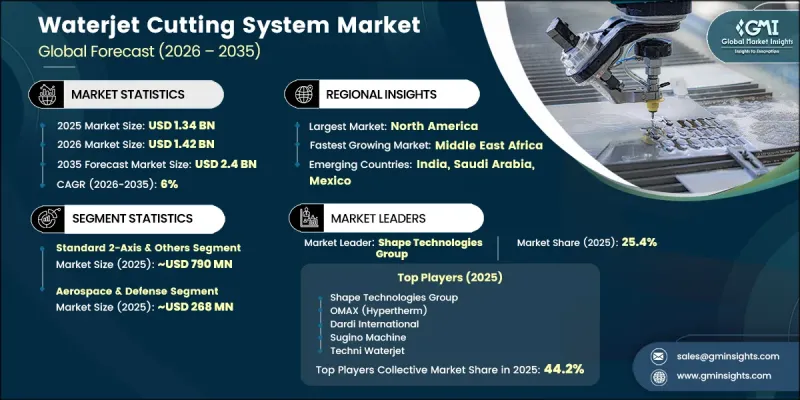
워터젯 절단 시스템 시장의 성장은 재료의 특성을 손상시키지 않으면서 고정밀 가공을 실현할 수 있는 비열 절단 기술에 대한 수요 증가에 힘입어 이루어지고 있습니다. 열을 발생시켜 재료의 품질에 악영향을 미칠 가능성이 있는 기존의 절단 방식과 달리, 워터젯 시스템은 구조적 무결성을 유지하면서 정밀한 절단이 가능합니다. 이 능력은 제조업체들이 정밀한 가공과 표면 손상을 최소화해야 하는 첨단 소재를 채택함에 따라 점점 더 중요해지고 있습니다. 기술의 발전 또한 시장 성장을 더욱 지원하고 있으며, 자동 제어, 지능형 절단 소프트웨어, 로봇 구성 및 자원 효율이 높은 운영 시스템의 통합이 진행되고 있습니다. 이러한 혁신을 통해 워터젯 기술의 적용 분야는 기존의 가공 용도에 그치지 않고, 엄격한 공차 요건과 복잡한 재료 사양이 요구되는 첨단 제조 환경으로 확대되고 있습니다. 여러 산업 분야에서 엔지니어링 소재의 사용이 확대됨에 따라 시장 성장에 유리한 여건이 지속적으로 조성되고 있으며, 정밀도가 중요한 생산 공정에서 워터젯 절단 시스템이 핵심 제조 솔루션으로서의 역할을 더욱 공고히 하고 있습니다.
| 시장 범위 | |
|---|---|
| 시작연도 | 2025년 |
| 예측 기간 | 2026-2035년 |
| 시작 금액 | 13억 4,000만 달러 |
| 예측 금액 | 24억 달러 |
| CAGR | 6% |
표준 2축 및 기존 평판 시스템 부문은 59%의 시장 점유율을 차지했으며, 2025년에는 7억 9,000만 달러의 매출을 기록했습니다. 이 부문은 제조 시설, 가공 센터 및 산업용 처리 공정 분야에서 수년간 쌓아온 대규모 도입 실적을 바탕으로 성장하고 있습니다. 이러한 시스템은 금속 시트, 플레이트, 복합재료를 이용한 2D 절단 용도로 널리 활용되고 있으며, 산업 생산 워크플로의 기반이 되는 요소로 자리 잡고 있습니다. 수요는 안정적이지만, 시장이 성숙 단계에 접어들었고 시장 침투율도 높기 때문에 이 부문의 성장세는 비교적 완만합니다. 그렇긴 하지만, 지속적인 업데이트 주기와 단계적인 기술 업그레이드를 통해 해당 부문 전체의 수익 창출은 계속해서 지원되고 있습니다.
2025년, 항공우주·방위 부문은 시장 점유율의 21.29%를 차지하며 2억 6,800만 달러에 달했습니다. 이 부문은 시장 내에서 여전히 기술적으로 가장 첨단이며 부가가치가 높은 최종사용자 부문 중 하나로 자리매김하고 있습니다. 항공우주·방위 분야에서 사업을 운영하는 제조업체들은 엄격한 치수 공차와 재료 성능 기준을 유지하면서 첨단 소재를 가공할 수 있는 고정밀 절단 솔루션을 필요로 하고 있습니다. 설계 부품의 복잡성이 심화되고 특수 재료의 사용이 증가함에 따라 이 분야에서 워터젯 절단 기술에 대한 수요는 계속해서 높아지고 있습니다. 생산 요건이 점점 더 고도화되는 가운데, 정밀도와 재료의 무결성이 극히 중요한 용도에서는 워터젯 시스템이 여전히 선호되는 솔루션으로 자리 잡고 있습니다.
북미의 워터젯 절단 시스템 시장은 34%의 점유율을 차지했으며, 2025년에는 4억 5,500만 달러의 시장 규모를 기록했습니다. 이 지역이 시장을 주도하고 있는 배경에는 첨단인 제조 활동의 집중, 잘 갖춰진 산업 인프라, 그리고 고정밀 생산 기술에 대한 지속적인 투자가 있습니다. 이 지역에서 확고히 자리 잡은 항공우주, 방위, 전자, 금속 가공 산업은 계속해서 첨단 절단 장비에 대한 큰 수요를 창출하고 있습니다. 또한 제조의 현대화, 자동화 노력, 그리고 차세대 생산 능력에 대한 지속적인 투자가 북미 전역의 시장 성장을 지속시키는 데 기여하고 있습니다. 해당 지역에서 업무 효율과 제품 품질 향상에 주력하고 있는 것은 폭넓은 산업 분야에서 워터젯 절단 시스템의 도입을 더욱 촉진하고 있습니다.
자주 묻는 질문
목차
제1장 조사 방법과 범위
제2장 개요
제3장 업계 인사이트
제4장 경쟁 구도
제5장 시장 추산·예측 : 워터젯 유형별, 2022-2035년
제6장 시장 추산·예측 : 제품/구성 유형별, 2022-2035년
제7장 시장 추산·예측 : 펌프 기술별, 2022-2035년
제8장 시장 추산·예측 : 용도별, 2022-2035년
제9장 시장 추산·예측 : 최종 용도 산업별, 2022-2035년
제10장 시장 추산·예측 : 지역별, 2022-2035년
제11장 기업 개요
KSA 26.07.21The Global Waterjet Cutting System Market was valued at USD 1.34 billion in 2025 and is estimated to grow at a CAGR of 6% to reach USD 2.4 billion by 2035.
Growth within the waterjet cutting system market is driven by rising demand for non-thermal cutting technologies capable of delivering high precision without compromising material properties. Unlike conventional cutting methods that generate heat and can negatively impact material quality, waterjet systems enable accurate cutting while preserving structural integrity. This capability has become increasingly important as manufacturers adopt advanced materials that require precise processing and minimal surface damage. Technological advancements are further strengthening market growth, with increasing integration of automated controls, intelligent cutting software, robotic configurations, and resource-efficient operating systems. These innovations are expanding the use of waterjet technology beyond traditional fabrication applications and into advanced manufacturing environments characterized by strict tolerance requirements and complex material specifications. The growing utilization of engineered materials across multiple industrial sectors continues to create favorable conditions for market expansion, reinforcing the role of waterjet cutting systems as a critical manufacturing solution for precision-focused production processes.
| Market Scope | |
|---|---|
| Start Year | 2025 |
| Forecast Year | 2026-2035 |
| Start Value | $1.34 Billion |
| Forecast Value | $2.4 Billion |
| CAGR | 6% |
The standard 2-axis and conventional flatbed systems segment held a 59% share, generating USD 790 million in 2025. The segment benefits from a large installed base developed over many years across manufacturing facilities, fabrication centers, and industrial processing operations. These systems are widely used for two-dimensional cutting applications involving metal sheets, plates, and composite materials, making them a fundamental component of industrial production workflows. While demand remains stable, growth within this category is comparatively moderate due to its maturity and extensive market penetration. Nevertheless, ongoing replacement cycles and incremental technology upgrades continue to support revenue generation across the segment.
The aerospace and defense sector accounted for 21.29% share in 2025, representing USD 268 million. This segment remains one of the most technically advanced and highest-value end-user categories within the market. Manufacturers operating in aerospace and defense environments require highly accurate cutting solutions capable of processing advanced materials while maintaining strict dimensional tolerances and material performance standards. The growing complexity of engineered components and increasing use of specialized materials continue to drive demand for waterjet cutting technologies within this sector. As production requirements become more sophisticated, waterjet systems remain a preferred solution for applications where precision and material integrity are critical.
North America Waterjet Cutting System Market held 34% share, generating USD 455 million in 2025. Regional market leadership is supported by a strong concentration of advanced manufacturing activities, extensive industrial infrastructure, and ongoing investments in high-precision production technologies. The region's established aerospace, defense, electronics, and metal processing industries continue to generate significant demand for advanced cutting equipment. Additionally, sustained investment in manufacturing modernization, automation initiatives, and next-generation production capabilities is contributing to continued market growth throughout North America. The region's focus on improving operational efficiency and product quality further strengthens adoption of waterjet cutting systems across a wide range of industrial applications.
Key companies operating in the Global Waterjet Cutting System Market include OMAX Corporation, Shape Technologies Group, Techni Waterjet, Dardi International, Sugino Machine, CMS SpA, STM Waterjet GmbH, and IGEMS AB. Companies participating in the Waterjet Cutting System Market are implementing a variety of strategic initiatives to strengthen their market position and enhance long-term competitiveness. Product innovation remains a primary focus, with manufacturers investing in advanced automation capabilities, intelligent software platforms, robotic integration, and improved cutting efficiency technologies. Many market participants are expanding their portfolios to address the evolving requirements of high-precision manufacturing industries. Investments in research and development are supporting the introduction of systems that deliver higher accuracy, reduced operating costs, and enhanced productivity. Companies are also strengthening customer relationships through comprehensive service offerings, training programs, maintenance support, and customized solutions. Strategic partnerships, geographic expansion, digitalization initiatives, and investments in sustainable resource management technologies are further helping organizations increase market penetration and differentiate their offerings.
Table of Contents
Chapter 1 Methodology & Scope
- 1.1 Research approach
- 1.2 Quality Commitments
- 1.2.1 GMI AI policy & data integrity commitment
- 1.2.1.1 Source consistency protocol
- 1.2.1 GMI AI policy & data integrity commitment
- 1.3 Research Trail & Confidence Scoring
- 1.3.1 Research Trail Components
- 1.3.2 Scoring Components
- 1.4 Data Collection
- 1.4.1 Partial list of primary sources
- 1.5 Data mining sources
- 1.5.1 Paid sources
- 1.5.1.1 Sources, by region
- 1.5.1 Paid sources
- 1.6 Base estimates and calculations
- 1.6.1 Base year calculation for any one approach
- 1.7 Forecast model
- 1.7.1 Quantified market impact analysis
- 1.7.1.1 Mathematical impact of growth parameters on forecast
- 1.7.1 Quantified market impact analysis
- 1.8 Research transparency addendum
- 1.8.1 Source attribution framework
- 1.8.2 Quality assurance metrics
- 1.8.2.1 Our commitment to trust
Chapter 2 Executive Summary
- 2.1 Industry 360° synopsis, 2022 - 2035
- 2.2 Key market trends
- 2.2.1 Region
- 2.2.2 Waterjet Type
- 2.2.3 Product/Configuration Type
- 2.2.4 Pump Technology
- 2.2.5 Application
- 2.2.6 End-use Industry
Chapter 3 Industry Insights
- 3.1 Industry ecosystem analysis
- 3.1.1 Raw Material & Component Suppliers (Abrasives, Pumps, Nozzles)
- 3.1.2 OEM Manufacturers & System Integrators
- 3.1.3 Distribution Channels & Dealers
- 3.1.4 End-User Industries
- 3.2 Supply chain analysis
- 3.2.1 Garnet Abrasive Supply Chain & Sourcing Geography
- 3.2.2 High-Pressure Pump Component Sourcing & Lead Times
- 3.2.3 Supply Chain Vulnerabilities & Risk Mitigation Strategies
- 3.2.4 Impact of Geopolitical Tensions on Abrasive Procurement
- 3.3 Industry impact forces
- 3.3.1 Market drivers
- 3.3.1.1 Rising Demand for Cold Cutting Processes in Aerospace & Defense (No Heat-Affected Zone)
- 3.3.1.2 Growing Adoption of Exotic & Composite Materials in Advanced Manufacturing
- 3.3.1.3 Industry 4.0 Integration Smart Manufacturing & Automated Cutting Cell Deployments
- 3.3.1.4 Expanding Infrastructure & Construction Investments Driving Stone/Tile Cutting Demand
- 3.3.2 Market restraints
- 3.3.2.1 High Capital Investment Costs Limiting SME Adoption ($60K-$300K+ per System)
- 3.3.2.2 Elevated Operating Costs Abrasive Consumption, Pump Maintenance & Energy Usage
- 3.3.2.3 Slow Cutting Speeds vs. Laser Systems for Thin Metal Sheets
- 3.3.3 Market opportunities
- 3.3.3.1 Robotics & 5/6-Axis System Adoption in Automotive & Aerospace Production Lines
- 3.3.3.2 Untapped Potential in Food Processing Hygienic Cold Cutting Applications
- 3.3.3.3 Water Recycling & Closed-Loop Abrasive Recovery Systems Sustainability-Driven Demand
- 3.3.3.4 Emerging Markets in Asia Pacific & Latin America Manufacturing Sector Expansion
- 3.3.1 Market drivers
- 3.4 Growth potential analysis
- 3.5 Technology & innovation landscape
- 3.5.1 Ultra-High-Pressure (UHP) System Advancements (90,000+ PSI)
- 3.5.2 5-Axis & 6-Axis Multi-Dimensional Cutting Innovations
- 3.5.3 Abrasive Recycling & Recovery Technologies
- 3.5.4 CNC Software & Digital Control Advancements
- 3.5.5 Hybrid Cutting Systems (Waterjet + Laser Integration)
- 3.6 Regulatory framework
- 3.6.1 Environmental Regulations Wastewater & Spent Abrasive Disposal (EU, US EPA)
- 3.6.2 Occupational Safety & Noise Emission Standards (OSHA, EU Machinery Directive)
- 3.6.3 CE Marking & Equipment Safety Certification Standards
- 3.6.4 Regional Regulatory Divergence & Compliance Cost Implications
- 3.7 Major market trends and disruptions
- 3.8 Future market trends
- 3.9 Pricing analysis (driven by primary research)
- 3.9.1 Historical Price Trend Analysis (Driven by Primary Research)
- 3.9.2 Pricing Strategy by Player Type (Premium / Value / Cost-plus) (Driven by Primary Research)
- 3.9.3 Total Cost of Ownership (TCO) Benchmarking Equipment, Abrasives & Maintenance
- 3.9.4 Impact of Glass & Raw Material Cost Inflation on Retail Kit Pricing
- 3.10 Trade data analysis (driven by primary research)
- 3.10.1 Import/Export Volume & Value Trends (Driven by Primary Research)
- 3.10.2 Key Trade Corridors & Tariff Impact (Driven by Primary Research)
- 3.11 Impact of AI & generative AI on the market
- 3.11.1 AI-Driven Disruption of Existing Business Models
- 3.11.2 GenAI Use Cases & Adoption Roadmap by Segment
- 3.11.3 Risks, Limitations & Regulatory Considerations
- 3.12 Investment & funding analysis
- 3.12.1 M&A Activity & Strategic Acquisitions
- 3.12.2 Private Equity & Venture Capital Investments
- 3.13 Porter's analysis
- 3.14 PESTEL analysis
Chapter 4 Competitive Landscape, 2025
- 4.1 Introduction
- 4.2 Company market share analysis
- 4.2.1 By Region
- 4.2.1.1 North America
- 4.2.1.2 Europe
- 4.2.1.3 Asia Pacific
- 4.2.1.4 Latin America
- 4.2.1.5 Middle East and Africa
- 4.2.1 By Region
- 4.3 Company matrix analysis
- 4.4 Competitive analysis of major market players
- 4.5 Competitive positioning matrix
- 4.6 Key developments
- 4.6.1 Mergers & acquisitions
- 4.6.2 Partnerships & collaborations
- 4.6.3 New product launches
- 4.6.4 Expansion plans
Chapter 5 Market Estimates and Forecast, By Waterjet Type, 2022 - 2035 (USD Billion) (Thousand Units)
- 5.1 Key trends
- 5.2 Abrasive Waterjet Systems
- 5.2.1 Garnet-Based Abrasive Systems
- 5.2.2 Alternative Abrasive Media Systems (Aluminum Oxide, Silicon Carbide)
- 5.3 Pure/Non-Abrasive Waterjet Systems
- 5.3.1 Food & Soft Material Cutting Applications
- 5.3.2 Textile & Rubber Cutting Applications
Chapter 6 Market Estimates and Forecast, By Product/Configuration Type, 2022 - 2035 (USD Billion) (Thousand Units)
- 6.1 Key trends
- 6.2 3D & Multi-Axis Waterjet Cutting Systems
- 6.2.1 5-Axis Systems
- 6.2.2 6-Axis Systems
- 6.3 Robotic Waterjet Cutting Systems
- 6.3.1 Articulated Arm Robotic Systems
- 6.3.2 Gantry-Mounted Robotic Systems
- 6.4 Micro Waterjet Cutting Systems
- 6.4.1 Electronics & Semiconductor Applications
- 6.4.2 Medical Device & Implant Applications
- 6.5 Standard 2-Axis & Others
Chapter 7 Market Estimates and Forecast, By Pump Technology, 2022 - 2035 (USD Billion) (Thousand Units)
- 7.1 Key Trends
- 7.2 Hydraulic Intensifier Pump Systems
- 7.2.1 Single-Acting Intensifier Pumps
- 7.2.2 Double-Acting Intensifier Pumps
- 7.3 Direct Drive Pump Systems
- 7.3.1 Triplex Direct Drive Pumps
- 7.3.2 Others
Chapter 8 Market Estimates and Forecast, By Application, 2022 - 2035 (USD Billion) (Thousand Units)
- 8.1 Key trends
- 8.2 Exotic Metal & Non-Traditional Material Cutting
- 8.2.1 Titanium & Nickel Alloy Cutting
- 8.2.2 Carbon Fiber Reinforced Polymer (CFRP) & Composite Cutting
- 8.2.3 Stainless Steel & Hardened Alloy Cutting
- 8.3 Ceramic & Stone Cutting
- 8.3.1 Architectural Tile & Flooring Applications
- 8.3.2 Granite, Marble & Natural Stone Applications
- 8.4 Glass & Metal Art
- 8.4.1 Architectural & Decorative Glass
- 8.4.2 Structural Glass for Construction
- 8.5 Gasket Cutting
- 8.5.1 Industrial Sealing Gaskets
- 8.5.2 Automotive & Engine Gaskets
- 8.6 Fiberglass Cutting
- 8.6.1 Marine Applications
- 8.6.2 Construction & Insulation Applications
- 8.7 Foam Product Cutting
- 8.7.1 Packaging Foam
- 8.7.2 Seating & Cushioning Foam
- 8.8 Others (Food, Rubber, Textile Material Cutting)
Chapter 9 Market Estimates and Forecast, By End-use Industry, 2022 - 2035 (USD Billion) (Thousand Units)
- 9.1 Key Trends
- 9.2 Automotive
- 9.2.1 Body Panel & Structural Component Cutting
- 9.2.2 Interior Component & Gasket Cutting
- 9.3 Aerospace & Defense
- 9.3.1 Structural Titanium & Composite Trimming
- 9.3.2 Engine Component & Nacelle Cutting
- 9.4 Metal Fabrication
- 9.4.1 Sheet Metal & Plate Cutting
- 9.4.2 Tool & Die Manufacturing
- 9.5 Electronics
- 9.5.1 PCB & Circuit Board Trimming
- 9.5.2 Display Glass & Component Cutting
- 9.6 Food Processing
- 9.6.1 Poultry & Meat Processing
- 9.6.2 Bakery & Confectionery Cutting
- 9.7 Construction
- 9.7.1 Decorative Stone & Tile Cutting
- 9.7.2 Architectural Glass & Facade Cutting
- 9.8 Medical Devices
- 9.8.1 Surgical Instrument Manufacturing
- 9.8.2 Implant & Medical Component Precision Cutting
- 9.9 Textile
- 9.10 Others (Mining, Machine Manufacturing)
Chapter 10 Market Estimates & Forecast, By Region, 2022 - 2035, (USD Billion) (Thousand Units)
- 10.1 Key trends
- 10.2 North America
- 10.2.1 U.S.
- 10.2.2 Canada
- 10.3 Europe
- 10.3.1 Germany
- 10.3.2 U.K.
- 10.3.3 France
- 10.3.4 Italy
- 10.3.5 Spain
- 10.4 Asia Pacific
- 10.4.1 China
- 10.4.2 India
- 10.4.3 Japan
- 10.4.4 South Korea
- 10.4.5 Australia
- 10.5 Latin America
- 10.5.1 Brazil
- 10.5.2 Mexico
- 10.5.3 Argentina
- 10.6 MEA
- 10.6.1 UAE
- 10.6.2 Saudi Arabia
- 10.6.3 South Africa
Chapter 11 Company Profiles
- 11.1 OMAX Corporation
- 11.2 Flow International Corporation
- 11.3 KMT Waterjet Systems
- 11.4 WARDJet Inc.
- 11.5 Dardi International Corporation
- 11.6 CMS SpA
- 11.7 Resato International B.V.
- 11.8 PTV spol. s r.o.
- 11.9 Koike Aronson Inc.
- 11.10 Techni Waterjet
- 11.11 Jet Edge Inc.
- 11.12 ANT Applied New Technologies AG
- 11.13 Kimla Sp. z o.o.
- 11.14 SEMYX LLC
- 11.15 Water Jet Sweden AB
- 11.16 STM Waterjet GmbH
- 11.17 BFT GmbH
- 11.18 Sugino Machine Limited
- 11.19 IGEMS AB
- 11.20 Hornet Cutting Systems
- 11.21 ALLFI Group AG