

|
시장보고서
상품코드
2083388
원격 간질 진료 시장 기회, 성장 촉진요인, 업계 동향 분석 및 예측(2026-2035년)Tele-epilepsy Market Opportunity, Growth Drivers, Industry Trend Analysis, and Forecast 2026 - 2035 |
||||||

세계의 원격 간질 진료 시장은 2025년에 5억 7,130만 달러로 평가되고 CAGR 14.9%로 성장하며, 2035년까지 23억 달러에 달할 것으로 추정되고 있습니다.
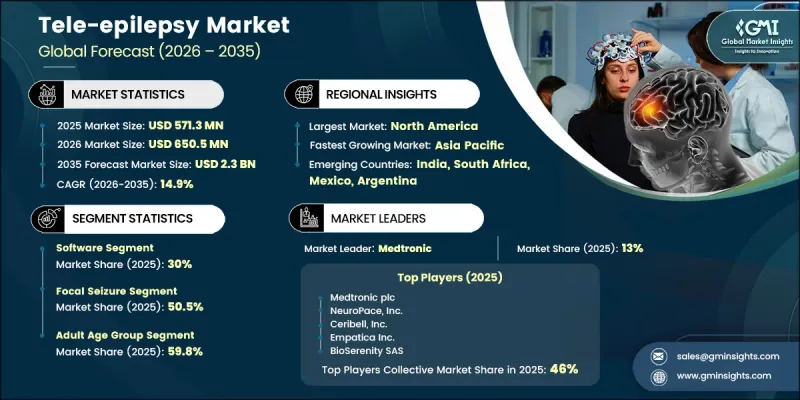
이 시장의 성장은 전 세계 간질 유병률의 증가, 원격의료에 대한 보험 보상 체계의 확대, 그리고 인공지능(AI) 및 사물인터넷(IoT) 기술이 임상 업무 흐름에 빠르게 통합되고 있는 점 등이 주요 요인으로 작용하고 있습니다. 케어 모델은 병원에서 이루어지는 정기적인 모니터링에서 웨어러블 생체 센서, 클라우드 기반 분석 플랫폼, AI를 활용한 발작 감지 시스템에 의해 지원되는 지속적인 원격 모니터링으로 전환되고 있습니다. 헬스케어 시스템에서는 북미, 유럽, 아시아태평양에서 재입원 감소, 신경과 전문의의 업무 효율 향상, 그리고 환자의 치료 프로토콜 장기 준수율 향상을 목적으로 원격 간질 관리 솔루션의 도입이 점점 더 확대되고 있습니다. 이러한 전환은 원격 모니터링 도입을 촉진하는 보험 환급 체계 확대 등 주요 헬스케어 시장의 정책적 지원에 힘입어 더욱 가속화되고 있습니다. 그 결과, 원격 간질 치료는 단순한 보조적 서비스가 아니라 현대 신경의료 제공의 핵심 요소로 발전하고 있으며, 병원 네트워크, 전문 간질 센터, 재택 치료 모델과의 통합이 진행되고 있습니다.
| 시장 범위 | |
|---|---|
| 시작연도 | 2025년 |
| 예측 기간 | 2026-2035년 |
| 시작 금액 | 5억 7,130만 달러 |
| 예측 금액 | 23억 달러 |
| CAGR | 14.9% |
2025년에는 소프트웨어 부문이 시장 점유율의 30%를 차지했습니다. 이는 AI를 활용한 발작 감지 시스템, 환자 모니터링 플랫폼, 그리고 신경질환 치료 워크플로우에 통합된 임상 의사결정 지원 툴의 도입 확대가 주도한 결과입니다. 이 부문의 성장은 전자 진료 기록 시스템과 원활하게 통합되어 발작 패턴을 파악하고 임상적 의사결정을 지원할 수 있는 고급 분석 기능을 제공하는 소프트웨어 솔루션에 대한 수요 증가에 힘입고 있습니다. 인공지능(AI) 및 기계학습 기능의 지속적인 발전 덕분에, 의료 서비스 제공자들은 전문의 인력을 비례적으로 늘리지 않고도 더 많은 환자를 원격으로 모니터링할 수 있게 되었으며, 그 결과 업무 효율성과 치료의 확장성이 향상되고 있습니다.
2025년 기준으로, 헬스케어 프로바이더 부문은 62.6%의 점유율을 차지했습니다. 이 범주에는 간질 환자 관리에 원격 모니터링 기술을 활용하고 있는 병원, 전문 신경과 센터, 진료소 및 감독 하의 재택 간호 환경이 포함됩니다. 도입을 지원하고 있는 것은 지속적인 모니터링을 통한 환자 예후의 개선과 대면 진료 및 입원을 최소화함으로써 의료 제공 비용을 절감할 수 있다는 두 가지 장점입니다. 헬스케어 시스템 분야에서 원격의료 솔루션을 신경과 치료 경로에 통합하려는 움직임이 커지고 있는 것이 의료 기관 전반에 걸친 원격 간질 플랫폼의 장기적인 도입을 지원하고 있습니다.
2025년, 북미의 원격 간질 진료 시장은 42.2%의 점유율을 차지했습니다. 시장 확대는 간질 치료에 적용 가능한 원격 환자 모니터링 및 만성질환 관리 서비스에 대한 보험 적용을 포함한 유리한 보상 제도에 힘입어 이루어지고 있습니다. 또한 캐나다에서는 전문의 확보가 여전히 어려운 의료 서비스가 부족한 지역이나 외딴 지역의 신경과 의료 접근성 개선을 목적으로 한 디지털 헬스케어 인프라에 대한 투자를 통해 지역 발전에 기여하고 있습니다.
자주 묻는 질문
목차
제1장 조사 방법과 범위
제2장 개요
제3장 업계 인사이트
제4장 경쟁 구도
제5장 시장 추산·예측 : 컴포넌트별, 2022-2035년
제6장 시장 추산·예측 : 간질 유형별, 2022-2035년
제7장 시장 추산·예측 : 연령층별, 2022-2035년
제8장 시장 추산·예측 : 최종 용도별, 2022-2035년
제9장 시장 추산·예측 : 지역별, 2022-2035년
제10장 기업 개요
KSA 26.07.21The Global Tele-Epilepsy Market was valued at USD 571.3 million in 2025 and is estimated to grow at a CAGR of 14.9% to reach USD 2.3 billion by 2035.
Growth in this market is shaped by the increasing prevalence of epilepsy worldwide, the expansion of telehealth reimbursement frameworks, and the accelerated integration of artificial intelligence and Internet of Things technologies into clinical workflows. The care model is shifting away from periodic hospital-based monitoring toward continuous remote supervision supported by wearable biosensors, cloud-based analytics platforms, and AI-enabled seizure detection systems. Healthcare systems across North America, Europe, and Asia Pacific are increasingly adopting tele-epilepsy solutions to reduce hospital readmissions, improve neurologist efficiency, and enhance long-term patient adherence to treatment protocols. This transition is further reinforced by policy-level support in key healthcare markets, including expanded reimbursement frameworks that encourage remote monitoring adoption. As a result, tele-epilepsy is evolving into a core component of modern neurological care delivery rather than a supplementary service, with growing integration into hospital networks, specialized epilepsy centers, and home-based care models.
| Market Scope | |
|---|---|
| Start Year | 2025 |
| Forecast Year | 2026-2035 |
| Start Value | $571.3 Million |
| Forecast Value | $2.3 Billion |
| CAGR | 14.9% |
The software segment accounted for 30% share in 2025, driven by the increasing adoption of AI-powered seizure detection systems, patient monitoring platforms, and clinical decision-support tools embedded within neurological care workflows. Growth in this segment is supported by rising demand for software solutions that integrate seamlessly with electronic health record systems while delivering advanced analytics capable of identifying seizure patterns and supporting clinical decision-making. The continued evolution of artificial intelligence and machine learning capabilities is enabling healthcare providers to monitor larger patient populations remotely without a proportional increase in specialist workforce requirements, thereby improving operational efficiency and care scalability.
The healthcare providers segment held 62.6% share in 2025. This category includes hospitals, specialty neurology centers, clinics, and supervised homecare environments that rely on remote monitoring technologies to manage epilepsy patients. Adoption is being driven by the dual benefits of improved patient outcomes through continuous monitoring and reduced healthcare delivery costs by minimizing in-person consultations and hospital admissions. The increasing willingness of healthcare systems to integrate telehealth solutions into neurology care pathways is reinforcing the long-term adoption of tele-epilepsy platforms across institutional settings.
North America Tele-Epilepsy Market held 42.2% share in 2025. Market expansion is being supported by favorable reimbursement structures that include coverage for remote patient monitoring and chronic disease management services applicable to epilepsy care. Canada is also contributing to regional growth through investments in digital healthcare infrastructure aimed at improving access to neurological care in underserved and remote regions, where specialist availability remains limited.
Major companies operating in the global tele-epilepsy market include BioSerenity SAS, Ceribell, Inc., CortiCare, Inc., Empatica Inc., Epitel, Inc., LivaNova PLC, Medtronic plc, NeuroPace, Inc., Nihon Kohden Corporation, Ovation Healthcare, Philips Healthcare, Real Time Tele-Epilepsy Consultants, Seer Medical, Teladoc Health, Inc., and Vidyo, Inc. Companies operating in the tele-epilepsy market are focusing on technological innovation, platform integration, and strategic collaborations to strengthen their market position. Continuous investment in artificial intelligence, machine learning, and wearable sensor technologies is improving the accuracy and efficiency of seizure detection and patient monitoring systems. Market players are also prioritizing interoperability with electronic health record systems to ensure seamless integration into existing healthcare workflows. Strategic partnerships with hospitals, neurology centers, and telehealth providers are expanding clinical adoption and strengthening service delivery networks.
Table of Contents
Chapter 1 Methodology & Scope
- 1.1 Research approach
- 1.2 Quality commitments
- 1.2.1 GMI AI policy & data integrity commitment
- 1.2.1.1 Source consistency protocol
- 1.2.1 GMI AI policy & data integrity commitment
- 1.3 Research trail & confidence scoring
- 1.3.1 Research trail components
- 1.3.2 Scoring components
- 1.4 Data collection
- 1.4.1 Partial list of primary sources
- 1.5 Data mining sources
- 1.5.1 Paid sources
- 1.5.1.1 Sources, by region
- 1.5.1 Paid sources
- 1.6 Base estimates and calculations
- 1.6.1 Base year calculation for any one approach
- 1.7 Market estimates & forecasts parameters
- 1.8 Forecast model
- 1.8.1 Quantified market impact analysis
- 1.8.1.1 Mathematical impact of growth parameters on forecast
- 1.8.1 Quantified market impact analysis
- 1.9 Research transparency addendum
- 1.9.1 Source attribution framework
- 1.9.2 Quality assurance metrics
- 1.9.3 Our commitment to trust
Chapter 2 Executive Summary
- 2.1 Industry 360° synopsis
- 2.1.1 Business trends
- 2.1.2 Component trends
- 2.1.3 Epilepsy type trends
- 2.1.4 Age group trends
- 2.1.5 End use trends
- 2.1.6 Regional trends
- 2.2 CXO perspectives: Strategic imperatives
Chapter 3 Industry Insights
- 3.1 Industry ecosystem analysis
- 3.2 Industry impact forces
- 3.2.1 Growth drivers
- 3.2.1.1 Rising prevalence of epilepsy
- 3.2.1.2 Growing demand for remote monitoring services
- 3.2.1.3 Technological development in telehealth services
- 3.2.1.4 Rising awareness among patients and caregivers
- 3.2.2 Industry pitfalls and challenges
- 3.2.2.1 Data security and privacy concerns
- 3.2.2.2 Limited reimbursement policies
- 3.2.3 Market opportunities
- 3.2.3.1 Integration of AI-driven predictive analytics in epilepsy care
- 3.2.3.2 Expansion of tele-epilepsy services in emerging markets
- 3.2.1 Growth drivers
- 3.3 Growth potential analysis
- 3.4 Technology and innovation landscape
- 3.4.1 Current technological trends
- 3.4.2 Emerging technologies
- 3.5 Pricing trend analysis (Driven by primary research)
- 3.6 Regulatory landscape (Driven by primary research)
- 3.6.1 North America
- 3.6.2 Europe
- 3.6.3 Asia Pacific
- 3.6.4 Latin America
- 3.6.5 MEA
- 3.7 Porter's analysis
- 3.8 PESTEL analysis
- 3.9 Future market trends
- 3.10 Impact of AI and Generative AI on the market (Driven by primary research)
- 3.11 Investment & funding analysis (Driven by primary research)
Chapter 4 Competitive Landscape, 2025
- 4.1 Introduction
- 4.2 Company market share analysis
- 4.2.1 North America
- 4.2.2 Europe
- 4.2.3 Asia Pacific
- 4.3 Company matrix analysis
- 4.4 Competitive analysis of major market players
- 4.5 Competitive positioning matrix
- 4.6 Key developments
- 4.6.1 Merger and acquisition
- 4.6.2 Partnership and collaboration
- 4.6.3 New product launches
- 4.6.4 Expansion plans
Chapter 5 Market Estimates and Forecast, By Component, 2022 - 2035 ($ Mn)
- 5.1 Key trends
- 5.2 Software
- 5.2.1 Cloud-based
- 5.2.2 On-premises
- 5.3 Services
- 5.3.1 Tele-consultation services
- 5.3.2 Tele-monitoring and screening services
- 5.3.3 Tele-education & training
- 5.3.4 Other services
- 5.4 Hardware
Chapter 6 Market Estimates and Forecast, By Epilepsy Type, 2022 - 2035 ($ Mn)
- 6.1 Key trends
- 6.2 Focal seizure
- 6.3 Generalized seizure
- 6.4 Combined seizure
Chapter 7 Market Estimates and Forecast, By Age Group, 2022 - 2035 ($ Mn)
- 7.1 Key trends
- 7.2 Pediatrics
- 7.3 Adults
Chapter 8 Market Estimates and Forecast, By End Use, 2022 - 2035 ($ Mn)
- 8.1 Key trends
- 8.2 Healthcare providers
- 8.2.1 Hospitals and clinics
- 8.2.2 Specialized epilepsy centers
- 8.2.3 Homecare settings
- 8.3 Patients
- 8.4 Other end users
Chapter 9 Market Estimates and Forecast, By Region, 2022 - 2035 ($ Mn)
- 9.1 Key trends
- 9.2 North America
- 9.2.1 U.S.
- 9.2.2 Canada
- 9.3 Europe
- 9.3.1 Germany
- 9.3.2 France
- 9.3.3 UK
- 9.3.4 Spain
- 9.3.5 Italy
- 9.3.6 Netherlands
- 9.4 Asia Pacific
- 9.4.1 China
- 9.4.2 Japan
- 9.4.3 India
- 9.4.4 Australia
- 9.4.5 South Korea
- 9.5 Latin America
- 9.5.1 Brazil
- 9.5.2 Mexico
- 9.5.3 Argentina
- 9.6 Middle East & Africa
- 9.6.1 Saudi Arabia
- 9.6.2 South Africa
- 9.6.3 UAE
Chapter 10 Company Profiles
- 10.1 BioSerenity SAS
- 10.2 Ceribell
- 10.3 CortiCare
- 10.4 Empatica
- 10.5 Epitel
- 10.6 LivaNova
- 10.7 Medtronic plc
- 10.8 NeuroPace
- 10.9 Nihon Kohden Corporation
- 10.10 Ovation Healthcare
- 10.11 Philips Healthcare
- 10.12 Real Time Tele-Epilepsy Consultants
- 10.13 Seer Medical
- 10.14 Teladoc Health
- 10.15 Vidyo


