
|
시장보고서
상품코드
2101529
극저온 배터리 재활용 시장 기회, 성장 촉진요인, 업계 동향 분석 및 예측(2026-2035년)Cryogenic Battery Recycling Market Opportunity, Growth Drivers, Industry Trend Analysis, and Forecast 2026 - 2035 |
||||||

세계의 극저온 배터리 재활용 시장은 2025년에 4억 1,040만 달러 규모에 달하고, 2035년까지 CAGR 18.9%로 성장하여 23억 달러에 달할 것으로 추정됩니다.
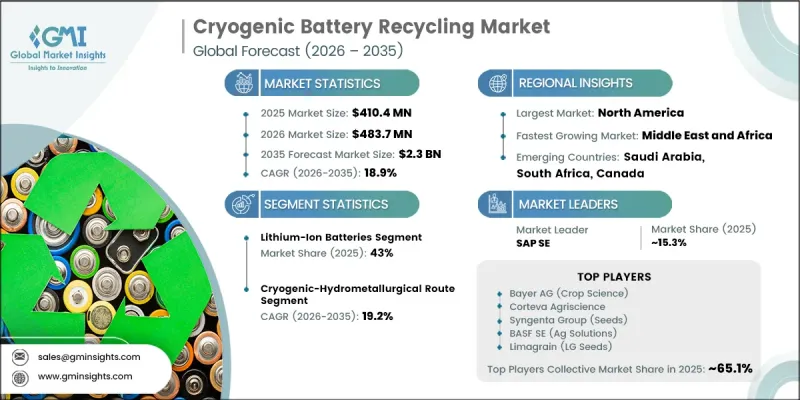
극저온 배터리 재활용 시장은 광범위한 배터리 재활용 산업 중에서도 전문성이 높은 분야로, 재료 회수 효율을 높이는 동시에 작업 안전성을 향상시키고 규제 준수를 지원하는 극저온 전처리 기술을 채택하고 있다는 점이 특징입니다. 전 세계적으로 전기자동차 보급이 성숙해짐에 따라 수명이 다해가는 배터리 팩의 수가 증가하고 있으며, 이는 재활용 가능한 소재의 안정적인 공급원이 되고 있습니다. 주요 자동차 시장에서 배터리 폐기량이 증가함에 따라, 상업 규모의 극저온 재활용 사업 실행 가능성이 점점 더 높아지고 있습니다. 이 공정은 다운스트림 재활용 단계를 통해 재료의 품질을 유지하면서 귀중한 배터리 재료를 회수한다는 큰 이점을 제공합니다. 장기적인 시장 성장은 단기적인 경제 변동이 아닌 업계의 구조적 동향에 의해 뒷받침되고 있으며, 예측 기간 동안 극저온 배터리 재활용은 지속가능한 배터리 수명주기 관리 및 자원 회수를 위한 점점 더 중요한 솔루션으로서의 입지를 확고히 할 것으로 전망됩니다.
| 시장 범위 | |
|---|---|
| 시작 연도 | 2025년 |
| 예측 기간 | 2026-2035년 |
| 초기 시장 규모 | 4억 1,040만 달러 |
| 예측액 | 23억 달러 |
| CAGR | 18.9% |
2025년에는 리튬이온 배터리 부문이 시장 점유율의 43%를 차지했습니다. 이 부문의 시장 주도적 지위는 폐기되는 전기자동차 배터리의 증가, 회수 가능한 재료의 높은 경제적 가치, 그리고 리튬이온 배터리의 화학적 특성과 극저온 전처리 기술 간의 높은 친화성에 의해 뒷받침되고 있습니다. 극저온 공정은 온도에 민감한 배터리 부품을 효과적으로 중화시키면서 전극의 무결성을 유지하기 때문에 기존의 재활용 방식에 비해 다운스트림 분리 공정을 보다 효율적으로 수행하여 고순도 소재의 회수를 가능하게 합니다.
극저온·습식 야금법을 이용한 처리 루트는 2025년에 41.5%의 점유율을 차지했으며, 2035년까지 연평균 성장률(CAGR) 19.2%로 성장할 것으로 전망됩니다. 이 처리 경로는 운영 확장성, 소재 회수 성능 및 제품 순도의 균형을 효과적으로 실현하고 있어 계속해서 시장을 선도하고 있습니다. 배터리 제조 용도의 품질 요건을 충족하는 재활용 소재를 생산할 수 있는 능력 덕분에 그 채택이 확대되고 있으며, 높은 회수 효율과 안정적인 운영 성능을 추구하는 상업 규모의 재활용 시설에 있어 선호되는 처리 방법 중 하나가 되고 있습니다.
북미의 극저온 배터리 재활용 시장은 2025년에 30.5%의 점유율을 차지했으며, 2035년까지 연평균 성장률(CAGR) 17%로 성장할 것으로 전망됩니다. 이 지역은 배터리 회수 네트워크에 대한 지속적인 투자, 재활용 인프라 확충, 전동 모빌리티 관련 제조 활동의 활성화, 그리고 첨단 배터리 처리 기술의 도입 확대에 힘입어 주도적인 위치를 유지하고 있습니다. 상업 규모의 재활용 사업에 극저온 전처리 시스템 도입이 진행되고 있는 것은, 재료 회수 능력과 운영 효율 향상에 기여할 뿐만 아니라 해당 지역의 시장 성장을 더욱 뒷받침하고 있습니다.
자주 묻는 질문
목차
제1장 조사 방법과 범위
제2장 주요 요약
제3장 업계 인사이트
제4장 경쟁 구도
제5장 시장 추정 및 예측 : 배터리 화학 조성별, 2022-2035년
제6장 시장 추정 및 예측 : 재활용 프로세스 루트별, 2022-2035년
제7장 시장 추정 및 예측 : 배터리 종류별, 2022-2035년
제8장 시장 추정 및 예측 : 지역별, 2022-2035년
제9장 기업 개요
KSM 26.08.04The Global Cryogenic Battery Recycling Market was valued at USD 410.4 million in 2025 and is estimated to grow at a CAGR of 18.9% to reach USD 2.3 billion by 2035.
The cryogenic battery recycling market represents a specialized segment within the broader battery recycling industry, distinguished by its use of cryogenic pretreatment technology that enhances material recovery efficiency while improving operational safety and supporting regulatory compliance. As electric vehicle adoption continues to mature globally, an increasing number of battery packs are approaching the end of their operational lifespan, creating a steady supply of recyclable materials. Growing battery retirement volumes across major automotive markets are making commercial-scale cryogenic recycling operations increasingly viable. The process offers significant advantages for recovering valuable battery materials while preserving material quality throughout downstream recycling stages. Long-term market growth is supported by structural industry trends rather than short-term economic fluctuations, positioning cryogenic battery recycling as an increasingly important solution for sustainable battery lifecycle management and resource recovery over the forecast period.
| Market Scope | |
|---|---|
| Start Year | 2025 |
| Forecast Year | 2026-2035 |
| Start Value | $410.4 Million |
| Forecast Value | $2.3 Billion |
| CAGR | 18.9% |
The lithium-ion batteries segment accounted for 43% share in 2025. Its market leadership is supported by the expanding number of retired electric vehicle batteries, the high economic value of recoverable materials, and the strong compatibility between lithium-ion battery chemistry and cryogenic pretreatment technology. The cryogenic process effectively neutralizes temperature-sensitive battery components while preserving electrode integrity, enabling more efficient downstream separation processes and supporting the recovery of high-purity materials compared with conventional recycling approaches.
The cryogenic-hydrometallurgical route represented 41.5% share in 2025 and is anticipated to grow at a CAGR of 19.2% throughout 2035. This processing route continues to lead the market because it delivers an effective balance of operational scalability, material recovery performance, and product purity. Its ability to produce recycled materials that satisfy the quality requirements of battery manufacturing applications has strengthened its adoption, making it one of the preferred processing methods for commercial-scale recycling facilities seeking high recovery efficiency and consistent operational performance.
North America Cryogenic Battery Recycling Market accounted for 30.5% share in 2025 and is expected to grow at a CAGR of 17% through 2035. The region maintains its leading position due to continued investment in battery collection networks, expanding recycling infrastructure, increasing manufacturing activity related to electric mobility, and the growing deployment of advanced battery processing technologies. The rising integration of cryogenic pretreatment systems into commercial recycling operations is further supporting regional market growth while enhancing material recovery capabilities and operational efficiency.
Major companies operating in the global cryogenic battery recycling market include Retriev Technologies, Umicore N.V., Redwood Materials, Fortum Battery Recycling, Glencore plc, BRUNP Recycling, Duesenfeld GmbH, SungEel HiTech, Accurec Recycling GmbH, Cirba Solutions, Green Li-ion, cylib GmbH, American Battery Technology Company (ABTC), Ascend Elements, Nth Cycle, and Primobius. Companies participating in the cryogenic battery recycling market are strengthening their competitive position by expanding processing capacity, investing in advanced recycling technologies, and improving material recovery efficiency. Industry participants continue to prioritize research and development to enhance cryogenic pretreatment processes, increase operational safety, and maximize the recovery of valuable battery materials. Strategic collaborations, technology partnerships, and acquisitions are helping companies broaden their capabilities while expanding their geographic presence. Businesses are also focusing on automation, process optimization, and sustainable recycling practices to improve productivity and reduce operating costs.
Table of Contents
Chapter 1 Methodology & Scope
- 1.1 Market scope and definition
- 1.2 Research design
- 1.2.1 Research approach
- 1.2.2 Data collection methods
- 1.3 Data mining sources
- 1.3.1 Global
- 1.3.2 Regional/Country
- 1.4 Base estimates and calculations
- 1.4.1 Base year calculation
- 1.4.2 Key trends for market estimation
- 1.5 Primary research and validation
- 1.5.1 Primary sources
- 1.6 Forecast model
- 1.7 Research assumptions and limitations
Chapter 2 Executive Summary
- 2.1 Industry 360° synopsis
- 2.2 Key market trends
- 2.2.1 Regional
- 2.2.2 Battery Chemistry
- 2.2.3 Recycling process route
- 2.2.4 Battery source
- 2.3 TAM Analysis, 2026-2035
- 2.4 CXO perspectives: Strategic imperatives
- 2.4.1 Executive decision points
- 2.4.2 Critical success factors
- 2.5 Future Outlook and Strategic Recommendations
Chapter 3 Industry Insights
- 3.1 Industry ecosystem analysis
- 3.1.1 Supplier Landscape
- 3.1.2 Profit Margin
- 3.1.3 Value addition at each stage
- 3.1.4 Factor affecting the value chain
- 3.1.5 Disruptions
- 3.2 Industry impact forces
- 3.2.1 Growth drivers
- 3.2.1.1 First-Generation EV Battery End-of-Life Wave Accelerating Spent Battery Volumes Globally
- 3.2.1.2 EU Battery Regulation 2023/1542 Mandating Minimum Recycled Content & Recovery Rate Thresholds
- 3.2.1.3 Critical Mineral Supply Security Imperatives - Lithium, Cobalt & Nickel Designated as Strategic Raw Materials
- 3.2.2 Industry pitfalls and challenges
- 3.2.2.1 High Liquid Nitrogen Consumption Costs Elevating Cryogenic Process OPEX vs. Conventional Alternatives
- 3.2.2.2 Regulatory Fragmentation & Cross-Border Battery Waste Classification Barriers under Basel Convention & UN 38.3
- 3.2.3 Market opportunities
- 3.2.3.1 Increasing Demand for Sustainable EV Battery Disposal & Material Recovery
- 3.2.3.2 Rising Regulatory Focus on Circular Economy & Hazardous Waste Management
- 3.2.1 Growth drivers
- 3.3 Growth potential analysis
- 3.4 Regulatory landscape
- 3.4.1 North America
- 3.4.2 Europe
- 3.4.3 Asia Pacific
- 3.4.4 Latin America
- 3.4.5 Middle East & Africa
- 3.5 Porter's analysis
- 3.6 PESTEL analysis
- 3.7 Price trends
- 3.7.1 By region
- 3.8 Future market trends
- 3.9 Technology and Innovation Landscape
- 3.9.1 Current technological trends
- 3.9.2 Emerging technologies
- 3.10 Patent Landscape
- 3.11 Trade statistics (HS code) (Note: the trade statistics will be provided for key countries only)
- 3.11.1 Major importing countries
- 3.11.2 Major exporting countries
- 3.12 Sustainability and environmental aspects
- 3.12.1 Sustainable practices
- 3.12.2 Waste reduction strategies
- 3.12.3 Energy efficiency in production
- 3.12.4 Eco-friendly initiatives
- 3.13 Carbon footprint considerations
Chapter 4 Competitive Landscape, 2025
- 4.1 Introduction
- 4.2 Company market share analysis
- 4.2.1 By region
- 4.2.1.1 North America
- 4.2.1.2 Europe
- 4.2.1.3 Asia Pacific
- 4.2.1.4 LATAM
- 4.2.1.5 MEA
- 4.2.1 By region
- 4.3 Company matrix analysis
- 4.4 Competitive analysis of major market players
- 4.5 Competitive positioning matrix
- 4.6 Key developments
- 4.6.1 Mergers & acquisitions
- 4.6.2 Partnerships & collaborations
- 4.6.3 New product launches
- 4.6.4 Expansion plans
Chapter 5 Market Estimates and Forecast, By Battery Chemistry, 2022 - 2035 (USD Million) (Kilo Tons)
- 5.1 Key trends
- 5.2 Lithium-ion (Li-ion)
- 5.2.1 NMC (Nickel Manganese Cobalt) - High Cobalt & Nickel Recovery Value
- 5.2.2 NCA (Nickel Cobalt Aluminum) - EV-Grade High-Density Packs
- 5.2.3 LFP (Lithium Iron Phosphate) - Fastest-Growing Sub-Segment, Cobalt-Free
- 5.2.4 LMO (Lithium Manganese Oxide) & Other Li-ion Variants
- 5.3 Lead-Acid
- 5.3.1 Flooded Lead-Acid
- 5.3.2 VRLA/AGM (Valve-Regulated Lead-Acid & Absorbent Glass Mat)
- 5.4 Nickel-Based
- 5.4.1 Nickel-Cadmium (Ni-Cd)
- 5.4.2 Nickel-Metal Hydride (Ni-MH)
- 5.5 Solid-State & Emerging Chemistries
- 5.5.1 Solid-State Batteries (Sulfide, Oxide & Polymer Electrolyte)
- 5.5.2 Sodium-Ion (Na-ion) Batteries
- 5.5.3 Lithium-Sulfur (Li-S) & Other Emerging Chemistries
Chapter 6 Market Estimates and Forecast, By Recycling Process Route, 2022 - 2035 (USD million) (Kilo Tons)
- 6.1 Key trends
- 6.2 Cryogenic-Mechanical Route
- 6.3 Cryogenic-Hydrometallurgical Route
- 6.4 Cryogenic-Pyrometallurgical Route
- 6.5 Cryogenic-Direct Recycling Route
Chapter 7 Market Estimates and Forecast, By Battery Source, 2022 - 2035 (USD million) (Kilo Tons)
- 7.1 Key trends
- 7.2 EV & e-Mobility Batteries
- 7.3 Stationary Energy Storage Batteries
- 7.4 Industrial & Commercial Batteries
- 7.5 Consumer Electronics Batteries
- 7.6 Aerospace, Defense & Specialty Batteries
Chapter 8 Market Estimates and Forecast, By Region, 2022 - 2035 (USD million) (Kilo Tons)
- 8.1 Key trends
- 8.2 North America
- 8.2.1 U.S.
- 8.2.2 Canada
- 8.3 Europe
- 8.3.1 Germany
- 8.3.2 UK
- 8.3.3 France
- 8.3.4 Spain
- 8.3.5 Italy
- 8.3.6 Rest of Europe
- 8.4 Asia Pacific
- 8.4.1 China
- 8.4.2 India
- 8.4.3 Japan
- 8.4.4 Australia
- 8.4.5 South Korea
- 8.4.6 Rest of Asia Pacific
- 8.5 Latin America
- 8.5.1 Brazil
- 8.5.2 Mexico
- 8.5.3 Rest of Latin America
- 8.6 Middle East and Africa
- 8.6.1 Saudi Arabia
- 8.6.2 South Africa
- 8.6.3 UAE
- 8.6.4 Rest of Middle East and Africa
Chapter 9 Company Profiles
- 9.1 Retriev Technologies
- 9.2 Umicore N.V.
- 9.3 Redwood Materials
- 9.4 Fortum Battery Recycling
- 9.5 Glencore plc
- 9.6 BRUNP Recycling
- 9.7 Duesenfeld GmbH
- 9.8 SungEel HiTech
- 9.9 Accurec Recycling GmbH
- 9.10 Cirba Solutions
- 9.11 Green Li-ion
- 9.12 cylib GmbH
- 9.13 American Battery Technology Company (ABTC)
- 9.14 Ascend Elements
- 9.15 Nth Cycle
- 9.16 Primobius