

|
시장보고서
상품코드
2101531
스피룰리나 블루(피코시아닌) 시장 기회, 성장요인, 업계 동향 분석 및 예측(2026-2035년)Spirulina Blue (Phycocyanin) Market Opportunity, Growth Drivers, Industry Trend Analysis, and Forecast 2026 - 2035 |
||||||

세계의 스피룰리나 블루(피코시아닌) 시장은 2025년에 2억 8,360만 달러 규모에 달하며, 2035년까지 CAGR 17.5%로 성장하며, 14억 달러에 달할 것으로 추정되고 있습니다.
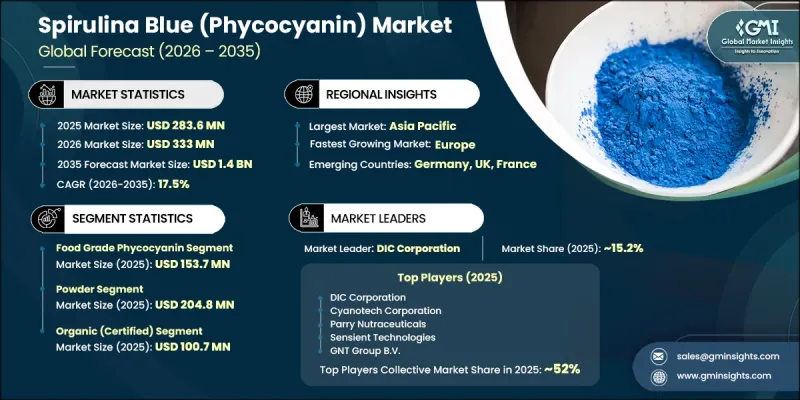
스피룰리나 블루(피코시아닌) 시장의 성장은 특히 제조사들이 합성 첨가물을 식물 유래 대체재로 지속적으로 대체하고 있는 가운데, 다양한 산업 분야에서 천연 유래 성분에 대한 수요가 증가하고 있는 데 힘입고 있습니다. 클린 라벨 제품, 천연 유래 식품 원료, 건강 지향적인 배합에 대한 소비자의 인식이 높아짐에 따라 피코시아닌을 주성분으로 하는 제품에 큰 비즈니스 기회가 창출되고 있습니다. 또한 영양가가 높은 천연 유래 성분을 함유한 기능성 식품, 음료, 영양 보조 식품, 화장품, 퍼스널 케어 제품의 인기가 높아지는 것도 수요를 지원하고 있습니다. 각 제조사는 제품의 품질, 발색 안정성, 생산 효율을 향상시키기 위해 첨단 배양, 추출, 정제 기술에 대한 투자를 추진하고 있으며, 이를 통해 상업적 보급이 더욱 확대되고 있습니다. 또한 웰빙을 중시하는 라이프스타일, 예방 영양학, 지속가능한 원료 조달에 대한 소비자의 관심 증가도 시장 수요를 지속적으로 강화하고 있습니다. 천연 착색료에 대한 규제 당국의 호의적인 수용과 식품 및 음료, 뉴트라슈티컬, 화장품 업계 전반에 걸친 제품 혁신의 증가는 장기적인 성장을 더욱 지원할 것으로 예상되며, 전 세계 스피룰리나 블루(피코시아닌) 시장은 예측 기간 중 지속적인 성장을 이룰 것으로 전망됩니다.
| 시장 범위 | |
|---|---|
| 시작연도 | 2025년 |
| 예측 기간 | 2026-2035년 |
| 초기 시장 규모 | 2억 8,360만 달러 |
| 예측액 | 14억 달러 |
| CAGR | 17.5% |
식품용 피코시아닌 시장 규모는 2025년 1억 5,370만 미달러로 평가되었습니다. 식품 업계 전반에 걸쳐 천연 유래 색소 원료에 대한 수요가 지속되고 있는 것이 이 부문의 성장을 지원하는 주요 요인입니다. 동시에 퍼스널 케어 및 화장품 업계에서의 채택이 증가하고 있으며, 제조사들이 프리미엄 제품 처방에 천연 유래 색소를 지속적으로 포함시키고 있으며, 더 광범위한 상업적 기회가 창출되고 있습니다. 이러한 동향으로 인해 여러 최종 용도 산업에서 식품용 피코시아닌에 대한 장기적인 수요가 더욱 강화될 것으로 예상됩니다.
2025년, 식품 및 음료 부문 시장 규모는 1억 550만 달러였습니다. 천연 성분을 선호하는 소비자 경향이 강해짐에 따라 제조사들은 다양한 식품 및 음료 제품에서 합성 착색료를 식물 유래 대체재로 대체하고 있습니다. 또한 소비자들이 전반적인 건강 유지와 예방 의학을 지원하는 제품을 점점 더 많이 찾게 됨에 따라 뉴트라슈티컬 및 영양 보조제 분야에서도 수요가 확대되고 있습니다. ‘클린 라벨’에 대한 선호와 건강 의식의 향상가 맞물려, 이 용도 부문 전체의 시장 성장을 지속적으로 지원하고 있습니다.
북미의 스피룰리나 블루(피코시아닌) 시장은 2025년에 7,800만 달러 규모를 기록했습니다. 지역 시장의 성장은 천연 식품 착색료에 대한 수요 증가, 클린 라벨 제품의 보급 확대, 그리고 식물 유래 영양소에 대한 소비자의 관심 고조 등에 힘입고 있습니다. 미국은 식품 및 음료, 영양 보충제, 퍼스널 케어 업계의 활발한 수요에 힘입어 계속해서 지역 시장에서 가장 큰 기여를 하는 국가로 자리매김하고 있습니다. 합성 성분에서 천연 유래 대체품으로의 전환이 지속됨에 따라 북미 전역에서 지속적인 시장 성장이 지원될 것으로 예상됩니다.
자주 묻는 질문
목차
제1장 조사 방법과 범위
제2장 개요
제3장 업계 인사이트
제4장 경쟁 구도
제5장 시장 추산·예측 : 서비스 유형별, 2022-2035년
제6장 시장 추산·예측 : 제품 유형별, 2022-2035년
제7장 시장 추산·예측 : 최종사용자별, 2022-2035년
제8장 시장 추산·예측 : 지역별, 2022-2035년
제9장 기업 개요
KSA 26.07.31The Global Spirulina Blue (Phycocyanin) Market was valued at USD 283.6 million in 2025 and is estimated to grow at a CAGR of 17.5% to reach USD 1.4 billion by 2035.
Growth in the spirulina blue (phycocyanin) market is fueled by the rising preference for naturally derived ingredients across multiple industries, particularly as manufacturers continue replacing synthetic additives with plant-based alternatives. Increasing consumer awareness of clean-label products, naturally sourced food ingredients, and health-oriented formulations is creating significant opportunities for phycocyanin-based products. Demand is also benefiting from the growing popularity of functional foods, beverages, dietary supplements, cosmetics, and personal care products that incorporate naturally derived ingredients with added nutritional value. Manufacturers are investing in advanced cultivation, extraction, and purification technologies to improve product quality, color stability, and production efficiency, enabling wider commercial adoption. In addition, expanding consumer interest in wellness-focused lifestyles, preventive nutrition, and sustainable ingredient sourcing continues to strengthen market demand. Favorable regulatory acceptance of natural colorants and increasing product innovation across food, beverage, nutraceutical, and cosmetic industries are expected to further support long-term expansion, positioning the global spirulina blue (phycocyanin) market for sustained growth throughout the forecast period.
| Market Scope | |
|---|---|
| Start Year | 2025 |
| Forecast Year | 2026-2035 |
| Start Value | $283.6 Million |
| Forecast Value | $1.4 Billion |
| CAGR | 17.5% |
The food-grade phycocyanin segment was valued at USD 153.7 million in 2025. Continued demand for naturally sourced color ingredients across the food industry remains the primary factor supporting segment growth. At the same time, increasing adoption within the personal care and cosmetics industries is contributing to broader commercial opportunities as manufacturers continue incorporating naturally derived pigments into premium product formulations. These trends are expected to strengthen long-term demand for food-grade phycocyanin across multiple end-use industries.
The food & beverages segment accounted for USD 105.5 million in 2025. Growing consumer preference for natural ingredients has encouraged manufacturers to replace synthetic colorants with plant-based alternatives across a broad range of food and beverage products. Demand is also expanding within nutraceuticals and dietary supplements as consumers increasingly seek products that support overall wellness and preventive healthcare. The combination of clean-label preferences and rising health awareness continues to reinforce market growth across this application segment.
North America Spirulina Blue (Phycocyanin) Market generated USD 78 million in 2025. Regional expansion is supported by increasing demand for natural food colorants, growing adoption of clean-label products, and rising consumer interest in plant-based nutrition. The United States remains the largest contributor to the regional market, driven by strong demand from the food and beverage, dietary supplement, and personal care industries. Continued replacement of synthetic ingredients with naturally sourced alternatives is expected to support sustained market growth across North America.
Major companies operating in the global spirulina blue (phycocyanin) market include Cyanotech Corporation, DIC Corporation (Spirulina Division), Parry Nutraceuticals (EID Parry Ltd.), Sensient Technologies Corporation, Givaudan SA (DDW / Sense Color), Yunnan Alphy Biotech Co., Ltd., Tianjin Norland Biotech Co., Ltd., Phyco-Biotech (France), Allmicroalgae, Natural Products S.A., GNT Group B.V. (EXBERRY(R)), FUL Foods, Fermentalg SA, Inner Mongolia Rejuve Biotech Co., Ltd., Pond Technologies Inc., and AlgoSource. Companies operating in the spirulina blue (phycocyanin) market are strengthening their market position by investing in advanced cultivation, extraction, and purification technologies to improve product quality, yield, and color stability. Manufacturers are expanding production capacity while developing innovative formulations that meet the growing demand for clean-label and naturally sourced ingredients. Strategic partnerships, distribution agreements, and geographic expansion initiatives are helping businesses broaden their customer base and improve global market access. Companies are also emphasizing research and development to enhance product functionality and support new applications across food, beverages, nutraceuticals, cosmetics, and personal care products.
Table of Contents
Chapter 1 Methodology & Scope
- 1.1 Market scope and definition
- 1.2 Research design
- 1.2.1 Research approach
- 1.2.2 Data collection methods
- 1.3 Data mining sources
- 1.3.1 Global
- 1.3.2 Regional/Country
- 1.4 Base estimates and calculations
- 1.4.1 Base year calculation
- 1.4.2 Key trends for market estimation
- 1.5 Primary research and validation
- 1.5.1 Primary sources
- 1.6 Forecast model
- 1.7 Research assumptions and limitations
Chapter 2 Executive Summary
- 2.1 Industry 360° synopsis
- 2.2 Key market trends
- 2.2.1 Regional
- 2.2.2 Grade
- 2.2.3 Form
- 2.2.4 Nature
- 2.2.5 Application
- 2.3 TAM Analysis, 2026-2035
- 2.4 CXO perspectives: Strategic imperatives
- 2.4.1 Executive decision points
- 2.4.2 Critical success factors
- 2.5 Future Outlook and Strategic Recommendations
Chapter 3 Industry Insights
- 3.1 Industry ecosystem analysis
- 3.1.1 Supplier Landscape
- 3.1.2 Profit Margin
- 3.1.3 Value addition at each stage
- 3.1.4 Factor affecting the value chain
- 3.1.5 Disruptions
- 3.2 Industry impact forces
- 3.2.1 Growth drivers
- 3.2.1.1 Rising adoption of precision agriculture & smart farming practices
- 3.2.1.2 Escalating water scarcity & imperative for irrigation efficiency
- 3.2.1.3 Government subsidies & policy push for sustainable soil management
- 3.2.2 Industry pitfalls and challenges
- 3.2.2.1 High initial capital investment: adoption barrier for smallholder farmers
- 3.2.2.2 Absence of standardized communication protocols & interoperability issues
- 3.2.3 Market opportunities
- 3.2.3.1 Increasing adoption of precision agriculture & smart farming technologies
- 3.2.3.2 Rising government & sustainability initiatives for soil conservation
- 3.2.1 Growth drivers
- 3.3 Growth potential analysis
- 3.4 Regulatory landscape
- 3.4.1 North America
- 3.4.2 Europe
- 3.4.3 Asia Pacific
- 3.4.4 Latin America
- 3.4.5 Middle East & Africa
- 3.5 Porter's analysis
- 3.6 PESTEL analysis
- 3.6.1 Technology and innovation landscape
- 3.6.2 Current technological trends
- 3.6.3 Emerging technologies
- 3.7 Price trends
- 3.7.1 By region
- 3.7.2 By product type
- 3.8 Future market trends
- 3.9 Technology and Innovation Landscape
- 3.9.1 Current technological trends
- 3.9.2 Emerging technologies
- 3.10 Patent Landscape
- 3.11 Trade statistics (HS code) (Note: the trade statistics will be provided for key countries only)
- 3.11.1 Major importing countries
- 3.11.2 Major exporting countries
- 3.12 Sustainability and environmental aspects
- 3.12.1 Sustainable practices
- 3.12.2 Waste reduction strategies
- 3.12.3 Energy efficiency in production
- 3.12.4 Eco-friendly initiatives
- 3.13 Carbon Footprint Considerations
Chapter 4 Competitive Landscape, 2025
- 4.1 Introduction
- 4.2 Company market share analysis
- 4.2.1 By region
- 4.2.1.1 North America
- 4.2.1.2 Europe
- 4.2.1.3 Asia Pacific
- 4.2.1.4 LATAM
- 4.2.1.5 MEA
- 4.2.1 By region
- 4.3 Company matrix analysis
- 4.4 Competitive analysis of major market players
- 4.5 Competitive positioning matrix
- 4.6 Key developments
- 4.6.1 Mergers & acquisitions
- 4.6.2 Partnerships & collaborations
- 4.6.3 New product launches
- 4.6.4 Expansion plans
Chapter 5 Market Estimates and Forecast, By Service Type, 2022 - 2035 (USD Million)
- 5.1 Key trends
- 5.2 Regulatory consulting & advisory services
- 5.3 Product testing & analysis services
- 5.4 Labeling & health claims compliance services
- 5.5 Quality management system (GMP/HACCP) services
- 5.6 Market authorization & regulatory submission services
- 5.7 Post-market surveillance & compliance monitoring services
Chapter 6 Market Estimates and Forecast, By Product Type, 2022 - 2035 (USD Million)
- 6.1 Key trends
- 6.2 Dietary supplements
- 6.3 Functional foods & nutraceuticals
- 6.4 Sports nutrition products
- 6.5 Infant & pediatric nutrition
- 6.6 Others
Chapter 7 Market Estimates and Forecast, By End user, 2022 - 2035 (USD Million)
- 7.1 Key trends
- 7.2 Manufacturers & brand owners
- 7.3 Contract manufacturers/CMOs
- 7.4 Distributors & retailers
- 7.5 Importers & exporters
Chapter 8 Market Estimates and Forecast, By Region, 2022 - 2035 (USD Million)
- 8.1 Key trends
- 8.2 North America
- 8.2.1 U.S.
- 8.2.2 Canada
- 8.3 Europe
- 8.3.1 Germany
- 8.3.2 UK
- 8.3.3 France
- 8.3.4 Spain
- 8.3.5 Italy
- 8.3.6 Rest of Europe
- 8.4 Asia Pacific
- 8.4.1 China
- 8.4.2 India
- 8.4.3 Japan
- 8.4.4 Australia
- 8.4.5 South Korea
- 8.4.6 Rest of Asia Pacific
- 8.5 Latin America
- 8.5.1 Brazil
- 8.5.2 Mexico
- 8.5.3 Argentina
- 8.5.4 Rest of Latin America
- 8.6 Middle East and Africa
- 8.6.1 Saudi Arabia
- 8.6.2 South Africa
- 8.6.3 UAE
- 8.6.4 Rest of Middle East and Africa
Chapter 9 Company Profiles
- 9.1 Cyanotech Corporation
- 9.2 DIC Corporation (Spirulina Division)
- 9.3 Parry Nutraceuticals (EID Parry Ltd.)
- 9.4 Sensient Technologies Corporation
- 9.5 Givaudan SA (DDW / Sense Color)
- 9.6 Yunnan Alphy Biotech Co., Ltd.
- 9.7 Tianjin Norland Biotech Co., Ltd.
- 9.8 Phyco-Biotech (France)
- 9.9 Allmicroalgae
- 9.10 GNT Group B.V. (EXBERRY®)
- 9.11 FUL Foods
- 9.12 Fermentalg SA
- 9.13 Inner Mongolia Rejuve Biotech Co., Ltd.
- 9.14 Pond Technologies Inc.
- 9.15 AlgoSource


