

|
시장보고서
상품코드
2101557
비타민 D3 시장 기회, 성장요인, 업계 동향 분석 및 예측(2026-2035년)Vitamin D3 (Cholecalciferol) Market Opportunity, Growth Drivers, Industry Trend Analysis, and Forecast 2026 - 2035 |
||||||

세계의 비타민 D3(코레카르시페로르) 시장은 2025년에 17억 달러 규모에 달하며, CAGR 6.6%로 성장하며, 2035년까지 32억 달러에 달할 것으로 예측됩니다.
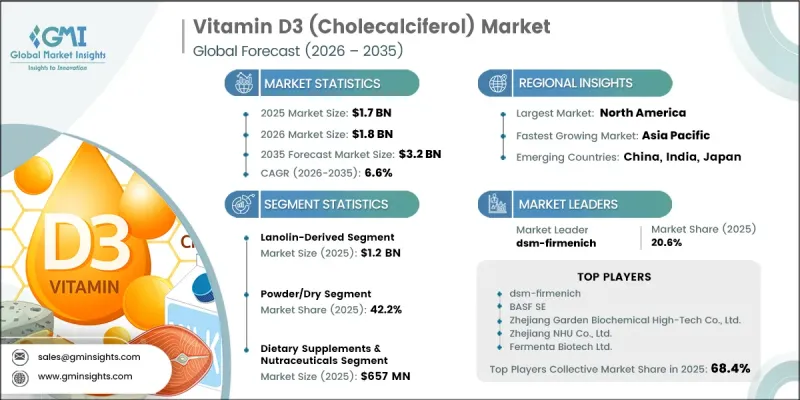
전 세계에서 예방 의료 및 영양을 통한 건강 유지에 대한 소비자의 인식이 높아짐에 따라 비타민 D3(콜레칼시페롤) 시장은 꾸준히 확대되고 있습니다. 전반적인 건강 유지를 위해 적절한 비타민 수치를 유지하는 것의 중요성이 널리 인식되면서, 다양한 연령대에서 영양 보조제 및 영양 강화 식품의 소비가 증가하고 있습니다. 또한 면역 기능과 뼈의 강도, 그리고 전반적인 건강 상태 유지에 대한 관심이 높아지는 것도 시장 성장에 더욱 기여하고 있습니다. 아울러 각 제조사들은 편의성, 접근성, 소비자 수용성을 향상시키는 혁신적인 제품 제형을 도입하고 있으며, 이를 통해 다양한 유통 채널에 걸친 시장 확대가 촉진되고 있습니다. 비타민 D3는 칼슘과 인의 균형을 유지하고 건강한 뼈와 치아를 지탱하는 데 필수적인 역할을 할 뿐만 아니라, 신체 전반의 몇 가지 중요한 생리 기능에도 기여하고 있습니다. 라이프스타일의 변화, 자연광 노출 감소, 비타민 결핍증에 대한 의식의 향상가 보충제에 대한 수요를 지속적으로 지원하고 있습니다. 또한 계몽 활동, 건강 의식의 향상, 예방 영양에 대한 중요성 강조로 인해 소비자들은 일상적인 헬스케어에 비타민 D3를 도입하도록 장려받고 있습니다. 이러한 요인들로 인해 예측 기간 중 비타민 D3(코레칼시페롤) 시장의 장기적인 성장 기회가 유지될 것으로 전망됩니다.
| 시장 범위 | |
|---|---|
| 시작연도 | 2025년 |
| 예측 기간 | 2026-2035년 |
| 초기 시장 규모 | 17억 달러 |
| 예측액 | 32억 달러 |
| CAGR | 6.6% |
라놀린 유래 부문은 2025년에 12억 달러에 달했습니다. 이 부문은 확립된 제조 인프라, 비용 효율적인 제조 공정, 그리고 의약품 등급과 식품 등급 모두의 용도에 폭넓게 적합하다는 점 덕분에 전 세계 생산에서 가장 큰 점유율을 유지하고 있습니다. 성숙한 생산 기술, 신뢰할 수 있는 원료 공급, 그리고 확장성이 뛰어난 제조 능력이 일관된 상업적 생산을 지속적으로 지원하고 있습니다. 이러한 장점 덕분에 라놀린 유래 비타민 D3는 광범위한 최종 용도 산업에서 여전히 선호되는 원료로 자리매김하며, 시장의 장기적이고 안정적인 성장을 지원하고 있습니다.
2025년에는 분말 및 건조 부문이 42.2%의 점유율을 차지했습니다. 이 제품 형태는 식품의 영양 강화, 영양 보조제 제조, 그리고 영양 프리믹스 용도와 뛰어난 호환성을 갖추고 있으며, 계속해서 시장을 주도하고 있습니다. 분말 제제는 취급의 용이성, 정확한 투여량 조절, 안정성 향상, 대규모 생산 공정에 대한 효율적인 통합 등의 장점을 가지고 있습니다. 식품, 의약품, 영양 보조제 제조업체들의 지속적인 수요로 인해 예측 기간 중 이 부문의 지속적인 성장이 지원될 것으로 예상됩니다.
북미의 비타민 D3(코레칼시페롤) 시장은 2035년까지 11억 달러에 달할 것으로 예측됩니다. 이 지역의 수요는 영양에 대한 소비자의 인식 제고, 예방 의료 관행의 확대, 그리고 다양한 인구층에서의 영양 보조제 소비 증가에 힘입어 지원되고 있습니다. 뼈 건강 유지, 면역 기능 지원, 그리고 전반적인 건강 증진에 대한 관심이 높아지면서 비타민 D3 제품의 폭넓은 활용이 계속해서 촉진되고 있습니다. 강화 식품, 영양 제품 및 건강 지향적 소비재에 대한 수요 증가 또한 이 지역 전체의 시장 확대에 더욱 기여하고 있습니다.
자주 묻는 질문
목차
제1장 조사 방법과 범위
제2장 개요
제3장 업계 인사이트
제4장 경쟁 구도
제5장 시장 추산·예측 : 소스별, 2022-2035년
제6장 시장 추산·예측 : 물리적 형상별, 2022-2035년
제7장 시장 추산·예측 : 용도별, 2022-2035년
제8장 시장 추산·예측 : 지역별, 2022-2035년
제9장 기업 개요
KSA 26.07.31The Global Vitamin D3 (Cholecalciferol) Market was valued at USD 1.7 billion in 2025 and is estimated to grow at a CAGR of 6.6% to reach USD 3.2 billion by 2035.
The vitamin D3 (Cholecalciferol) market continues to expand steadily as consumer awareness of preventive healthcare and nutritional wellness increases worldwide. Growing recognition of the importance of maintaining adequate vitamin levels for overall health is encouraging higher consumption of dietary supplements and fortified food products across various age groups. Rising interest in supporting immune function, bone strength, and general well-being is further contributing to market growth. Manufacturers are also introducing innovative product formulations that improve convenience, accessibility, and consumer acceptance, helping broaden the market across multiple distribution channels. Vitamin D3 plays an essential role in maintaining calcium and phosphorus balance, supporting healthy bones and teeth, while also contributing to several important physiological functions throughout the body. Changing lifestyles, reduced exposure to natural sunlight, and increasing awareness of vitamin deficiencies continue to support demand for supplementation. In addition, educational initiatives, growing health consciousness, and stronger emphasis on preventive nutrition are encouraging consumers to incorporate vitamin D3 into their daily wellness routines. These factors are expected to sustain long-term growth opportunities for the vitamin D3 (Cholecalciferol) market throughout the forecast period.
| Market Scope | |
|---|---|
| Start Year | 2025 |
| Forecast Year | 2026-2035 |
| Start Value | $1.7 Billion |
| Forecast Value | $3.2 Billion |
| CAGR | 6.6% |
The lanolin-derived segment reached USD 1.2 billion in 2025. This segment maintains the largest share of global production due to its well-established manufacturing infrastructure, cost-effective production process, and broad suitability for both pharmaceutical-grade and food-grade applications. Mature production technologies, reliable raw material availability, and scalable manufacturing capabilities continue to support consistent commercial output. These advantages have enabled lanolin-derived vitamin D3 to remain the preferred source across a wide range of end-use industries while supporting stable long-term market growth.
The powder and dry segment accounted for 42.2% share in 2025. This product format continues to lead the market because it offers excellent compatibility with food fortification, dietary supplement manufacturing, and nutritional premix applications. Powder formulations provide advantages including simplified handling, precise dosage control, extended stability, and efficient integration into large-scale production processes. Continued demand from food, pharmaceutical, and nutraceutical manufacturers is expected to support sustained growth for this segment throughout the forecast period.
North America Vitamin D3 (Cholecalciferol) Market is projected to reach USD 1.1 billion by 2035. Regional demand is supported by increasing consumer awareness of nutrition, expanding adoption of preventive healthcare practices, and growing consumption of dietary supplements across diverse population groups. Rising focus on maintaining bone health, supporting immune function, and improving overall wellness continues to encourage wider use of vitamin D3 products. Increasing demand for fortified foods, nutritional products, and health-focused consumer goods is further contributing to market expansion across the region.
Major companies operating in the global vitamin D3 (Cholecalciferol) market include Adisseo, BASF SE, Dishman Carbogen Amcis Ltd., dsm-firmenich, Fermenta Biotech Ltd., Lycored Ltd., Stabicoat Vitamins, Taizhou Hisound Pharmaceutical Co., Ltd., Xiamen Kingdomway Group Company, Zhejiang Garden Biochemical High-Tech Co., Ltd., Zhejiang Medicine Co., Ltd., and Zhejiang NHU Co., Ltd. Companies operating in the vitamin D3 (Cholecalciferol) market are strengthening their competitive position through continuous product innovation, production expansion, and strategic investments in manufacturing capabilities. Market participants are focusing on improving product quality, enhancing formulation technologies, and increasing production efficiency to meet rising global demand. Businesses are also expanding their distribution networks and strengthening relationships with food, pharmaceutical, and nutraceutical manufacturers to increase market reach. Investment in research and development remains a key priority to support new product applications and improve production processes.
Table of Contents
Chapter 1 Methodology & Scope
- 1.1 Market scope and definition
- 1.2 Research design
- 1.2.1 Research approach
- 1.2.2 Data collection methods
- 1.3 Data mining sources
- 1.3.1 Global
- 1.3.2 Regional/Country
- 1.4 Base estimates and calculations
- 1.4.1 Base year calculation
- 1.4.2 Key trends for market estimation
- 1.5 Primary research and validation
- 1.5.1 Primary sources
- 1.6 Forecast model
- 1.7 Research assumptions and limitations
Chapter 2 Executive Summary
- 2.1 Industry 360° synopsis
- 2.2 Key market trends
- 2.2.1 Source
- 2.2.2 Physical form
- 2.2.3 Application
- 2.2.4 Regional
- 2.3 TAM Analysis, 2026-2035
- 2.4 CXO perspectives: Strategic imperatives
- 2.5 Future outlook and strategic recommendations
Chapter 3 Industry Insights
- 3.1 Industry ecosystem analysis
- 3.1.1 Supplier landscape
- 3.1.2 Profit margin
- 3.1.3 Value addition at each stage
- 3.1.4 Factor affecting the value chain
- 3.1.5 Disruptions
- 3.2 Industry impact forces
- 3.2.1 Growth drivers
- 3.2.2 Industry pitfalls and challenges
- 3.2.3 Market opportunities
- 3.3 Growth potential analysis
- 3.4 Regulatory landscape
- 3.4.1 North America
- 3.4.2 Europe
- 3.4.3 Asia Pacific
- 3.4.4 Latin America
- 3.4.5 Middle East & Africa
- 3.5 Porter's analysis
- 3.6 PESTEL analysis
- 3.7 Technology and innovation landscape
- 3.7.1 Current technological trends
- 3.7.2 Emerging technologies
- 3.8 Price trends
- 3.8.1 By region
- 3.8.2 By tag technology
- 3.9 Future market trends
- 3.10 Patent landscape
- 3.11 Trade statistics (HS code)
- 3.11.1 Major importing countries
- 3.11.2 Major exporting countries
- 3.12 Sustainability and environmental aspects
- 3.12.1 Sustainable practices
- 3.12.2 Waste reduction strategies
- 3.12.3 Energy efficiency in production
- 3.12.4 Eco-friendly initiatives
- 3.13 Carbon footprint consideration
Chapter 4 Competitive Landscape, 2025
- 4.1 Introduction
- 4.2 Company market share analysis
- 4.2.1 By region
- 4.2.1.1 North America
- 4.2.1.2 Europe
- 4.2.1.3 Asia Pacific
- 4.2.1.4 LATAM
- 4.2.1.5 MEA
- 4.2.1 By region
- 4.3 Company matrix analysis
- 4.4 Competitive analysis of major market players
- 4.5 Competitive positioning matrix
- 4.6 Key developments
- 4.6.1 Mergers & acquisitions
- 4.6.2 Partnerships & collaborations
- 4.6.3 New product launches
- 4.6.4 Expansion plans
Chapter 5 Market Estimates and Forecast, By Source, 2022-2035 (USD Billion) (Kilo Tons)
- 5.1 Key trends
- 5.2 Lanolin-derived
- 5.3 Fish oil-derived
- 5.4 Algal/lichen-derived (vegan)
- 5.5 Synthetic
Chapter 6 Market Estimates and Forecast, By Physical Form, 2022-2035 (USD Billion) (Kilo Tons)
- 6.1 Key trends
- 6.2 Oil / liquid
- 6.3 Powder / dry
- 6.4 Crystalline
Chapter 7 Market Estimates and Forecast, By Application, 2022-2035 (USD Billion) (Kilo Tons)
- 7.1 Key trends
- 7.2 Pharmaceuticals
- 7.2.1 Prescription therapeutics
- 7.2.2 OTC formulations
- 7.2.3 Injectable & parenteral preparations
- 7.3 Dietary supplements & nutraceuticals
- 7.3.1 Standalone vitamin d3 supplements
- 7.3.2 Multivitamin & combination formulations
- 7.3.3 Sports & performance nutrition
- 7.4 Food & beverage fortification
- 7.4.1 Dairy products
- 7.4.2 Cereals, bread & bakery fortification
- 7.4.3 Beverages
- 7.4.4 Edible oils & fats fortification
- 7.5 Animal feed & veterinary
- 7.5.1 Poultry feed
- 7.5.2 Livestock & ruminant feed
- 7.5.3 Aquaculture feed
- 7.5.4 Pet food & companion animal nutrition
- 7.6 Cosmetics & personal care
- 7.6.1 Anti-ageing & skin barrier topicals
- 7.6.2 UV repair & photoprotection formulations
Chapter 8 Market Estimates and Forecast, By Region, 2022-2035 (USD Billion) (Kilo Tons)
- 8.1 Key trends
- 8.2 North America
- 8.2.1 U.S.
- 8.2.2 Canada
- 8.3 Europe
- 8.3.1 Germany
- 8.3.2 UK
- 8.3.3 France
- 8.3.4 Spain
- 8.3.5 Italy
- 8.3.6 Rest of Europe
- 8.4 Asia Pacific
- 8.4.1 China
- 8.4.2 India
- 8.4.3 Japan
- 8.4.4 Australia
- 8.4.5 South Korea
- 8.4.6 Rest of Asia Pacific
- 8.5 Latin America
- 8.5.1 Brazil
- 8.5.2 Mexico
- 8.5.3 Argentina
- 8.5.4 Rest of Latin America
- 8.6 Middle East and Africa
- 8.6.1 Saudi Arabia
- 8.6.2 South Africa
- 8.6.3 UAE
- 8.6.4 Rest of Middle East and Africa
Chapter 9 Company Profiles
- 9.1 Adisseo
- 9.2 BASF SE
- 9.3 Dishman Carbogen Amcis Ltd.
- 9.4 dsm-firmenich
- 9.5 Fermenta Biotech Ltd.
- 9.6 Lycored Ltd.
- 9.7 Stabicoat Vitamins
- 9.8 Taizhou Hisound Pharmaceutical Co., Ltd.
- 9.9 Xiamen Kingdomway Group Company
- 9.10 Zhejiang Garden Biochemical High-Tech Co., Ltd.
- 9.11 Zhejiang Medicine Co., Ltd.
- 9.12 Zhejiang NHU Co., Ltd.


