

|
시장보고서
상품코드
2101566
농업용 미스팅 및 포깅 시스템 시장 기회, 성장 촉진요인, 업계 동향 분석 및 예측(2026-2035년)Agriculture Misting and Fogging Systems Market Opportunity, Growth Drivers, Industry Trend Analysis, and Forecast 2026 - 2035 |
||||||

세계의 농업용 미스팅 및 포깅 시스템 시장은 2025년에 19억 달러로 평가되었으며, CAGR 8.6%로 성장하여 2035년까지 44억 달러에 달할 것으로 추정됩니다.
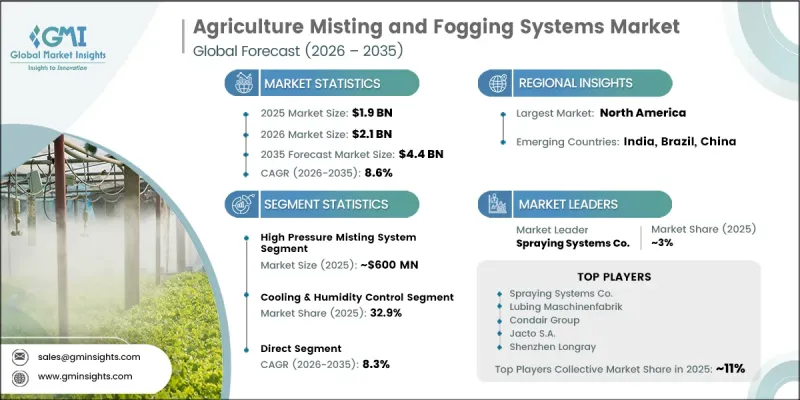
기온 상승, 예측 불가능한 기상 조건, 그리고 더위와 관련된 농업적 과제의 증가로 인해 농가들은 효과적인 미기후 제어 솔루션 도입을 추진하고 있습니다. 미스트 및 포깅 시스템은 증발 냉각 방식을 활용하여 적절한 온도와 습도 조건을 유지함으로써 작물의 건전한 생육과 가축 관리 개선을 지원합니다. 기후 적응 전략에 대한 인식 제고와 안정적인 농업 생산의 필요성으로 인해, 상업적 농업 경영에서 이러한 시스템의 도입이 가속화되고 있습니다. 생산자들이 환경적 스트레스를 관리하고, 자원 효율을 높이며, 안정적인 생산 조건을 유지하기 위한 신뢰할 수 있는 솔루션을 모색함에 따라, 이러한 기술의 중요성은 점점 더 커지고 있습니다. 농업 현대화를 위한 노력의 확대와 제어된 농업 환경에 대한 투자 증가로 인해, 예측 기간 동안 전 세계 농업용 미스트·포깅 시스템 시장에는 지속적인 성장 기회가 창출될 것으로 전망됩니다.
| 시장 범위 | |
|---|---|
| 시작 연도 | 2025년 |
| 예측 기간 | 2026-2035년 |
| 초기 시장 규모 | 19억 달러 |
| 예측액 | 44억 달러 |
| CAGR | 8.6% |
고압 미스트 시스템 부문은 2025년에 6억 달러의 시장 규모를 기록했으며, 2026년부터 2035년까지 연평균 성장률(CAGR) 7.8%로 성장할 것으로 전망됩니다. 이 부문은 미세한 미스트 입자를 발생시켜 효율적인 냉각 성능을 발휘하고, 효과적인 온도 조절을 실현하는 동시에 물 사용량을 최적화할 수 있다는 점에서 주도적인 위치를 유지하고 있습니다. 고압 미스트 시스템은 미기후 조건을 일정하게 유지하는 데 도움이 되므로, 정밀한 환경 제어가 필요한 용도에서 점점 더 선호되고 있습니다. 효율적인 냉각 및 습도 관리를 지원하는 능력 덕분에 현대적인 농업 시설에서의 도입이 지속적으로 확대되고 있습니다.
2025년 기준, 냉각·습도 제어 부문은 시장 점유율의 32.9%를 차지했습니다. 농업 생산성을 유지하는 데 있어 온도 및 습도 관리가 매우 중요한 역할을 하고 있기 때문에 이 부문은 여전히 주요 응용 분야로 남아 있습니다. 효과적인 습도 조절과 냉각 성능은 보다 건전한 재배 환경 유지, 운영의 일관성 향상, 그리고 농업 활동에 대한 환경적 스트레스의 영향을 완화하는 데 기여합니다. 생산 효율 향상과 안정적인 조건 유지에 대한 관심이 높아짐에 따라, 첨단 미스트 및 포깅 솔루션에 대한 수요는 계속해서 확대되고 있습니다.
미국 농업용 미스트 및 포깅 시스템 시장은 2025년에 3억 달러에 달했으며, 2026년부터 2035년까지 연평균 성장률(CAGR) 9.7%로 성장할 것으로 전망됩니다. 미국은 선진적인 농업 인프라, 대규모 농업 경영, 그리고 자동화된 환경 관리 기술의 도입 확대에 힘입어 고도로 발달한 시장을 형성하고 있습니다. 기온 상승 및 기후 조건 변화에 대한 우려가 커짐에 따라 농업 분야 전반에서 미스트 및 포깅 솔루션에 대한 투자 확대가 촉진되고 있습니다. 고압 미스트 시스템은 그 효율성, 신뢰성, 그리고 최신 자동 농업 시스템과의 호환성 덕분에 계속해서 높은 도입률을 유지하고 있습니다.
자주 묻는 질문
목차
제1장 조사 방법과 범위
제2장 주요 요약
제3장 업계 인사이트
제4장 경쟁 구도
제5장 시장 추정 및 예측 : 장비 유형별, 2022-2035년
제6장 시장 추정 및 예측 : 용도별, 2022-2035년
제7장 시장 추정 및 예측 : 최종 적용 분야별, 2022-2035년
제8장 시장 추정 및 예측 : 유통 채널별, 2022-2035년
제9장 시장 추정 및 예측 : 지역별, 2022-2035년
제10장 기업 개요
KSM 26.08.04The Global Agriculture Misting and Fogging Systems Market was valued at USD 1.9 billion in 2025 and is estimated to grow at a CAGR of 8.6% to reach USD 4.4 billion by 2035.
Rising temperatures, unpredictable weather conditions, and increasing occurrences of heat-related agricultural challenges are encouraging farmers to implement effective microclimate control solutions. Misting and fogging systems help maintain suitable temperature and humidity conditions by using evaporative cooling methods, supporting healthier crop development and improved livestock management. Growing awareness of climate adaptation strategies and the need for consistent agricultural output are accelerating the adoption of these systems across commercial farming operations. These technologies are becoming increasingly important as producers seek reliable solutions to manage environmental stress, improve resource efficiency, and maintain stable production conditions. Expanding agricultural modernization efforts and increasing investment in controlled farming environments are expected to create continued growth opportunities for the global agriculture misting and fogging systems market throughout the forecast period.
| Market Scope | |
|---|---|
| Start Year | 2025 |
| Forecast Year | 2026-2035 |
| Start Value | $1.9 Billion |
| Forecast Value | $4.4 Billion |
| CAGR | 8.6% |
The high-pressure misting system segment generated USD 600 million in 2025 and is expected to grow at a CAGR of 7.8% from 2026 to 2035. This segment maintains a leading position due to its ability to provide efficient cooling performance through the generation of fine mist particles that support effective temperature regulation while optimizing water usage. High-pressure misting systems are increasingly preferred for applications requiring precise environmental control because they help maintain consistent microclimate conditions. Their ability to support efficient cooling and humidity management continues to strengthen adoption across modern agricultural facilities.
The cooling and humidity control segment accounted for 32.9% share in 2025. This segment remains the primary application area due to the critical role of temperature and moisture management in maintaining agricultural productivity. Effective humidity regulation and cooling performance help support healthier growing environments, improve operational consistency, and reduce the impact of environmental stress on agricultural activities. Increasing focus on improving production efficiency and maintaining stable conditions continues to drive demand for advanced misting and fogging solutions.
United States Agriculture Misting And Fogging Systems Market reached USD 300 million in 2025 and projected to grow at a CAGR of 9.7% from 2026 to 2035. The country represents a highly developed market supported by advanced agricultural infrastructure, large-scale farming operations, and increasing adoption of automated environmental management technologies. Growing concerns related to rising temperatures and changing climate conditions are encouraging greater investment in misting and fogging solutions across agricultural applications. High-pressure misting systems continue to experience strong adoption due to their efficiency, reliability, and compatibility with modern automated farming systems.
Major companies operating in the global agriculture misting and fogging systems market include Hardi International A/S, PulsFOG Dr. Stahl & Sohn GmbH, IGEBA Geratebau GmbH, MJ-Tech B.V., Birchmeier Spruhtechnik AG, Jacto S.A. (Maquinas Agricolas Jacto), Shenzhen Longray Technology Co., Ltd., WhiteFog (Beyaz Sis Makine), Rovic Agrochemicals (Pty) Ltd., OZmist, FuFong Fogging Co., Koolfog, Inc., Dramm Corporation, Curtis Dyna-Fog (B&G Equipment / Pelsis Group), VES-Artex, Agromehanika d.d., Venkateshwara Agrotech Industries, NSTG Agri-Tech Group Co., Ltd., Mitra Agro Equipments Pvt. Ltd., Gigola & Riccardi S.p.A., and TrueMIST (EKA HR Consulting Pvt. Ltd.). Companies operating in the agriculture misting and fogging systems market are strengthening their competitive position by developing advanced climate control technologies, expanding product portfolios, and improving system efficiency. Manufacturers are focusing on research and development activities to introduce solutions with enhanced automation, improved water management, and greater operational reliability. Strategic partnerships, regional expansion, and stronger distribution networks are helping companies increase their market presence and reach a wider customer base. Businesses are also investing in smart monitoring capabilities, energy-efficient designs, and customized solutions to address evolving agricultural requirements. In addition, companies are improving technical support services, expanding manufacturing capabilities, and accelerating innovation to deliver higher-value products.
Table of Contents
Chapter 1 Methodology & Scope
- 1.1 Market scope & definitions
- 1.2 Research design
- 1.2.1 Research approach
- 1.2.2 Data collection methods
- 1.3 Base estimates and calculations
- 1.3.1 Base year calculation
- 1.3.2 Market estimates & forecasts parameters
- 1.4 Forecast Model
- 1.4.1 Key trends for market estimates
- 1.4.2 Quantified market impact analysis
- 1.4.2.1 Mathematical impact of growth parameters on forecast
- 1.4.3 Scenario analysis framework
- 1.5 Primary research and validation
- 1.5.1 Some of the primary sources (but not limited to)
- 1.6 Data mining sources
- 1.6.1 Paid Sources
- 1.7 Primary research and validation
- 1.7.1 Primary sources
- 1.8 Research Trail & confidence scoring
- 1.8.1 Research trail components
- 1.8.2 Scoring components
- 1.9 Research transparency addendum
- 1.9.1 Source attribution framework
- 1.9.2 Quality assurance metrics
- 1.9.3 Our commitment to trust
- 1.10 Market Definitions
Chapter 2 Executive Summary
- 2.1 Industry 360° synopsis
- 2.2 Key market trends
- 2.2.1 Region
- 2.2.2 Equipment type
- 2.2.3 Application
- 2.2.4 End use setting
- 2.2.5 Distribution channel
Chapter 3 Industry Insights
- 3.1 Industry ecosystem analysis
- 3.1.1 Raw material suppliers and component suppliers
- 3.1.2 System manufacturers & OEMs
- 3.1.3 Distributors, dealers & channel partners
- 3.1.4 End-user segments & post-sale service providers
- 3.1.5 Profit margin
- 3.1.6 Value addition at each stage
- 3.1.7 Factor affecting the value chain
- 3.2 Industry impact forces
- 3.2.1 Growth drivers
- 3.2.1.1 Rising Global Temperatures & Increasing Frequency of Heat Stress Events
- 3.2.1.2 Rapid Expansion of Greenhouse & Controlled Environment Agriculture (CEA) Globally
- 3.2.1.3 Strengthening Livestock Welfare Regulations Mandating Temperature Management
- 3.2.2 Market Pitfalls
- 3.2.2.1 High Initial Capital Investment for High-Pressure Misting System Installation
- 3.2.2.2 Nozzle Clogging & Maintenance Complexity in Hard-Water Agricultural Regions
- 3.2.3 Market Opportunities
- 3.2.3.1 Integration with IoT-Enabled Smart Farm Platforms & Automated Climate Control
- 3.2.3.2 Expanding Vertical Farming & Urban Agriculture Creating New CEA-Grade Demand
- 3.2.1 Growth drivers
- 3.3 Growth potential analysis
- 3.4 Regulatory Framework
- 3.4.1 Pesticide & chemical application regulations by region
- 3.4.2 Water usage & environmental compliance standards
- 3.4.3 Emerging regulatory trends impacting market access
- 3.5 Major market trends and disruptions
- 3.6 Technological and innovation landscape
- 3.6.1 Current technological trends
- 3.6.2 Emerging technologies
- 3.6.3 Evolution of misting & fogging technologies
- 3.6.4 Nozzle design & atomization advancements
- 3.6.5 Smart controls, IoT integration & automation trends
- 3.6.6 Water conservation technologies in precision misting
- 3.7 Pricing Analysis (driven by primary research)
- 3.7.1 Historical price trend analysis
- 3.7.2 Pricing strategy by player type (premium / value / cost-plus)
- 3.8 Future market trends
- 3.9 Supply chain analysis
- 3.9.1 Critical component dependencies
- 3.9.2 Regional manufacturing hubs
- 3.9.3 Supply chain resilience & risk factors
- 3.9.4 Vertical integration trends
- 3.10 Trade data analysis (driven by paid database) (HS Code- 8424)
- 3.10.1 Import/export volume & value trends
- 3.10.2 Key trade corridors & tariff impact
- 3.11 Impact of AI & Generative AI on the Market
- 3.11.1 AI-driven disruption of existing business models
- 3.11.2 GenAI use cases & adoption roadmap by segment
- 3.11.3 Risks, limitations & regulatory considerations
- 3.12 Porter's analysis
- 3.13 PESTEL analysis
- 3.14 Capacity & Production Landscape (driven by primary research)
- 3.14.1 Installed capacity by region & key producer
- 3.14.2 Capacity utilization rates & expansion pipelines
Chapter 4 Competitive Landscape, 2025
- 4.1 Introduction
- 4.2 Company market share analysis
- 4.2.1 By Region
- 4.2.1.1 North America
- 4.2.1.2 Europe
- 4.2.1.3 Asia Pacific
- 4.2.1.4 Latin America
- 4.2.1.5 Middle East & Africa
- 4.2.1 By Region
- 4.3 Company matrix analysis
- 4.4 Competitive analysis of major market players
- 4.5 Competitive positioning matrix
- 4.6 Key developments
- 4.6.1 Mergers & acquisitions
- 4.6.2 Partnerships & collaborations
- 4.6.3 New product launches
- 4.6.4 Expansion plans
Chapter 5 Market Estimates & Forecast, By Equipment Type, 2022 - 2035, (USD Billion) (Thousand Units)
- 5.1 Key trends
- 5.2 Low pressure misting systems
- 5.2.1 Portable/handheld low pressure misting systems
- 5.2.2 Fixed/installed low pressure misting systems
- 5.3 High pressure misting systems
- 5.3.1 Portable high pressure misting systems
- 5.3.2 Fixed/installed high pressure misting systems
- 5.4 Thermal fogging machines
- 5.4.1 Handheld thermal foggers
- 5.4.2 Vehicle-mounted/trailer-mounted thermal foggers
- 5.5 Cold/ULV fogging machines
- 5.5.1 Handheld cold/ULV foggers
- 5.5.2 Vehicle-mounted/trailer-mounted cold/ULV foggers
- 5.6 Mist fans
Chapter 6 Market Estimates & Forecast, By Application, 2022 - 2035, (USD Billion) (Thousand Units)
- 6.1 Key trends
- 6.2 Cooling & humidity control
- 6.2.1 Ambient temperature reduction in enclosed agricultural facilities
- 6.2.2 Humidity regulation for crop propagation & growth
- 6.3 Pest control & crop protection
- 6.3.1 Insecticide & pesticide application
- 6.3.2 Fungicide & disease prevention application
- 6.4 Disinfection & sanitation
- 6.4.1 Livestock & poultry facility disinfection
- 6.4.2 Post-harvest storage & packing house sanitation
- 6.5 Fertilizer & nutrient delivery
- 6.5.1 Foliar micronutrient application
- 6.5.2 Liquid fertilizer distribution via misting
- 6.6 Dust suppression
- 6.6.1 Feed lot & animal facility dust control
- 6.6.2 Grain storage & handling facility dust management
Chapter 7 Market Estimates & Forecast, By End Use Setting, 2022 - 2035, (USD Billion) (Thousand Units)
- 7.1 Key trends
- 7.2 Greenhouse & controlled environment agriculture (CEA)
- 7.2.1 Commercial glass & polyethylene greenhouses
- 7.2.2 Polytunnels & shade houses
- 7.2.3 Vertical farms & indoor growing facilities
- 7.3 Livestock & poultry farming
- 7.3.1 Poultry (broiler & layer) facilities
- 7.3.2 Dairy & cattle farms
- 7.3.3 Swine facilities
- 7.4 Open field crop farming
- 7.4.1 Row crops & cereal grain fields
- 7.4.2 Vegetable & leafy green production
- 7.5 Orchards, vineyards & specialty crops
- 7.5.1 Fruit orchards (citrus, stone fruit, pome fruit)
- 7.5.2 Vineyards & berry crops
- 7.5.3 High-value specialty & export crops
- 7.6 Nurseries & horticulture
- 7.6.1 Commercial plant nurseries
- 7.6.2 Floriculture & ornamental crop production
Chapter 8 Market Estimates & Forecast, By Distribution Channel, 2022 - 2035, (USD Billion) (Thousand Units)
- 8.1 Key trends
- 8.2 Direct
- 8.3 Indirect
Chapter 9 Market Estimates & Forecast, By Region, 2022 - 2035, (USD Billion) (Thousand Units)
- 9.1 Key trends
- 9.2 North America
- 9.2.1 U.S.
- 9.2.2 Canada
- 9.3 Europe
- 9.3.1 Germany
- 9.3.2 UK
- 9.3.3 France
- 9.3.4 Italy
- 9.3.5 Spain
- 9.4 Asia Pacific
- 9.4.1 China
- 9.4.2 India
- 9.4.3 Japan
- 9.4.4 South Korea
- 9.4.5 Australia
- 9.5 Latin America
- 9.5.1 Brazil
- 9.5.2 Mexico
- 9.5.3 Argentina
- 9.6 MEA
- 9.6.1 Saudi Arabia
- 9.6.2 UAE
- 9.6.3 South Africa
Chapter 10 Company Profiles
- 10.1 Global Players
- 10.1.1 PulsFOG Dr. Stahl & Sohn GmbH
- 10.1.2 IGEBA Geratebau GmbH
- 10.1.3 MJ-Tech B.V.
- 10.1.4 Hardi International A/S
- 10.1.5 Birchmeier Spruhtechnik AG
- 10.1.6 Jacto S.A. (Maquinas Agricolas Jacto)
- 10.1.7 Shenzhen Longray Technology Co., Ltd.
- 10.2 Regional Players
- 10.2.1 WhiteFog (Beyaz Sis Makine)
- 10.2.2 Rovic Agrochemicals (Pty) Ltd.
- 10.2.3 OZmist
- 10.2.4 FuFong Fogging Co.
- 10.2.5 Koolfog, Inc.
- 10.2.6 Dramm Corporation
- 10.2.7 Curtis Dyna-Fog (B&G Equipment / Pelsis Group)
- 10.2.8 VES-Artex
- 10.2.9 Agromehanika d.d.
- 10.2.10 Venkateshwara Agrotech Industries
- 10.3 Emerging Players
- 10.3.1 NSTG Agri-Tech Group Co., Ltd.
- 10.3.2 Mitra Agro Equipments Pvt. Ltd.
- 10.3.3 Gigola & Riccardi S.p.A.
- 10.3.4 TrueMIST (EKA HR Consulting Pvt. Ltd.)


