

|
시장보고서
상품코드
2101594
태양광발전식 관개 시스템 시장 기회, 성장요인, 업계 동향 분석 및 예측(2026-2035년)Solar-Powered Irrigation System Market Opportunity, Growth Drivers, Industry Trend Analysis, and Forecast 2026 - 2035 |
||||||

세계의 태양광발전식 관개 시스템 시장은 2025년에 36억 달러 규모에 달하며, CAGR 11%로 성장하며, 2035년까지 112억 달러에 달할 것으로 추정되고 있습니다.
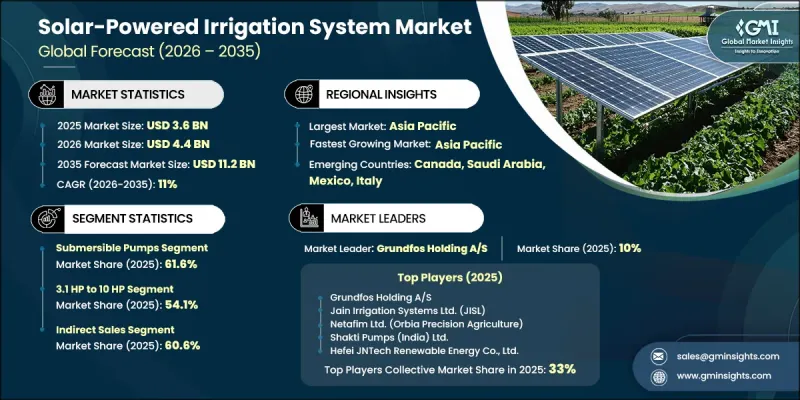
이러한 성장은 농가가 디젤 연료를 동력원으로 하는 관개 시스템에서 재생 가능 에너지로 전환함에 따라 농업 분야의 에너지 이용 구조적 변화에 의해 주도되고 있습니다. 연료 가격 변동성 증가, 태양광발전 자금 조달 메커니즘에 대한 접근성 개선, 그리고 물 이용 효율에 관한 요건의 강화로 인해 소규모 농가부터 대규모 농업 경영에 이르기까지 도입이 가속화되고 있습니다. 거시적인 관점에서 볼 때, 전 세계 식량 수요의 증가, 기후 변화에 대한 적응 필요성, 그리고 태양광발전 시스템 비용의 지속적인 감소가 장기적인 시장 펀더멘털을 강화하고 있습니다. 정부 주도의 보조금 프로그램, 기후 정책에 대한 노력, 그리고 다자간 자금 조달 구상은 경제적으로 실현 가능하고 정책적으로 지원되는 해결책으로서 태양광발전 기반 관개로 전환하는 것을 더욱 지원하고 있습니다. 농업 시스템에는 생산성을 향상시키는 동시에 생산 단위당 물과 에너지 소비량을 줄이는 것이 점점 더 요구되고 있으며, 태양광발전 기반 관개는 이러한 제약에 대한 효과적인 해결책이 되고 있습니다. 또한 지하수위의 하락과 강우 패턴의 불규칙화로 인해 안정적인 농업 생산을 확보하고, 전력망 및 화석 연료에 대한 의존도를 낮출 수 있는 효율적인 관개 기술에 대한 의존도가 높아지고 있습니다. 그 결과, 태양광발전 기반 관개 시스템은 전 세계에서 지속가능한 농업 현대화 전략의 핵심 요소로 자리 잡고 있습니다.
| 시장 범위 | |
|---|---|
| 시작연도 | 2025년 |
| 예측 기간 | 2026-2035년 |
| 개시 금액 | 36억 달러 |
| 예측액 | 112억 달러 |
| CAGR | 11% |
수중 펌프 부문은 2025년에 61.6%의 점유율을 차지하며, 2035년까지 연평균 성장률(CAGR) 10.7%로 성장할 것으로 전망됩니다. 이 부문은 심층 지하수 양수 용도에 대한 높은 적합성과 지표수 이용이 제한된 지역에서 안정적인 관개 성능을 지원하는 능력 덕분에 계속해서 시장을 주도하고 있습니다. 지하수 양수 솔루션의 채택이 확대됨에 따라 농업 시장 전체에서 수중 펌프 구성에 대한 수요가 더욱 증가하고 있습니다.
2025년에는 3.1 HP-10HP 출력 범위의 부문이 54.1%의 점유율을 차지할 것으로 예상되며, 이는 중소규모 농업 수요와의 높은 적합성을 반영합니다. 이 출력 범위의 시스템은 중심도 관개 용도로 널리 이용되고 있으며, 다양한 규모의 농지에 적합합니다. 이 부문은 개발도상국 농업 경제권에서 다양한 작물 생산 수요에 대응하는 비용 효율이 뛰어나고 확장성이 뛰어난 관개 시스템에 대한 수요 증가로 인해 계속해서 혜택을 보고 있습니다.
북미의 태양광발전식 관개 시스템 시장은 2025년에 21.1%의 점유율을 차지하며, 2035년까지 연평균 성장률(CAGR) 11.3%로 성장할 것으로 전망됩니다. 이 지역의 성장은 절수형 농업 기술에 대한 투자 증가와 재생 가능 에너지를 활용한 관개 솔루션 도입 확대에 힘입고 있습니다. 지하수 보전과 농장 차원의 에너지 최적화에 대한 관심이 높아지고 있는 점은, 농업 지역 전반, 특히 관개 에너지 비용과 수자원 관리가 여전히 중요한 운영 과제로 남아 있는 지역에서 시장 확장을 지속적으로 지원하고 있습니다.
자주 묻는 질문
목차
제1장 조사 방법과 범위
제2장 개요
제3장 업계 인사이트
제4장 경쟁 구도
제5장 시장 추산·예측 : 제품 유형별, 2022-2035년
제6장 시장 추산·예측 : 컴포넌트별, 2022-2035년
제7장 시장 추산·예측 : 관개 시스템 유형별, 2022-2035년
제8장 시장 추산·예측 : 시스템 접속성별, 2022-2035년
제9장 시장 추산·예측 : 출력 정격별, 2022-2035년
제10장 시장 추산·예측 : 최종사용자별, 2022-2035년
제11장 시장 추산·예측 : 유통 채널별, 2022-2035년
제12장 시장 추산·예측 : 지역별, 2022-2035년
제13장 기업 개요
KSA 26.07.31The Global Solar Powered Irrigation System Market was valued at USD 3.6 billion in 2025 and is estimated to grow at a CAGR of 11% to reach USD 11.2 billion by 2035.
Growth is driven by a structural shift in agricultural energy usage as farmers transition away from diesel-based irrigation systems toward renewable energy alternatives. Rising fuel price volatility, improved access to solar financing mechanisms, and stricter water-use efficiency requirements are accelerating adoption across both smallholder and large-scale farming operations. At the macro level, increasing global food demand, climate change adaptation needs, and continuous reductions in photovoltaic system costs are strengthening long-term market fundamentals. Government-backed subsidy programs, climate policy commitments, and multilateral funding initiatives are further reinforcing the transition toward solar-powered irrigation as a financially viable and policy-supported solution. Agricultural systems are increasingly required to enhance productivity while reducing water and energy consumption per output unit, making solar-powered irrigation an effective response to these constraints. In addition, declining groundwater levels and irregular rainfall patterns are increasing reliance on efficient irrigation technologies that ensure consistent agricultural output and reduced operational dependency on grid electricity or fossil fuels. As a result, solar-powered irrigation systems are becoming a core component of sustainable agricultural modernization strategies worldwide.
| Market Scope | |
|---|---|
| Start Year | 2025 |
| Forecast Year | 2026-2035 |
| Start Value | $3.6 Billion |
| Forecast Value | $11.2 Billion |
| CAGR | 11% |
The submersible pump segment accounted for 61.6% share in 2025 and is expected to grow at a CAGR of 10.7% through 2035. This segment continues to dominate due to its strong suitability for deep groundwater extraction applications and its ability to support stable irrigation performance in regions with limited surface water availability. Increasing adoption of underground water pumping solutions is further strengthening demand for submersible configurations across agricultural markets.
The 3.1 HP to 10 HP power range segment held 54.1% share in 2025, reflecting its strong alignment with small and medium-scale farming requirements. Systems within this capacity range are widely used for moderate-depth irrigation applications and are well-suited for a broad base of agricultural land sizes. The segment continues to benefit from increasing demand for cost-efficient, scalable irrigation systems that support diverse crop production needs across developing agricultural economies.
North America Solar Powered Irrigation System Market accounted for 21.1% share in 2025 and is projected to grow at a CAGR of 11.3% through 2035. Growth in the region is supported by rising investment in water-efficient agricultural technologies and expanding adoption of renewable energy-based irrigation solutions. Increasing focus on groundwater conservation and farm-level energy optimization continues to support market expansion across agricultural regions, particularly where irrigation energy costs and water resource management remain key operational concerns.
Major companies operating in the solar powered irrigation system market include LORENTZ (Bernt Lorentz GmbH & Co. KG), Grundfos Holding A/S, Netafim Ltd. (Orbia Precision Agriculture), Jain Irrigation Systems Ltd. (JISL), Hefei JNTech Renewable Energy Co., Ltd., Shakti Pumps (India) Ltd., C.R.I. Pumps Pvt. Ltd. (CRI Group), and Tata Power Solar Systems Ltd. Companies operating in the solar powered irrigation system market are strengthening their competitive position through continuous technological innovation, expansion of product portfolios, and integration of energy-efficient pumping solutions. Manufacturers are focusing on improving system performance through advanced controllers, higher-efficiency photovoltaic modules, and smart irrigation management capabilities. Strategic partnerships with agricultural development agencies, financial institutions, and government programs are helping companies expand market access and increase adoption in rural farming regions. Businesses are also investing in localized manufacturing, cost optimization strategies, and scalable system designs to cater to diverse farm sizes and irrigation requirements.
Table of Contents
Chapter 1 Methodology and Scope
- 1.1 Market scope and definition
- 1.2 Research design
- 1.2.1 Research approach
- 1.2.2 Data collection methods
- 1.3 Data mining sources
- 1.3.1 Global
- 1.3.2 Regional/Country
- 1.4 Base estimates and calculations
- 1.4.1 Base year calculation
- 1.4.2 Key trends for market estimation
- 1.5 Primary research and validation
- 1.5.1 Primary sources
- 1.6 Forecast model
- 1.7 Research assumptions and limitations
Chapter 2 Executive Summary
- 2.1 Industry 360° synopsis
- 2.2 Key market trends
- 2.2.1 Regional
- 2.2.2 Product type
- 2.2.3 Component
- 2.2.4 Irrigation system type
- 2.2.5 System connectivity
- 2.2.6 Power rating
- 2.2.7 End user
- 2.2.8 Distribution channel
Chapter 3 Industry Insights
- 3.1 Industry ecosystem analysis
- 3.1.1 Supplier landscape
- 3.1.2 Profit margin
- 3.1.3 Value addition at each stage
- 3.1.4 Factors affecting the value chain
- 3.2 Industry impact forces
- 3.2.1 Growth drivers
- 3.2.1.1 Transition to sustainable & low-carbon agriculture
- 3.2.1.2 Rising energy costs for farmers
- 3.2.1.3 Water scarcity & need for efficient irrigation
- 3.2.2 Industry pitfalls & challenges
- 3.2.2.1 High upfront investment
- 3.2.2.2 Risk of groundwater overuse
- 3.2.3 Opportunities
- 3.2.3.1 Integration with micro-irrigation
- 3.2.3.2 Smart irrigation & digital farming
- 3.2.1 Growth drivers
- 3.3 Growth potential analysis
- 3.4 Regulatory framework
- 3.4.1 Government subsidy & incentive programs (PM-KUSUM, USDA REAP, EU farm-to-fork)
- 3.4.2 Net metering policies impacting grid-connected systems
- 3.4.3 Water use rights & groundwater extraction regulations
- 3.4.4 International standards & certifications (IEC, ISO, BIS)
- 3.5 Pricing analysis (driven by primary research)
- 3.5.1 Historical price trend analysis by material category (2022-2025)
- 3.5.2 Pricing strategy by player type (premium / value / cost-plus)
- 3.6 Trade data analysis (driven by paid database)
- 3.6.1 Import/export volume & value trends
- 3.6.2 Key trade corridors & tariff impact
- 3.7 Impact of AI & generative AI on the market
- 3.7.1 AI-driven disruption of existing business models
- 3.7.2 GenAI use cases & adoption roadmap by segment
- 3.7.3 Risks, limitations & regulatory considerations
- 3.8 Capacity & production landscape (driven by primary research)
- 3.8.1 Installed manufacturing capacity by region & key producer
- 3.8.2 Capacity utilization rates & expansion pipelines
Chapter 4 Competitive Landscape, 2025
- 4.1 Introduction
- 4.2 Company market share analysis
- 4.2.1 By region
- 4.2.1.1 North America
- 4.2.1.2 Europe
- 4.2.1.3 Asia Pacific
- 4.2.1.4 Latin America
- 4.2.1.5 Middle East and Africa
- 4.2.1 By region
- 4.3 Company matrix analysis
- 4.4 Competitive analysis of major market players
- 4.5 Competitive positioning matrix
- 4.6 Key developments
- 4.6.1 Mergers & acquisitions
- 4.6.2 Partnerships & collaborations
- 4.6.3 New product launches
- 4.6.4 Expansion plans
Chapter 5 Market Estimates and Forecast, By Product Type, 2022 - 2035 (USD Billion) (Thousand Units)
- 5.1 Key trends
- 5.2 Submersible pumps
- 5.3 Surface pumps
- 5.4 Floating pumps
Chapter 6 Market Estimates and Forecast, By Component, 2022 - 2035 (USD Billion) (Thousand Units)
- 6.1 Key trends
- 6.2 Solar panels (PV modules)
- 6.3 Pump controllers / MPPT controllers
- 6.4 Water pumps
- 6.5 Inverters & variable frequency drives (VFDs)
- 6.6 Batteries & storage systems
- 6.7 Balance of system (BOS) & others
Chapter 7 Market Estimates and Forecast, By Irrigation System Type, 2022 - 2035 (USD Billion) (Thousand Units)
- 7.1 Key trends
- 7.2 Drip irrigation
- 7.3 Sprinkler irrigation
- 7.4 Center pivot & lateral-move
- 7.5 Surface/flood irrigation
- 7.6 Subsurface/micro irrigation
Chapter 8 Market Estimates and Forecast, By System Connectivity, 2022 - 2035 (USD Billion) (Thousand Units)
- 8.1 Key trends
- 8.2 Standalone/direct solar (DC) systems
- 8.3 Battery-backed off-grid systems
- 8.4 Grid-connected hybrid systems
Chapter 9 Market Estimates and Forecast, By Power Rating, 2022 - 2035 (USD Billion) (Thousand Units)
- 9.1 Key trends
- 9.2 Up to 3 HP
- 9.3 3.1 HP to 10 HP
- 9.4 Above 10 HP
Chapter 10 Market Estimates and Forecast, By End User, 2022 - 2035 (USD Billion) (Thousand Units)
- 10.1 Key trends
- 10.2 Smallholder & subsistence farmers
- 10.3 Commercial farms & agribusinesses
- 10.4 Greenhouses & controlled environment agriculture (CEA)
- 10.5 Livestock & dairy farms
- 10.6 Landscaping, golf & municipal
- 10.7 Government & NGO projects
Chapter 11 Market Estimates and Forecast, By Distribution Channel, 2022 - 2035 (USD Billion) (Thousand Units)
- 11.1 Key trends
- 11.2 Direct sales
- 11.3 Indirect sales
Chapter 12 Market Estimates and Forecast, By Region, 2022 - 2035 (USD Billion) (Thousand Units)
- 12.1 Key trends
- 12.2 North America
- 12.2.1 U.S.
- 12.2.2 Canada
- 12.3 Europe
- 12.3.1 Germany
- 12.3.2 UK
- 12.3.3 France
- 12.3.4 Italy
- 12.3.5 Spain
- 12.4 Asia Pacific
- 12.4.1 China
- 12.4.2 Japan
- 12.4.3 India
- 12.4.4 Australia
- 12.4.5 South Korea
- 12.5 Latin America
- 12.5.1 Brazil
- 12.5.2 Mexico
- 12.5.3 Argentina
- 12.6 Middle East and Africa
- 12.6.1 South Africa
- 12.6.2 Saudi Arabia
- 12.6.3 UAE
Chapter 13 Company Profiles
- 13.1 Global players
- 13.1.1 LORENTZ (Bernt Lorentz GmbH & Co. KG)
- 13.1.2 Grundfos Holding A/S
- 13.1.3 Netafim Ltd.
- 13.1.4 Jain Irrigation Systems Ltd.
- 13.1.5 Hefei JNTech Renewable Energy Co., Ltd.
- 13.2 Regional players
- 13.2.1 Shakti Pumps Ltd.
- 13.2.2 C.R.I. Pumps Pvt. Ltd.
- 13.2.3 Tata Power Solar Systems Ltd.
- 13.2.4 Rain Bird Corporation
- 13.2.5 Wilo SE
- 13.3 Emerging players
- 13.3.1 SunCulture
- 13.3.2 Futurepump Ltd.
- 13.3.3 EBARA Bombas America do Sul Ltda.
- 13.3.4 DAB Pumps SpA
- 13.3.5 Zhejiang Rison Pumping Tech Co., Ltd.


