

|
시장보고서
상품코드
2101620
종자 육종을 위한 반수체 유도 기술 시장 기회, 성장 촉진요인, 업계 동향 분석 및 예측(2026-2035년)Haploid Induction Technology for Seed Breeding Market Opportunity, Growth Drivers, Industry Trend Analysis, and Forecast 2026 - 2035 |
||||||

세계의 종자 육종을 위한 반수체 유도 기술 시장은 2025년에 4억 6,000만 달러로 평가되었으며, CAGR 10.1%로 성장하여 2035년까지 12억 달러에 달할 것으로 예측됩니다.
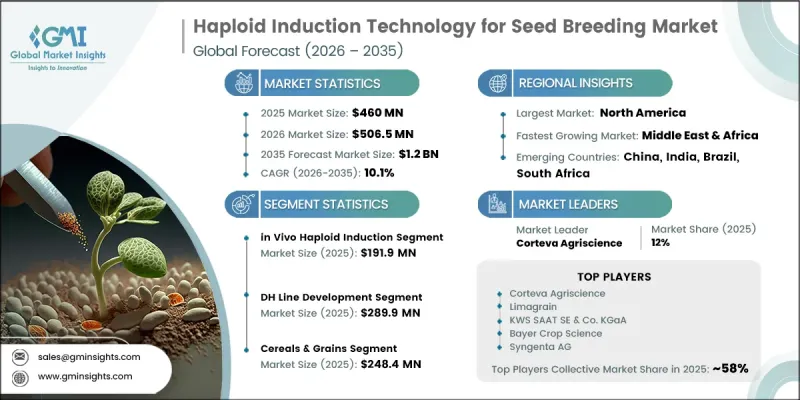
종자 육종을 위한 반수체 유도 기술 시장은 종자 개발자들이 작물 개량을 가속화하고 유전적 정확도를 높이기 위해 첨단 육종 기법을 점점 더 많이 채택함에 따라 급속히 발전하고 있습니다. CRISPR/Cas9 유전자 편집 기술과 배가 반수체(DH) 플랫폼의 결합은 정밀하게 개량된 자가수분 계통의 개발을 가속화함으로써 중요한 성장 기회로 부상하고 있습니다. 이러한 통합 기술은 기존 육종 기간을 단축하는 데 기여할 뿐만 아니라, 대규모 형질 개발을 위한 새로운 기회를 창출하고 있습니다. 또한, 종자 기업들이 DH 계통 생성을 전문 서비스 제공업체에 외주화하는 경향을 보이고 있는 점도 시장에 긍정적인 영향을 미치고 있습니다. 이를 통해 기업들은 인프라 투자를 줄이고 업무 효율을 높일 수 있게 됩니다. 하플로이드 유도법의 채택은 기존 용도를 넘어 확대되고 있으며, 더 광범위한 작물에서 관심이 높아지고 있습니다. 육종 프로토콜의 발전은 다양한 작물 카테고리와 지역에서 새로운 기회를 개척하며, 보다 광범위한 상업적 채택을 뒷받침하고 있습니다. 이러한 기술의 확산으로 인해, 하플로이드 유도 시스템은 현대 종자 개발 및 정밀 농업 분야에서 귀중한 도구로서의 역할을 강화하고 있습니다.
| 시장 범위 | |
|---|---|
| 시작 연도 | 2025년 |
| 예측 기간 | 2026-2035년 |
| 초기 시장 규모 | 4억 6,000만 달러 |
| 예측액 | 12억 달러 |
| CAGR | 10.1% |
생체 내 반수체 유도 부문의 시장 규모는 2025년에 1억 9,190만 달러로 평가되며, 2026년부터 2035년까지 연평균 성장률(CAGR) 8.6%로 성장할 것으로 예측됩니다. 이 부문은 상업적 육종 프로그램에서 활발히 채택되고 있어, 종자 육종 시장 내 반수체 유도 기술 분야에서 주도적인 위치를 유지하고 있습니다. 이 기법은 확립된 절차, 풍부한 업계 경험, 그리고 종자 연구개발 업무에 대한 효율적인 통합이라는 장점을 가지고 있습니다. 그 확장성과 비용 측면에서의 우위는 특히 개량 작물 품종의 신속한 개발을 추구하는 상업용 종자 생산자들 사이에서 안정적인 수요를 지속적으로 뒷받침하고 있습니다.
DH 계통 개발 부문은 2025년에 2억 8,990만 달러를 차지했으며, 2026년부터 2035년까지 연평균 성장률(CAGR) 8.8%로 성장할 것으로 전망됩니다. 이 응용 분야는 상업 및 연구 기반 육종 프로그램 전반에 걸쳐 반수체 유도 기술의 핵심적인 활용 사례입니다. DH 계통 개발을 통해 다양한 유전 자원으로부터 균일성이 높은 자가수분 계통을 생성할 수 있을 뿐만 아니라, 기존의 육종 기법에 비해 필요한 시간과 자원을 절감할 수 있습니다. 이 기술은 여러 작물에 걸친 하이브리드 종자 개발 프로그램을 뒷받침하고 있으며, 육종 효율 향상과 유전적 진보 가속화가 가능하다는 점에서 그 중요성이 지속적으로 높아지고 있습니다.
북미의 종자 육종을 위한 반수체 유도 기술 시장은 2025년에 1억 5,200만 달러 규모에 달했습니다. 북미는 선진적인 농업 연구 생태계, 강력한 상업용 종자 부문, 그리고 이배반수체법의 광범위한 채택을 바탕으로 전 세계 종자 육종을 위한 반수체 유도 기술 산업에서 선도적인 지역으로 자리매김하고 있습니다. 이 지역은 작물 유전학, 생명공학 연구 및 첨단 육종 인프라에 대한 막대한 투자의 혜택을 받고 있습니다. 미국에서 사업을 영위하는 주요 종자 기업들은 DH 기술을 육종 파이프라인에 지속적으로 통합하고 있으며, 이는 상업적 적용의 확대를 촉진하여 지역 시장의 성장을 강화하고 있습니다.
세계 종자 육종을 위한 반수체 유도 기술 시장에서 사업을 전개하는 주요 기업으로는 Syngenta AG, Corteva Agriscience, Bayer Crop Science, BASF SE (Nunhems), Limagrain, KWS SAAT SE & Co. KGaA, Sakata Seed Corporation, Rijk Zwaan, Fytagoras, ScreenSYS, Haplotech Inc., CIMMYT, Iowa State University DH Facility, University of Hohenheim DH Program, and Procera (Romania) 등이 있습니다. 다중 교배 육종 기술 시장에서 사업을 전개하는 각 기업은 공동 연구, 기술 개발 및 첨단 육종 역량의 확충을 통해 시장 내 입지를 강화하고 있습니다. 업계 관계자들은 혁신적인 육종 플랫폼에 대한 투자, DH 생산 효율 향상 및 유전자 편집 기술의 통합에 주력하며 작물 개발 프로세스를 강화하고 있습니다. 또한 각 기업은 연구 기관과 제휴를 맺고, 종자 개발자들의 도입 확대를 지원하기 위해 서비스 제공 범위를 넓히고 있습니다. 자동화, 첨단 유전학적 도구 및 전문적인 육종 서비스에 대한 투자를 확대함으로써 기업들은 확장성을 높이고 개발 기간 단축을 도모하고 있습니다.
자주 묻는 질문
목차
제1장 조사 방법과 범위
제2장 주요 요약
제3장 업계 인사이트
제4장 경쟁 구도
제5장 시장 추정 및 예측 : 기술 유형별, 2022-2035년
제6장 시장 추정 및 예측 : 용도별, 2022-2035년
제7장 시장 추정 및 예측 : 작물 유형별, 2022-2035년
제8장 시장 추정 및 예측 : 최종사용자별, 2022-2035년
제9장 시장 추정 및 예측 : 지역별, 2022-2035년
제10장 기업 개요
KSM 26.08.05The Global Haploid Induction Technology for Seed Breeding Market was valued at USD 460 million in 2025 and is estimated to grow at a CAGR of 10.1% to reach USD 1.2 billion by 2035.
The haploid induction technology for seed breeding market is advancing rapidly as seed developers increasingly adopt advanced breeding approaches to accelerate crop improvement and enhance genetic precision. The combination of CRISPR/Cas9 gene editing with doubled haploid (DH) platforms is emerging as a significant growth opportunity by enabling faster development of precisely improved inbred lines. These integrated technologies are helping reduce traditional breeding timelines while creating new opportunities for large-scale trait development. The market is also benefiting from the growing preference among seed companies to outsource DH line generation to specialized service providers, allowing them to reduce infrastructure investments and improve operational efficiency. Adoption of haploid induction methods is expanding beyond traditional applications, with increasing interest across a wider range of crops. Advances in breeding protocols are helping unlock new opportunities across different crop categories and regions, supporting broader commercial adoption. The expansion of these technologies is strengthening the role of haploid induction systems as a valuable tool for modern seed development and precision agriculture.
| Market Scope | |
|---|---|
| Start Year | 2025 |
| Forecast Year | 2026-2035 |
| Start Value | $460 Million |
| Forecast Value | $1.2 Billion |
| CAGR | 10.1% |
The in vivo haploid induction segment was valued at USD 191.9 million in 2025 and is projected to grow at a CAGR of 8.6% between 2026 and 2035. This segment maintains a leading position in the haploid induction technology for seed breeding market due to its strong adoption in commercial breeding programs. The approach benefits from established procedures, extensive industry experience, and efficient integration into seed research and development operations. Its scalability and cost advantages continue to support consistent demand, particularly among commercial seed producers seeking faster development of improved crop varieties.
The DH line development segment accounted for USD 289.9 million in 2025 and is expected to grow at a CAGR of 8.8% from 2026 to 2035. This application area represents the core use case of haploid induction technology across commercial and research-based breeding programs. DH line development enables the generation of highly uniform inbred lines from diverse genetic material while reducing the time and resources required compared with conventional breeding approaches. The technology supports hybrid seed development programs across multiple crops and continues to gain importance due to its ability to improve breeding efficiency and accelerate genetic advancement.
North America Haploid Induction Technology for Seed Breeding Market was valued at USD 152 million in 2025. North America represents a leading region in the global haploid induction technology for seed breeding industry due to its advanced agricultural research ecosystem, strong commercial seed sector, and extensive adoption of doubled haploid methods. The region benefits from significant investments in crop genetics, biotechnology research, and advanced breeding infrastructure. Major seed companies operating in the United States continue to integrate DH technologies into their breeding pipelines, supporting the expansion of commercial applications and strengthening regional market growth.
The major companies operating in the global haploid induction technology for seed breeding market include Syngenta AG, Corteva Agriscience, Bayer Crop Science, BASF SE (Nunhems), Limagrain, KWS SAAT SE & Co. KGaA, Sakata Seed Corporation, Rijk Zwaan, Fytagoras, ScreenSYS, Haplotech Inc., CIMMYT, Iowa State University DH Facility, University of Hohenheim DH Program, and Procera (Romania). Companies operating in the haploid induction technology for seed breeding market are strengthening their market position through research collaborations, technology development, and expansion of advanced breeding capabilities. Industry participants are investing in innovative breeding platforms, improving DH production efficiency, and integrating gene-editing technologies to enhance crop development processes. Companies are also forming partnerships with research institutions and expanding service offerings to support wider adoption among seed developers. Increasing investments in automation, advanced genetic tools, and specialized breeding services are helping businesses improve scalability and reduce development timelines.
Table of Contents
Chapter 1 Methodology & Scope
- 1.1 Market scope and definition
- 1.2 Research design
- 1.2.1 Research approach
- 1.2.2 Data collection methods
- 1.3 Data mining sources
- 1.3.1 Global
- 1.3.2 Regional/Country
- 1.4 Base estimates and calculations
- 1.4.1 Base year calculation
- 1.4.2 Key trends for market estimation
- 1.5 Primary research and validation
- 1.5.1 Primary sources
- 1.6 Forecast model
- 1.7 Research assumptions and limitations
Chapter 2 Executive Summary
- 2.1 Industry 360° synopsis
- 2.2 Key market trends
- 2.2.1 Technology
- 2.2.2 Application
- 2.2.3 Crop Type
- 2.2.4 End User
- 2.2.5 Regional
- 2.3 TAM Analysis, 2026-2035
- 2.4 CXO perspectives: Strategic imperatives
- 2.5 Future outlook and strategic recommendations
Chapter 3 Industry Insights
- 3.1 Industry ecosystem analysis
- 3.1.1 Supplier landscape
- 3.1.2 Profit margin
- 3.1.3 Value addition at each stage
- 3.1.4 Factor affecting the value chain
- 3.1.5 Disruptions
- 3.2 Industry impact forces
- 3.2.1 Growth drivers
- 3.2.2 Industry pitfalls and challenges
- 3.2.3 Market opportunities
- 3.3 Growth potential analysis
- 3.4 Regulatory landscape
- 3.4.1 North America
- 3.4.2 Europe
- 3.4.3 Asia Pacific
- 3.4.4 Latin America
- 3.4.5 Middle East & Africa
- 3.5 Porter's analysis
- 3.6 PESTEL analysis
- 3.7 Technology and innovation landscape
- 3.7.1 Current technological trends
- 3.7.2 Emerging technologies
- 3.8 Price trends
- 3.8.1 By region
- 3.8.2 By technology
- 3.9 Future market trends
- 3.10 Patent landscape
- 3.11 Trade statistics (HS code)
- 3.11.1 Major importing countries
- 3.11.2 Major exporting countries
- 3.12 Sustainability and environmental aspects
- 3.12.1 Sustainable practices
- 3.12.2 Waste reduction strategies
- 3.12.3 Energy efficiency in production
- 3.12.4 Eco-friendly initiatives
Chapter 4 Competitive Landscape, 2025
- 4.1 Introduction
- 4.2 Company market share analysis
- 4.2.1 By region
- 4.2.1.1 North America
- 4.2.1.2 Europe
- 4.2.1.3 Asia Pacific
- 4.2.1.4 LATAM
- 4.2.1.5 MEA
- 4.2.1 By region
- 4.3 Company matrix analysis
- 4.4 Competitive analysis of major market players
- 4.5 Competitive positioning matrix
- 4.6 Key developments
- 4.6.1 Mergers & acquisitions
- 4.6.2 Partnerships & collaborations
- 4.6.3 New product launches
- 4.6.4 Expansion plans
Chapter 5 Market Estimates and Forecast, By Technology Type, 2022-2035 (USD Million) (Kilo Tons)
- 5.1 Key trends
- 5.2 In Vivo Haploid Induction
- 5.3 In Vitro Haploid Induction
- 5.4 Gene Editing-Enabled HI (HI-Edit/IMGE)
- 5.5 Haploid Screening & ID Tools
- 5.6 Chromosome Doubling Agents
Chapter 6 Market Estimates and Forecast, By Application, 2022-2035 (USD Million) (Kilo Tons)
- 6.1 Key trends
- 6.2 DH Line Development
- 6.3 HI-Edit / IMGE
- 6.4 CMS Line Development
- 6.5 Reverse Breeding
- 6.6 Synthetic Apomixis
- 6.7 Research & Functional Genomics
Chapter 7 Market Estimates and Forecast, By Crop Type, 2022-2035 (USD Million) (Kilo Tons)
- 7.1 Key trends
- 7.2 Cereals & Grains
- 7.3 Oilseeds & Pulses
- 7.4 Vegetables & Specialty Crops
- 7.5 Others
Chapter 8 Market Estimates and Forecast, By End User, 2022-2035 (USD Million) (Kilo Tons)
- 8.1 Key trends
- 8.2 Commercial Seed Companies
- 8.3 Public Research Institutions
- 8.4 Government Agricultural Programs
- 8.5 DH Contract Service Providers
Chapter 9 Market Estimates and Forecast, By Region, 2022-2035 (USD Million) (Kilo Tons)
- 9.1 Key trends
- 9.2 North America
- 9.2.1 U.S.
- 9.2.2 Canada
- 9.3 Europe
- 9.3.1 Germany
- 9.3.2 UK
- 9.3.3 France
- 9.3.4 Spain
- 9.3.5 Italy
- 9.3.6 Rest of Europe
- 9.4 Asia Pacific
- 9.4.1 China
- 9.4.2 India
- 9.4.3 Japan
- 9.4.4 Australia
- 9.4.5 South Korea
- 9.4.6 Rest of Asia Pacific
- 9.5 Latin America
- 9.5.1 Brazil
- 9.5.2 Mexico
- 9.5.3 Argentina
- 9.5.4 Rest of Latin America
- 9.6 Middle East and Africa
- 9.6.1 Saudi Arabia
- 9.6.2 South Africa
- 9.6.3 UAE
- 9.6.4 Rest of Middle East and Africa
Chapter 10 Company Profiles
- 10.1 Corteva Agriscience
- 10.2 Syngenta AG
- 10.3 Bayer Crop Science
- 10.4 BASF SE (Nunhems)
- 10.5 Limagrain
- 10.6 KWS SAAT SE & Co. KGaA
- 10.7 Sakata Seed Corporation
- 10.8 Rijk Zwaan
- 10.9 Fytagoras
- 10.10 ScreenSYS
- 10.11 Haplotech Inc.
- 10.12 CIMMYT
- 10.13 Iowa State University DH Facility
- 10.14 University of Hohenheim DH Program
- 10.15 Procera (Romania)


