|
시장보고서
상품코드
2101640
자동차용 접이식 스티어링 칼럼 시장 기회, 성장요인, 업계 동향 분석 및 예측(2026-2035년)Automotive Collapsible Steering Column Market Opportunity, Growth Drivers, Industry Trend Analysis, and Forecast 2026 - 2035 |
||||||

세계의 자동차용 접이식 스티어링 칼럼 시장은 2025년에 38억 달러 규모에 달하며, CAGR 6.5%로 성장하며, 2035년까지 71억 달러에 달할 것으로 예측됩니다.
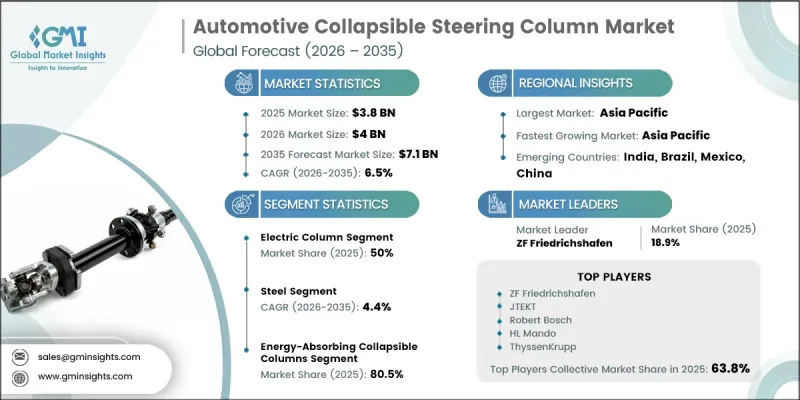
자동차용 접이식 스티어링 컬럼 시장의 성장은 차량의 전기화가 급속히 진행되고, ADAS(첨단 운전자 보조 시스템)의 보급이 확대되며, 첨단 자율주행 기술이 지속적으로 개발됨에 따라 견인되고 있습니다. 현대 차량에 더욱 정교한 자동화 기술이 탑재됨에 따라 각 제조사들은 엄격한 안전 기준을 유지하면서 기능성을 향상시킨 첨단 스티어링 컬럼 시스템을 도입하고 있습니다. 동시에, 업계에서는 유압식 파워 스티어링에서 전동식 파워 스티어링 시스템으로의 대대적인 전환이 진행되고 있으며, 전자 부품이 통합되고 기능이 강화된 보다 정교한 스티어링 컬럼 어셈블리에 대한 수요가 발생하고 있습니다. 이러한 첨단 시스템은 에너지 흡수형 안전 장치와 전자식 위치 결정 기능, 개선된 제어 시스템, 그리고 커넥티드 카 아키텍처와의 높은 호환성을 겸비하고 있습니다. 센서, 전자제어 장치(ECU), 그리고 지능형 스티어링 기술의 통합이 진행됨에 따라 스티어링 컬럼 어셈블리의 종합적인 가치는 높아지는 한편, 차량의 안전성과 운전 편의성 향상도 지원되고 있습니다. 자동차 안전 기술의 지속적인 혁신과 전기자동차 및 지능형 차량의 생산 증가가 맞물리면서, 전 세계 자동차용 접이식 스티어링 칼럼 시장은 장기적인 성장이 지속될 것으로 예상됩니다.
| 시장 범위 | |
|---|---|
| 시작연도 | 2025년 |
| 예측 기간 | 2026-2035년 |
| 초기 시장 규모 | 38억 달러 |
| 예측액 | 71억 달러 |
| CAGR | 6.5% |
전동 스티어링 컬럼 부문은 2025년에 50%의 점유율을 차지하며, 2026-2035년에 연평균 성장률(CAGR) 9.9%로 성장할 것으로 전망됩니다. 이 부문은 전동 파워 스티어링 시스템의 채택 확대와 전자제어식 차량 기술에 대한 수요 증가로 인해 시장내 입지를 더욱 공고히 하고 있습니다. 기존 스티어링 시스템과 비교하여, 전동 스티어링 컬럼은 기능성 향상, 최신 차량 전자 장비와의 통합성 향상, 그리고 운전자의 편의성 향상을 실현하고 있으며, 차세대 승용차에서 선호되는 솔루션이 되고 있습니다.
강재 부문은 2025년에 72.4%의 점유율을 차지하고 있으며, 2026-2035년 연평균 성장률(CAGR) 4.4%를 기록할 것으로 예상됩니다. 강재는 뛰어난 구조적 강도, 높은 내구성, 신뢰할 수 있는 내피로성, 그리고 일관된 충돌 에너지 관리를 실현하므로 계속해서 시장을 주도하고 있습니다. 고장력 강재의 지속적인 발전으로 제조사들은 차량의 안전성을 향상시키는 동시에, 점점 더 엄격해지는 자동차 성능 요건 및 경량화 요건을 충족할 수 있게 되었으며, 이는 스티어링 컬럼 제조 분야에서 강재의 주도적 지위를 더욱 공고히 하고 있습니다.
중국의 자동차용 붕괴형 스티어링 칼럼 시장은 2025년에 55%의 점유율을 차지하며 9억 7,780만 달러의 시장 규모를 기록했습니다. 중국은 막대한 자동차 생산 대수, 자동차 기술에 대한 지속적인 투자, 그리고 전기자동차(EV) 제조의 급속한 확대에 힘입어 여전히 이 지역 최대 자동차 제조 거점으로 자리 잡고 있습니다. 강력한 산업 기반, 확립된 공급망 생태계, 그리고 첨단 스티어링 기술에 대한 수요 증가가 지역 시장에서 중국의 주도적 지위를 더욱 공고히 하고 있습니다.
자주 묻는 질문
목차
제1장 조사 방법
제2장 개요
제3장 업계 인사이트
제4장 경쟁 구도
제5장 시장 추산·예측 : 칼럼 유형별, 2022-2035년
제6장 시장 추산·예측 : 소재별, 2022-2035년
제7장 시장 추산·예측 : 메커니즘별, 2022-2035년
제8장 시장 추산·예측 : 차량별, 2022-2035년
제9장 시장 추산·예측 : 유통 채널별, 2022-2035년
제10장 시장 추산·예측 : 지역별, 2022-2035년
제11장 기업 개요
KSA 26.07.31The Global Automotive Collapsible Steering Column Market was valued at USD 3.8 billion in 2025 and is estimated to grow at a CAGR of 6.5% to reach USD 7.1 billion by 2035.
Growth in the automotive collapsible steering column market is driven by the rapid advancement of vehicle electrification, the expanding adoption of advanced driver assistance systems (ADAS), and the ongoing development of highly automated driving technologies. As modern vehicles incorporate greater levels of automation, manufacturers are introducing advanced steering column systems that provide improved functionality while maintaining stringent safety standards. At the same time, the industry is experiencing a major transition from hydraulic power steering to electric power steering systems, creating demand for more sophisticated steering column assemblies equipped with integrated electronic components and enhanced functionality. These advanced systems combine energy-absorbing safety mechanisms with electronic positioning capabilities, improved control systems, and greater compatibility with connected vehicle architectures. The growing integration of sensors, electronic control units, and intelligent steering technologies is increasing the overall value of steering column assemblies while supporting enhanced vehicle safety and driving comfort. Continuous innovation in automotive safety technologies, combined with rising production of electric and intelligent vehicles, is expected to sustain long-term growth across the global automotive collapsible steering column market.
| Market Scope | |
|---|---|
| Start Year | 2025 |
| Forecast Year | 2026-2035 |
| Start Value | $3.8 Billion |
| Forecast Value | $7.1 Billion |
| CAGR | 6.5% |
The electric column segment accounted for 50% share in 2025 and is projected to grow at a CAGR of 9.9% during 2026-2035. The segment continues to strengthen its market position due to the increasing adoption of electric power steering systems and the growing demand for electronically controlled vehicle technologies. Compared with conventional steering systems, electric steering columns provide enhanced functionality, greater integration with modern vehicle electronics, and improved driver convenience, making them the preferred solution for next-generation passenger vehicles.
The steel segment held 72.4% in 2025 and is expected to register a CAGR of 4.4% between 2026 and 2035. Steel continues to dominate the market because it provides excellent structural strength, high durability, reliable fatigue resistance, and consistent crash energy management. Ongoing advancements in high-strength steel materials are enabling manufacturers to improve vehicle safety while meeting increasingly stringent automotive performance and lightweighting requirements, reinforcing steel's leading position in steering column manufacturing.
China Automotive Collapsible Steering Column Market accounted for 55% share, generating USD 977.8 million in 2025. The country remains the largest automotive manufacturing hub within the region, supported by substantial vehicle production, continued investments in automotive technology, and the rapid expansion of electric vehicle manufacturing. Strong industrial capabilities, a well-established supplier ecosystem, and increasing demand for advanced steering technologies continue to reinforce China's leadership within the regional market.
Major companies operating in the global automotive collapsible steering column market include Nexteer Automotive, JTEKT, ZF Friedrichshafen, Robert Bosch, thyssenkrupp Steering, NSK, HL Mando, China Automotive Systems Inc. (CAAS) / Henglong, Zhejiang Shibao, and Astemo. Companies operating in the automotive collapsible steering column market are strengthening their market position by investing in advanced steering technologies that improve vehicle safety, electronic integration, and overall system performance. Manufacturers are expanding research and development activities to support electric steering systems, intelligent steering functions, and compatibility with automated driving technologies. Strategic collaborations with automotive manufacturers, technology providers, and component suppliers are helping companies accelerate innovation and broaden their global presence. Businesses are also increasing production capacity, improving manufacturing efficiency, and adopting lightweight materials to enhance product competitiveness.
Table of Contents
Chapter 1 Research Methodology
- 1.1 Research approach
- 1.2 Quality Commitments
- 1.2.1 GMI AI policy & data integrity commitment
- 1.2.1.1 Source consistency protocol
- 1.2.1 GMI AI policy & data integrity commitment
- 1.3 Research Trail & Confidence Scoring
- 1.3.1 Research Trail Components
- 1.3.2 Scoring Components
- 1.4 Data Collection
- 1.4.1 Partial list of primary sources
- 1.5 Data mining sources
- 1.5.1 Paid sources
- 1.5.1.1 Sources, by region
- 1.5.1 Paid sources
- 1.6 Base estimates and calculations
- 1.6.1 Base year calculation for any one approach
- 1.7 Forecast model
- 1.7.1 Quantified market impact analysis
- 1.7.1.1 Mathematical impact of growth parameters on forecast
- 1.7.1 Quantified market impact analysis
- 1.8 Research transparency addendum
- 1.8.1 Source attribution framework
- 1.8.2 Quality assurance metrics
- 1.8.3 Our commitment to trust
Chapter 2 Executive Summary
- 2.1 Industry 360° synopsis, 2022 - 2035
- 2.2 Key market trends
- 2.2.1 Regional
- 2.2.2 Column Type
- 2.2.3 Material
- 2.2.4 Mechanism
- 2.2.5 Vehicle
- 2.2.6 Distribution Channel
- 2.3 TAM Analysis, 2026-2035
- 2.4 CXO perspectives: Strategic imperatives
Chapter 3 Industry Insights
- 3.1 Industry ecosystem analysis
- 3.1.1 Supplier landscape
- 3.1.2 Profit margin analysis
- 3.1.3 Cost structure
- 3.1.4 Value addition at each stage
- 3.1.5 Factor affecting the value chain
- 3.1.6 Disruptions
- 3.2 Industry impact forces
- 3.2.1 Growth drivers
- 3.2.1.1 Stringent Global Frontal-Impact Safety Mandates Driving Universal Column Adoption
- 3.2.1.2 Rapid Vehicle Electrification & Growth of Electric Power Steering (EPS) Creating Demand for Electric Collapsible Columns
- 3.2.1.3 Rising ADAS & Autonomous Driving Development Requiring Advanced Retractable/Stowable Column Architectures
- 3.2.1.4 Increasing Global Vehicle Production Volume Expanding Total Addressable Market
- 3.2.2 Industry pitfalls and challenges
- 3.2.2.1 High Material & Manufacturing Costs of Energy-Absorbing Designs Constraining Adoption in Price-Sensitive Markets
- 3.2.2.2 Complex Integration of Collapsible Columns with Steer-by-Wire & Autonomous Vehicle Platforms
- 3.2.3 Market opportunities
- 3.2.3.1 Steer-by-Wire Transition Opening New Architecture for Smart Retractable Column Systems in Level 3-5 Autonomous Vehicles
- 3.2.3.2 Emerging EV Platform Rollouts in Asia Pacific & Latin America Requiring New Lightweight Column Designs
- 3.2.3.3 Aftermarket Replacement Demand in Aging Vehicle Fleets - Especially Commercial Vehicle Segments in MEA & LATAM
- 3.2.3.4 Shared Mobility & Robotaxi Fleets Driving Demand for Quick-Swap, High-Cycle Modular Column Architectures
- 3.2.1 Growth drivers
- 3.3 Growth potential analysis
- 3.4 Technology and innovation landscape
- 3.4.1 Current technological trends
- 3.4.2 Emerging technologies
- 3.5 Pricing Analysis (Driven by primary research)
- 3.5.1 Historical Price Trend Analysis
- 3.5.2 Pricing Strategy by Player Type
- 3.6 Regulatory landscape
- 3.6.1 North America
- 3.6.1.1 Federal Motor Vehicle Safety Standards (FMVSS)
- 3.6.1.2 National Highway Traffic Safety Administration (NHTSA) Regulations
- 3.6.1.3 Canadian Motor Vehicle Safety Standards (CMVSS)
- 3.6.1.4 Insurance Institute for Highway Safety (IIHS) Protocols
- 3.6.2 Europe
- 3.6.2.1 UNECE Regulations (UN R12, UN R94, UN R95)
- 3.6.2.2 EU General Safety Regulation (EU 2019/2144)
- 3.6.2.3 Euro NCAP Protocols
- 3.6.3 Asia Pacific
- 3.6.3.1 China GB Automotive Safety Standards
- 3.6.3.2 India Automotive Industry Standards (AIS)
- 3.6.3.3 Japan MLIT / JASIC Safety Standards
- 3.6.3.4 ASEAN NCAP Protocols
- 3.6.4 Latin America
- 3.6.4.1 Brazil CONTRAN Regulations
- 3.6.4.2 Latin NCAP Protocols
- 3.6.4.3 Argentina IRAM Standards
- 3.6.5 Middle East & Africa
- 3.6.5.1 GCC Technical Regulations
- 3.6.5.2 Saudi SASO Regulations
- 3.6.5.3 South Africa NRCS Standards
- 3.6.1 North America
- 3.7 Porter's analysis
- 3.8 PESTEL analysis
- 3.9 Patent analysis (Driven by primary research)
- 3.10 Cost breakdown analysis
- 3.11 Capacity & production landscape (Driven by Primary Research)
- 3.11.1 Installed capacity by region & key producer
- 3.11.2 Capacity utilization rates & expansion pipelines
- 3.12 Trade data analysis (Driven by Paid Research)
- 3.12.1 Import/export volume & value trends
- 3.12.2 Key trade corridors & tariff impact
- 3.13 Impact of AI and Generative AI on the Market
- 3.13.1 AI Driven Disruption of Existing Business Models
- 3.13.2 GenAI Use Cases and Adoption Roadmap by Segment
- 3.13.3 Risks Limitations and Regulatory Considerations
- 3.14 Sustainability and environmental aspects
- 3.14.1 Sustainable practices
- 3.14.2 Waste reduction strategies
- 3.14.3 Energy efficiency in production
- 3.14.4 Eco-friendly Initiatives
- 3.14.5 Carbon footprint considerations
- 3.15 Forecast assumptions & scenario analysis (Driven by Primary Research)
- 3.15.1 Base Case- Key Macro & Industry Variables Driving CAGR
- 3.15.2 Optimistic Scenarios- Favorable macro and industry tailwinds
- 3.15.3 Pessimistic Scenario - Macroeconomic slowdown or industry headwinds
Chapter 4 Competitive Landscape, 2025
- 4.1 Introduction
- 4.2 Company market share analysis
- 4.2.1 North America
- 4.2.2 Europe
- 4.2.3 Asia Pacific
- 4.2.4 LATAM
- 4.2.5 MEA
- 4.3 Competitive analysis of major market players
- 4.4 Competitive positioning matrix
- 4.5 Key developments
- 4.5.1 Mergers & acquisitions
- 4.5.2 Partnerships & collaborations
- 4.5.3 New Product Launches
- 4.5.4 Expansion Plans and funding
- 4.6 Company tier benchmarking
- 4.6.1 Tier classification criteria & qualifying thresholds
- 4.6.2 Tier positioning matrix by revenue, geography & innovation
Chapter 5 Market Estimates & Forecast, By Column Type, 2022 - 2035 (USD Bn, Units)
- 5.1 Key trends
- 5.2 Manual
- 5.3 Electric
- 5.4 Hydraulic
Chapter 6 Market Estimates & Forecast, By Material, 2022 - 2035 (USD Bn, Units)
- 6.1 Key trends
- 6.2 Steel
- 6.3 Aluminum
- 6.4 Composite Materials
- 6.5 Plastic & Hybrid Alloy
Chapter 7 Market Estimates & Forecast, By Mechanism, 2022 - 2035 (USD Bn, Units)
- 7.1 Key trends
- 7.2 Energy-Absorbing Collapsible Columns
- 7.3 Non-Energy-Absorbing Collapsible Columns
Chapter 8 Market Estimates & Forecast, By Vehicle, 2022 - 2035 (USD Bn, Units)
- 8.1 Key trends
- 8.2 Passenger Vehicles
- 8.2.1 Hatchback
- 8.2.2 Sedan
- 8.2.3 SUV
- 8.3 Commercial Vehicles
- 8.3.1 LCV (Light Commercial Vehicles)
- 8.3.2 MCV (Medium Commercial Vehicles)
- 8.3.3 HCV (Heavy Commercial Vehicles)
Chapter 9 Market Estimates & Forecast, By Distribution Channel, 2022 - 2035 (USD Bn, Units)
- 9.1 Key trends
- 9.2 OEM (Original Equipment Manufacturer)
- 9.3 Aftermarket
Chapter 10 Market Estimates & Forecast, By Region, 2022 - 2035 (USD Bn, Units)
- 10.1 Key trends
- 10.2 North America
- 10.2.1 US
- 10.2.2 Canada
- 10.3 Europe
- 10.3.1 Germany
- 10.3.2 UK
- 10.3.3 France
- 10.3.4 Italy
- 10.3.5 Spain
- 10.3.6 Russia
- 10.3.7 Norway
- 10.3.8 Netherlands
- 10.3.9 Sweden
- 10.4 Asia Pacific
- 10.4.1 China
- 10.4.2 India
- 10.4.3 Japan
- 10.4.4 Australia
- 10.4.5 South Korea
- 10.4.6 Singapore
- 10.4.7 Thailand
- 10.4.8 Indonesia
- 10.4.9 Vietnam
- 10.5 Latin America
- 10.5.1 Brazil
- 10.5.2 Mexico
- 10.5.3 Argentina
- 10.6 MEA
- 10.6.1 South Africa
- 10.6.2 Saudi Arabia
- 10.6.3 UAE
- 10.6.4 Turkey
Chapter 11 Company Profiles
- 11.1 Global Players
- 11.1.1 Nexteer Automotive
- 11.1.2 JTEKT
- 11.1.3 ZF Friedrichshafen
- 11.1.4 Robert Bosch / Bosch Automotive Steering
- 11.1.5 thyssenkrupp Steering
- 11.1.6 NSK
- 11.1.7 Schaeffler Technologies
- 11.1.8 Knorr-Bremse Steering Systems
- 11.1.9 Astemo (formerly Hitachi Astemo)
- 11.1.10 Hyundai Mobis
- 11.2 Regional Players
- 11.2.1 HL Mando
- 11.2.2 JTEKT Column Systems (formerly Fuji Kiko)
- 11.2.3 China Automotive Systems (CAAS) / Henglong
- 11.2.4 Zhejiang Shibao
- 11.2.5 Beijing Hainachuan Automotive Parts (BHAP)
- 11.2.6 Yamada Manufacturing
- 11.2.7 Rane Steering Systems
- 11.2.8 JTEKT India
- 11.2.9 Pailton Engineering
- 11.2.10 Coram