

|
시장보고서
상품코드
2101645
메톡시페노자이드 및 디아미드계 살충제 시장 기회, 성장요인, 업계 동향 분석 및 예측(2026-2035년)Methoxyfenozide and Diamide Insecticides Market Opportunity, Growth Drivers, Industry Trend Analysis, and Forecast 2026 - 2035 |
||||||

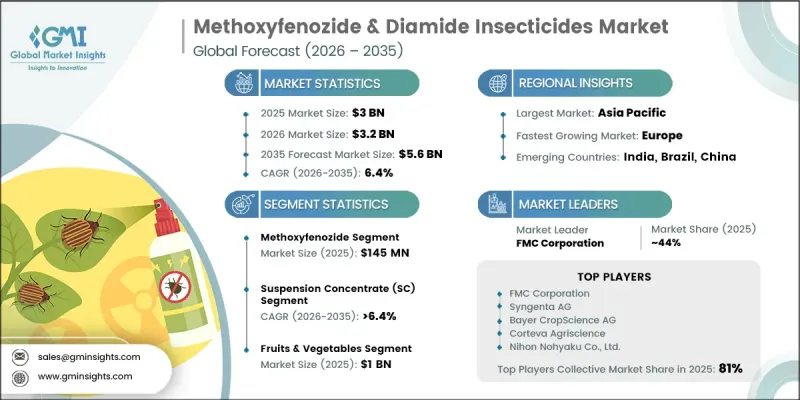
세계의 메톡시페노자이드 및 디아미드계 살충제 시장은 2025년에 30억 달러 규모에 달하며, CAGR 6.4%로 성장하며, 2035년까지 56억 달러에 달할 것으로 예측됩니다.
메톡시페노자이드 및 디아미드계 살충제 시장은 농업 생산자들이 생산성을 향상시키면서 진화하는 해충의 내성에 대처하기 위해 선택적 작물 보호 제품을 점점 더 많이 채택함에 따라 꾸준한 성장을 보이고 있습니다. 수요는 기존의 광범위 스펙트럼 살충제에서 표적 해충 방제를 실현하고 지속가능한 농업 관행을 지원하는 첨단 제제로 전환되고 있습니다. 주요 농업 경제권에서 통합 해충 관리(IPM) 프로그램의 도입이 확대됨에 따라 정례적인 살포 일정이 아닌 해충 개체 수 기준치에 기반한 선택적 화학 물질 사용이 촉진되고 있습니다. 규제 동향과 내성 관리 전략도 구매 결정에 영향을 미치고 있으며, 생산자들은 살충제 프로그램의 다양화와 서로 다른 작용 기전을 가진 제품의 도입을 추진하고 있습니다. 또한 특수 작물에 대한 제품 등록 범위 확대와 고부가가치 농업 생산에서의 사용 확대가 시장 수요를 지속적으로 지원하고 있습니다. 효과적인 내성 관리, 작물 보호 효율 향상, 그리고 지속가능한 농업 관행에 대한 중요성이 높아짐에 따라 예측 기간 중 전 세계 메톡시페노자이드 및 디아미드계 살충제 시장의 장기적인 성장 기회가 더욱 강화될 것으로 예상됩니다.
| 시장 범위 | |
|---|---|
| 시작연도 | 2025년 |
| 예측 기간 | 2026-2035년 |
| 초기 시장 규모 | 30억 달러 |
| 예측액 | 56억 달러 |
| CAGR | 6.4% |
메톡시페노자이드 부문은 2025년에 1억 4,500만 달러의 시장 규모를 기록하며 시장 점유율의 4.8%를 차지했습니다. 메톡시페노자이드는 선택적 살충제 솔루션 분야에서 여전히 중요한 제품 카테고리이지만, 일부 지역의 규제 체계 변화로 인해 시장 역학이 재편되고 신제품 승인이 제한되고 있습니다. 이러한 동향은 향후 성장 기회에 영향을 미치는 한편, 제조사들이 혁신과 제품 다각화를 통해 포트폴리오를 강화하도록 촉진하고 있습니다.
과일·채소 부문은 2025년에 10억 달러의 시장 규모를 기록하며 시장 점유율의 33%를 차지했습니다. 이 용도 부문은 원예 생산에 수반되는 높은 작물 보호 요건과 특산 작물의 높은 부가가치로 인해 계속해서 시장을 주도하고 있습니다. 생산자들이 작물의 품질 향상, 수확량 확보, 해충으로 인한 손실 최소화에 주력하고 있으므로 과일 및 채소 재배 전반에 걸쳐 첨단 살충제 제제에 대한 수요는 계속해서 견고합니다. 이러한 작물의 높은 경제적 가치는 선택적 살충제 기술의 지속적인 채택을 지원하고 있습니다.
북미의 메톡시페노자이드 및 디아미드계 살충제 시장은 2025년에 6억 4,520만 달러 규모를 기록하며, 2035년까지 연평균 성장률(CAGR) 6.7%로 성장할 것으로 전망됩니다. 이 지역이 시장을 주도하고 있는 배경에는 상업 농업과 특산 작물 생산 모두에서 견고한 수요가 있습니다. 제품 등록의 지속적인 확대, 현대적인 작물 보호 기법의 도입 확대, 그리고 농업 생산성에 대한 지속적인 투자가 장기적인 시장 성장을 지원하고 있습니다. 내성 관리 및 효율적인 해충 방제 전략에 대한 집중적인 노력은 이 지역의 시장 전망을 더욱 견고하게 만들고 있습니다.
자주 묻는 질문
목차
제1장 조사 방법과 범위
제2장 개요
제3장 업계 인사이트
제4장 경쟁 구도
제5장 시장 추산·예측 : 카테고리 유형별, 2022-2035년
제6장 시장 추산·예측 : 제제 유형별, 2022-2035년
제7장 시장 추산·예측 : 작물 유형별, 2022-2035년
제8장 시장 추산·예측 : 지역별, 2022-2035년
제9장 기업 개요
KSA 26.07.31The Global Methoxyfenozide & Diamide Insecticides Market was valued at USD 3 billion in 2025 and is estimated to grow at a CAGR of 6.4% to reach USD 5.6 billion by 2035.
The methoxyfenozide & diamide insecticides market is witnessing steady expansion as agricultural producers increasingly adopt selective crop protection products to address evolving pest resistance while improving productivity. Demand is shifting away from conventional broad-spectrum insecticides toward advanced formulations that offer targeted pest control and support sustainable farming practices. Growing implementation of integrated pest management programs across major agricultural economies is encouraging the use of selective chemistries based on pest population thresholds rather than routine spraying schedules. Regulatory developments and resistance management strategies are also influencing purchasing decisions, prompting growers to diversify insecticide programs and adopt products with different modes of action. In addition, broader product registrations across specialty crops and expanding usage in high-value agricultural production continue to strengthen market demand. Increasing emphasis on effective resistance management, improved crop protection efficiency, and sustainable agricultural practices is expected to reinforce long-term growth opportunities for the global methoxyfenozide & diamide insecticides market throughout the forecast period.
| Market Scope | |
|---|---|
| Start Year | 2025 |
| Forecast Year | 2026-2035 |
| Start Value | $3 Billion |
| Forecast Value | $5.6 Billion |
| CAGR | 6.4% |
The methoxyfenozide segment was valued at USD 145 million in 2025 and accounted for 4.8% share. Although methoxyfenozide remains an important product category within selective insecticide solutions, evolving regulatory frameworks in several regions are reshaping market dynamics and limiting new product approvals. These developments are influencing future growth opportunities while encouraging manufacturers to strengthen their portfolios through innovation and diversified product offerings.
The fruits and vegetables segment generated USD 1 billion in 2025, representing 33% share. This application segment continues to lead the market due to the high crop protection requirements associated with horticultural production and the premium value of specialty crops. Demand for advanced insecticide formulations remains strong across fruit and vegetable cultivation as growers focus on improving crop quality, protecting yields, and minimizing pest-related losses. The high economic value of these crops continues to support the sustained adoption of selective insecticide technologies.
North America Methoxyfenozide & Diamide Insecticides Market generated USD 645.2 million in 2025 and is projected to grow at a CAGR of 6.7% through 2035. The country's leadership reflects strong demand across both commercial agriculture and specialty crop production. Continued expansion of product registrations, increasing adoption of modern crop protection practices, and ongoing investments in agricultural productivity are supporting long-term market growth. The emphasis on resistance management and efficient pest control strategies further strengthens the outlook for the regional market.
Major companies operating in the global methoxyfenozide & diamide insecticides market include Syngenta AG, Bayer CropScience AG, FMC Corporation, Corteva Agriscience, UPL Limited, Adama Ltd., Nippon Soda Co., Ltd., ISK - Ishihara Sangyo Kaisha Ltd., Nihon Nohyaku Co., Ltd., Nufarm Limited, Kumiai Chemical Industry Co., Ltd., Jiangsu Yangnong Chemical Co., Ltd., Zhejiang Rayfull Chemicals Co., Ltd., Lier Chemical Co., Ltd., and Shandong Sino-Agri United Biotechnology. Companies operating in the methoxyfenozide & diamide insecticides market are strengthening their market presence by investing in product innovation, expanding regulatory approvals, and developing advanced insecticide formulations with improved efficacy and resistance management capabilities. Manufacturers are increasing research and development activities to introduce selective crop protection solutions that support sustainable farming practices and integrated pest management programs. Strategic collaborations with agricultural distributors, research institutions, and farming organizations are helping companies broaden product availability and improve customer outreach.
Table of Contents
Chapter 1 Methodology & Scope
- 1.1 Market scope and definition
- 1.2 Research design
- 1.2.1 Research approach
- 1.2.2 Data collection methods
- 1.3 Data mining sources
- 1.3.1 Global
- 1.3.2 Regional/Country
- 1.4 Base estimates and calculations
- 1.4.1 Base year calculation
- 1.4.2 Key trends for market estimation
- 1.5 Primary research and validation
- 1.5.1 Primary sources
- 1.6 Forecast model
- 1.7 Research assumptions and limitations
Chapter 2 Executive Summary
- 2.1 Industry 360° synopsis
- 2.2 Key market trends
- 2.2.1 Category type
- 2.2.2 Formulation type
- 2.2.3 Crop Type
- 2.2.4 Regional
- 2.3 TAM Analysis, 2026-2035
- 2.4 CXO perspectives: Strategic imperatives
- 2.5 Future outlook and strategic recommendations
Chapter 3 Industry Insights
- 3.1 Industry ecosystem analysis
- 3.1.1 Supplier landscape
- 3.1.2 Profit margin
- 3.1.3 Value addition at each stage
- 3.1.4 Factor affecting the value chain
- 3.1.5 Disruptions
- 3.2 Industry impact forces
- 3.2.1 Growth drivers
- 3.2.2 Industry pitfalls and challenges
- 3.2.3 Market opportunities
- 3.3 Growth potential analysis
- 3.4 Regulatory landscape
- 3.4.1 North America
- 3.4.2 Europe
- 3.4.3 Asia Pacific
- 3.4.4 Latin America
- 3.4.5 Middle East & Africa
- 3.5 Porter's analysis
- 3.6 PESTEL analysis
- 3.7 Technology and innovation landscape
- 3.7.1 Current technological trends
- 3.7.2 Emerging technologies
- 3.8 Price trends
- 3.8.1 By region
- 3.8.2 By category type
- 3.9 Future market trends
- 3.10 Patent landscape
- 3.11 Trade statistics (HS code)
- 3.11.1 Major importing countries
- 3.11.2 Major exporting countries
- 3.12 Sustainability and environmental aspects
- 3.12.1 Sustainable practices
- 3.12.2 Waste reduction strategies
- 3.12.3 Energy efficiency in production
- 3.12.4 Eco-friendly initiatives
Chapter 4 Competitive Landscape, 2025
- 4.1 Introduction
- 4.2 Company market share analysis
- 4.2.1 By region
- 4.2.1.1 North America
- 4.2.1.2 Europe
- 4.2.1.3 Asia Pacific
- 4.2.1.4 LATAM
- 4.2.1.5 MEA
- 4.2.1 By region
- 4.3 Company matrix analysis
- 4.4 Competitive analysis of major market players
- 4.5 Competitive positioning matrix
- 4.6 Key developments
- 4.6.1 Mergers & acquisitions
- 4.6.2 Partnerships & collaborations
- 4.6.3 New product launches
- 4.6.4 Expansion plans
Chapter 5 Market Estimates and Forecast, By Category Type, 2022-2035 (USD Million) (Kilo Tons)
- 5.1 Key trends
- 5.2 Methoxyfenozide
- 5.3 Diamide Insecticides
- 5.3.1 Chlorantraniliprole
- 5.3.2 Cyantraniliprole
- 5.3.3 Flubendiamide
- 5.3.4 Other Diamides
Chapter 6 Market Estimates and Forecast, By Formulation Type, 2022-2035 (USD Million) (Kilo Tons)
- 6.1 Key trends
- 6.2 Suspension Concentrate (SC)
- 6.3 Wettable Powder / WDG
- 6.4 Emulsifiable Concentrate (EC)
- 6.5 Granules
- 6.6 Seed Treatment Formulations
- 6.7 Combination/Premix Products
- 6.8 Others
Chapter 7 Market Estimates and Forecast, By Crop Type, 2022-2035 (USD Million) (Kilo Tons)
- 7.1 Key trends
- 7.2 Fruits & Vegetables
- 7.3 Cereals & Grains
- 7.4 Oilseeds & Pulses
- 7.5 Field Crops (Fiber & Row)
- 7.6 Turf & Ornamentals
- 7.7 Others
Chapter 8 Market Estimates and Forecast, By Region, 2022-2035 (USD Million) (Kilo Tons)
- 8.1 Key trends
- 8.2 North America
- 8.2.1 U.S.
- 8.2.2 Canada
- 8.3 Europe
- 8.3.1 Germany
- 8.3.2 UK
- 8.3.3 France
- 8.3.4 Spain
- 8.3.5 Italy
- 8.3.6 Rest of Europe
- 8.4 Asia Pacific
- 8.4.1 China
- 8.4.2 India
- 8.4.3 Japan
- 8.4.4 Australia
- 8.4.5 South Korea
- 8.4.6 Rest of Asia Pacific
- 8.5 Latin America
- 8.5.1 Brazil
- 8.5.2 Mexico
- 8.5.3 Argentina
- 8.5.4 Rest of Latin America
- 8.6 Middle East and Africa
- 8.6.1 Saudi Arabia
- 8.6.2 South Africa
- 8.6.3 UAE
- 8.6.4 Rest of Middle East and Africa
Chapter 9 Company Profiles
- 9.1 Corteva Agriscience
- 9.2 Nippon Soda Co., Ltd.
- 9.3 Syngenta AG
- 9.4 Bayer CropScience AG
- 9.5 FMC Corporation
- 9.6 UPL Limited
- 9.7 ISK - Ishihara Sangyo Kaisha Ltd.
- 9.8 Nihon Nohyaku Co., Ltd.
- 9.9 Nufarm Limited
- 9.10 Adama Ltd.
- 9.11 Jiangsu Yangnong Chemical Co., Ltd.
- 9.12 Zhejiang Rayfull Chemicals Co., Ltd.
- 9.13 Kumiai Chemical Industry Co., Ltd.
- 9.14 Lier Chemical Co., Ltd.
- 9.15 Shandong Sino-Agri United Biotechnology

(주말 및 공휴일 제외)


