
|
시장보고서
상품코드
2101668
액체 및 주사제 충전 기계 시장 기회, 성장 촉진요인, 업계 동향 분석 및 예측(2026-2035년)Liquid and Injectable Filling Machinery Market Opportunity, Growth Drivers, Industry Trend Analysis, and Forecast 2026 - 2035 |
||||||

세계의 액체 및 주사제 충전 기계 시장은 2025년에 101억 달러 규모에 달하고, CAGR 6.7%로 성장하여 2035년까지 192억 달러에 달할 것으로 예측됩니다.
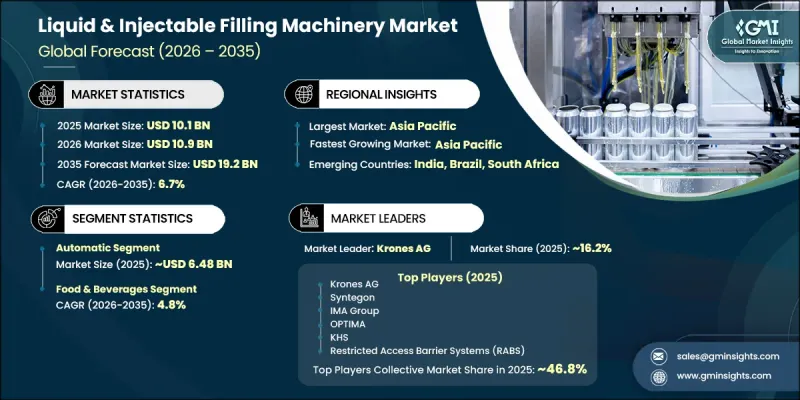
제약사, 식품·음료 기업, 화장품 제조사가 효율성, 정밀도 및 규정 준수를 향상시키기 위해 첨단 충전 솔루션을 점점 더 많이 도입함에 따라, 액체 및 주사제 충전 기계 시장은 꾸준한 성장을 이루고 있습니다. 이 시장은 무균 제약 제조 시설의 현대화와 여러 가공 산업에서의 자동화 도입 가속화라는 두 가지 주요 수요 동향에 의해 형성되고 있습니다. 주사제 치료에 대한 투자 확대와 무균 제조에 대한 규제 요건의 강화로 인해 제조업체들은 첨단 제어 시스템과 오염 방지 기술을 갖춘 충전 설비로 업그레이드를 추진하고 있습니다. 동시에 신흥 지역의 각 산업 분야에서도 생산성 향상과 일관된 품질 기준 유지를 목적으로 자동 충전 기계 도입이 점점 더 확대되고 있습니다. 제조업체들이 운영 위험 감소, 공정 신뢰성 향상, 생산능력 확대에 주력하는 가운데, 수동 및 반자동 시스템에서 고도로 자동화된 플랫폼으로의 전환은 업계의 중요한 전환점이 되고 있습니다. 이러한 동향은 유연하고 디지털로 통합된 고성능 충전 솔루션을 제공하는 장비 공급업체에게 장기적인 성장 기회를 창출하고 있습니다.
| 시장 범위 | |
|---|---|
| 시작 연도 | 2025년 |
| 예측 기간 | 2026-2035년 |
| 개시 금액 | 101억 달러 |
| 예측 금액 | 192억 달러 |
| CAGR | 6.7% |
제약사들이 무균성 확보와 업무 효율 향상을 목적으로 노동 집약적인 충전 공정을 자동화 시스템으로 순차적으로 대체함에 따라, 액체 및 주사제 충전 기계 시장은 큰 변혁의 한가운데에 있습니다. 이러한 변화는 선진적인 제조 관행에 대한 규제 당국의 기대감 고조, 주사제 수요 증가, 그리고 중요한 생산 환경에 대한 관리 강화의 필요성에 힘입어 가속화되고 있습니다. 각 제조사는 진화하는 생산 요건에 대응하기 위해 자동화된 운영, 모니터링 기능 향상, 그리고 공정 검증 강화를 지원할 수 있는 설비를 점점 더 우선시하고 있습니다.
자동 충전기 시장 규모는 2025년에 64억 8,000만 달러에 달했으며, 2026년부터 2035년까지 연평균 성장률(CAGR) 7.7%로 성장할 것으로 전망됩니다. 자동화 시스템에 대한 선호도가 높아지고 있는 배경에는 관리된 제조 공정, 디지털 문서화, 자동화된 품질 관리와 같은 제약 업계의 요구 사항 외에도 대량 생산 부문이 추구하는 효율성의 이점이 있습니다. 새로운 투자는 주로 액체 충전 용도에 대응하는 첨단 설비 구성, 생산 속도 향상 및 무균 처리 능력 강화에 중점을 두고 있습니다.
CMO/CDMO 부문은 2025년에 8억 5,100만 달러를 기록했으며, 2035년까지 연평균 성장률(CAGR) 8.3%로 성장할 것으로 전망됩니다. 위탁 제조·개발 기관(CMO/CDMO)은 공유된 제조 환경 내에서 여러 제품과 고객을 지원하기 위해 적응성이 높은 설비 솔루션이 필요합니다. 이러한 시설에서는 다양한 고객의 품질 요건을 충족하기 위해 고도의 세척 검증, 멸균 능력, 디지털 배치 관리 시스템 및 운영상의 유연성이 요구됩니다. 이러한 사양의 복잡성은 설비의 가치를 높여주며, 단일 제품 의약품 제조 시설에 비해 OEM 서비스 및 지원 제공 기회를 더욱 확대하고 있습니다.
북미의 액체 및 주사제 충전 기계 시장은 의약품 등급의 무균 충전 기술에 대한 견조한 수요에 힘입어 2025년에는 27%의 시장 점유율을 기록했습니다. 무균 의약품 제조에 관한 규제 요건은 계속해서 해당 지역 전체의 설비 투자에 영향을 미치고 있으며, 제약사들이 자동화, 데이터 관리 및 공정 제어 기능이 강화된 첨단 충전 시스템의 도입을 촉진하고 있습니다. 전자 기록, 데이터 무결성 및 제조 규정 준수와 관련된 요건은 미국 제약 업계 전반에 걸쳐 새로운 충전 기계 솔루션의 설계와 도입을 지속적으로 주도하고 있습니다.
자주 묻는 질문
목차
제1장 조사 방법과 범위
제2장 주요 요약
제3장 업계 인사이트
제4장 경쟁 구도
제5장 시장 추정 및 예측 : 기계 유형별, 2022-2035년
제6장 시장 추정 및 예측 : 충전 기술별, 2022-2035년
제7장 시장 추정 및 예측 : 용기 유형별, 2022-2035년
제8장 시장 추정 및 예측 : 충전 유형별, 2022-2035년
제9장 시장 추정 및 예측 : 최종 이용 산업별, 2022-2035년
제10장 시장 추정 및 예측 : 생산능력/처리능력별, 2022-2035년
제11장 시장 추정 및 예측 : 유통 채널별, 2022-2035년
제12장 시장 추정 및 예측 : 지역별, 2022-2035년
제13장 기업 개요
KSM 26.08.06The Global Liquid & Injectable Filling Machinery Market was valued at USD 10.1 billion in 2025 and is estimated to grow at a CAGR of 6.7% to reach USD 19.2 billion by 2035.
The liquid & injectable filling machinery market is experiencing steady growth as pharmaceutical manufacturers, food and beverage companies, and cosmetics producers increasingly adopt advanced filling solutions to improve efficiency, accuracy, and compliance. The market is being shaped by two major demand trends: the modernization of sterile pharmaceutical manufacturing facilities and the accelerated adoption of automation across multiple processing industries. Growing investments in injectable therapies and stricter regulatory expectations for sterile production are encouraging manufacturers to upgrade filling equipment with advanced control systems and contamination prevention technologies. At the same time, industries across emerging regions are increasingly adopting automated filling machinery to improve productivity and maintain consistent quality standards. The transition from manual and semi-automated systems toward highly automated platforms is becoming a key industry shift as manufacturers focus on reducing operational risks, improving process reliability, and increasing production capacity. These developments are creating long-term growth opportunities for equipment suppliers offering flexible, digitally integrated, and high-performance filling solutions.
| Market Scope | |
|---|---|
| Start Year | 2025 |
| Forecast Year | 2026-2035 |
| Start Value | $10.1 Billion |
| Forecast Value | $19.2 Billion |
| CAGR | 6.7% |
The liquid & injectable filling machinery market is undergoing a major transformation as pharmaceutical companies increasingly replace labor-intensive filling processes with automated systems designed to improve sterility assurance and operational efficiency. This shift is supported by rising regulatory expectations for advanced manufacturing practices, increased demand for injectable medicines, and the need for better control over critical production environments. Manufacturers are increasingly prioritizing equipment capable of supporting automated operations, improved monitoring, and enhanced process validation to meet evolving production requirements.
Automatic filling machines generated USD 6.48 billion in 2025 and is expected to grow at a CAGR of 7.7% from 2026 to 2035. The increasing preference for automated systems is driven by pharmaceutical requirements for controlled production processes, digital documentation, and automated quality management, along with the efficiency advantages demanded by high-volume manufacturing sectors. New investments are primarily focused on advanced equipment configurations that support liquid filling applications, improved production speed, and enhanced sterile processing capabilities.
The CMO/CDMO segment accounted USD 851 million in 2025 and is projected to grow at an 8.3% CAGR trough 2035. Contract manufacturing and development organizations require highly adaptable equipment solutions because they support multiple products and customers within shared manufacturing environments. These facilities demand advanced cleaning validation, sterilization capabilities, digital batch management systems, and operational flexibility to meet diverse customer quality requirements. The complexity of these specifications increases equipment value and creates stronger opportunities for OEM service and support offerings compared with single-product pharmaceutical manufacturing facilities.
North America Liquid & Injectable Filling Machinery Market held 27% share in 2025, supported by strong demand for pharmaceutical-grade aseptic filling technologies. Regulatory requirements surrounding sterile pharmaceutical manufacturing continue to influence equipment investments throughout the region, encouraging pharmaceutical companies to adopt advanced filling systems with enhanced automation, data management, and process control capabilities. Requirements related to electronic records, data integrity, and manufacturing compliance continue to shape the design and deployment of new filling machinery solutions across the U.S. pharmaceutical sector.
Major companies operating in the global liquid & injectable filling machinery market include Krones AG, Syntegon Technology GmbH, IMA Group, Tetra Pak International S.A., GEA Group AG, OPTIMA Packaging Group GmbH, KHS GmbH, Bausch+Strobel SE & Co. KG, groninger & co. gmbh, Serac Group, Sidel Group, Marchesini Group S.p.A., Rommelag, ProMach Inc., NKP Pharma Pvt. Ltd., Lodha International LLP, Ambica Pharma Machines Pvt. Ltd., Snowbell Machines Pvt. Ltd., Cozzoli Machine Company, AST, and Dara Pharma S.L. Companies operating in the liquid & injectable filling machinery market are strengthening their market position through continuous product development, automation upgrades, and expansion of advanced manufacturing capabilities. Market participants are investing in smart filling technologies, digital monitoring systems, and flexible equipment platforms to address changing customer needs across pharmaceutical and industrial sectors. Strategic partnerships, global service networks, and customized equipment solutions are helping companies improve customer relationships and expand their presence across key regions.
Table of Contents
Chapter 1 Methodology & Scope
- 1.1 Research approach
- 1.2 Quality Commitments
- 1.2.1 GMI AI policy & data integrity commitment
- 1.2.2 Source consistency protocol
- 1.3 Research Trail & Confidence Scoring
- 1.3.1 Research Trail Components
- 1.3.2 Scoring Components
- 1.4 Data Collection
- 1.4.1 Partial list of primary sources
- 1.5 Data mining sources
- 1.5.1 Paid sources
- 1.5.1.1 Sources, by region
- 1.5.1 Paid sources
- 1.6 Base estimates and calculations
- 1.6.1 Base year calculation
- 1.7 Forecast model
- 1.7.1 Quantified market impact analysis
- 1.7.1.1 Mathematical impact of growth parameters on forecast
- 1.7.1 Quantified market impact analysis
- 1.8 Research transparency addendum
- 1.8.1 Source attribution framework
- 1.8.2 Quality assurance metrics
- 1.8.3 Our commitment to trust
Chapter 2 Executive Summary
- 2.1 Industry 360° synopsis
- 2.2 Key market trends
- 2.2.1 Region
- 2.2.2 Machine Type
- 2.2.3 Filling Technology
- 2.2.4 Container Type
- 2.2.5 Fill Type
- 2.2.6 End-use Industry
- 2.2.7 Output/Throughput Capacity
- 2.2.8 Distribution channel
Chapter 3 Industry Insights
- 3.1 Industry ecosystem analysis
- 3.1.1 Supplier landscape
- 3.1.2 Profit margin
- 3.1.3 Value addition at each stage
- 3.1.4 Factor affecting the value chain
- 3.2 Industry impact forces
- 3.2.1 Growth drivers
- 3.2.1.1 Surging demand for biologics, mRNA vaccines & sterile injectables driving aseptic filling line investments
- 3.2.1.2 EU GMP Annex 1 revision (2023) mandating isolator & environmental monitoring upgrades across European pharma facilities
- 3.2.1.3 Industry 4.0 adoption - AI, IoT, digital twins & servo automation improving throughput & reducing downtime
- 3.2.1.4 Expansion of CMO/CDMO capacity globally creating sustained demand for multi-format filling systems
- 3.2.1.5 Rising prefilled syringe & auto-injector demand (GLP-1 agonists, oncology, insulin) requiring high-precision filling equipment
- 3.2.2 Industry pitfalls & challenges
- 3.2.2.1 High capital investment for aseptic, isolator-integrated & high-speed filling systems limiting SME adoption
- 3.2.2.2 Complex & divergent validation requirements across FDA, EMA & PMDA increasing engineering hours & delaying site acceptance tests
- 3.2.2.3 Skilled workforce shortage
- 3.2.2.4 Supply chain vulnerabilities in critical components
- 3.2.3 Opportunities
- 3.2.3.1 Personalized medicine & small-batch flexible filling
- 3.2.3.2 Emerging market pharma infrastructure build-out (India, Southeast Asia, MEA) creating new equipment procurement pipelines
- 3.2.3.3 Single-use filling technology expansion
- 3.2.3.4 BFS (blow-fill-seal) technology adoption in sterile ophthalmic & respiratory drug packaging
- 3.2.1 Growth drivers
- 3.3 Growth potential analysis
- 3.4 Supply Chain Analysis
- 3.4.1 Critical Component Sourcing
- 3.4.2 Single-Source vs. Multi-Source Supplier Strategies
- 3.4.3 Nearshoring & Reshoring Trends in Machinery Supply Chains
- 3.4.4 Lead Time Analysis & Procurement Risk Assessment
- 3.5 Future market trends
- 3.6 Technology and innovation landscape
- 3.6.1 Current technological trends
- 3.6.2 Emerging technologies
- 3.7 Regulatory landscape
- 3.7.1 FDA cGMP & 21 CFR Part 11 (Electronic Records) Requirements
- 3.7.2 EU GMP Annex 1 (2023 Revision)
- 3.7.3 PMDA (Japan) Regulatory Requirements for Injectable Filling
- 3.7.4 WHO Prequalification Standards for Vaccine Filling Equipment
- 3.7.5 ICH Q12 Harmonization Progress & Equipment Validation Impact
- 3.7.6 Emerging Market Regulatory Frameworks (India CDSCO, China NMPA)
- 3.8 Trade data analysis
- 3.8.1 Import/Export Volume & Value Trends by Machine Category (Driven by Primary Research)
- 3.8.2 Key Trade Corridors & Tariff Impact (EU to Asia, US to LATAM) (Driven by Primary Research)
- 3.8.3 HS Code Classification - 8422.30 (Machinery for Filling, Closing, Sealing)
- 3.9 Impact of AI & generative AI on the market
- 3.9.1 AI-Driven Disruption of Existing Filling Line Architectures
- 3.9.2 GenAI Use Cases & Adoption Roadmap by Segment (Pharma vs. F&B vs. Cosmetics)
- 3.9.3 Predictive Maintenance, Nozzle Calibration & Process Optimization via AI
- 3.9.4 Risks, Limitations & Regulatory Considerations (GAMP 5, Data Integrity)
- 3.10 Pricing Analysis
- 3.10.1 Pricing Strategy by Player Type (Premium / Value / Cost-plus) (Driven by Primary Research)
- 3.10.2 Price Benchmarking by Machine Type
- 3.10.3 Total Cost of Ownership (TCO) Analysis
- 3.11 Porter's analysis
- 3.12 PESTEL analysis
Chapter 4 Competitive Landscape, 2025
- 4.1 Introduction
- 4.2 Company market share analysis
- 4.3 Company matrix analysis
- 4.4 Competitive analysis of major market players
- 4.5 Competitive positioning matrix
- 4.6 Key developments
- 4.6.1 Mergers & acquisitions
- 4.6.2 Partnerships & collaborations
- 4.6.3 New product launches
- 4.6.4 Expansion plans
Chapter 5 Market Estimates & Forecast, By Machine Type, 2022 - 2035, (USD Billion) (Million Units)
- 5.1 Key Trends
- 5.2 Automatic Filling Machines
- 5.2.1 Rotary Automatic Filling Machines
- 5.2.2 Inline/Linear Automatic Filling Machines
- 5.2.3 Monobloc (Rinse-Fill-Cap) Automatic Systems
- 5.3 Semi-Automatic Filling Machines
- 5.3.1 Benchtop Semi-Automatic Filling Machines
- 5.3.2 Floor-Standing Semi-Automatic Filling Machines
- 5.4 Manual Filling Machines
- 5.4.1 Handheld & Bench-Top Manual Fillers
- 5.4.2 Gravity-Fed Manual Dispensing Systems
Chapter 6 Market Estimates & Forecast, By Filling Technology, 2022 - 2035, (USD Billion) (Million Units)
- 6.1 Key Trends
- 6.2 Piston Filling
- 6.2.1 Single-Acting Piston Filling
- 6.2.2 Double-Acting Piston Filling
- 6.3 Peristaltic/Pump Filling
- 6.3.1 Servo Peristaltic Pump Filling
- 6.3.2 Standard Peristaltic Pump Filling
- 6.4 Overflow Filling
- 6.5 Gravity/Time-Gravity Filling
- 6.6 Net Weight/Gravimetric Filling
- 6.7 Vacuum Filling
- 6.8 Time-Pressure Filling
- 6.9 Others (Mass Flow Meter, Corrosive Liquid, Servo Pump)
Chapter 7 Market Estimates & Forecast, By Container Type, 2022 - 2035, (USD Billion) (Million Units)
- 7.1 Key Trends
- 7.2 Vials & Ampoules
- 7.2.1 Glass Vials
- 7.2.2 Plastic/Polymer Vials
- 7.2.3 Glass Ampoules
- 7.3 Prefilled Syringes
- 7.3.1 Glass Prefilled Syringes
- 7.3.2 Plastic/COC/COP Prefilled Syringes
- 7.4 Cartridges
- 7.4.1 Insulin & Pen-Injector Cartridges
- 7.4.2 Auto-Injector Cartridges
- 7.5 Bottles & Jars
- 7.5.1 Glass Bottles
- 7.5.2 Plastic (PET/HDPE) Bottles
- 7.5.3 Jars (Cosmetic & Food Grade)
- 7.6 Pouches & Sachets
- 7.6.1 Flexible Pouches (Stand-Up & Flat)
- 7.6.2 Single-Dose Sachets
- 7.7 Bags (IV Bags & Bag-in-Box)
- 7.7.1 Large Volume Parenteral (LVP) IV Bags
- 7.7.2 Industrial Bag-in-Box Formats
- 7.8 Others (Tubes, Cans, Drums & Bulk Containers)
Chapter 8 Market Estimates & Forecast, By Fill Type, 2022 - 2035, (USD Billion) (Million Units)
- 8.1 Key Trends
- 8.2 Aseptic Filling
- 8.2.1 Isolator-Based Aseptic Filling
- 8.2.2 RABS (Restricted Access Barrier System)
- 8.2.3 Blow-Fill-Seal (BFS) Aseptic Filling
- 8.3 Cold Filling
- 8.3.1 Ambient Cold Filling (Chemical Preservatives)
- 8.3.2 Refrigerated Cold Filling (Carbonated & Sensitive Beverages)
- 8.4 Hot/Warm Filling
- 8.4.1 Hot Fill (>85°C)
- 8.4.2 Warm Fill (65-85°C)
Chapter 9 Market Estimates & Forecast, By End-use Industry, 2022 - 2035, (USD Billion) (Million Units)
- 9.1 Key Trends
- 9.2 Pharmaceutical & Biotech
- 9.2.1 Small Molecule Drugs (Injectable & Oral Liquid)
- 9.2.2 Biologics (Monoclonal Antibodies, Biosimilars)
- 9.2.3 Vaccines (Vial & Prefilled Syringe Format)
- 9.2.4 Ophthalmic & Respiratory Drugs
- 9.3 Contract Manufacturing Organizations (CMOs/CDMOs)
- 9.3.1 Large CMOs (Multi-Product Commercial-Scale)
- 9.3.2 Specialty/Niche CDMOs (Biologics & High-Potency)
- 9.4 Food & Beverages
- 9.4.1 Non-Alcoholic Beverages (Water, Juices, RTD)
- 9.4.2 Alcoholic Beverages (Wine, Spirits, Beer)
- 9.4.3 Dairy & Liquid Food (Sauces, Oils, Condiments)
- 9.5 Cosmetics & Personal Care
- 9.5.1 Skincare (Serums, Lotions, Creams)
- 9.5.2 Haircare (Shampoos, Conditioners, Oils)
- 9.5.3 Fragrance & Color Cosmetics
- 9.6 Chemical & Industrial
- 9.6.1 Agrochemicals & Pesticides
- 9.6.2 Household Cleaning & Detergents
- 9.6.3 Lubricants & Industrial Fluids
- 9.7 Others (Nutraceuticals, Veterinary, Oil & Gas)
Chapter 10 Market Estimates & Forecast, By Output/Throughput Capacity, 2022 - 2035, (USD Billion) (Million Units)
- 10.1 Key Trends
- 10.2 Low Output (Up to 100 Fills/Hr)
- 10.3 Medium Output (101-500 Fills/Hr)
- 10.4 High Output (501-1,000 Fills/Hr)
- 10.5 Very High Output (Above 1,000 Fills/Hr)
Chapter 11 Market Estimates & Forecast, By Distribution Channel, 2022 - 2035, (USD Billion) (Million Units)
- 11.1 Key Trends
- 11.2 Direct
- 11.3 Indirect
Chapter 12 Market Estimates & Forecast, By Region, 2022 - 2035, (USD Billion) (Million Units)
- 12.1 Key Trends
- 12.2 North America
- 12.2.1 U.S.
- 12.2.2 Canada
- 12.3 Europe
- 12.3.1 Germany
- 12.3.2 France
- 12.3.3 UK
- 12.3.4 Italy
- 12.3.5 Spain
- 12.4 Asia Pacific
- 12.4.1 China
- 12.4.2 Japan
- 12.4.3 India
- 12.4.4 Australia
- 12.4.5 South Korea
- 12.5 Latin America
- 12.5.1 Brazil
- 12.5.2 Mexico
- 12.5.3 Argentina
- 12.6 MEA
- 12.6.1 Saudi Arabia
- 12.6.2 UAE
- 12.6.3 South Africa
Chapter 13 Company Profiles
- 13.1 Global Leaders
- 13.1.1 Syntegon Technology GmbH
- 13.1.2 Krones AG
- 13.1.3 IMA Group
- 13.1.4 GEA Group AG
- 13.1.5 Tetra Pak International S.A.
- 13.1.6 KHS GmbH
- 13.1.7 OPTIMA Packaging Group GmbH
- 13.2 Regional Players
- 13.2.1 groninger & co. gmbh
- 13.2.2 Bausch+Strobel SE & Co. KG
- 13.2.3 Serac Group
- 13.2.4 Sidel Group
- 13.2.5 Marchesini Group S.p.A.
- 13.2.6 Rommelag
- 13.2.7 ProMach Inc.
- 13.3 Emerging Players
- 13.3.1 NKP Pharma Pvt. Ltd.
- 13.3.2 Lodha International LLP
- 13.3.3 Ambica Pharma Machines Pvt. Ltd.
- 13.3.4 Snowbell Machines Pvt. Ltd.
- 13.3.5 Cozzoli Machine Company
- 13.3.6 AST
- 13.3.7 Dara Pharma S.L.

(주말 및 공휴일 제외)


