|
시장보고서
상품코드
2101669
실시간 인라인 병원체 검출용 바이오센서 시장 기회, 성장 촉진요인, 업계 동향 분석 및 예측(2026-2035년)Biosensors for Real-Time In-Line Pathogen Detection Market Opportunity, Growth Drivers, Industry Trend Analysis, and Forecast 2026 - 2035 |
||||||

세계의 실시간 인라인 병원체 검출용 바이오센서 시장은 2025년에 5억 10만 달러 규모에 달하고, 2035년까지 CAGR 11.2%로 성장하여 13억 달러에 달할 것으로 추정됩니다.
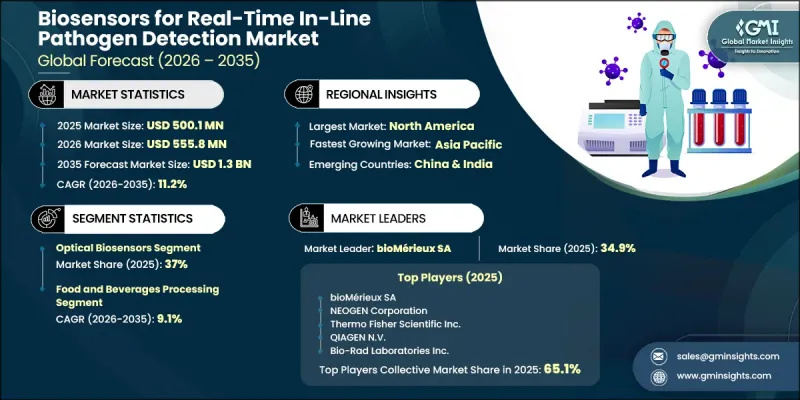
시장 성장을 주도하는 요인은 예방적 공정 모니터링에 대한 규제 요건의 강화, 식품 및 의약품 안전성에 대한 중요성 증대, 그리고 산업 활동 전반에 걸친 연속 병원체 검출 기술의 채택 확대입니다. 각 업계에서는 품질 보증을 강화하는 동시에 운영 위험을 줄이고 규제 준수를 지원하는 실시간 모니터링 솔루션의 중요성을 점점 더 강조하고 있습니다. 전 세계적으로 식중독 발생 건수가 증가하고 있는 점과 맞물려, 생산 공정을 중단하지 않고도 생물학적 오염 물질을 검출할 수 있는 첨단 바이오센서 기술에 대한 수요가 더욱 가속화되고 있습니다. 제조업체들이 공정 자동화, 제품 안전성 및 업무 효율성을 지속적으로 우선시함에 따라, 인라인 바이오센서는 현대 제조 인프라에 없어서는 안 될 요소로 자리 잡고 있습니다. 연속 모니터링 기술을 통해 의사결정의 신속화, 공정 제어의 개선, 그리고 중요한 생산 환경에서의 오염 위험을 최소화할 수 있습니다. 첨단 센싱 기술, 자동화 및 지능형 모니터링 시스템에 대한 투자 확대에 힘입어 시장 성장은 더욱 가속화될 것으로 예상됩니다. 이에 따라 인라인 실시간 병원체 검출용 바이오센서는 여러 최종 이용 산업 분야에서 산업 안전, 제품 품질 및 규제 준수를 향상시키기 위한 필수적인 솔루션으로서의 입지를 확고히 할 것입니다.
| 시장 범위 | |
|---|---|
| 시작 연도 | 2025년 |
| 예측 기간 | 2026-2035년 |
| 개시 금액 | 5억 10만 달러 |
| 예측 금액 | 13억 달러 |
| CAGR | 11.2% |
2025년, 식품·음료 가공 부문은 시장 점유율의 38.2%를 차지하며 1억 9,100만 미달러의 매출을 기록했습니다. 이 부문의 주도적 지위는 제조업체들이 식품 안전 프로그램을 강화하고, 품질 보증을 개선하며, 끊임없이 변화하는 규제 요건을 준수하는 데 도움이 되는 병원체 연속 모니터링 기술의 채택 확대에 힘입고 있습니다. 자동 모니터링 솔루션 및 생물학적 유해 요인 관리 강화에 대한 수요가 증가함에 따라, 식품 가공 시설 전반에서 이 용도의 중요성은 계속해서 높아지고 있습니다.
2025년, 전기화학식 바이오센서 부문은 38.1%의 시장 점유율을 차지했습니다. 이 시장의 선도적 지위는 비용 효율적인 운영, 소형 센싱 플랫폼과의 호환성, 산업용 처리 시스템과의 손쉬운 통합, 그리고 신뢰할 수 있는 신호 성능과 같은 이점들에 의해 뒷받침되고 있습니다. 센싱 재료 및 검출 능력의 지속적인 개선으로 인해 산업용 전반에 걸친 전기화학식 바이오센서 기술의 채택이 더욱 촉진되고 있습니다.
2025년, 북미의 실시간 인라인 병원체 검출용 바이오센서 시장은 37%의 점유율을 차지했습니다. 미국은 대규모 식품 가공 시설과 제약 제조 거점이 다수 존재하고, 첨단 품질 모니터링 기술이 널리 채택되고 있어 해당 지역의 수요를 지속적으로 견인하고 있습니다. 규제 준수, 공정 자동화, 그리고 산업 안전 솔루션에 대한 지속적인 투자가 이 지역 전체의 지속적인 시장 성장을 뒷받침할 것으로 예상됩니다.
자주 묻는 질문
목차
제1장 조사 방법과 범위
제2장 주요 요약
제3장 업계 인사이트
제4장 경쟁 구도
제5장 시장 추정 및 예측 : 기술별, 2022-2035년
제6장 시장 추정 및 예측 : 바이오 리셉터 소자별, 2022-2035년
제7장 시장 추정 및 예측 : 병원체 유형별, 2022-2035년
제8장 시장 추정 및 예측 : 최종 이용 산업별, 2022-2035년
제9장 시장 추정 및 예측 : 지역별, 2022-2035년
제10장 기업 개요
KSM 26.08.06The Global Biosensors for Real-Time In-Line Pathogen Detection Market was valued at USD 500.1 million in 2025 and is estimated to grow at a CAGR of 11.2% to reach USD 1.3 billion by 2035.
Market growth is driven by increasingly stringent regulatory requirements for preventive process monitoring, rising emphasis on food and pharmaceutical safety, and growing adoption of continuous pathogen detection technologies across industrial operations. Industries are placing greater importance on real-time monitoring solutions that enhance quality assurance while reducing operational risks and supporting regulatory compliance. The increasing incidence of foodborne illnesses worldwide has further accelerated demand for advanced biosensor technologies capable of detecting biological contaminants without interrupting production processes. As manufacturers continue to prioritize process automation, product safety, and operational efficiency, in-line biosensors are becoming an integral component of modern manufacturing infrastructure. Continuous monitoring technologies enable faster decision-making, improve process control, and minimize the risk of contamination across critical production environments. Growing investment in advanced sensing technologies, automation, and intelligent monitoring systems is expected to further strengthen market growth, positioning biosensors for in-line real-time pathogen detection as an essential solution for improving industrial safety, product quality, and regulatory compliance across multiple end-use industries.
| Market Scope | |
|---|---|
| Start Year | 2025 |
| Forecast Year | 2026-2035 |
| Start Value | $500.1 Million |
| Forecast Value | $1.3 Billion |
| CAGR | 11.2% |
The food and beverages processing segment accounted for 38.2% share in 2025, generating USD 191 million. Its leading position is supported by increasing adoption of continuous pathogen monitoring technologies that help manufacturers strengthen food safety programs, improve quality assurance, and comply with evolving regulatory requirements. Rising demand for automated monitoring solutions and enhanced biological hazard control continues to reinforce the importance of this application across food processing facilities.
The electrochemical biosensors segment held 38.1% share in 2025. Market leadership is supported by advantages including cost-effective operation, compatibility with compact sensing platforms, ease of integration into industrial processing systems, and reliable signal performance. Continuous improvements in sensing materials and detection capabilities are further strengthening the adoption of electrochemical biosensor technologies across industrial applications.
North America Biosensors for Real-Time In-Line Pathogen Detection Market captured 37% share in 2025. The United States continues to lead regional demand due to the strong presence of large-scale food processing facilities, pharmaceutical manufacturing operations, and widespread adoption of advanced quality monitoring technologies. Continued investment in regulatory compliance, process automation, and industrial safety solutions is expected to support sustained market growth across the region.
Major companies operating in the Global Biosensors for Real-Time In-Line Pathogen Detection Market include bioMerieux SA, Thermo Fisher Scientific, NEOGEN Corporation, QIAGEN N.V., Bio-Rad Laboratories, Merck KGaA, Microbia Environnement, Rqmicro AG, Tailin Bioengineering, FluIDect GmbH, SWIFTR Bio, Kraken Sense, and BioVind Inc. Companies participating in the biosensors for in-line real-time pathogen detection market are strengthening their competitive position through continuous investment in research and development, advanced biosensor technologies, and product innovation. Manufacturers are expanding their portfolios with highly sensitive, rapid-response detection systems that improve process efficiency and support regulatory compliance. Strategic collaborations, technology partnerships, and geographic expansion are helping companies increase market reach and strengthen customer relationships across multiple industries. Businesses are also focusing on integrating biosensors with automation platforms, digital monitoring systems, and data analytics to enhance real-time process visibility and operational efficiency.
Table of Contents
Chapter 1 Methodology & Scope
- 1.1 Research approach
- 1.2 Quality Commitments
- 1.2.1 GMI AI policy & data integrity commitment
- 1.2.1.1 Source consistency protocol
- 1.2.1 GMI AI policy & data integrity commitment
- 1.3 Research Trail & Confidence Scoring
- 1.3.1 Research Trail Components
- 1.3.2 Scoring Components
- 1.4 Data Collection
- 1.4.1 Partial list of primary sources
- 1.5 Data mining sources
- 1.5.1 Paid sources
- 1.5.1.1 Sources, by region
- 1.5.1 Paid sources
- 1.6 Base estimates and calculations
- 1.6.1 Base year calculation for any one approach
- 1.7 Forecast model
- 1.7.1 Quantified market impact analysis
- 1.7.1.1 Mathematical impact of growth parameters on forecast
- 1.7.1 Quantified market impact analysis
- 1.8 Research transparency addendum
- 1.8.1 Source attribution framework
- 1.8.2 Quality assurance metrics
- 1.8.3 Our commitment to trust
Chapter 2 Executive Summary
- 2.1 Industry 360° synopsis
- 2.2 Key market trends
- 2.2.1 Regional
- 2.2.2 By Technology Type
- 2.2.3 By Bioreceptor Element
- 2.2.4 By Pathogen Type
- 2.2.5 By End-User Industry
- 2.3 TAM Analysis, 2026-2035
- 2.4 CXO perspectives: Strategic imperatives
Chapter 3 Industry Insights
- 3.1 Industry ecosystem analysis
- 3.1.1 Supplier landscape
- 3.1.2 Profit margin
- 3.1.3 Value addition at each stage
- 3.1.4 Factor affecting the value chain
- 3.1.5 Disruptions
- 3.2 Industry impact forces
- 3.2.1 Growth drivers
- 3.2.2 Industry pitfalls and challenges
- 3.2.3 Market opportunities
- 3.3 Growth potential analysis
- 3.4 Regulatory landscape
- 3.4.1 North America
- 3.4.2 Europe
- 3.4.3 Asia Pacific
- 3.4.4 Latin America
- 3.4.5 Middle East & Africa
- 3.5 Porter's analysis
- 3.6 PESTEL analysis
- 3.7 Price trends
- 3.7.1 By region
- 3.7.2 By Technology Type
- 3.8 Future market trends
- 3.9 Technology and Innovation landscape
- 3.9.1 Current technological trends
- 3.9.2 Emerging technologies
- 3.10 Patent Landscape
- 3.11 Trade statistics (HS code)
- 3.11.1 Major importing countries
- 3.11.2 Major exporting countries
- 3.12 Sustainability and environmental aspects
- 3.12.1 Sustainable practices
- 3.12.2 Waste reduction strategies
- 3.12.3 Energy efficiency in production
- 3.12.4 Eco friendly initiatives
Chapter 4 Competitive Landscape, 2025
- 4.1 Introduction
- 4.2 Company market share analysis
- 4.2.1 By region
- 4.2.1.1 North America
- 4.2.1.2 Europe
- 4.2.1.3 Asia Pacific
- 4.2.1.4 LATAM
- 4.2.1.5 MEA
- 4.2.1 By region
- 4.3 Company matrix analysis
- 4.4 Competitive analysis of major market players
- 4.5 Competitive positioning matrix
- 4.6 Key developments
- 4.6.1 Mergers & acquisitions
- 4.6.2 Partnerships & collaborations
- 4.6.3 New Product Launches
- 4.6.4 Expansion Plans
Chapter 5 Market Estimates and Forecast, By Technology Type, 2022 to 2035 (USD Million) (Tons)
- 5.1 Key trends
- 5.2 Electrochemical Biosensors
- 5.3 Optical Biosensors
- 5.4 Piezoelectric Biosensors
- 5.5 Thermal / Calorimetric
- 5.6 Others (CRISPR-LF, Microfluidic, Magnetic)
Chapter 6 Market Estimates and Forecast, By Bioreceptor Element, 2022 to 2035 (USD Million) (Tons)
- 6.1 Key trends
- 6.2 Antibody-Based (Immunosensors)
- 6.3 Nucleic Acid-Based (Aptasensors/DNA/RNA)
- 6.4 Enzyme-Based Biosensors
- 6.5 Bacteriophage-Based
- 6.6 MIP-Based
- 6.7 Others
Chapter 7 Market Estimates and Forecast, By Pathogen Type, 2022 to 2035 (USD Million) (Tons)
- 7.1 Key trends
- 7.2 Bacterial Pathogens
- 7.3 Viral Pathogens
- 7.4 Fungal & Mold Pathogens
- 7.5 Parasitic Pathogens
- 7.6 Multiplex / Multi-Pathogen Panel
Chapter 8 Market Estimates and Forecast, By End-User Industry, 2022 to 2035 (USD Million) (Tons)
- 8.1 Key trends
- 8.2 Food & Beverage Processing
- 8.3 Pharmaceutical & Biopharmaceutical
- 8.4 Water & Wastewater Treatment
- 8.5 Healthcare & Blood Supply Chain
- 8.6 Agriculture & Livestock Processing
- 8.7 Environmental Monitoring Agencies
- 8.8 Others
Chapter 9 Market Estimates and Forecast, By Region, 2022 to 2035 (USD Million) (Tons)
- 9.1 Key trends
- 9.2 North America
- 9.2.1 U.S.
- 9.2.2 Canada
- 9.3 Europe
- 9.3.1 Germany
- 9.3.2 UK
- 9.3.3 France
- 9.3.4 Spain
- 9.3.5 Italy
- 9.3.6 Rest of Europe
- 9.4 Asia Pacific
- 9.4.1 China
- 9.4.2 India
- 9.4.3 Japan
- 9.4.4 Australia
- 9.4.5 South Korea
- 9.4.6 Rest of Asia Pacific
- 9.5 Latin America
- 9.5.1 Brazil
- 9.5.2 Mexico
- 9.5.3 Argentina
- 9.5.4 Rest of Latin America
- 9.6 Middle East and Africa
- 9.6.1 Saudi Arabia
- 9.6.2 South Africa
- 9.6.3 UAE
- 9.6.4 Rest of Middle East and Africa
Chapter 10 Company Profiles
- 10.1 bioMerieux SA
- 10.2 NEOGEN Corporation
- 10.3 Thermo Fisher Scientific Inc.
- 10.4 QIAGEN N.V.
- 10.5 Bio-Rad Laboratories Inc.
- 10.6 Tailin Bioengineering Co., Ltd.
- 10.7 Merck KGaA (MilliporeSigma)
- 10.8 Rqmicro AG
- 10.9 Microbia Environnement
- 10.10 FluIDect GmbH
- 10.11 SWIFTR Bio
- 10.12 Kraken Sense
- 10.13 BioVind Inc.