

|
시장보고서
상품코드
2101676
자동차용 토크 액추에이터 모터 시장 기회, 성장 촉진요인, 업계 동향 분석 및 예측(2026-2035년)Automotive Torque Actuator Motor Market Opportunity, Growth Drivers, Industry Trend Analysis, and Forecast 2026 - 2035 |
||||||

세계의 자동차용 토크 액추에이터 모터 시장은 2025년에 100억 달러 규모에 달하고, CAGR 5%로 성장하여 2035년까지 162억 달러에 달할 것으로 예측됩니다.
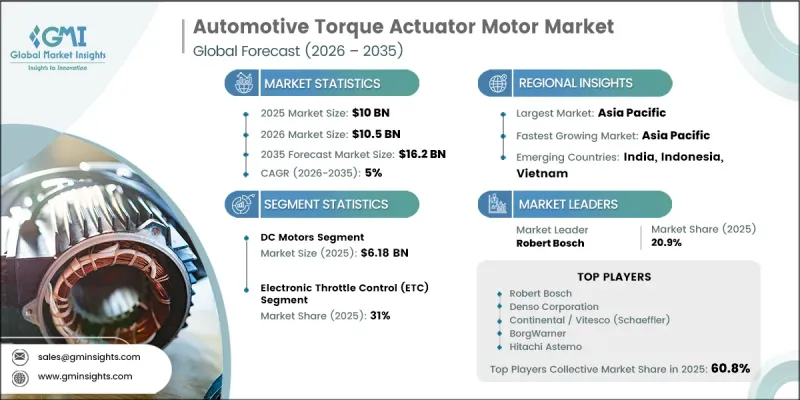
자동차 제조사들이 내연기관 차량, 하이브리드 차량, 배터리 전기자동차(BEV) 등 각 플랫폼에서 전자 제어식 차량 시스템으로의 전환을 가속화함에 따라, 자동차용 토크 액추에이터 모터 시장은 지속적으로 확대되고 있습니다. 고급 전자 아키텍처의 통합이 진행됨에 따라, 차량의 효율 향상, 안전성 강화 및 시스템 응답성 향상을 뒷받침하는 고정밀 액추에이터 모터에 대한 수요가 증가하고 있습니다. 배터리 전기자동차(BEV)는 일반적으로 내연기관 차량보다 더 많은 액추에이터 모터가 필요하기 때문에 전 세계적으로 전기자동차의 보급이 확대됨에 따라 추가적인 성장 기회가 창출되고 있습니다. 더 깨끗한 교통 수단과 차량 성능 향상을 촉진하는 규제 조치가 전자 제어 자동차 시스템의 도입을 더욱 뒷받침하고 있습니다. 기계식 및 유압식 부품이 전기 구동식 대체품으로 지속적으로 대체됨에 따라, 차량 설계 방식이 혁신되는 동시에 소프트웨어 통합 심화, 패키징 유연성 향상 및 자동화 능력 강화가 가능해졌습니다. 또한, 각 제조사들은 센싱 기능, 진단 기능, 전자 제어 기능을 통합한 지능형 액추에이터 기술을 점점 더 많이 채택하고 있으며, 자동차 산업이 더욱 연결되고 기술적으로 고도화된 차량으로 진화함에 따라 자동차용 토크 액추에이터 모터 시장의 장기적인 성장 전망은 더욱 견고해지고 있습니다.
| 시장 범위 | |
|---|---|
| 시작 연도 | 2025년 |
| 예측 기간 | 2026-2035년 |
| 초기 시장 규모 | 100억 달러 |
| 예측액 | 162억 달러 |
| CAGR | 5% |
DC 모터 부문은 62%의 점유율을 차지하며, 2025년에는 61억 8,000만 달러의 매출을 기록했습니다. 이 부문은 2035년까지 93억 1,000만 달러에 달하며, 연평균 성장률(CAGR) 4.2%로 성장할 것으로 예측됩니다. 이러한 선도적 지위는, 입증된 성능, 비용 효율성, 장기적인 운영 신뢰성을 제조사가 지속적으로 중시하는 대량 생산형 자동차 용도에서 영구자석식 DC 모터가 널리 채택되고 있는 데 힘입고 있습니다. 차량 생산 프로그램 전반에 걸친 이러한 보급은 시장 전체 매출에 대한 해당 부문의 압도적인 기여도를 더욱 공고히 하고 있습니다.
전자 스로틀 제어(ETC) 부문은 2025년에 31%의 점유율을 차지했습니다. 내연기관 차량, 하이브리드 차량, 플러그인 하이브리드 차량의 각 플랫폼에 전자 스로틀 제어가 광범위하게 도입됨에 따라 안정적인 수요가 지속되고 있습니다. 그러나 순수 전기자동차(BEV) 아키텍처에는 스로틀 제어 시스템이 존재하지 않으며, 기존 자동차 시장에서 ETC 기술의 보급률이 이미 높은 점을 고려할 때, 향후 성장은 비교적 완만할 것으로 전망됩니다.
아시아태평양의 자동차용 토크 액추에이터 모터 시장은 61%의 점유율을 차지하며, 2025년에는 60억 9,000만 달러의 시장 규모를 기록했습니다. 이는 해당 지역의 대규모 자동차 제조 산업, 전기화 차량 생산 확대, 그리고 첨단 자동차 기술 도입을 지속적으로 촉진하는 우호적인 규제 조치에 힘입은 결과입니다.
자주 묻는 질문
목차
제1장 조사 방법과 범위
제2장 주요 요약
제3장 업계 인사이트
제4장 경쟁 구도
제5장 시장 추정 및 예측 : 모터 유형별, 2022-2035년
제6장 시장 추정 및 예측 : 파워트레인별, 2022-2035년
제7장 시장 추정 및 예측 : 차종별, 2022-2035년
제8장 시장 추정 및 예측 : 판매 채널별, 2022-2035년
제9장 시장 추정 및 예측 : 용도별, 2022-2035년
제10장 시장 추정 및 예측 : 지역별, 2022-2035년
제11장 기업 개요
KSM 26.08.04The Global Automotive Torque Actuator Motor Market was valued at USD 10 billion in 2025 and is estimated to grow at a CAGR of 5% to reach USD 16.2 billion by 2035.
The automotive torque actuator motor market continues to expand as vehicle manufacturers accelerate the transition toward electronically controlled vehicle systems across conventional, hybrid, and battery electric vehicle platforms. The increasing integration of advanced electronic architectures is driving demand for precision actuator motors that support improved vehicle efficiency, enhanced safety, and greater system responsiveness. Battery electric vehicles generally require a higher number of actuator motors than internal combustion engine vehicles, creating additional growth opportunities as electric mobility adoption continues to rise globally. Regulatory initiatives encouraging cleaner transportation and improved vehicle performance are further supporting the implementation of electronically controlled automotive systems. The ongoing replacement of mechanical and hydraulic components with electrically operated alternatives is reshaping vehicle design while enabling greater software integration, improved packaging flexibility, and enhanced automation capabilities. In addition, manufacturers are increasingly incorporating intelligent actuator technologies equipped with integrated sensing, diagnostic functions, and electronic control capabilities, strengthening the long-term growth outlook for the automotive torque actuator motor market as the automotive industry advances toward more connected and technologically sophisticated vehicles.
| Market Scope | |
|---|---|
| Start Year | 2025 |
| Forecast Year | 2026-2035 |
| Start Value | $10 Billion |
| Forecast Value | $16.2 Billion |
| CAGR | 5% |
The DC motor segment accounted for 62% share, generating USD 6.18 billion in 2025. The segment is projected to reach USD 9.31 billion by 2035, growing at a CAGR of 4.2%. Its leading position is supported by the extensive use of permanent magnet DC motors across high-volume automotive applications where manufacturers continue to prioritize proven performance, cost efficiency, and long-term operational reliability. Their widespread adoption across vehicle production programs reinforces the segment's dominant contribution to overall market revenue.
The electronic throttle control (ETC) segment held 31% share in 2025. The broad implementation of electronic throttle control across internal combustion engine, hybrid electric, and plug-in hybrid vehicle platforms continues to support consistent demand. However, future growth remains comparatively moderate due to the absence of throttle control systems in fully battery electric vehicle architectures and the already high penetration of ETC technologies across established automotive markets.
Asia Pacific Automotive Torque Actuator Motor Market held 61% share, generating USD 6.09 billion in 2025, supported by its large-scale automotive manufacturing industry, expanding production of electrified vehicles, and favorable regulatory initiatives that continue to encourage the adoption of advanced vehicle technologies.
Major companies operating in the global automotive torque actuator motor market include Denso Corporation, Robert Bosch GmbH, BorgWarner Inc., Johnson Electric Holdings, Valeo SE, Continental/Vitesco (Schaeffler), and Hitachi Astemo (Astemo Ltd.). Companies operating in the automotive torque actuator motor market are strengthening their competitive position by investing in advanced motor technologies, expanding manufacturing capabilities, and developing high-performance actuator solutions that meet evolving vehicle requirements. Manufacturers are increasing research and development efforts to improve motor efficiency, durability, precision, and integration with advanced electronic vehicle systems. Strategic collaborations with automotive manufacturers and Tier-1 suppliers continue to support long-term supply agreements and accelerate product development. Companies are also expanding their global manufacturing footprint and optimizing supply chains to improve production flexibility and meet rising regional demand.
Table of Contents
Chapter 1 Methodology & Scope
- 1.1 Research approach
- 1.2 Quality Commitments
- 1.2.1 GMI AI policy & data integrity commitment
- 1.2.1.1 Source consistency protocol
- 1.2.1 GMI AI policy & data integrity commitment
- 1.3 Research Trail & Confidence Scoring
- 1.3.1 Research Trail Components
- 1.3.2 Scoring Components
- 1.4 Data Collection
- 1.4.1 Partial list of primary sources
- 1.5 Data mining sources
- 1.5.1 Paid sources
- 1.5.1.1 Sources, by region
- 1.5.1 Paid sources
- 1.6 Base estimates and calculations
- 1.6.1 Base year calculation
- 1.7 Forecast model
- 1.7.1 Quantified market impact analysis
- 1.7.1.1 Mathematical impact of growth parameters on forecast
- 1.7.1 Quantified market impact analysis
- 1.8 Research transparency addendum
- 1.8.1 Source attribution framework
- 1.8.2 Quality assurance metrics
- 1.8.3 Our commitment to trust
Chapter 2 Executive Summary
- 2.1 Industry 360° synopsis
- 2.2 Key market trends
- 2.2.1 Motor Type
- 2.2.2 Powertrain
- 2.2.3 Vehicle Type
- 2.2.4 Sales Channel
- 2.2.5 Application
- 2.3 TAM Analysis, 2026-2035
- 2.4 CXO perspectives: Strategic imperatives
Chapter 3 Industry Insights
- 3.1 Industry ecosystem analysis
- 3.1.1 Supplier landscape
- 3.1.2 Cost structure
- 3.1.3 Profit margin
- 3.1.4 Value addition at each stage
- 3.1.5 Vertical integration trends
- 3.1.6 Disruptors
- 3.2 Industry impact forces
- 3.2.1 Growth drivers
- 3.2.1.1 Increasing Vehicle Electrification
- 3.2.1.2 Stringent Emission and Fuel Efficiency Regulations
- 3.2.1.3 Rising Adoption of Drive-by-Wire Technologies
- 3.2.1.4 Increasing Integration of Smart Actuation Systems
- 3.2.2 Industry pitfalls & challenges
- 3.2.2.1 Declining Engine Actuator Demand in BEVs
- 3.2.2.2 High Reliability and Functional Safety Requirements
- 3.2.2.3 Cost Pressure Across the Supply Chain
- 3.2.3 Market opportunities
- 3.2.3.1 Expansion of Thermal Management Systems in EVs
- 3.2.3.2 Growth in Software-Defined Vehicles
- 3.2.3.3 Increasing Adoption of Active Aerodynamics
- 3.2.3.4 Vehicle Electrification and Platform Modernization
- 3.2.1 Growth drivers
- 3.3 Growth potential analysis
- 3.4 Technology and Innovation landscape
- 3.4.1 Current technologies
- 3.4.2 Emerging technologies
- 3.5 Pricing Analysis (Driven by Primary Research)
- 3.5.1 Historical Price Trend Analysis
- 3.5.2 Pricing Strategy by Player Type (Premium / Value / Cost-plus)
- 3.6 Regulatory landscape
- 3.6.1 North America
- 3.6.1.1 FMVSS (US)
- 3.6.1.2 EPA Tier 3 Emission Standards (US)
- 3.6.1.3 CARB LEV III Regulations (US)
- 3.6.1.4 SAE J1939 Standards (US)
- 3.6.2 Europe
- 3.6.2.1 Euro 7 Emission Regulation
- 3.6.2.2 UNECE R10 (EMC)
- 3.6.2.3 UNECE R155 (Cybersecurity)
- 3.6.2.4 RoHS & REACH
- 3.6.3 Asia-Pacific
- 3.6.3.1 China VI Emission Standards (China)
- 3.6.3.2 GB/T Automotive Standards (China)
- 3.6.3.3 Japan Road Vehicle Safety Standards (Japan)
- 3.6.3.4 BS VI Emission Standards (India)
- 3.6.3.5 Australian Design Rules (ADR)
- 3.6.4 Latin America
- 3.6.4.1 PROCONVE L7/L8 (Brazil)
- 3.6.4.2 NOM Vehicle Standards (Mexico)
- 3.6.5 Middle East & Africa
- 3.6.5.1 UAE Vehicle Safety Regulations
- 3.6.5.2 SASO Vehicle Standards (Saudi Arabia)
- 3.6.5.3 SANS Vehicle Standards (South Africa)
- 3.6.1 North America
- 3.7 Porter's analysis
- 3.8 PESTEL analysis
- 3.9 Patent analysis (Driven by Primary Research)
- 3.10 Trade Data Analysis (Driven by paid database)
- 3.10.1 Import/export volume & value trends
- 3.10.2 Key trade corridors & tariff impact
- 3.11 Cost breakdown analysis
- 3.12 Capacity & Production Landscape (Driven by Primary Research)
- 3.12.1 Installed Capacity by Region & Key Producer
- 3.12.2 Capacity Utilization Rates & Expansion Pipelines
- 3.13 Impact of AI & generative AI on the market
- 3.13.1 AI Driven Disruption of Existing Business Models
- 3.13.2 GenAI Use Cases and Adoption Roadmap by Segment
- 3.13.3 Risks Limitations and Regulatory Considerations
- 3.14 Sustainability and environmental aspects
- 3.14.1 Sustainable practices
- 3.14.2 Waste reduction strategies
- 3.14.3 Energy efficiency in production
- 3.14.4 Eco-friendly Initiatives
- 3.14.5 Carbon footprint considerations
- 3.15 Forecast assumptions & scenario analysis (Driven by Primary Research)
- 3.15.1 Base Case key macro & industry variables driving CAGR
- 3.15.2 Optimistic Scenarios Favorable Macro and Industry Tailwinds
- 3.15.3 Pessimistic Scenario Macroeconomic slowdown or industry headwinds
Chapter 4 Competitive Landscape, 2025
- 4.1 Introduction
- 4.2 Company market share analysis
- 4.2.1 North America
- 4.2.2 Europe
- 4.2.3 Asia-Pacific
- 4.2.4 Latin America
- 4.2.5 Middle East & Africa
- 4.3 Competitive positioning matrix
- 4.4 Key developments
- 4.4.1 Mergers & acquisitions
- 4.4.2 Partnerships & collaborations
- 4.4.3 New product launches
- 4.4.4 Expansion plans and funding
- 4.5 Company tier benchmarking
- 4.5.1 Tier classification criteria & qualifying thresholds
- 4.5.2 Tier positioning matrix by revenue, geography & innovation
Chapter 5 Market Estimates & Forecast, By Motor Type, 2022 - 2035 ($Mn, Units)
- 5.1 Key trends
- 5.2 DC Motor
- 5.3 Stepper Motor
- 5.4 Servo Motor
- 5.5 Others
Chapter 6 Market Estimates & Forecast, By Powertrain, 2022 - 2035 ($Mn, Units)
- 6.1 Key trends
- 6.2 Internal Combustion Engine (ICE)
- 6.3 Hybrid Electric Vehicle (HEV) / Plug-in Hybrid Electric Vehicle (PHEV)
- 6.4 Battery Electric Vehicle (BEV)
- 6.5 Fuel Cell Electric Vehicle (FCEV)
Chapter 7 Market Estimates & Forecast, By Vehicle Type, 2022 - 2035 ($Mn, Units)
- 7.1 Key trends
- 7.2 Passenger Vehicles
- 7.2.1 Hatchback
- 7.2.2 Sedan
- 7.2.3 SUV
- 7.3 Commercial Vehicles
- 7.3.1 Light Commercial Vehicle (LCV)
- 7.3.2 Medium Commercial Vehicle (MCV)
- 7.3.3 Heavy Commercial Vehicle (HCV)
Chapter 8 Market Estimates & Forecast, By Sales Channel, 2022 - 2035 ($Mn, Units)
- 8.1 Key trends
- 8.2 Original Equipment Manufacturer (OEM)
- 8.3 Aftermarket
Chapter 9 Market Estimates & Forecast, By Application, 2022 - 2035 ($Mn, Units)
- 9.1 Key trends
- 9.2 Electronic Throttle Control (ETC)
- 9.3 Turbocharger Actuation
- 9.4 Exhaust Gas Recirculation (EGR)
- 9.5 Variable Valve Timing (VVT)
- 9.6 Intake Manifold Runner Control (IMRC)
- 9.7 Transmission Actuation
- 9.8 Active Grille Shutter (AGS)
- 9.9 HVAC Blend Door Actuation
- 9.10 Others
Chapter 10 Market Estimates & Forecast, By Region, 2022 - 2035 ($Mn, Units)
- 10.1 North America
- 10.1.1 US
- 10.1.2 Canada
- 10.2 Europe
- 10.2.1 UK
- 10.2.2 Germany
- 10.2.3 France
- 10.2.4 Italy
- 10.2.5 Spain
- 10.2.6 Belgium
- 10.2.7 Netherlands
- 10.2.8 Sweden
- 10.2.9 Russia
- 10.3 Asia Pacific
- 10.3.1 China
- 10.3.2 India
- 10.3.3 Japan
- 10.3.4 Australia
- 10.3.5 Singapore
- 10.3.6 South Korea
- 10.3.7 Vietnam
- 10.3.8 Indonesia
- 10.3.9 Thailand
- 10.4 Latin America
- 10.4.1 Brazil
- 10.4.2 Mexico
- 10.4.3 Argentina
- 10.5 MEA
- 10.5.1 South Africa
- 10.5.2 Saudi Arabia
- 10.5.3 UAE
- 10.5.4 Turkey
Chapter 11 Company Profiles
- 11.1 Global Players
- 11.1.1 Aptiv
- 11.1.2 BorgWarner
- 11.1.3 Continental
- 11.1.4 Denso
- 11.1.5 Hitachi Astemo
- 11.1.6 Johnson Electric Holdings
- 11.1.7 Marelli
- 11.1.8 Mitsubishi Electric
- 11.1.9 Nidec
- 11.1.10 Robert Bosch
- 11.1.11 Valeo
- 11.1.12 Vitesco Technologies
- 11.1.13 ZF Friedrichshafen
- 11.2 Regional Players
- 11.2.1 HELLA
- 11.2.2 Aisan Industry
- 11.2.3 Mabuchi Motor
- 11.2.4 Mikuni
- 11.3 Emerging Players / Disruptors
- 11.3.1 Inzi Controls
- 11.3.2 Ningbo Tuopu
- 11.3.3 Shinano Kenshi


