

|
시장보고서
상품코드
2101677
마이코톡신 검사 및 제염 시장 기회, 성장 촉진요인, 업계 동향 분석 및 예측(2026-2035년)Mycotoxin Testing and Decontamination Market Opportunity, Growth Drivers, Industry Trend Analysis, and Forecast 2026 - 2035 |
||||||

세계의 마이코톡신 검사 및 제염 시장은 2025년에 44억 달러 규모에 달하고, CAGR 5.8%로 성장하여 2035년까지 78억 달러에 달할 것으로 예측됩니다.
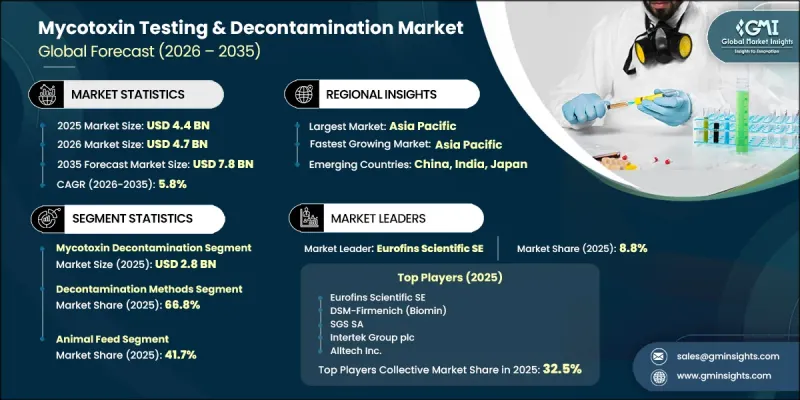
이러한 성장은 규제 체계의 강화, 국제 식품 무역의 확대, 그리고 공급망 전반에 걸친 마이코톡신 위험에 대한 인식 제고로 인해 주도되고 있습니다. 마이코톡신 검사는 크로마토그래피, 면역분석법, 신속 검출 키트 등의 첨단 분석 기술을 활용하여 식품 및 사료에 포함된 아플라톡신 등의 유해 화합물을 식별하는 데 매우 중요한 역할을 하고 있습니다. 주목할 만한 시장 변화로는 예방, 감시, 관리 기능을 통합된 워크플로우로 결합한 현장 신속 검사 시스템에 대한 수요가 증가하고 있다는 점을 들 수 있습니다. 이러한 전환을 통해 식품 안전성이 향상되고, 오염 사고로 인한 경제적 손실이 감소하며, 규제 준수가 강화되는 동시에 공급망 전반의 투명성이 높아지고 있습니다. 사료 분야에서는 오염 제거 솔루션이 가축의 건강과 생산성을 뒷받침하고, 식품 가공 분야에서는 지속적인 모니터링을 통해 소비자의 안전과 수출 적격성을 확보하고 있습니다. 중요한 구조적 변화로, 몇몇 주요 관할 구역에서 자발적인 검사 관행에서 인증을 받은 의무적인 규정 준수 체제로의 전환이 진행되고 있으며, 이것이 기초적인 수요를 크게 끌어올리고 있습니다. 또한, 규제 확대에 따라 오염 물질 모니터링 범위가 새로운 곰팡이 대사 산물을 포함하도록 확대되는 동시에, 민감한 식품 카테고리의 허용 한도가 강화되면서 전 세계적으로 검사 요건이 더욱 엄격해지고 있습니다.
| 시장 범위 | |
|---|---|
| 시작 연도 | 2025년 |
| 예측 기간 | 2026-2035년 |
| 개시 금액 | 44억 달러 |
| 예측 금액 | 78억 달러 |
| CAGR | 5.8% |
마이코톡신 제염 부문의 시장 규모는 2025년에 28억 달러로 평가되었습니다. 이 부문은 주로 점토계 재료, 활성탄, 효모 유래 세포벽 성분, 수화 나트륨-칼슘-알루미노실리케이트 등을 포함한 사료 첨가제 및 결합제 솔루션에 의해 주도되고 있습니다. 이러한 솔루션은 효율성과 광범위한 독소 결합 능력이 필수적인 성능 요건으로 간주되는 전 세계 배합 사료 업계의 대규모 및 비용 중심 운영 모델에 부합합니다.
2025년, 해독 방법 부문의 시장 점유율은 66.8%를 차지했습니다. 이 부문의 혁신은 효소를 이용한 해독 시스템이나 기존의 화학적 처리를 점차 대체하고 있는 미생물 기반 솔루션 등, 생물학적이며 지속가능한 접근 방식에 점점 더 초점을 맞추고 있습니다. 다기능 결합제 및 통합형 마이코톡신 위험 관리 플랫폼의 활용도 점점 더 확대되고 있습니다. 동시에 정밀 농업 도구와 수확 후 모니터링 기술의 통합을 통해 예방 전략이 강화되고 있으며, 이는 농업 밸류체인 전반에 걸친 종단간(end-to-end) 마이코톡신 위험 관리로의 광범위한 전환을 반영하고 있습니다.
북미의 마이코톡신 검사 및 제염 시장은 확립된 규제 환경과 성숙한 식품 안전 인프라에 힘입어 2035년까지 20억 달러에 달할 것으로 예상됩니다. 이 지역은 FDA 및 USDA와 같은 기관의 엄격한 감독이 특징이며, 이는 첨단 분석 검사 기법의 꾸준한 도입을 지속적으로 뒷받침하고 있습니다. 미국은 여전히 주요 시장이며, 식품 생산자, 곡물 가공업체, 사료 제조업체 사이에서 인식이 높아짐에 따라 공급망 전반에 걸쳐 안정적인 수요가 확보되고 있습니다.
자주 묻는 질문
목차
제1장 조사 방법과 범위
제2장 주요 요약
제3장 업계 인사이트
제4장 경쟁 구도
제5장 시장 추정 및 예측 : 제공 유형별, 2022-2035년
제6장 시장 추정 및 예측 : 기술·방법별, 2022-2035년
제7장 시장 추정 및 예측 : 마이코톡신 유형별, 2022-2035년
제8장 시장 추정 및 예측 : 최종 이용 산업별, 2022-2035년
제9장 시장 추정 및 예측 : 지역별, 2022-2035년
제10장 기업 개요
KSM 26.08.06The Global Mycotoxin Testing & Decontamination Market was valued at USD 4.4 billion in 2025 and is estimated to grow at a CAGR of 5.8% to reach USD 7.8 billion by 2035.
Growth is shaped by stricter regulatory frameworks, expanding international food trade, and heightened awareness of fungal toxin risks across supply chains. Mycotoxin testing plays a critical role in identifying hazardous compounds such as aflatoxins in food and animal feed, using advanced analytical techniques including chromatography, immunoassays, and rapid detection kits. A notable market shift is the rising preference for on-site and rapid testing systems that integrate prevention, monitoring, and control functions within unified workflows. This transition is improving food safety assurance, reducing financial losses from contamination events, and strengthening regulatory compliance while enhancing transparency across supply networks. In feed applications, decontamination solutions support livestock health and productivity, while in food processing, continuous monitoring safeguards consumer safety and export eligibility. A key structural change is the transition from optional testing practices to mandatory, accredited compliance systems in several major jurisdictions, which is significantly reinforcing baseline demand. Regulatory expansion has also widened contaminant monitoring scopes to include additional fungal metabolites while tightening permissible limits in sensitive food categories, further intensifying testing requirements globally.
| Market Scope | |
|---|---|
| Start Year | 2025 |
| Forecast Year | 2026-2035 |
| Start Value | $4.4 Billion |
| Forecast Value | $7.8 Billion |
| CAGR | 5.8% |
The mycotoxin decontamination segment was valued at USD 2.8 billion in 2025. This segment is largely driven by feed additive and binder solutions that include clay-based materials, activated carbon, yeast-derived cell wall components, and hydrated sodium calcium aluminosilicates. These solutions align with the large-scale, cost-sensitive operational model of the global compound feed industry, where efficiency and broad-spectrum toxin binding capability are essential performance requirements.
The decontamination methods segment accounted for a 66.8% share in 2025. Innovation within this segment is increasingly focused on biological and sustainable approaches, including enzyme-driven detoxification systems and microbial-based solutions that are gradually replacing traditional chemical treatments. The use of multi-functional binders and integrated toxin risk management platforms is becoming more widespread. At the same time, the integration of precision agriculture tools and post-harvest monitoring technologies is strengthening preventive strategies, reflecting a broader shift toward end-to-end mycotoxin risk management across the agricultural value chain.
North America Mycotoxin Testing & Decontamination Market is expected to reach USD 2 billion by 2035, supported by its well-established regulatory environment and mature food safety infrastructure. The region is characterized by stringent oversight from agencies such as the FDA and USDA, which continues to drive consistent adoption of advanced analytical testing methods. The United States remains the primary contributor, with strong awareness among food producers, grain processors, and feed manufacturers ensuring steady demand across the entire supply chain.
Major companies operating in the global mycotoxin testing & decontamination industry include Eurofins Scientific SE, Neogen Corporation, SGS SA, Intertek Group plc, Bureau Veritas SA, ALS Limited, Romer Labs (ERBER Group), Merieux NutriSciences, DSM-Firmenich (Biomin), Alltech Inc., Kemin Industries Inc., Olmix Group SAS, and Charm Sciences Inc. Companies in the mycotoxin testing & decontamination market are prioritizing expansion of rapid and on-site testing solutions that reduce turnaround time and improve supply chain responsiveness. Many players are investing in advanced analytical platforms that integrate chromatography, immunoassay, and digital reporting capabilities for higher accuracy and regulatory compliance. Strategic collaborations with food producers and feed manufacturers are being strengthened to embed testing and decontamination solutions directly into production workflows. Firms are also focusing on biological and enzyme-based detoxification technologies to align with sustainability trends and reduce reliance on chemical treatments.
Table of Contents
Chapter 1 Methodology & Scope
- 1.1 Market scope and definition
- 1.2 Research design
- 1.2.1 Research approach
- 1.2.2 Data collection methods
- 1.3 Data mining sources
- 1.3.1 Global
- 1.3.2 Regional/Country
- 1.4 Base estimates and calculations
- 1.4.1 Base year calculation
- 1.4.2 Key trends for market estimation
- 1.5 Primary research and validation
- 1.5.1 Primary sources
- 1.6 Forecast model
- 1.7 Research assumptions and limitations
Chapter 2 Executive Summary
- 2.1 Industry 360° synopsis
- 2.2 Key market trends
- 2.2.1 Offering type
- 2.2.2 Technology & method
- 2.2.3 Mycotoxin type
- 2.2.4 End use industry
- 2.2.5 Regional
- 2.3 TAM Analysis, 2026-2035
- 2.4 CXO perspectives: Strategic imperatives
- 2.5 Future outlook and strategic recommendations
Chapter 3 Industry Insights
- 3.1 Industry ecosystem analysis
- 3.1.1 Supplier landscape
- 3.1.2 Profit margin
- 3.1.3 Value addition at each stage
- 3.1.4 Factor affecting the value chain
- 3.1.5 Disruptions
- 3.2 Industry impact forces
- 3.2.1 Growth drivers
- 3.2.2 Industry pitfalls and challenges
- 3.2.3 Market opportunities
- 3.3 Growth potential analysis
- 3.4 Regulatory landscape
- 3.4.1 North America
- 3.4.2 Europe
- 3.4.3 Asia Pacific
- 3.4.4 Latin America
- 3.4.5 Middle East & Africa
- 3.5 Porter's analysis
- 3.6 PESTEL analysis
- 3.7 Technology and innovation landscape
- 3.7.1 Current technological trends
- 3.7.2 Emerging technologies
- 3.8 Price trends
- 3.8.1 By region
- 3.8.2 By tag technology
- 3.9 Future market trends
- 3.10 Patent landscape
- 3.11 Trade statistics (HS code)
- 3.11.1 Major importing countries
- 3.11.2 Major exporting countries
- 3.12 Sustainability and environmental aspects
- 3.12.1 Sustainable practices
- 3.12.2 Waste reduction strategies
- 3.12.3 Energy efficiency in production
- 3.12.4 Eco-friendly initiatives
- 3.13 Carbon footprint consideration
Chapter 4 Competitive Landscape, 2025
- 4.1 Introduction
- 4.2 Company market share analysis
- 4.2.1 By region
- 4.2.1.1 North America
- 4.2.1.2 Europe
- 4.2.1.3 Asia Pacific
- 4.2.1.4 LATAM
- 4.2.1.5 MEA
- 4.2.1 By region
- 4.3 Company matrix analysis
- 4.4 Competitive analysis of major market players
- 4.5 Competitive positioning matrix
- 4.6 Key developments
- 4.6.1 Mergers & acquisitions
- 4.6.2 Partnerships & collaborations
- 4.6.3 New product launches
- 4.6.4 Expansion plans
Chapter 5 Market Estimates and Forecast, By Offering Type, 2022-2035 (USD Billion) (Million Test)
- 5.1 Key trends
- 5.2 Mycotoxin testing
- 5.2.1 Testing products
- 5.2.1.1 Instruments & equipment
- 5.2.1.2 Test kits & reagents
- 5.2.1.3 Consumables & accessories
- 5.2.2 Testing services
- 5.2.2.1 In-house laboratory testing
- 5.2.2.2 Contract testing services
- 5.2.1 Testing products
- 5.3 Mycotoxin decontamination
- 5.3.1 Decontamination products
- 5.3.1.1 Feed additives & binders
- 5.3.1.2 Chemical detoxification agents
- 5.3.1.3 Biological/enzymatic detoxifiers
- 5.3.2 Decontamination systems & equipment
- 5.3.2.1 Physical treatment systems
- 5.3.2.2 Industrial decontamination systems
- 5.3.1 Decontamination products
Chapter 6 Market Estimates and Forecast, By Technology & Method, 2022-2035 (USD Billion) (Million Test)
- 6.1 Key trends
- 6.2 Testing Technologies
- 6.2.1 Chromatography-based
- 6.2.1.1 HPLC
- 6.2.1.2 LC-MS/MS
- 6.2.1.3 GC-MS
- 6.2.1.4 HRMS
- 6.2.2 Immunoassay-based
- 6.2.2.1 ELISA
- 6.2.2.2 Radioimmunoassay (RIA)
- 6.2.2.3 FPIA
- 6.2.3 Lateral Flow Assay-based
- 6.2.3.1 Quantitative LFA
- 6.2.3.2 Qualitative/Semi-Quantitative Strip Tests
- 6.2.4 Spectroscopy-based
- 6.2.4.1 Near-Infrared (NIR)
- 6.2.4.2 FTIR
- 6.2.4.3 Fluorescence Spectroscopy
- 6.2.5 Biosensor-based
- 6.2.5.1 Electrochemical Biosensors
- 6.2.5.2 Optical Biosensors
- 6.2.5.3 Nano-Material Enhanced
- 6.2.1 Chromatography-based
- 6.3 Decontamination methods
- 6.3.1 Physical methods
- 6.3.1.1 Thermal treatment
- 6.3.1.2 UV irradiation
- 6.3.1.3 Ozone treatment
- 6.3.1.4 Gamma irradiation
- 6.3.2 Chemical methods
- 6.3.2.1 Ammoniation & alkali treatment
- 6.3.2.2 Organic acid treatment
- 6.3.2.3 Oxidizing agent treatment
- 6.3.3 Biological & enzymatic methods
- 6.3.3.1 Microbial biotransformation
- 6.3.3.2 Enzymatic degradation agents
- 6.3.3.3 Probiotic-based detoxification
- 6.3.4 Adsorption-based methods
- 6.3.4.1 Clay minerals
- 6.3.4.2 Activated carbon binders
- 6.3.4.3 Yeast cell wall extract
- 6.3.4.4 HSCAS
- 6.3.1 Physical methods
Chapter 7 Market Estimates and Forecast, By Mycotoxin Type, 2022-2035 (USD Billion) (Million Test)
- 7.1 Key trends
- 7.2 Aflatoxins
- 7.2.1 Aflatoxin B1
- 7.2.2 Aflatoxin B2
- 7.2.3 Aflatoxin G1
- 7.2.4 Aflatoxin G2
- 7.2.5 Aflatoxin M1 (Dairy)
- 7.3 Ochratoxins
- 7.3.1 Ochratoxin A (OTA)
- 7.3.2 Ochratoxin B (OTB)
- 7.4 Fumonisins
- 7.4.1 Fumonisin B1 & B2
- 7.4.2 Fumonisin B3
- 7.5 DON & Trichothecenes
- 7.5.1 Deoxynivalenol (DON/Vomitoxin)
- 7.5.2 T-2 & HT-2 Toxins
- 7.5.3 Diacetoxyscirpenol (DAS)
- 7.6 Zearalenone (ZEA)
- 7.7 Patulin
- 7.8 Ergot Alkaloids
- 7.9 Others
Chapter 8 Market Estimates and Forecast, By End Use Industry, 2022-2035 (USD Billion) (Million Test)
- 8.1 Key trends
- 8.2 Food & beverages
- 8.2.1 Cereals, grains & pulses
- 8.2.2 Nuts & dried fruits
- 8.2.3 Spices & herbs
- 8.2.4 Dairy & dairy products
- 8.2.5 Beverages (beer/wine/juice)
- 8.2.6 Processed & packaged foods
- 8.2.7 Meat & poultry
- 8.3 Animal feed
- 8.3.1 Poultry feed
- 8.3.2 Swine feed
- 8.3.3 Ruminant feed
- 8.3.4 Aquaculture feed
- 8.3.5 Pet food
- 8.4 Agriculture & grain
- 8.4.1 Grain elevators & post-harvest storage
- 8.4.2 Commodity trading & export inspection
- 8.4.3 Seed & oilseed processing
- 8.5 Pharmaceuticals
- 8.5.1 Drug formulation & raw material qc
- 8.5.2 Herbal & botanical products
- 8.5.3 Nutraceutical & dietary supplement
- 8.6 Environmental testing
- 8.6.1 Soil & agricultural land surveillance
- 8.6.2 Water quality monitoring
- 8.6.3 Indoor air & occupational exposure
Chapter 9 Market Estimates and Forecast, By Region, 2022-2035 (USD Billion) (Million Test)
- 9.1 Key trends
- 9.2 North America
- 9.2.1 U.S.
- 9.2.2 Canada
- 9.3 Europe
- 9.3.1 Germany
- 9.3.2 UK
- 9.3.3 France
- 9.3.4 Spain
- 9.3.5 Italy
- 9.3.6 Rest of Europe
- 9.4 Asia Pacific
- 9.4.1 China
- 9.4.2 India
- 9.4.3 Japan
- 9.4.4 Australia
- 9.4.5 South Korea
- 9.4.6 Rest of Asia Pacific
- 9.5 Latin America
- 9.5.1 Brazil
- 9.5.2 Mexico
- 9.5.3 Argentina
- 9.5.4 Rest of Latin America
- 9.6 Middle East and Africa
- 9.6.1 Saudi Arabia
- 9.6.2 South Africa
- 9.6.3 UAE
- 9.6.4 Rest of Middle East and Africa
Chapter 10 Company Profiles
- 10.1 Alltech Inc.
- 10.2 ALS Limited
- 10.3 Bureau Veritas SA
- 10.4 Charm Sciences Inc.
- 10.5 DSM-Firmenich (Biomin)
- 10.6 Eurofins Scientific SE
- 10.7 Intertek Group plc
- 10.8 Kemin Industries Inc.
- 10.9 Merieux NutriSciences
- 10.10 Neogen Corporation
- 10.11 Olmix Group SAS
- 10.12 Romer Labs (ERBER Group)
- 10.13 SGS SA


