

|
시장보고서
상품코드
2101886
자동 소포 싱귤레이터 시장 기회, 성장 촉진요인, 업계 동향 분석 및 예측(2026-2035년)Automatic Parcel Singulator Market Opportunity, Growth Drivers, Industry Trend Analysis, and Forecast 2026 - 2035 |
||||||

세계의 자동 소포 싱귤레이터 시장은 2025년에 7억 3,000만 달러 규모에 달하고, CAGR 9%로 성장하여 2035년에는 17억 5,000만 달러에 달할 것으로 예측됩니다.
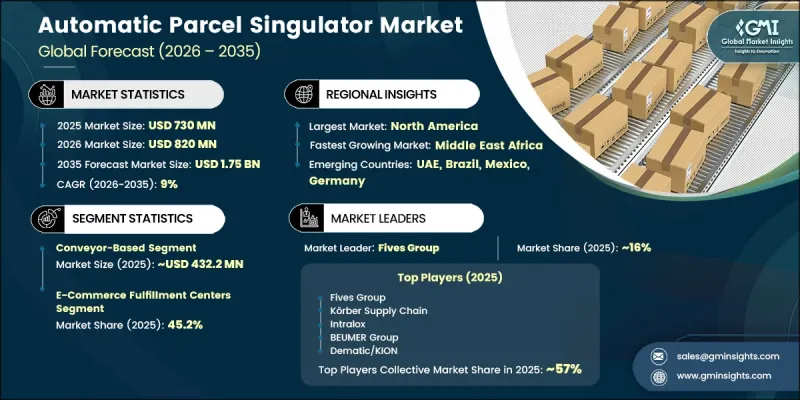
E-Commerce의 지속적인 확대, 소포 처리량 증가, 그리고 주문 이행 및 유통 네트워크의 현대화로 인해 자동 자재 취급 솔루션 도입이 가속화되면서 해당 시장은 강력한 성장을 이루고 있습니다. 주문 처리 속도 향상, 분류 정확도 제고, 업무 효율 개선에 대한 수요가 높아짐에 따라 물류 사업자들의 첨단 소포 처리 기술에 대한 투자가 촉진되고 있습니다. 심화되는 인력 부족과 임금 상승 압력으로 인해 기업들은 수작업에 의존하는 소포 투입 공정을 일관되게 빠른 성능을 발휘할 수 있는 자동화 시스템으로 대체하는 움직임을 더욱 가속화하고 있습니다. 또한 머신비전, 인공지능, 로봇 공학 및 지능형 센싱 기술의 지속적인 발전으로 소포 식별, 분류 및 처리 능력이 크게 향상되고 있습니다. 기업들은 운영 비용을 절감하면서 생산성과 서비스 품질을 향상시키는 확장성이 뛰어난 자동화 솔루션에 점점 더 집중하고 있습니다. 대규모 물류 허브의 지속적인 개발, 제3자 물류(3PL) 사업의 확대, 그리고 스마트 창고에 대한 투자 증가는 자동 소포 분리기 시장에 계속해서 호재를 창출하고 있습니다. 공급망 자동화가 진행되고 신속한 배송에 대한 고객의 기대가 계속 높아지는 가운데, 지능형 소포 분리 시스템에 대한 수요는 예측 기간 동안 견조한 추세를 보일 것으로 전망됩니다.
| 시장 범위 | |
|---|---|
| 시작 연도 | 2025년 |
| 예측 기간 | 2026-2035년 |
| 초기 시장 규모 | 7억 3,000만 달러 |
| 예측액 | 17억 5,000만 달러 |
| CAGR | 9% |
로봇식 싱귤레이터 부문은 2025년에 15.8%의 점유율을 차지했으며, 2035년까지 30%에 달할 것으로 전망됩니다. 이는 시간당 1,000-2,500개의 소포를 처리하는 시설을 위해 설계된 단일 팔형 로봇 시스템입니다. 같은 해 시장에서 멀티암형 로봇 시스템은 7%의 점유율을 차지하고 있으며, 더 큰 처리 능력을 갖추고 대규모 자동 분류 작업에 대응할 수 있어 계속해서 높은 평균 판매 가격을 유지하고 있습니다.
우편·택배 서비스 부문은 2025년에 29.1%의 점유율을 차지했으며, 그 규모는 약 3억 3,000만 달러였습니다. 소포 처리량의 확대에 따라, 또한 각 기관이 처리 효율 향상, 처리 능력 증강, 그리고 점점 더 복잡해지는 소포 흐름에 대응하기 위해 최신 자동화 기술에 대한 투자를 확대함에 따라, 수요는 민간 물류 사업자로 계속 이동하고 있습니다.
북미 자동 소포 싱귤레이터 시장은 2025년에 36.5%의 점유율을 차지했으며, 2035년까지 5억 4,350만 달러에 달할 것으로 전망됩니다. 이 지역의 성장은 창고 자동화에 대한 지속적인 투자, 물류 인프라 확충, 그리고 배송 센터 전반에 걸친 첨단 소포 처리 시스템 도입 확대에 힘입고 있습니다. 지능형 자동화 기술의 적극적인 도입에 더해, 주문 처리 업무의 지속적인 현대화와 스마트 물류 시설에 대한 투자 확대가 맞물려 해당 지역 전체의 시장 확장을 지속적으로 견인하고 있습니다.
자주 묻는 질문
목차
제1장 조사 방법과 범위
제2장 주요 요약
제3장 업계 인사이트
제4장 경쟁 구도
제5장 시장 추정 및 예측 : 기술 유형별, 2022-2035년
제6장 시장 추정 및 예측 : 자동화별, 2022-2035년
제7장 시장 추정 및 예측 : 소포 유형별, 2022-2035년
제8장 시장 추정 및 예측 : 최종 용도별, 2022-2035년
제9장 시장 추정 및 예측 : 유통 채널별, 2022-2035년
제10장 시장 추정 및 예측 : 지역별, 2022-2035년
제11장 기업 개요
KSM 26.08.05The Global Automatic Parcel Singulator Market was valued at USD 730 million in 2025 and is estimated to grow at a CAGR of 9% to reach USD 1.75 billion by 2035.
The market is witnessing strong growth as the continuous expansion of e-commerce, increasing parcel volumes, and the modernization of fulfillment and distribution networks accelerate the adoption of automated material handling solutions. Rising demand for faster order processing, higher sorting accuracy, and improved operational efficiency is encouraging logistics providers to invest in advanced parcel handling technologies. Growing labor shortages and increasing wage pressures are further driving companies to replace manual parcel induction processes with automated systems capable of delivering consistent high-speed performance. In addition, continuous advancements in machine vision, artificial intelligence, robotics, and intelligent sensing technologies are significantly improving parcel identification, orientation, and throughput capabilities. Businesses are increasingly focusing on scalable automation solutions that reduce operational costs while improving productivity and service quality. The ongoing development of large distribution hubs, expanding third-party logistics operations, and increasing investment in smart warehouses continue to create favorable opportunities for the automatic parcel singulator market. As supply chains become more automated and customer expectations for rapid deliveries continue to rise, demand for intelligent parcel singulation systems is expected to remain strong throughout the forecast period.
| Market Scope | |
|---|---|
| Start Year | 2025 |
| Forecast Year | 2026-2035 |
| Start Value | $730 Million |
| Forecast Value | $1.75 Billion |
| CAGR | 9% |
The robotic singulators segment held 15.8% share in 2025 and is projected to reach 30% by 2035. Single-arm robotic systems, designed for facilities processing between 1,000 and 2,500 parcels per hour. Multi-arm robotic systems accounted for 7% of the market during the same year and continue to generate higher average selling prices because of their ability to manage greater throughput and support large-scale automated sorting operations.
The postal and courier services segment held 29.1% share in 2025, representing approximately USD 330 million. Demand continues to shift toward private logistics providers as parcel volumes expand and organizations invest in modern automation technologies to improve processing efficiency, increase throughput capacity, and accommodate increasingly complex parcel flows.
North America Automatic Parcel Singulator Market accounted for 36.5% share in 2025 and is projected to reach USD 543.5 million by 2035. Regional growth is supported by continuous investments in warehouse automation, expanding logistics infrastructure, and increasing deployment of advanced parcel handling systems across distribution centers. Strong adoption of intelligent automation technologies, together with ongoing modernization of fulfillment operations and rising investment in smart logistics facilities, continues to strengthen market expansion throughout the region.
Key players in the global automatic parcel singulator market include BEUMER Group, Vanderlande Industries, Dematic (KION Group), Honeywell Intelligrated, Korber Supply Chain, Fives Group - Smart Automation Solutions, Intralox LLC, Wayzim Technology Co., Ltd., Kengic Intelligent Equipment, Falcon Autotech, Isitec International, NPI (National Postal Industries), Daifuku Co., Ltd., Interroll Group, robominds GmbH, Photoneo (Zebra Technologies), Hangzhou YaoLi Tech Co., Ltd., Realkey Machinery (RKSORT), Guangdong Siwun Logistics Equipment, Hangzhou Sunnen Technology, Bowe Systec GmbH. Companies operating in the automatic parcel singulator market are strengthening their competitive position by investing in advanced robotics, artificial intelligence, machine vision, and intelligent automation technologies to improve parcel handling accuracy and operational efficiency. Manufacturers are expanding product portfolios with scalable, modular systems capable of supporting varying throughput requirements across logistics facilities. Strategic partnerships with warehouse automation providers, logistics companies, and system integrators are helping businesses broaden their customer base and accelerate technology adoption.
Table of Contents
Chapter 1 Methodology & Scope
- 1.1 Research approach
- 1.2 Quality Commitments
- 1.2.1 GMI AI policy & data integrity commitment
- 1.2.1.1 Source consistency protocol
- 1.2.1 GMI AI policy & data integrity commitment
- 1.3 Research Trail & Confidence Scoring
- 1.3.1 Research Trail Components
- 1.3.2 Scoring Components
- 1.4 Data Collection
- 1.4.1 Partial list of primary sources
- 1.5 Data mining sources
- 1.5.1 Paid sources
- 1.5.1.1 Sources, by region
- 1.5.1 Paid sources
- 1.6 Base estimates and calculations
- 1.6.1 Base year calculation for any one approach
- 1.7 Forecast model
- 1.7.1 Quantified market impact analysis
- 1.7.1.1 Mathematical impact of growth parameters on forecast
- 1.7.1 Quantified market impact analysis
- 1.8 Research transparency addendum
- 1.8.1 Source attribution framework
- 1.8.2 Quality assurance metrics
- 1.8.3 Our commitment to trust
Chapter 2 Executive Summary
- 2.1 Industry 360° synopsis
- 2.2 Key market trends
- 2.2.1 Region
- 2.2.2 Technology Type
- 2.2.3 Automation
- 2.2.4 Parcel Type
- 2.2.5 End-use
- 2.2.6 Distribution channel
Chapter 3 Industry Insights
- 3.1 Industry ecosystem analysis
- 3.1.1 Supplier landscape
- 3.1.2 Profit margin
- 3.1.3 Value addition at each stage
- 3.1.4 Factor affecting the value chain
- 3.2 Industry impact forces
- 3.2.1 Growth drivers
- 3.2.1.1 Rapid growth of e-commerce parcel volumes & same-day delivery
- 3.2.1.2 Acute warehouse labor shortages & rising wage inflation accelerating automation ROI
- 3.2.1.3 Expansion of high-throughput fulfillment & distribution center infrastructure
- 3.2.1.4 Increasing adoption of ai, machine vision & iot in smart warehouse operations
- 3.2.2 Industry pitfalls & challenges
- 3.2.2.1 High capital expenditure & long payback periods for sme operators
- 3.2.2.2 System integration complexity with legacy warehouse management systems (wms)
- 3.2.2.3 Space constraints & retrofitting challenges in existing facilities
- 3.2.3 Opportunities
- 3.2.3.1 Untapped Demand in Emerging Markets (Southeast Asia, Latin America, Middle East)
- 3.2.3.2 Growing Adoption of Robotics-as-a-Service (raas) & Leasing Models Lowering Entry Barriers
- 3.2.3.3 Airport & Cargo Terminal Singulation
- 3.2.3.4 Soft-Pack & Polybag Singulation
- 3.2.1 Growth drivers
- 3.3 Growth potential analysis
- 3.4 Supply Chain Analysis
- 3.4.1 Critical Component Sourcing (Vision Sensors, Servo Motors, Control Systems)
- 3.4.2 Supply Chain Disruption Risk Assessment
- 3.4.3 Nearshoring & Localization Trends in Component Supply
- 3.5 Future market trends
- 3.6 Technology and innovation landscape
- 3.6.1 Next-Generation AI & Computer Vision in Parcel Singulation
- 3.6.2 Robotics & Collaborative Automation Trends
- 3.6.3 IoT Integration & Real-Time Performance Monitoring
- 3.6.4 Edge Computing & Predictive Maintenance Technologies
- 3.6.5 Sustainability-Driven Design Innovations (Energy-Efficient Drives, Low-Noise Systems)
- 3.7 Regulatory landscape
- 3.7.1 Occupational Safety & Machinery Directives (EU Machinery Regulation, OSHA)
- 3.7.2 Electromagnetic Compatibility (EMC) & CE/UL Certification Requirements
- 3.7.3 Environmental & Energy Efficiency Regulations (ErP Directive, ISO 14001)
- 3.7.4 Emerging AI & Autonomous Systems Regulations Impacting Logistics Automation
- 3.8 Trade data analysis (HS Code)
- 3.8.1 Import/Export Volume & Value Trends
- 3.8.2 Key Trade Corridors & Tariff Impact (US-China, EU-Asia) (Driven by Primary Research)
- 3.9 Impact of AI & generative AI on the market
- 3.9.1 AI-Driven Disruption of Existing Conveyor-Based Singulation Models
- 3.9.2 GenAI Use Cases & Adoption Roadmap by Segment (Predictive Maintenance, Dynamic Flow Optimization, Defect Detection)
- 3.9.3 Risks, Limitations & Regulatory Considerations for AI in Parcel Handling
- 3.10 Pricing Analysis
- 3.10.1 Historical Price Trend Analysis by System Type (Driven by Primary Research)
- 3.10.2 Pricing Strategy by Player Type (Premium / Value / Cost-plus) (Driven by Primary Research)
- 3.10.3 Total Cost of Ownership (TCO) Framework
- 3.11 Porter's analysis
- 3.12 PESTEL analysis
Chapter 4 Competitive Landscape, 2025
- 4.1 Introduction
- 4.2 Company market share analysis
- 4.3 Company matrix analysis
- 4.4 Competitive analysis of major market players
- 4.5 Competitive positioning matrix
- 4.6 Key developments
- 4.6.1 Mergers & acquisitions
- 4.6.2 Partnerships & collaborations
- 4.6.3 New product launches
- 4.6.4 Expansion plans
Chapter 5 Market Estimates & Forecast, By Technology Type, 2022 - 2035, (USD Million) (Thousand Units)
- 5.1 Key Trends
- 5.2 Conveyor-Based Singulators
- 5.2.1 Belt-Driven Singulators
- 5.2.2 Roller-Based Singulators
- 5.2.3 Linear Singulators
- 5.2.4 Rotary Singulators
- 5.2.5 Tilt-Tray Singulators
- 5.2.6 Pusher-Type Singulators
- 5.3 Robotic Singulators
- 5.3.1 Single-Arm Robotic Singulators
- 5.3.2 Multi-Arm Robotic Singulators
- 5.4 AI Vision-Guided Singulators
- 5.4.1 2D Vision-Based Systems
- 5.4.2 3D Vision-Based Systems
- 5.5 Hybrid Singulators
Chapter 6 Market Estimates & Forecast, By Automation, 2022 - 2035, (USD Million) (Thousand Units)
- 6.1 Key Trends
- 6.2 Fully Automated
- 6.3 Semi-Automated
- 6.4 AI-Enabled/Intelligent
Chapter 7 Market Estimates & Forecast, By Parcel Type, 2022 - 2035, (USD Million) (Thousand Units)
- 7.1 Key Trends
- 7.2 Small Parcels & Polybags
- 7.3 Standard Parcels & Cartons
- 7.4 Large & Oversized Parcels
- 7.5 Flats & Envelopes
- 7.6 Irregular & Odd-Shaped Items
Chapter 8 Market Estimates & Forecast, By End-use, 2022 - 2035, (USD Million) (Thousand Units)
- 8.1 Key Trends
- 8.2 E-commerce Fulfillment Centers
- 8.2.1 Pure-Play E-commerce Operators
- 8.2.2 Omnichannel Retail Fulfillment
- 8.3 Postal & Courier Services
- 8.3.1 National Postal Operators
- 8.3.2 Private Express & Courier Companies
- 8.4 Third-Party Logistics (3PL) & Distribution Hubs
- 8.5 Retail Distribution Centers
- 8.6 Airports & Cargo Terminals
- 8.7 Others (Manufacturing, Pharmaceutical, Industrial)
Chapter 9 Market Estimates & Forecast, By Distribution Channel, 2022 - 2035, (USD Million) (Thousand Units)
- 9.1 Key Trends
- 9.2 Direct Sales
- 9.3 System Integrators & Value-Added Resellers (VARs)
- 9.4 Distributors & Resellers
- 9.5 Online & Digital Sales Platforms
Chapter 10 Market Estimates & Forecast, By Region, 2022 - 2035, (USD Million) (Thousand Units)
- 10.1 Key Trends
- 10.2 North America
- 10.2.1 U.S.
- 10.2.2 Canada
- 10.3 Europe
- 10.3.1 Germany
- 10.3.2 France
- 10.3.3 UK
- 10.3.4 Italy
- 10.3.5 Spain
- 10.4 Asia Pacific
- 10.4.1 China
- 10.4.2 Japan
- 10.4.3 India
- 10.4.4 Australia
- 10.4.5 South Korea
- 10.5 Latin America
- 10.5.1 Brazil
- 10.5.2 Mexico
- 10.5.3 Argentina
- 10.6 MEA
- 10.6.1 Saudi Arabia
- 10.6.2 UAE
- 10.6.3 South Africa
Chapter 11 Company Profiles
- 11.1 Global Leaders
- 11.1.1 BEUMER Group
- 11.1.2 Fives Group - Smart Automation Solutions
- 11.1.3 Korber Supply Chain
- 11.1.4 Vanderlande Industries
- 11.1.5 Dematic (KION Group)
- 11.1.6 Intralox LLC
- 11.1.7 Honeywell Intelligrated
- 11.2 Regional Players
- 11.2.1 Wayzim Technology Co., Ltd.
- 11.2.2 Kengic Intelligent Equipment
- 11.2.3 Falcon Autotech
- 11.2.4 Isitec International
- 11.2.5 NPI (National Postal Industries)
- 11.2.6 Daifuku Co., Ltd
- 11.2.7 Interroll Group
- 11.3 Emerging Players
- 11.3.1 robominds GmbH
- 11.3.2 Photoneo (Zebra Technologies)
- 11.3.3 Hangzhou YaoLi Tech Co., Ltd.
- 11.3.4 Realkey Machinery (RKSORT)
- 11.3.5 Guangdong Siwun Logistics Equipment
- 11.3.6 Hangzhou Sunnen Technology
- 11.3.7 Bowe Systec GmbH


