

|
시장보고서
상품코드
2101891
척추 로봇 수술 시장 기회, 성장 촉진요인, 업계 동향 분석 및 예측(2026-2035년)Spine Robotic Surgery Market Opportunity, Growth Drivers, Industry Trend Analysis, and Forecast 2026 - 2035 |
||||||

세계의 척추 로봇 수술 시장은 2025년에 4억 8,740만 달러 규모에 달하고, 2035년까지 CAGR 12.6%로 성장하여 16억 달러에 달할 것으로 추정됩니다.
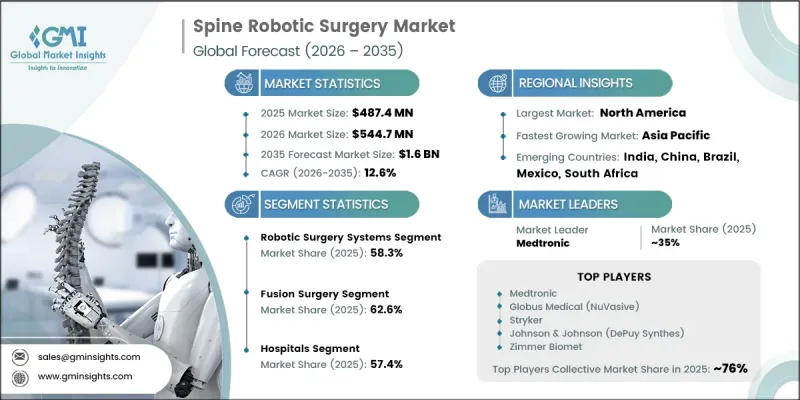
의료 서비스 제공자들이 수술의 정확도와 환자 예후를 개선하기 위해 첨단 수술 기술을 점점 더 많이 도입함에 따라, 척추 로봇 수술 시장은 꾸준한 성장을 이루고 있습니다. 최소침습 수술법에 대한 수요 증가, 의료 분야에 대한 투자 확대, 그리고 척추 질환 유병률의 증가가 시장 확장을 위한 호재를 계속해서 창출하고 있습니다. 로봇 보조 척추 수술은 지능형 로봇 플랫폼과 첨단 내비게이션 기술을 결합하여 외과의가 복잡한 수술을 더 높은 정밀도, 일관성 및 제어력으로 수행할 수 있도록 지원합니다. 이 기술은 임플란트의 정확한 배치를 지원하고, 수술 계획의 정확도를 높이며, 수술의 편차를 최소화하는 동시에 회복 기간 단축 및 합병증 발생률 감소에도 기여하고 있습니다. 인공지능, 실시간 영상 진단, 내비게이션 기능의 통합을 포함한 지속적인 기술 혁신으로 인해 의료 시설 전반에 걸쳐 로봇 보조 시스템의 도입이 더욱 촉진되고 있습니다. 병원과 전문 외과 센터가 첨단 수술 인프라에 대한 투자를 지속하는 가운데, 척추 로봇 수술 시장은 예측 기간 동안 임상 현장에서의 수용도 증가와 지속적인 혁신에 힘입어 지속적인 성장이 예상됩니다.
| 시장 범위 | |
|---|---|
| 시작 연도 | 2025년 |
| 예측 기간 | 2026-2035년 |
| 시작 시점 시장 규모 | 4억 8,740만 달러 |
| 예측액 | 16억 달러 |
| CAGR | 12.6% |
척추 로봇 수술 시장의 경쟁 구도는 메드트로닉(Medtronic), 글로버스 메디컬(Globus Medical), 스트라이커(Stryker), 존슨 앤 존슨(Johnson & Johnson, DePuy Synthes), 짐머 바이오메트(Zimmer Biomet)와 같은 주요 기업들이 주도하고 있습니다. 이 기업들은 지속적인 제품 개발, 광범위한 국제 사업 전개, 그리고 기술 혁신에 대한 막대한 투자를 통해 시장 내 입지를 지속적으로 강화하고 있습니다. 또한, 최소침습 수술의 보급 확대와 로봇 보조 수술 기술의 지속적인 진화도 시장 확대를 뒷받침하고 있습니다. 영상 진단, 내비게이션 시스템, 인공지능(AI)의 지속적인 개선으로 로봇 플랫폼의 성능, 효율성 및 사용 편의성이 향상되어 의료 제공자들 사이에서 도입이 확대되고 있습니다. 높은 수술 정밀도가 요구되는 척추 수술 건수가 증가하고 있는 점도 첨단 로봇 솔루션에 대한 수요를 더욱 부추기고 있습니다.
로봇 수술 시스템 부문은 기술 발전, 임상 성과 향상, 그리고 매우 복잡한 척추 수술을 지원하는 능력 덕분에 2025년에는 58.3%의 시장 점유율을 차지했습니다. 정밀성을 중시하는 수술 기술에 대한 수요 증가는 의료 기관 전반에 걸친 로봇 시스템 도입을 지속적으로 견인하고 있습니다. 최신 로봇 플랫폼은 첨단 영상 진단, 인공지능, 실시간 내비게이션 기술을 결합하여 임플란트 위치 결정 및 수술 정밀도를 향상시키고 있습니다. 이러한 기능 덕분에 수술의 일관성이 향상되고, 환자 예후 개선이 촉진되며, 수술의 편차가 감소하고, 척추 수술 전반의 효율이 높아집니다.
2025년, 병원 부문은 57.4%의 점유율을 차지했습니다. 이러한 선도적 지위는 첨단 의료 인프라, 전문 수술팀, 그리고 로봇 보조 척추 수술을 수행할 수 있는 통합된 수술 환경에 대한 접근성에 의해 뒷받침되고 있습니다. 첨단 영상 기술, 내비게이션 플랫폼 및 로봇 시스템의 도입으로 인해, 이러한 수술의 주요 제공자로서의 병원의 위상은 더욱 강화되었습니다. 로봇 보조 수술 기술에 대한 지속적인 투자가 예측 기간 동안 이 부문의 지속적인 성장을 뒷받침할 것으로 예상됩니다.
2025년, 북미의 척추 로봇 수술 시장은 53.9%의 점유율을 차지했습니다. 이 지역은 첨단 수술 기술에 대한 강력한 수요, 막대한 의료비 지출, 그리고 로봇 보조 수술의 채택 확대에 힘입어 계속해서 업계를 선도하고 있습니다. 척추 중재술이 필요한 환자 수의 증가와 더불어, 혁신적인 의료 기술 및 첨단 의료 인프라에 대한 지속적인 투자가 맞물려 이 지역 전체의 시장 성장을 지속적으로 뒷받침하고 있습니다.
자주 묻는 질문
목차
제1장 조사 방법
제2장 주요 요약
제3장 업계 인사이트
제4장 경쟁 구도
제5장 시장 추정 및 예측 : 제품 유형별, 2022-2035년
제6장 시장 추정 및 예측 : 용도별, 2022-2035년
제7장 시장 추정 및 예측 : 최종 용도별, 2022-2035년
제8장 시장 추정 및 예측 : 지역별, 2022-2035년
제9장 기업 개요
KSM 26.08.06The Global Spine Robotic Surgery Market was valued at USD 487.4 million in 2025 and is estimated to grow at a CAGR of 12.6% to reach USD 1.6 billion by 2035.
The spine robotic surgery market is experiencing steady growth as healthcare providers increasingly adopt advanced surgical technologies to improve procedural accuracy and patient outcomes. Rising demand for minimally invasive surgical techniques, increasing healthcare investments, and the growing incidence of spinal conditions continue to create favorable opportunities for market expansion. Robotic-assisted spine surgery combines intelligent robotic platforms with advanced navigation technologies, enabling surgeons to perform complex procedures with greater precision, consistency, and control. The technology supports improved implant placement, enhances surgical planning, and minimizes procedural variability while contributing to shorter recovery periods and reduced complication rates. Continuous technological advancements, including the integration of artificial intelligence, real-time imaging, and navigation capabilities, are further strengthening the adoption of robotic-assisted systems across healthcare facilities. As hospitals and specialized surgical centers continue to invest in advanced surgical infrastructure, the spine robotic surgery market is expected to witness sustained growth, supported by increasing clinical acceptance and ongoing innovation throughout the forecast period.
| Market Scope | |
|---|---|
| Start Year | 2025 |
| Forecast Year | 2026-2035 |
| Start Value | $487.4 Million |
| Forecast Value | $1.6 Billion |
| CAGR | 12.6% |
The competitive landscape of the spine robotic surgery market is led by companies such as Medtronic, Globus Medical, Stryker, Johnson & Johnson (DePuy Synthes), and Zimmer Biomet. These organizations continue to strengthen their market positions through continuous product development, broad international operations, and significant investments in technological advancement. Market expansion has also been supported by the increasing adoption of minimally invasive surgical procedures and the ongoing evolution of robotic-assisted surgical technologies. Continuous improvements in imaging, navigation systems, and artificial intelligence have enhanced the performance, efficiency, and accessibility of robotic platforms, encouraging wider adoption across healthcare providers. The growing number of spinal procedures requiring high surgical precision continues to reinforce demand for advanced robotic solutions.
The robotic surgery systems segment accounted for 58.3% share in 2025 owing to technological advancements, improved clinical outcomes, and its ability to support highly complex spinal procedures. Increasing demand for precision-focused surgical technologies continues to drive the adoption of robotic systems across healthcare facilities. Modern robotic platforms combine advanced imaging, artificial intelligence, and real-time navigation technologies to improve implant positioning and surgical accuracy. These capabilities enhance procedural consistency, support better patient outcomes, reduce surgical variability, and improve overall efficiency during spinal procedures.
The hospitals segment held 57.4% share in 2025. Their leadership is supported by access to advanced medical infrastructure, specialized surgical teams, and integrated operating environments capable of performing robotic-assisted spinal procedures. The adoption of sophisticated imaging technologies, navigation platforms, and robotic systems has further strengthened the position of hospitals as the primary providers of these procedures. Continued investments in robotic-assisted surgical technologies are expected to support sustained segment growth throughout the forecast period.
North America Spine Robotic Surgery Market held 53.9% share in 2025. The region continues to lead the industry due to strong demand for advanced surgical technologies, substantial healthcare expenditures, and increasing adoption of robotic-assisted procedures. A growing patient population requiring spinal interventions, combined with continued investment in innovative medical technologies and advanced healthcare infrastructure, continues to support market growth across the region.
Prominent companies operating in the global spine robotic surgery market include B. Braun, Brainlab, Curexo, Globus Medical (NuVasive), Intuitive Surgical, Johnson & Johnson (DePuy Synthes), Medtronic plc, Orthofix Medical, Siemens Healthineers, Stryker Corporation, Surgical Theater, Surgivisio, Tinavi Medical Technologies, and Zimmer Biomet. Companies operating in the spine robotic surgery market are reinforcing their market position through continuous innovation, strategic collaborations, and expansion of advanced robotic technology portfolios. Industry participants are investing heavily in research and development to improve robotic precision, navigation capabilities, artificial intelligence integration, and surgical workflow efficiency. Many companies are expanding their global footprint through partnerships, acquisitions, and distribution agreements while strengthening relationships with healthcare providers and academic institutions. Manufacturers are also focusing on product enhancements, software upgrades, surgeon training programs, and clinical evidence generation to encourage broader adoption.
Table of Contents
Chapter 1 Research Methodology
- 1.1 Research approach
- 1.2 Quality commitments
- 1.2.1 GMI AI policy & data integrity commitment
- 1.2.1.1 Source consistency protocol
- 1.2.1 GMI AI policy & data integrity commitment
- 1.3 Research trail & confidence scoring
- 1.3.1 Research trail components
- 1.3.2 Scoring components
- 1.4 Data collection
- 1.4.1 Partial list of primary sources
- 1.5 Data mining sources
- 1.5.1 Paid sources
- 1.5.1.1 Sources, by region
- 1.5.1 Paid sources
- 1.6 Base estimates and calculations
- 1.6.1 Base year calculation for any one approach
- 1.7 Forecast model
- 1.7.1 Quantified market impact analysis
- 1.7.1.1 Mathematical impact of growth parameters on forecast
- 1.7.1 Quantified market impact analysis
- 1.8 Research transparency addendum
- 1.8.1 Source attribution framework
- 1.8.2 Quality assurance metrics
- 1.8.3 Our commitment to trust
Chapter 2 Executive Summary
- 2.1 Industry 360° synopsis
- 2.2 Key market trends
- 2.2.1 Regional trends
- 2.2.2 Product type trends
- 2.2.3 Application trends
- 2.2.4 End use trends
- 2.3 CXO perspectives: Strategic imperatives
Chapter 3 Industry Insights
- 3.1 Industry ecosystem analysis
- 3.2 Industry impact forces
- 3.2.1 Growth drivers
- 3.2.1.1 Increasing prevalence of spinal disorders.
- 3.2.1.2 Technological advancements
- 3.2.1.3 Surge in minimally invasive surgical procedures
- 3.2.1.4 Increased healthcare spending
- 3.2.2 Industry pitfalls and challenges
- 3.2.2.1 Complexity of robotic devices
- 3.2.2.2 Stringent regulatory requirements
- 3.2.3 Market opportunities
- 3.2.3.1 Growth potential in developing economies
- 3.2.3.2 Continued investment in research and development for product development
- 3.2.1 Growth drivers
- 3.3 Growth potential analysis
- 3.4 Regulatory landscape (Driven by primary research)
- 3.4.1 North America
- 3.4.2 Europe
- 3.4.3 Asia Pacific
- 3.4.4 Latin America
- 3.4.5 MEA
- 3.5 Technology landscape (Driven by primary research)
- 3.5.1 Current technological trends
- 3.5.2 Emerging technologies
- 3.6 Pricing trend analysis (Driven by primary research)
- 3.7 Future market trends
- 3.8 Patent analysis (Driven by primary research)
- 3.9 Porter's analysis
- 3.10 PESTEL analysis
- 3.11 Impact of AI and Generative AI on the market (Driven by primary research)
- 3.12 Value chain analysis (Driven by primary research)
- 3.13 Consumer insights (Driven by primary research)
- 3.14 Treatment infrastructure & clinical adoption landscape
- 3.15 Gap analysis
Chapter 4 Competitive Landscape, 2025
- 4.1 Introduction
- 4.2 Company matrix analysis
- 4.3 Company market share analysis (Driven by primary research)
- 4.3.1 Global
- 4.3.2 North America
- 4.3.3 Europe
- 4.3.4 Asia Pacific
- 4.4 Competitive positioning matrix
- 4.5 Competitive analysis of major market players
- 4.6 Key developments
- 4.6.1 Mergers & acquisitions
- 4.6.2 Partnerships & collaborations
- 4.6.3 New product launches
- 4.6.4 Expansion plans
Chapter 5 Market Estimates and Forecast, By Product Type, 2022 - 2035 ($ Mn)
- 5.1 Key trends
- 5.2 Robotic surgery systems
- 5.2.1 Fully robotic systems
- 5.2.2 Robotic arm-assisted systems
- 5.3 Surgical navigation systems
- 5.3.1 Electromagnetic navigation systems
- 5.3.2 Optical navigation systems
- 5.3.3 Hybrid navigation systems
- 5.4 Software solutions
- 5.5 Accessories and consumables
Chapter 6 Market Estimates and Forecast, By Application, 2022 - 2035 ($ Mn)
- 6.1 Key trends
- 6.2 Fusion surgery
- 6.3 Non-fusion surgery
Chapter 7 Market Estimates and Forecast, By End Use, 2022 - 2035 ($ Mn)
- 7.1 Key trends
- 7.2 Hospitals
- 7.3 Ambulatory surgical centers
- 7.4 Other end users
Chapter 8 Market Estimates and Forecast, By Region, 2022 - 2035 ($ Mn)
- 8.1 Key trends
- 8.2 North America
- 8.2.1 U.S.
- 8.2.2 Canada
- 8.3 Europe
- 8.3.1 Germany
- 8.3.2 UK
- 8.3.3 France
- 8.3.4 Spain
- 8.3.5 Italy
- 8.3.6 Netherlands
- 8.4 Asia Pacific
- 8.4.1 China
- 8.4.2 Japan
- 8.4.3 India
- 8.4.4 Australia
- 8.4.5 South Korea
- 8.5 Latin America
- 8.5.1 Brazil
- 8.5.2 Mexico
- 8.5.3 Argentina
- 8.6 Middle East and Africa
- 8.6.1 South Africa
- 8.6.2 Saudi Arabia
- 8.6.3 UAE
Chapter 9 Company Profiles
- 9.1 B. Braun
- 9.2 Brainlab
- 9.3 Curexo
- 9.4 Globus Medical (NuVasive)
- 9.5 Intuitive Surgical
- 9.6 Johnson & Johnson (DePuy Synthes)
- 9.7 Medtronic plc
- 9.8 Orthofix Medical
- 9.9 Siemens Healthineers
- 9.10 Stryker Corporation
- 9.11 Surgical Theater
- 9.12 Surgivisio
- 9.13 Tinavi Medical Technologies
- 9.14 Zimmer Biomet


