

|
시장보고서
상품코드
2101900
트럭 탑재 크레인 시장 기회, 성장 촉진요인, 업계 동향 분석 및 예측(2026-2035년)Truck Loader Crane Market Opportunity, Growth Drivers, Industry Trend Analysis, and Forecast 2026 - 2035 |
||||||

세계의 트럭 탑재 크레인 시장은 2025년에 26억 8,000만 달러 규모에 달하고, CAGR 4.7%로 성장하여 2035년까지 41억 9,000만 달러에 달할 것으로 예측됩니다.
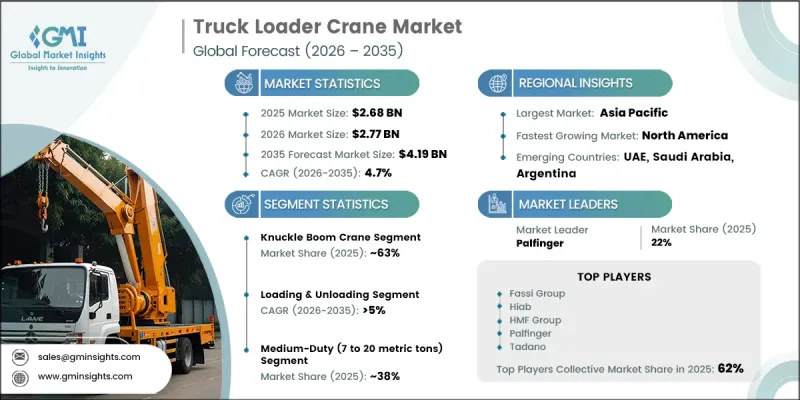
인프라 개발에 대한 투자 확대와 효율적인 자재 취급 솔루션에 대한 수요 증가로 인해 해당 시장은 꾸준한 성장을 이루고 있습니다. 교통망, 도시 개발, 에너지 인프라에 대한 지출이 증가함에 따라, 트럭 탑재 크레인의 유연성과 기동성, 그리고 고정식 크레인 설치 없이도 다양한 용도로 리프팅 작업을 수행할 수 있는 능력이 높이 평가되어 도입이 촉진되고 있습니다. 또한, E-Commerce 활동의 확대와 유통 네트워크 정비에 힘입어 효율적인 물류 솔루션에 대한 수요가 높아지면서, 자체 적재 기능을 갖춘 차량으로의 전환을 더욱 촉진하고 있습니다. 재생에너지 프로젝트의 증가 또한, 장비 이동 및 설치 작업에 사용되는 트럭 탑재 크레인에게 더 많은 기회를 창출하고 있습니다. 게다가 신흥 경제국에서의 항만 현대화 및 물류 센터 개발은 화물 운송 및 산업 활동에서 다목적 리프팅 장비에 대한 수요를 높여 시장의 전망을 강화하고 있습니다.
| 시장 범위 | |
|---|---|
| 시작 연도 | 2025년 |
| 예측 기간 | 2026-2035년 |
| 시작 시점 시장 규모 | 26억 8,000만 달러 |
| 예측액 | 41억 9,000만 달러 |
| CAGR | 4.7% |
너클 붐 부문은 2025년에 63%의 점유율을 차지했으며, 2026년부터 2035년까지 연평균 성장률(CAGR) 5%로 성장할 것으로 전망됩니다. 도시 개발 활동의 활성화와 인구 밀집 지역의 작업 공간 제약으로 인해, 기존 리프팅 장비를 대신하여 너클 붐 방식의 트럭 탑재 크레인 도입이 확대되고 있습니다. 이러한 크레인은 기동성 향상, 관절 가동 범위 확대, 조작 정밀도 향상을 실현하여 제한된 환경에서 자재를 들어 올려야 하는 프로젝트에 적합합니다. 구조물 근처에서도 안정성을 유지하면서 접근이 어려운 위치까지 도달할 수 있는 능력이 건설 및 인프라 분야에서의 활용 확대를 뒷받침하고 있습니다.
2025년에는 적재·하역 부문이 시장 점유율의 35%를 차지했으며, 2026년부터 2035년까지 연평균 성장률(CAGR) 5%로 성장할 것으로 전망됩니다. 전 세계 건설 활동의 확대에 따라 건설자재의 효율적인 운반에 대한 수요가 증가하고 있으며, 이는 로더 크레인의 도입을 촉진하고 있습니다. 이러한 시스템은 별도의 적재 장비에 의존하지 않고 자재 운반 작업을 신속하게 수행함으로써 프로젝트 효율 향상과 운영 비용 절감에 기여합니다. 운송 프로세스의 합리화와 노동 생산성 향상에 기여함에 따라, 건설자재의 자재 취급 분야에서 그 중요성은 점점 더 커지고 있습니다.
아시아태평양의 트럭 탑재 크레인 시장은 2025년에 45%의 점유율을 차지하며 12억 달러의 시장 규모를 기록했습니다. 이 지역의 시장 성장은 급속한 도시 확장과 주택, 상업, 공공 인프라 프로젝트에 대한 투자 증가에 힘입고 있습니다. 개발도상국에서의 건설 활동 확대에 따라, 공간이 제한된 지역에서 하역 요구 사항을 효율적으로 처리할 수 있는 장비에 대한 수요가 발생하고 있습니다. 트럭 탑재 크레인은 신속한 배치 능력, 운영상의 다용도성, 그리고 지역 전반에 걸친 광범위한 도시 건설 및 토목 공사 활동을 지원할 수 있다는 점에서 건설업체들 사이에서 인기가 높아지고 있습니다.
자주 묻는 질문
목차
제1장 조사 방법
제2장 주요 요약
제3장 업계 인사이트
제4장 경쟁 구도
제5장 시장 추정 및 예측 : 크레인별, 2022-2035년
제6장 시장 추정 및 예측 : 적재 능력별, 2022-2035년
제7장 시장 추정 및 예측 : 용도별, 2022-2035년
제8장 시장 추정 및 예측 : 최종 용도별, 2022-2035년
제9장 시장 추정 및 예측 : 연료별, 2022-2035년
제10장 시장 추정 및 예측 : 지역별, 2022-2035년
제11장 기업 개요
KSM 26.08.06The Global Truck Loader Crane Market was valued at USD 2.68 billion in 2025 and is estimated to grow at a CAGR of 4.7% to reach USD 4.19 billion by 2035.
The market is witnessing steady expansion due to increasing investments in infrastructure development and the rising need for efficient material handling solutions. Growing spending on transportation networks, urban development, and energy infrastructure is encouraging the adoption of truck loader cranes due to their flexibility, mobility, and ability to perform lifting operations across multiple applications without requiring fixed crane installations. The rising demand for efficient logistics solutions, supported by expanding e-commerce activities and distribution networks, is further driving the shift toward vehicles equipped with self-loading capabilities. Increasing renewable energy projects are also creating additional opportunities for truck loader cranes used in equipment movement and installation activities. Furthermore, modernization of ports and development of logistics centers across emerging economies are strengthening market prospects by increasing demand for versatile lifting equipment in cargo movement and industrial operations.
| Market Scope | |
|---|---|
| Start Year | 2025 |
| Forecast Year | 2026-2035 |
| Start Value | $2.68 Billion |
| Forecast Value | $4.19 Billion |
| CAGR | 4.7% |
The knuckle boom crane segment held a 63% share in 2025 and is anticipated to grow at a CAGR of 5% from 2026 to 2035. Increasing urban development activities and limited working areas in densely populated regions are encouraging the adoption of knuckle boom truck loader cranes over conventional lifting equipment. These cranes provide enhanced maneuverability, improved articulation, and greater operational accuracy, making them suitable for projects that require lifting materials in restricted environments. Their ability to reach difficult positions while maintaining stability near structures supports their growing preference across construction and infrastructure applications.
The loading and unloading segment accounted for 35% share in 2025 and is expected to grow at a CAGR of 5% between 2026 and 2035. Expanding construction activities worldwide are increasing the requirement for efficient movement of construction materials, which is supporting the adoption of loader cranes. These systems enable faster material transfer operations without depending on separate loading equipment, helping improve project efficiency and reduce operational expenses. Their contribution to streamlined transportation processes and improved workforce productivity is strengthening their importance in construction material handling applications.
Asia Pacific Truck Loader Crane Market accounted for 45% share, generating USD 1.2 billion in 2025. The region's market growth is supported by rapid urban expansion and increasing investments in residential, commercial, and public infrastructure projects. Growing construction activities in developing economies are creating demand for equipment that can efficiently handle lifting requirements in areas with space constraints. Truck loader cranes are gaining popularity among contractors due to their quick deployment capabilities, operational versatility, and ability to support a wide range of urban construction and civil engineering activities across the region.
Major players operating in the global truck loader crane industry include Hiab, Tadano, Palfinger AG, SANY, Cormach, XCMG, Manitex, Zoomlion, Fassi Group, and HMF Group. Companies operating in the truck loader crane market are focusing on strategies such as product innovation, technological advancements, strategic partnerships, geographic expansion, and customized solutions to strengthen their market position. Manufacturers are investing in the development of cranes with improved lifting capacity, enhanced safety features, and better operational efficiency to address evolving customer requirements. Companies are also adopting digital technologies, including smart monitoring systems and automation features, to improve equipment performance and reliability. Expanding distribution networks and strengthening relationships with construction, logistics, and industrial sectors are helping players increase their market reach. Strategic acquisitions, collaborations, and investments in research and development are further enabling companies to enhance their product portfolios and maintain competitiveness in the global market.
Table of Contents
Chapter 1 Methodology
- 1.1 Research approach
- 1.2 Quality Commitments
- 1.2.1 GMI AI policy & data integrity commitment
- 1.2.1.1 Source consistency protocol
- 1.2.1 GMI AI policy & data integrity commitment
- 1.3 Research Trail & Confidence Scoring
- 1.3.1 Research Trail Components
- 1.3.2 Scoring Components
- 1.4 Data Collection
- 1.4.1 Partial list of primary sources
- 1.5 Data mining sources
- 1.5.1 Paid sources
- 1.5.2 Sources, by region
- 1.6 Base estimates and calculations
- 1.6.1 Base year calculation
- 1.7 Forecast model
- 1.7.1 Quantified market impact analysis
- 1.7.1.1 Mathematical impact of growth parameters on forecast
- 1.7.1 Quantified market impact analysis
- 1.8 Research transparency addendum
- 1.8.1 Source attribution framework
- 1.8.2 Quality assurance metrics
- 1.8.3 Our commitment to trust
Chapter 2 Executive Summary
- 2.1 Industry 360° synopsis, 2022 - 2035
- 2.2 Key market trends
- 2.2.1 Regional
- 2.2.2 Crane
- 2.2.3 Lifting Capacity
- 2.2.4 Application
- 2.2.5 End Use
- 2.2.6 Fuel
- 2.3 TAM Analysis, 2026-2035
- 2.4 CXO perspectives: Strategic imperatives
Chapter 3 Industry Insights
- 3.1 Industry ecosystem analysis
- 3.1.1 Supplier landscape
- 3.1.2 Profit margin analysis
- 3.1.3 Cost structure
- 3.1.4 Value addition at each stage
- 3.1.5 Factor affecting the value chain
- 3.1.6 Disruptions
- 3.2 Industry impact forces
- 3.2.1 Growth drivers
- 3.2.1.1 Growing global construction & infrastructure investment driving fleet demand
- 3.2.1.2 E-commerce expansion fueling last-mile logistics & self-loading truck adoption
- 3.2.1.3 Renewable energy buildout (wind, solar) requiring heavy-lift truck crane solutions
- 3.2.1.4 Rising port & terminal development across Asia Pacific & Middle East
- 3.2.2 Industry pitfalls and challenges
- 3.2.2.1 High capital expenditure & total cost of ownership limiting SME adoption
- 3.2.2.2 Tightening emission regulations constraining diesel-hydraulic crane sales
- 3.2.2.3 Skilled operator shortage & safety certification barriers
- 3.2.3 Market opportunities
- 3.2.3.1 Electrification & hybridization of loader cranes
- 3.2.3.2 Smart/connected crane technology creating new aftermarket revenue streams
- 3.2.3.3 Emerging market infrastructure development
- 3.2.3.4 Fleet rental model expansion reducing entry barriers for small operators
- 3.2.1 Growth drivers
- 3.3 Growth potential analysis
- 3.4 Technology and innovation landscape
- 3.4.1 Current technological trends
- 3.4.2 Emerging technologies
- 3.5 Price analysis (Driven by Primary Research)
- 3.5.1 Historical Price Trend Analysis
- 3.5.2 Pricing Strategy by Player Type (Premium / Value / Cost-plus)
- 3.6 Regulatory landscape
- 3.6.1 North America
- 3.6.1.1 Environmental Protection Agency (EPA)
- 3.6.1.2 Occupational Safety and Health Administration (OSHA)
- 3.6.1.3 U.S. Department of Transportation (DOT)
- 3.6.1.4 National Highway Traffic Safety Administration (NHTSA)
- 3.6.1.5 Canadian Standards Association (CSA) - Crane Safety Standards
- 3.6.2 Europe
- 3.6.2.1 EU Machinery Regulation (EU) 2023/1230
- 3.6.2.2 CE Marking Compliance
- 3.6.2.3 EN 12999 - Loader Cranes Safety Standard
- 3.6.2.4 EN 13000 - Mobile Cranes Safety Standard
- 3.6.2.5 EU Stage V Emission Regulation for Non-Road Mobile Machinery
- 3.6.3 Asia Pacific
- 3.6.3.1 China Compulsory Certification (CCC)
- 3.6.3.2 GB/T Standards for Truck-Mounted and Loader Cranes (China)
- 3.6.3.3 Indian Central Motor Vehicle Rules (CMVR)
- 3.6.3.4 Bureau of Indian Standards (BIS) - Crane and Lifting Equipment Standards
- 3.6.3.5 Japanese Industrial Standards (JIS) for Cranes
- 3.6.3.6 Australian Design Rules (ADR) for Heavy Vehicles
- 3.6.4 Latin America
- 3.6.4.1 Brazilian National Institute of Metrology (INMETRO)
- 3.6.4.2 Brazilian National Traffic Council (CONTRAN)
- 3.6.4.3 ABNT Standards for Cranes and Lifting Equipment
- 3.6.4.4 Mexican Official Standards (NOM) for Commercial Vehicles and Lifting Equipment
- 3.6.5 Middle East & Africa
- 3.6.5.1 GCC Standardization Organization (GSO)
- 3.6.5.2 Saudi Standards, Metrology and Quality Organization (SASO)
- 3.6.5.3 Emirates Authority for Standardization and Metrology (ESMA/UAE Standards)
- 3.6.1 North America
- 3.7 Trade data analysis (Driven by Paid Research)
- 3.7.1 Import/export volume & value trends
- 3.7.2 Key trade corridors & tariff impact
- 3.8 Impact of AI & generative AI on the market
- 3.8.1 AI-driven disruption of existing business models
- 3.8.2 GenAI use cases & adoption roadmap by segment
- 3.8.3 Risks, limitations & regulatory considerations
- 3.9 Capacity & production landscape (Driven by Primary Research)
- 3.9.1 Installed capacity by region & key producer
- 3.9.2 Capacity utilization rates & expansion pipelines
- 3.10 Cost breakdown analysis
- 3.11 Patent analysis (Driven by Primary Research)
- 3.12 Porter's analysis
- 3.13 PESTEL analysis
- 3.14 Sustainability and environmental aspects
- 3.14.1 Sustainable practices
- 3.14.2 Waste reduction strategies
- 3.14.3 Energy efficiency in production
- 3.14.4 Eco-friendly Initiatives
- 3.14.5 Carbon footprint considerations
- 3.15 Forecast assumptions & scenario analysis (Driven by Primary Research)
- 3.15.1 Base Case - key macro & industry variables driving CAGR
- 3.15.2 Optimistic Scenarios - Favorable macro and industry tailwinds
- 3.15.3 Pessimistic Scenario - Macroeconomic slowdown or industry headwinds
Chapter 4 Competitive Landscape, 2025
- 4.1 Introduction
- 4.2 Company market share analysis
- 4.2.1 North America
- 4.2.2 Europe
- 4.2.3 Asia Pacific
- 4.2.4 LATAM
- 4.2.5 MEA
- 4.3 Competitive analysis of major market players
- 4.4 Competitive positioning matrix
- 4.5 Key developments
- 4.5.1 Mergers & acquisitions
- 4.5.2 Partnerships & collaborations
- 4.5.3 New Product Launches
- 4.5.4 Expansion Plans and funding
- 4.6 Company tier benchmarking
- 4.6.1 Tier classification criteria & qualifying thresholds
- 4.6.2 Tier positioning matrix by revenue, geography & innovation
Chapter 5 Market Estimates & Forecast, By Crane, 2022 - 2035 ($Mn, Units)
- 5.1 Key trends
- 5.2 Knuckle Boom
- 5.3 Stiff Boom
Chapter 6 Market Estimates & Forecast, By Lifting Capacity, 2022 - 2035 ($Mn, Units)
- 6.1 Key trends
- 6.2 Small-duty (Up to 6 Metric Tons)
- 6.3 Medium-duty (7 to 20 Metric Tons)
- 6.4 Big-duty (21 to 80 Metric Tons)
- 6.5 Heavy-duty (Above 80 Metric Tons)
Chapter 7 Market Estimates & Forecast, By Application, 2022 - 2035 ($Mn, Units)
- 7.1 Key trends
- 7.2 Loading & unloading
- 7.3 Lifting & positioning
- 7.4 Pipe & cable laying
- 7.5 Timber & bulk material handling
- 7.6 Waste collection & skip loading
- 7.7 Others
Chapter 8 Market Estimates & Forecast, By End Use, 2022 - 2035 ($Mn, Units)
- 8.1 Key trends
- 8.2 Construction & civil infrastructure
- 8.3 Logistics & transportation
- 8.4 Mining
- 8.5 Oil & gas
- 8.6 Energy & utilities
- 8.7 Forestry & agriculture
- 8.8 Waste management & municipal services
- 8.9 Others
Chapter 9 Market Estimates & Forecast, By Fuel, 2022 - 2035 ($Mn, Units)
- 9.1 Key trends
- 9.2 Diesel
- 9.3 Electric
- 9.4 Hybrid
Chapter 10 Market Estimates & Forecast, By Region, 2022 - 2035 ($Mn, Units)
- 10.1 Key trends
- 10.2 North America
- 10.2.1 US
- 10.2.2 Canada
- 10.3 Europe
- 10.3.1 UK
- 10.3.2 Germany
- 10.3.3 France
- 10.3.4 Italy
- 10.3.5 Spain
- 10.3.6 Russia
- 10.3.7 Nordics
- 10.4 Asia Pacific
- 10.4.1 China
- 10.4.2 India
- 10.4.3 Japan
- 10.4.4 South Korea
- 10.4.5 Southeast Asia
- 10.4.5.1 Indonesia
- 10.4.5.2 Malaysia
- 10.4.5.3 Singapore
- 10.4.5.4 Thailand
- 10.4.5.5 Vietnam
- 10.4.6 ANZ
- 10.5 Latin America
- 10.5.1 Brazil
- 10.5.2 Argentina
- 10.5.3 Mexico
- 10.6 MEA
- 10.6.1 UAE
- 10.6.2 Saudi Arabia
- 10.6.3 South Africa
Chapter 11 Company Profiles
- 11.1 Global Players
- 11.1.1 Cormach
- 11.1.2 CPS Group
- 11.1.3 Fassi
- 11.1.4 Hiab
- 11.1.5 HMF Group
- 11.1.6 Manitex
- 11.1.7 Palfinger
- 11.1.8 SANY
- 11.1.9 Tadano
- 11.1.10 XCMG
- 11.1.11 Zoomlion
- 11.2 Regional Players
- 11.2.1 ACE
- 11.2.2 Furukawa Unic
- 11.2.3 Hidrokon
- 11.2.4 Kanglim
- 11.2.5 PM Group
- 11.2.6 SOOSAN CEBOTICS
- 11.3 Emerging Players
- 11.3.1 Jomac
- 11.3.2 Next Hydraulics
- 11.3.3 Sany Palfinger


