

|
시장보고서
상품코드
2101902
스마트 엘리베이터 시장 기회, 성장 촉진요인, 업계 동향 분석 및 예측(2026-2035년)Smart Elevator Market Opportunity, Growth Drivers, Industry Trend Analysis, and Forecast 2026 - 2035 |
||||||

세계의 스마트 엘리베이터 시장은 2025년에 268억 달러 규모에 달하고, CAGR 8.4%로 성장하여 2035년까지 613억 달러에 달할 것으로 예측됩니다.
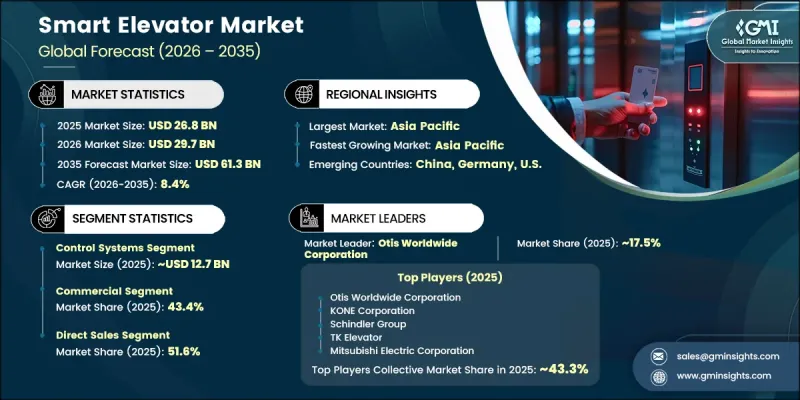
시장의 성장은 전 세계적인 도시화의 가속화와 스마트 시티 인프라에 대한 투자 확대에 힘입어 견인되고 있습니다. 신흥국 및 선진국의 대도시권 인구 증가와 고층 빌딩의 급속한 건설 활동으로 인해 지능형 수직 운송 시스템에 대한 지속적인 수요가 발생하고 있습니다. 개발업체들은 보다 광범위한 스마트 인프라 생태계의 일환으로, 현대식 건물에 커넥티드 엘리베이터 솔루션을 통합하는 움직임을 강화하고 있습니다. 정부가 지원하는 대규모 스마트 시티 구상과 다자간 기구의 자금 지원에 힘입어, 주거, 상업, 공공 시설 각 프로젝트에서의 장기적인 도입이 더욱 가속화되고 있습니다. 동시에 IoT 프레임워크, 인공지능, 클라우드 기반 분석 기술의 발전으로 시스템 효율이 대폭 향상되고 도입 비용이 절감되고 있습니다. 현대의 스마트 엘리베이터는 연결 기능이 내장된 설계가 점점 더 보편화되어, 설치 시점부터 실시간 모니터링, 예측 유지보수, 에너지 최적화가 가능해졌습니다. 이러한 변화를 통해 엘리베이터 업계는 하드웨어 중심의 모델에서 벗어나, 장기적인 운영 효율과 수명주기 전반에 걸친 가치 창출을 뒷받침하는 데이터 주도형 서비스 지향 생태계로 재편되고 있습니다.
| 시장 범위 | |
|---|---|
| 시작 연도 | 2025년 |
| 예측 기간 | 2026-2035년 |
| 시작 시점 시장 규모 | 268억 달러 |
| 예측액 | 613억 달러 |
| CAGR | 8.4% |
제어 시스템 부문은 2025년에 127억 달러를 차지했으며, 2035년까지 연평균 성장률(CAGR) 7.8%로 성장할 것으로 전망됩니다. 이 부문이 주도적인 위치를 차지하고 있는 이유는 승객의 최적 경로 설정, 교통 흐름 관리, 에너지 효율 제어, 예측 유지보수 시스템, 클라우드 기반 모니터링 플랫폼 등 엘리베이터의 지능형 관리에서 매우 중요한 역할을 수행하고 있기 때문입니다. 이러한 기술들은 종합적으로 운영 효율을 향상시키는 동시에, 여러 대의 엘리베이터가 가동되는 환경 전반에서 가동 중단 시간과 에너지 소비를 줄여줍니다.
상업 부문은 2025년에 43.4%의 점유율을 차지했습니다. 이러한 우위는 오피스 복합 시설, 소매 센터, 호텔 및 리조트 시설, 공항, 교통 허브에서의 높은 설치 밀도에 힘입은 것입니다. 스마트 엘리베이터 시스템은 입주자 경험 향상, 운영 비용 절감, 그리고 현대의 지속가능성 및 성능 기준에 부합하는 효율적인 건물 관리 전략을 지원할 수 있기 때문에 상업 인프라에서 널리 채택되고 있습니다.
북미의 스마트 엘리베이터 시장은 2025년에 66억 달러 규모에 도달했으며, 2035년까지 연평균 성장률(CAGR) 8%로 성장할 것으로 전망됩니다. 이 지역이 시장을 주도하고 있는 배경에는 상업용 부동산 개발의 활성화, 노후화된 엘리베이터 시스템의 대규모 현대화, 그리고 에너지 효율, 안전성, 접근성 준수에 초점을 맞춘 규제 요건의 강화가 진행되고 있다는 점을 들 수 있습니다. 미국에서는 지속적인 인프라 업그레이드와 스마트 빌딩 기술의 광범위한 도입으로 인해 계속해서 지역 수요의 주요 견인 역할을 하고 있습니다.
자주 묻는 질문
목차
제1장 조사 방법과 범위
제2장 주요 요약
제3장 업계 인사이트
제4장 경쟁 구도
제5장 시장 추정 및 예측 : 구성요소별, 2022-2035년
제6장 시장 추정 및 예측 : 용도별, 2022-2035년
제7장 시장 추정 및 예측 : 유통 채널별, 2022-2035년
제8장 시장 추정 및 예측 : 지역별, 2022-2035년
제9장 기업 개요
KSM 26.08.06The Global Smart Elevator Market was valued at USD 26.8 billion in 2025 and is estimated to grow at a CAGR of 8.4% to reach USD 61.3 billion by 2035.
Market growth is driven by accelerating urbanization and increasing investments in smart city infrastructure worldwide. Expanding metropolitan populations and rapid high-rise construction activity across emerging and developed economies are creating sustained demand for intelligent vertical transportation systems. Developers are increasingly integrating connected elevator solutions into modern buildings as part of broader smart infrastructure ecosystems. Large-scale government-backed smart city initiatives, along with funding from multilateral institutions, are further reinforcing long-term deployment across residential, commercial, and institutional projects. At the same time, advancements in IoT frameworks, artificial intelligence, and cloud-based analytics are significantly improving system efficiency and reducing deployment costs. Modern smart elevators are increasingly designed with built-in connectivity, enabling real-time monitoring, predictive maintenance, and energy optimization from the point of installation. This transition is reshaping the elevator industry from a hardware-centric model to a data-driven, service-oriented ecosystem that supports long-term operational efficiency and lifecycle value creation.
| Market Scope | |
|---|---|
| Start Year | 2025 |
| Forecast Year | 2026-2035 |
| Start Value | $26.8 Billion |
| Forecast Value | $61.3 Billion |
| CAGR | 8.4% |
The control systems segment accounted for USD 12.7 billion in 2025 and is projected to grow at a CAGR of 7.8% through 2035. This segment leads due to its critical role in managing elevator intelligence, including optimized passenger routing, traffic flow management, energy efficiency controls, predictive maintenance systems, and cloud-enabled monitoring platforms. These technologies collectively enhance operational efficiency while reducing downtime and energy consumption across multi-elevator environments.
The commercial segment held a 43.4% share in 2025. This dominance is driven by high installation density in office complexes, retail centers, hospitality properties, airports, and transport hubs. Smart elevator systems are widely adopted in commercial infrastructure due to their ability to improve tenant experience, reduce operational costs, and support efficient building management strategies aligned with modern sustainability and performance standards.
North America Smart Elevator Market accounted for USD 6.6 billion in 2025 and is projected to grow at a CAGR of 8% through 2035. The region's leadership is supported by strong commercial real estate development, large-scale modernization of aging elevator systems, and increasingly strict regulatory requirements focused on energy efficiency, safety, and accessibility compliance. The United States remains the primary contributor to regional demand due to continuous infrastructure upgrades and widespread adoption of smart building technologies.
Major companies operating in the global smart elevator market include Otis Worldwide Corporation, KONE Corporation, Schindler Group, TK Elevator, Mitsubishi Electric Corporation, Fujitec Co., Ltd., Hyundai Elevator Co., Ltd., Hitachi Ltd., Toshiba Elevator and Building Systems Corporation, Savaria Corporation, Motion Control Engineering, Inc., Liftinsight, Sigma Elevator Company, Robert Bosch GmbH (Smart Building Division), Honeywell International Inc. (Building Technologies), Nidec Corporation (Elevator & Escalator Division), Wittur Group, Yungtay Engineering Co., Ltd., Orona Group, Stannah Group, and Kleemann Hellas S.A. Companies operating in the smart elevator market are focusing on strengthening their competitive position through integration of advanced IoT, AI, and cloud-based technologies that enable predictive maintenance and real-time system optimization. Manufacturers are increasingly shifting toward service-oriented business models that emphasize lifecycle management, remote diagnostics, and performance-based maintenance contracts. Strategic partnerships with real estate developers and smart city planners are helping expand deployment across large infrastructure projects. Firms are also investing in energy-efficient drive systems and regenerative braking technologies to align with sustainability goals and regulatory requirements.
Table of Contents
Chapter 1 Methodology and Scope
- 1.1 Market scope and definition
- 1.2 Research design
- 1.2.1 Research approach
- 1.2.2 Data collection methods
- 1.3 Data mining sources
- 1.3.1 Global
- 1.3.2 Regional/Country
- 1.4 Base estimates and calculations
- 1.4.1 Base year calculation
- 1.4.2 Key trends for market estimation
- 1.5 Primary research and validation
- 1.5.1 Primary sources
- 1.6 Forecast model
- 1.7 Research assumptions and limitations
Chapter 2 Executive Summary
- 2.1 Industry 360° synopsis
- 2.2 Key market trends
- 2.3 Regional
- 2.4 Component
- 2.5 Technology
- 2.6 Application
- 2.7 End user
- 2.8 Distribution channel
Chapter 3 Industry Insights
- 3.1 Industry Ecosystem Analysis
- 3.1.1 Supplier landscape
- 3.1.2 Factor affecting the value chain
- 3.1.3 Profit margin analysis by value chain stage
- 3.1.4 Disruptions
- 3.1.5 Future outlook
- 3.2 Industry impact forces
- 3.2.1 Growth drivers
- 3.2.1.1 Rapid urbanization and growth in high-rise construction activity globally
- 3.2.1.2 Rising investment in smart city and smart building infrastructure
- 3.2.1.3 Increasing adoption of predictive maintenance to reduce operational downtime
- 3.2.2 Pitfalls & Challenges
- 3.2.2.1 High initial installation and modernization costs vs. conventional elevator
- 3.2.2.2 Complex integration challenges with legacy building infrastructure
- 3.2.3 Opportunities
- 3.2.3.1 Large-scale modernization of aging elevator fleets in developed economies
- 3.2.3.2 Smart building and BMS ecosystem expansion creating bundled solution demand
- 3.2.1 Growth drivers
- 3.3 Growth potential analysis
- 3.4 Future market trends
- 3.5 Technology and innovation landscape
- 3.5.1 Current technological trends
- 3.5.2 Emerging technologies
- 3.5.3 IoT-enabled elevator systems
- 3.5.4 AI & machine learning integration
- 3.5.5 Cloud computing & edge computing deployment
- 3.5.6 Destination dispatch technology evolution
- 3.5.7 Regenerative drive & energy recovery systems
- 3.6 Pricing analysis (driven by primary research)
- 3.6.1 Historical price trend analysis
- 3.6.2 Pricing strategy by player type (premium / value / cost-plus)
- 3.7 Regulatory landscape
- 3.7.1 Building safety codes & elevator standards (EN 81, ASME A17.1)
- 3.7.2 Energy efficiency directives & green building certifications (LEED, BREEAM)
- 3.7.3 Cybersecurity regulations for connected building systems
- 3.7.4 Accessibility compliance requirements (ADA, European Accessibility Act)
- 3.8 Trade data analysis (driven by paid database) (HS Code- 8428)
- 3.8.1 Key trade corridors & tariff impact
- 3.8.2 Trade policy changes & regional trade agreements
- 3.9 Supply Chain Analysis
- 3.9.1 Raw material & component sourcing
- 3.9.2 Tier 1 & tier 2 supplier landscape
- 3.9.3 Supply chain risk assessment & disruption scenarios
- 3.10 Impact of AI & generative AI on the market
- 3.10.1 AI-driven disruption of existing business models
- 3.10.2 GenAI use cases & adoption roadmap by segment
- 3.10.3 Risks, limitations & regulatory considerations
- 3.11 Capacity & production landscape (driven by primary research)
- 3.11.1 Installed capacity by region & key producer
- 3.11.2 Capacity utilization rates & expansion pipelines
- 3.12 Porter's five forces analysis
- 3.13 PESTEL analysis
Chapter 4 Competitive Landscape, 2025
- 4.1 Introduction
- 4.2 Company market share analysis
- 4.2.1 By region
- 4.2.1.1 North America
- 4.2.1.2 Europe
- 4.2.1.3 Asia Pacific
- 4.2.1.4 Latin America
- 4.2.1.5 Middle East and Africa
- 4.2.1 By region
- 4.3 Company matrix analysis
- 4.4 Competitive analysis of major market players
- 4.5 Competitive positioning matrix
- 4.6 Key developments
- 4.6.1 Mergers & acquisitions
- 4.6.2 Partnerships & collaborations
- 4.6.3 New product launches
- 4.6.4 Expansion plans
Chapter 5 Market Estimates & Forecast, By Component, 2022-2035 (USD Billion) (Thousand Units)
- 5.1 Key trends
- 5.2 Control systems
- 5.2.1 Destination dispatch systems
- 5.2.2 Energy management software
- 5.2.3 Predictive maintenance algorithms & platforms
- 5.2.4 Drive control units & variable frequency drives (VFDs)
- 5.3 Maintenance systems
- 5.3.1 IoT sensors & condition monitoring modules
- 5.3.2 Remote diagnostics platforms
- 5.3.3 Fault detection & alerting systems
- 5.4 Communication systems
- 5.4.1 IoT connectivity modules (Wi-Fi, 4G/5G, BLE)
- 5.4.2 Cloud-based data transfer infrastructure
- 5.4.3 Building management system (BMS) interfaces
- 5.4.4 Remote monitoring dashboards & analytics portals
Chapter 6 Market Estimates & Forecast, By Application, 2022-2035 (USD Billion) (Thousand Units)
- 6.1 Key trends
- 6.2 Commercial
- 6.2.1 Office buildings & corporate campuses
- 6.2.2 Retail malls & shopping centers
- 6.2.3 Hotels & hospitality complexes
- 6.2.4 Airports & transportation hubs
- 6.3 Residential
- 6.3.1 Multi-family apartment towers
- 6.3.2 Luxury high-rise condominiums
- 6.3.3 Mixed-use residential complexes
- 6.4 Institutional
- 6.4.1 Hospitals & healthcare facilities
- 6.4.2 Government buildings & public infrastructure
- 6.4.3 Educational campuses & universities
- 6.5 Industrial
- 6.5.1 Manufacturing facilities & warehouses
- 6.5.2 Logistics hubs & distribution centers
Chapter 7 Market Estimates & Forecast, By Distribution Channel, 2022-2035 (USD Billion) (Thousand Units)
- 7.1 Key trends
- 7.2 Direct sales
- 7.3 Indirect sales
Chapter 8 Market Estimates & Forecast, By Region, 2022-2035 (USD Billion) (Thousand Units)
- 8.1 Key trends
- 8.2 North America
- 8.2.1 U.S.
- 8.2.2 Canada
- 8.3 Europe
- 8.3.1 UK
- 8.3.2 Germany
- 8.3.3 France
- 8.3.4 Italy
- 8.3.5 Spain
- 8.3.6 Russia
- 8.4 Asia Pacific
- 8.4.1 China
- 8.4.2 India
- 8.4.3 Japan
- 8.4.4 South Korea
- 8.4.5 Australia
- 8.5 Latin America
- 8.5.1 Brazil
- 8.5.2 Mexico
- 8.6 MEA
- 8.6.1 South Africa
- 8.6.2 Saudi Arabia
- 8.6.3 UAE
Chapter 9 Company Profiles
- 9.1 Global Players
- 9.1.1 Otis Worldwide Corporation
- 9.1.2 KONE Corporation
- 9.1.3 Schindler Group
- 9.1.4 TK Elevator
- 9.1.5 Mitsubishi Electric Corporation
- 9.2 Regional players
- 9.2.1 Fujitec Co., Ltd.
- 9.2.2 Hyundai Elevator Co., Ltd.
- 9.2.3 Hitachi, Ltd.
- 9.2.4 Toshiba Elevator and Building Systems Corporation
- 9.2.5 Savaria Corporation
- 9.2.6 Motion Control Engineering, Inc.
- 9.2.7 Liftinsight
- 9.2.8 Sigma Elevator Company
- 9.2.9 Robert Bosch GmbH (Smart Building Division)
- 9.2.10 Honeywell International Inc. (Building Technologies)
- 9.3 Emerging players
- 9.3.1 Nidec Corporation (Elevator & Escalator Division)
- 9.3.2 Wittur Group
- 9.3.3 Yungtay Engineering Co., Ltd.
- 9.3.4 Orona Group
- 9.3.5 Stannah Group
- 9.3.6 Kleemann Hellas S.A.


