

|
시장보고서
상품코드
2101928
매립지 가스 시장 기회, 성장 촉진요인, 업계 동향 분석 및 예측(2026-2035년)Landfill Gas Market Opportunity, Growth Drivers, Industry Trend Analysis, and Forecast 2026 - 2035 |
||||||

세계의 매립지 가스(LFG) 시장은 2025년에 39억 달러 규모에 달하고, CAGR 5.8%로 성장하여 2035년까지 68억 달러에 달할 것으로 추정됩니다.
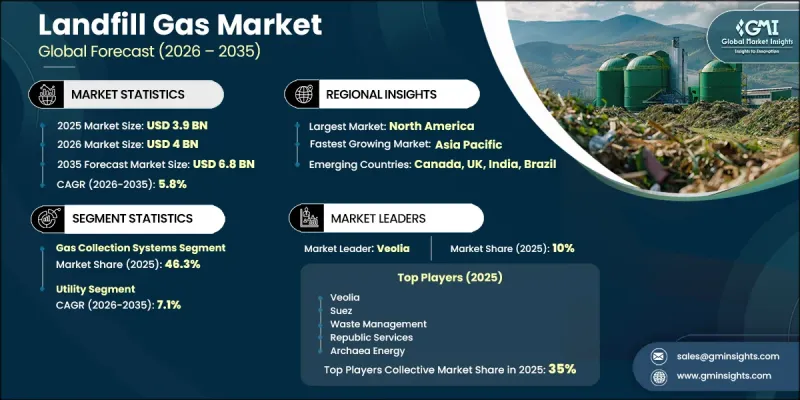
매립지 가스(LFG) 시장은 정부 및 매립지 운영 사업자가 환경 성능 향상과 변화하는 규제 요건에 대응하기 위해 첨단 가스 수집·처리 인프라에 대한 투자를 지속하고 있어 꾸준한 성장을 이루고 있습니다. 도시 고형 폐기물 처리 시설 전반에 걸친 가스 수집·제어 시스템의 도입 확대가, 특히 폐기물 관리 체제가 잘 갖춰져 있고 재생에너지 도입 촉진 정책이 충실한 지역에서 시장 확대를 뒷받침하고 있습니다. 또한, 이 시장은 최종 용도 측면에서의 구조적 전환의 혜택도 받고 있습니다. 기존에는 주로 기존 방식의 발전에 의존했으나, 현재는 매립지 가스를 재생 가능 천연가스로 변환하여 운송이나 파이프라인을 통한 공급에 활용하는 데 중점을 두고 있습니다. 동시에 메탄 배출 규제가 점점 더 엄격해지고 있어 매립지 운영자는 가스 회수 능력 강화와 처리 효율 향상을 요구받고 있습니다. 모듈식 처리 기술의 발전으로 프로젝트 비용이 절감되는 동시에 도입이 가속화되면서, 더 폭넓은 시장 진입 기회가 창출되고 있습니다. 또한, 기업의 지속가능성 이니셔티브와 지자체의 기후 전략에 따라 온실가스 배출을 줄이기 위한 신뢰할 수 있는 수단으로서 매립지 가스 이용의 중요성이 높아지고 있으며, 이는 전 세계 매립지 가스(LFG) 시장 전체의 장기적인 성장을 더욱 뒷받침하고 있습니다.
| 시장 범위 | |
|---|---|
| 시작 연도 | 2025년 |
| 예측 기간 | 2026-2035년 |
| 초기 시장 규모 | 39억 달러 |
| 예측액 | 68억 달러 |
| CAGR | 5.8% |
가스 플레어링 시스템 부문은 2025년에 18.2%의 점유율을 차지했으며, 2035년까지 연평균 성장률(CAGR) 1.5%로 성장할 것으로 전망되어, 제품 카테고리 중 성장률이 가장 낮은 부문이 될 것입니다. 가스 플레어링은 에너지 회수나 재생 가능 천연가스 생산을 뒷받침할 만한 충분한 가스 수집량이나 품질이 확보되지 않은 매립지에서 여전히 필수적인 규정 준수 대책으로 기능하고 있습니다. 프로젝트 초기 단계나 소규모 시설에서는 여전히 플레어링이 널리 이용되고 있지만, 점점 더 많은 매립지 운영 사업자가 회수된 매립지 가스의 에너지 회수율 향상 및 고부가가치 활용을 가능하게 하는 기술에 투자함에 따라, 이 부문은 과도기적인 해결책으로 인식되기 시작하고 있습니다.
공익사업 부문은 2025년에 38.5%의 점유율을 차지했으며, 2035년까지 연평균 성장률(CAGR) 7.1%로 성장할 것으로 전망됩니다. 공공사업자들은 보다 광범위한 탈탄소화 전략 및 재생에너지 조달 이니셔티브의 일환으로, 매립지 가스에서 생산된 재생 천연가스를 에너지 공급 포트폴리오에 편입하는 움직임을 강화하고 있습니다. 재생 가능 가스 이용에 대한 정책 지원 확대, 바이오메탄 혼합 요건 확충, 그리고 탄소 배출량 감축 노력 강화가 공익사업 기업들의 지속적인 수요에 유리한 조건을 조성하고 있으며, 예측 기간 동안 해당 부문의 주도적 지위를 공고히 하고 있습니다.
북미의 매립지 가스(LFG) 시장은 2025년에 38.5%의 점유율을 차지하며 최대 지역 시장이 되었습니다. 이 지역의 성장은 확립된 환경 규제, 성숙한 재생 천연가스 장려 프로그램, 그리고 매립지 가스 수집 인프라에 대한 지속적인 투자에 힘입고 있습니다. 배출 관리에 관한 규제 요건은 매립지 운영 사업자들에게 첨단 가스 수집 및 처리 시스템 도입을 지속적으로 촉진하고 있으며, 이로 인해 매립지 가스 기술에 대한 안정적인 수요가 발생하여 북미 전역의 장기적인 시장 확장을 뒷받침하고 있습니다.
자주 묻는 질문
목차
제1장 조사 방법과 범위
제2장 주요 요약
제3장 업계 인사이트
제4장 경쟁 구도
제5장 시장 규모 및 예측 : 유형별, 2022-2035년
제6장 시장 규모 및 예측 : 기술별, 2022-2035년
제7장 시장 규모 및 예측 : 최종사용별, 2022-2035년
제8장 시장 규모 및 예측 : 지역별, 2022-2035년
제9장 기업 개요
KSM 26.08.05The Global Landfill Gas (LFG) Market was valued at USD 3.9 billion in 2025 and is estimated to grow at a CAGR of 5.8% to reach USD 6.8 billion by 2035.
The landfill gas (LFG) market is experiencing steady growth as governments and landfill operators continue investing in advanced gas collection and treatment infrastructure to improve environmental performance and meet evolving regulatory requirements. Growing deployment of gas collection and control systems across municipal solid waste facilities is supporting market expansion, particularly in regions with well-established waste management frameworks and renewable energy incentives. The market is also benefiting from a structural transition in end-use applications, with increasing emphasis on converting landfill gas into renewable natural gas for transportation and pipeline distribution instead of relying primarily on conventional electricity generation. At the same time, increasingly stringent methane emission regulations are encouraging landfill operators to strengthen gas capture capabilities and improve processing efficiency. Advances in modular processing technologies are reducing project costs while accelerating deployment, creating opportunities for broader market participation. In addition, corporate sustainability initiatives and municipal climate strategies are increasing the importance of landfill gas utilization as a reliable pathway for reducing greenhouse gas emissions, further supporting long-term growth across the global landfill gas (LFG) market.
| Market Scope | |
|---|---|
| Start Year | 2025 |
| Forecast Year | 2026-2035 |
| Start Value | $3.9 Billion |
| Forecast Value | $6.8 Billion |
| CAGR | 5.8% |
The gas flaring systems segment accounted for 18.2% share in 2025 and is projected to grow at a CAGR of 1.5% through 2035, representing the slowest-growing product category. Gas flaring continues to serve as an essential compliance solution for landfill sites where gas collection volumes or quality remain insufficient to support energy recovery or renewable natural gas production. Although flaring remains widely utilized during early project stages and at smaller facilities, the segment is increasingly viewed as a transitional solution as more landfill operators invest in technologies that enable greater energy recovery and higher-value utilization of captured landfill gas.
The utility segment represented 38.5% share in 2025 and is expected to grow at a CAGR of 7.1% through 2035. Utilities continue to increase the integration of landfill gas-derived renewable natural gas into their energy supply portfolios as part of broader decarbonization strategies and renewable energy procurement initiatives. Growing policy support for renewable gas utilization, expanding biomethane blending requirements, and increasing commitments to lower carbon emissions are creating favorable conditions for sustained demand from utility companies, reinforcing the segment's leadership throughout the forecast period.
North America Landfill Gas (LFG) Market accounted for 38.5% share in 2025, making it the largest regional market. Growth across the region is supported by established environmental regulations, mature renewable natural gas incentive programs, and ongoing investments in landfill gas collection infrastructure. Regulatory requirements governing emissions management continue to encourage landfill operators to install advanced gas collection and treatment systems, creating consistent demand for landfill gas technologies and supporting long-term market expansion across North America.
Major companies operating in the global landfill gas (LFG) market include Ameresco, Republic Services, Waste Management, Veolia, SUEZ, Archaea Energy, Montauk Renewables, Clean Energy Fuels Corp., and Beijing Enterprises Holdings. Companies operating in the landfill gas (LFG) market are strengthening their competitive position by investing in advanced gas collection technologies, renewable natural gas production facilities, and efficient gas upgrading systems. Manufacturers and project developers continue to focus on improving methane recovery rates, increasing operational efficiency, and reducing project development costs through modular processing technologies. Strategic partnerships with municipalities, landfill operators, utility providers, and energy companies are expanding project pipelines and improving long-term revenue opportunities.
Table of Contents
Chapter 1 Methodology & Scope
- 1.1 Research approach
- 1.2 Quality commitments
- 1.2.1 GMI AI policy & data integrity commitment
- 1.2.1.1 Source consistency protocol
- 1.2.1 GMI AI policy & data integrity commitment
- 1.3 Research trail & confidence scoring
- 1.3.1 Research trail components
- 1.3.2 Scoring components
- 1.4 Data collection
- 1.4.1 Partial list of primary sources
- 1.5 Data mining sources
- 1.5.1 Paid sources
- 1.5.1.1 Sources, by region
- 1.5.1 Paid sources
- 1.6 Base estimates and calculations
- 1.6.1 Base year calculation for any one approach
- 1.7 Market estimates & forecasts parameters
- 1.8 Forecast model
- 1.8.1 Quantified market impact analysis
- 1.8.1.1 Mathematical impact of growth parameters on forecast
- 1.8.1 Quantified market impact analysis
- 1.9 Research transparency addendum
- 1.9.1 Source attribution framework
- 1.9.2 Quality assurance metrics
- 1.9.3 Our commitment to trust
- 1.10 Market definitions
Chapter 2 Executive Summary
- 2.1 Industry synopsis, 2022 - 2035
- 2.1.1 Business trends
- 2.1.2 Type trends
- 2.1.3 Technology trends
- 2.1.4 End use trends
- 2.1.5 Regional trends
Chapter 3 Industry Insights
- 3.1 Industry ecosystem analysis
- 3.1.1 Feedstock layer
- 3.1.2 Gas generation & collection layer
- 3.1.3 Treatment, processing & upgrading layer
- 3.1.4 End-use energy conversion layer
- 3.1.5 Value chain profitability & margin analysis
- 3.2 Regulatory landscape
- 3.3 Industry impact forces
- 3.3.1 Growth drivers
- 3.3.1.1 Stringent GHG emission mandates
- 3.3.1.2 Rising corporate & municipal net-zero commitments
- 3.3.2 Industry pitfalls and challenges
- 3.3.2.1 High capital expenditure for gas collection infrastructure
- 3.3.1 Growth drivers
- 3.4 Growth potential analysis
- 3.5 Porter's analysis
- 3.5.1 Bargaining power of suppliers
- 3.5.2 Bargaining power of buyers
- 3.5.3 Threat of new entrants
- 3.5.4 Threat of substitutes
- 3.5.5 Intensity of competitive rivalry
- 3.6 PESTEL analysis
- 3.6.1 Political factors
- 3.6.2 Economic factors
- 3.6.3 Social factors
- 3.6.4 Technological factors
- 3.6.5 Environmental factors
- 3.6.6 Legal factors
- 3.7 Impact of AI and generative AI on the market (Driven by primary research)
- 3.7.1 AI-driven disruption of utility business
- 3.7.2 GenAI use cases & adoption roadmap
- 3.7.3 Risks, limitations & regulatory considerations
- 3.8 Infrastructure & deployment landscape (Driven by Primary Research)
- 3.8.1 Deployment penetration
- 3.8.2 Scalability constraints & infrastructure investment trends
Chapter 4 Competitive Landscape, 2026
- 4.1 Introduction
- 4.2 Company market share analysis, by region, 2025
- 4.2.1 North America
- 4.2.2 Europe
- 4.2.3 Asia Pacific
- 4.2.4 Middle East & Africa
- 4.2.5 Latin America
- 4.3 Competitive analysis of major market players
- 4.4 Competitive positioning matrix
- 4.5 Key developments
- 4.5.1 Mergers & acquisitions
- 4.5.2 Partnerships & collaborations
- 4.5.3 New product launches
- 4.5.4 Expansion plans and funding
- 4.6 Company tier benchmarking
- 4.6.1 Tier classification criteria & qualifying thresholds
- 4.6.2 Tier positioning matrix by revenue, geography & innovation
Chapter 5 Market Size and Forecast, By type, 2022 - 2035 (USD Million)
- 5.1 Key trends
- 5.2 Municipal solid waste
- 5.3 Industrial waste
- 5.4 Bioreactor
- 5.5 Closed/Legacy
Chapter 6 Market Size and Forecast, By technology, 2022 - 2035 (USD Million)
- 6.1 Key trends
- 6.2 Gas collection systems
- 6.3 Gas treatment & processing systems
- 6.4 Gas flaring systems
Chapter 7 Market Size and Forecast, By End use, 2022 - 2035 (USD Million)
- 7.1 Key trends
- 7.2 Utility
- 7.3 Industrial manufacturing
- 7.4 Commercial facilities
- 7.5 Municipal operations
- 7.6 Transportation
Chapter 8 Market Size and Forecast, By Region, 2022 - 2035 (USD Million)
- 8.1 Key trends
- 8.2 North America
- 8.2.1 U.S.
- 8.2.2 Canada
- 8.2.3 Mexico
- 8.3 Europe
- 8.3.1 Germany
- 8.3.2 UK
- 8.3.3 France
- 8.3.4 Spain
- 8.3.5 Italy
- 8.4 Asia Pacific
- 8.4.1 China
- 8.4.2 India
- 8.4.3 Japan
- 8.4.4 South Korea
- 8.4.5 Australia
- 8.5 Middle East & Africa
- 8.5.1 Saudi Arabia
- 8.5.2 UAE
- 8.5.3 South Africa
- 8.6 Latin America
- 8.6.1 Brazil
- 8.6.2 Argentina
Chapter 9 Company Profiles
- 9.1 Ameresco
- 9.2 Archaea Energy
- 9.3 Beijing Enterprises Holdings
- 9.4 Biffa Group
- 9.5 Brightmark LLC
- 9.6 Clean Energy Fuels Corp
- 9.7 Fortistar LLC
- 9.8 Gasrec
- 9.9 Infinis Energy
- 9.10 LiquidPower Technologies
- 9.11 Montauk Renewables
- 9.12 Opal Fuels
- 9.13 Republic Services
- 9.14 RNG Energy Solutions
- 9.15 SCS Engineers
- 9.16 Shanks Group
- 9.17 Suez
- 9.18 Vanguard Renewables
- 9.19 Veolia
- 9.20 Waste Management


