

|
시장보고서
상품코드
2101937
자동 병따개 시장 기회, 성장 촉진요인, 업계 동향 분석 및 예측(2026-2035년)Automatic Bottle Opener Market Opportunity, Growth Drivers, Industry Trend Analysis, and Forecast 2026 - 2035 |
||||||

세계의 자동 병따개 시장은 2025년에 7억 5,200만 달러 규모에 달하고, 2035년까지 CAGR 6.6%로 성장하여 14억 3,000만 달러에 달할 것으로 예측됩니다.
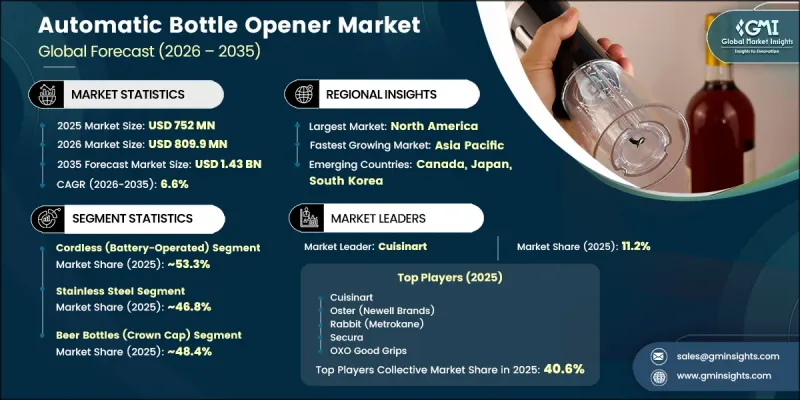
자동 병따개 시장은 주거 및 상업 환경 모두에서 편의성이 높고 인체공학적으로 설계되었으며 미적으로도 아름다운 주방용품에 대한 수요가 지속적으로 확대됨에 따라 꾸준한 성장을 이루고 있습니다. 소비자들은 사용 편의성과 현대적인 디자인을 겸비한 제품을 점점 더 선호하고 있으며, 이로 인해 일반 가정, 숙박 시설, 외식 산업에서 전동식 음료 용품의 보급이 촉진되고 있습니다. 고급 주방용품에 대한 지출 증가, 소비자의 라이프스타일 변화, 그리고 가정 내 엔터테인먼트에 대한 관심 증대가 시장 성장에 유리한 환경을 조성하고 있습니다. 편의성은 구매 시 주요 판단 기준이 되고 있으며, 구매자들은 주방용품을 선택할 때 효율성, 내구성, 사용감, 디자인, 그리고 전반적인 사용자 경험을 더욱 중요하게 여기고 있습니다. 지속적인 제품 혁신과 기능성 향상 또한 다양한 소비자층에서 자동 병따개의 매력을 높이고 있습니다. 또한, 체계화된 소매 채널과 온라인 판매 채널의 확장으로 제품의 접근성이 향상되어 제조업체는 더 폭넓은 고객층에 도달할 수 있게 되었을 뿐만 아니라, 예측 기간 동안 전 세계 자동 병따개 시장의 지속적인 성장을 뒷받침하고 있습니다.
| 시장 범위 | |
|---|---|
| 시작 연도 | 2025년 |
| 예측 기간 | 2026-2035년 |
| 초기 시장 규모 | 7억 5,200만 달러 |
| 예측액 | 14억 3,000만 달러 |
| CAGR | 6.6% |
무선 부문은 2025년에 53.3%의 점유율을 차지했으며, 2035년까지 61.4%의 점유율에 도달할 것으로 전망되어, 연평균 성장률(CAGR)은 8.1%로 확대될 전망입니다. 무선 제품에 대한 소비자의 선호도가 높아지고 있는 배경에는 주택, 야외, 상업 시설 등 다양한 상황에서 이러한 제품이 제공하는 유연성과 편의성이 있습니다. 충전식 배터리 기술의 발전으로 작동 성능이 대폭 향상되어, 사용자는 이전 제품 세대에 비해 한 번의 충전으로 더 많은 병 개봉 횟수를 처리할 수 있게 되었습니다. 이러한 개선을 통해 제품의 신뢰성이 향상되고 충전 빈도도 감소함에 따라 소비자의 수용도가 더욱 확대되어, 해당 부문의 지속적인 성장에 기여하고 있습니다.
스테인리스강 부문은 2025년에 46.8%의 점유율을 차지하고, 2035년까지 51.8%의 점유율을 확보할 것으로 예상되며, 연평균 성장률(CAGR) 7.7%로 성장하여 시장 전체의 성장률을 상회할 것으로 전망됩니다. 이 소재는 내구성, 내식성, 그리고 고급스러운 외관 덕분에 여전히 선호되는 선택지이며, 상업용 및 가정용 모두에 적합합니다. 높은 시각적 매력과 긴 수명은 중저가 및 프리미엄 제품 카테고리에서의 채택을 지속적으로 촉진하고 있으며, 가격은 제품 디자인, 브랜드 포지셔닝, 부속품에 따라 달라집니다.
북미 자동 병따개 시장은 37.8%의 점유율을 차지하고 있으며, 2035년까지 35.4%로 감소할 전망이고, 연평균 성장률(CAGR)은 5.9%를 기록할 것으로 예측됩니다. 이 지역 내에서 미국이 계속해서 가장 큰 기여를 할 것으로 보이며, 2025년에는 북미 전체 매출의 약 88.5%를 차지할 전망입니다. 고급 주방용품에 대한 소비자의 활발한 지출, 잘 갖춰진 소매 생태계, 그리고 편의성을 높이는 제품에 대한 수요 증가가 이 지역 시장의 주도적 지위를 지속적으로 뒷받침하고 있습니다. 또한, 집에서 식사하거나 손님을 대접하는 데 대한 소비자의 관심이 높아지면서 이 지역 전체의 자동 병따개 수요를 더욱 부추기고 있습니다.
자주 묻는 질문
목차
제1장 조사 방법
제2장 주요 요약
제3장 업계 인사이트
제4장 경쟁 구도
제5장 시장 추정 및 예측 : 제품 유형별, 2022-2035년
제6장 시장 추정 및 예측 : 소재별, 2022-2035년
제7장 시장 추정 및 예측 : 보틀 유형별, 2022-2035년
제8장 시장 추정 및 예측 : 용도별, 2022-2035년
제9장 시장 추정 및 예측 : 가격대별, 2022-2035년
제10장 시장 추정 및 예측 : 유통 채널별, 2022-2035년
제11장 시장 추정 및 예측 : 지역별, 2022-2035년
제12장 기업 개요
KSM 26.08.05The Global Automatic Bottle Opener Market was valued at USD 752 million in 2025 and is estimated to grow at a CAGR of 6.6% to reach USD 1.43 billion by 2035.
The automatic bottle opener market is experiencing steady expansion as demand for convenient, ergonomic, and aesthetically appealing kitchen accessories continues to grow across both residential and commercial environments. Consumers are increasingly seeking products that combine ease of use with modern design, encouraging broader adoption of electrically assisted beverage accessories in households, hospitality establishments, and foodservice operations. Rising spending on premium kitchen products, changing consumer lifestyles, and growing interest in home-based entertainment are creating favorable conditions for market growth. Convenience has become a major purchasing consideration, with buyers placing greater emphasis on efficiency, durability, comfort, design, and overall user experience when selecting kitchen tools. Continuous product innovation and improvements in functionality are also enhancing the appeal of automatic bottle openers across multiple consumer segments. In addition, the expansion of organized retail and online sales channels has improved product accessibility, enabling manufacturers to reach a broader customer base while supporting the sustained growth of the global automatic bottle opener market throughout the forecast period.
| Market Scope | |
|---|---|
| Start Year | 2025 |
| Forecast Year | 2026-2035 |
| Start Value | $752 Million |
| Forecast Value | $1.43 Billion |
| CAGR | 6.6% |
The cordless segment held 53.3% share in 2025 and is projected to hold 61.4% share by 2035, expanding at a CAGR of 8.1%. Growing consumer preference for cordless operation is driven by the flexibility and convenience these products offer across residential, outdoor, and commercial settings. Advancements in rechargeable battery technology have significantly improved operating performance, allowing users to complete substantially more bottle-opening cycles on a single charge than earlier product generations. These improvements have enhanced product reliability while reducing charging frequency, contributing to stronger consumer acceptance and sustained segment growth.
The stainless steel segment accounted for 46.8% share in 2025 and is expected to capture 51.8% by 2035 while growing at a CAGR of 7.7%, exceeding the overall market growth rate. The material remains the preferred choice due to its durability, corrosion resistance, and premium appearance, making it well-suited for both commercial applications and household use. Its strong visual appeal and long service life continue to support adoption across mid-range and premium product categories, with pricing varying according to product design, brand positioning, and included accessories.
North America Automatic Bottle Opener Market held 37.8% share, and is anticipated to represent 35.4% by 2035 while registering a CAGR of 5.9%. The United States remained the leading contributor within the region, generating approximately 88.5% of North American revenue in 2025. Strong consumer spending on premium kitchen accessories, a well-developed retail ecosystem, and increasing demand for products that enhance convenience continue to support regional market leadership. Growing consumer interest in home dining and entertaining further strengthens demand for automatic bottle openers across the region.
Major companies operating in the global automatic bottle opener market include Cuisinart, Ozeri, Rabbit (Metrokane), Oster (Newell Brands), OXO Good Grips, Vacu Vin, Zhuhai Kelitong (KLT), Brabantia, Peugeot Saveurs, Pulltex, Secura, Trudeau Corporation, Zwilling J.A. Henckels, WMF, Ivation, Chef Craft, Tyzine, Crenova, Coravin, Circle Joy, and Epare. Companies operating in the automatic bottle opener market are strengthening their competitive position through continuous product innovation, premium product development, and expansion of their global distribution networks. Manufacturers are investing in research and development to improve battery performance, ergonomic design, durability, and overall user convenience while introducing aesthetically appealing products that align with evolving consumer preferences. Businesses are also expanding their presence through online retail platforms, strategic partnerships, and broader geographic distribution to improve market reach. Portfolio diversification, branding initiatives, and customer-focused product enhancements remain key priorities for leading companies.
Table of Contents
Chapter 1 Research Methodology
- 1.1 Research approach
- 1.2 Quality Commitments
- 1.2.1 GMI AI policy & data integrity commitment
- 1.2.1.1 Source consistency protocol
- 1.2.1 GMI AI policy & data integrity commitment
- 1.3 Research Trail & Confidence Scoring
- 1.3.1 Research Trail Components
- 1.3.2 Scoring Components
- 1.4 Data Collection
- 1.4.1 Partial list of primary sources
- 1.5 Data mining sources
- 1.5.1 Paid sources
- 1.5.1.1 Sources, by region
- 1.5.1 Paid sources
- 1.6 Base estimates and calculations
- 1.6.1 Base year calculation for any one approach
- 1.7 Forecast model
- 1.7.1 Quantified market impact analysis
- 1.7.1.1 Mathematical impact of growth parameters on forecast
- 1.7.1 Quantified market impact analysis
- 1.8 Research transparency addendum
- 1.8.1 Source attribution framework
- 1.8.2 Quality assurance metrics
- 1.8.3 Our commitment to trust
Chapter 2 Executive Summary
- 2.1 Industry 360° synopsis, 2022 - 2035
- 2.2 Key market trends
- 2.2.1 Regional
- 2.2.2 Product type
- 2.2.3 Material
- 2.2.4 Bottle type
- 2.2.5 Application
- 2.2.6 Pricing tier
- 2.2.7 Distribution channel
Chapter 3 Industry Insights
- 3.1 Industry ecosystem analysis
- 3.1.1 Factor affecting the value chain
- 3.1.2 Profit margin analysis
- 3.1.3 Disruptions
- 3.1.4 Future outlook
- 3.1.5 Manufacturers
- 3.1.6 Distributors
- 3.2 Supplier landscape
- 3.3 Key news & initiatives
- 3.4 Technology & Innovation Landscape
- 3.5 Regulatory landscape
- 3.6 Impact on forces
- 3.6.1 Growth drivers
- 3.6.1.1 Growing convenience trends increase automatic bottle opener product demand
- 3.6.1.2 Expanding hospitality industry boosts commercial bottle opener adoption
- 3.6.1.3 Increasing home entertainment activities strengthen kitchen gadget sales
- 3.6.2 Industry pitfalls & challenges
- 3.6.2.1 Availability of manual alternatives limits automatic opener adoption
- 3.6.2.2 Battery dependency affects automatic bottle opener operational reliability
- 3.6.3 Opportunities
- 3.6.3.1 Smart kitchen integration creates premium opener product opportunities
- 3.6.3.2 Sustainable materials strengthen eco-friendly opener product demand globally.
- 3.6.1 Growth drivers
- 3.7 Porter's analysis
- 3.8 PESTEL analysis
- 3.9 Pricing analysis (driven by primary research)
- 3.9.1 Historical price trend analysis (2019-2023) (driven by primary research)
- 3.9.2 Pricing strategy by player type (premium / value / cost-plus) (driven by primary research)
- 3.9.3 Price benchmarking across distribution channels (online vs. offline) (driven by primary research)
- 3.10 Trade data analysis (driven by paid database)
- 3.10.1 Import/export volume & value trends by key corridor
- 3.10.2 Key trade corridors & tariff impact (U.S.-China, EU-Asia)
- 3.11 Impact of AI & generative AI on the market
- 3.11.1 AI-driven disruption of kitchen appliance business models
- 3.11.2 GenAI use cases & adoption roadmap by segment (smart kitchen integration, predictive maintenance)
- 3.11.3 Risks, limitations & regulatory considerations for AI-enabled devices
- 3.12 Distribution infrastructure & channel penetration landscape (driven by primary research)
- 3.12.1 Channel coverage by region & format (modern trade vs. traditional trade vs. e-commerce) (driven by primary research)
- 3.12.2 Last-mile infrastructure gaps & emerging channel shifts (DTC, quick commerce, gifting platforms) (driven by primary research)
Chapter 4 Competitive Landscape, 2025
- 4.1 Introduction
- 4.2 Company market share analysis
- 4.3 Competitive positioning matrix
- 4.4 Strategic outlook matrix
- 4.5 Competitive analysis of major market players
- 4.6 Key developments
- 4.6.1 Mergers & acquisitions
- 4.6.2 Partnerships & collaborations
- 4.6.3 New product launches
- 4.6.4 Expansion plans
Chapter 5 Market Estimates & Forecast, By Product Type, 2022-2035 (USD Billion) (Million Units)
- 5.1 Key trends
- 5.1.1 Cordless (Battery-Operated)
- 5.1.2 Corded (Electric-Powered)
Chapter 6 Market Estimates & Forecast, By Material, 2022-2035 (USD Billion) (Million Units)
- 6.1 Key trends
- 6.2 Stainless Steel
- 6.3 Plastic (ABS/Polycarbonate)
- 6.4 Aluminum
- 6.5 Wood/Bamboo
- 6.6 Others
Chapter 7 Market Estimates & Forecast, By Bottle Type, 2022-2035 (USD Billion) (Million Units)
- 7.1 Key trends
- 7.2 Wine Bottles (Cork-Sealed)
- 7.3 Beer Bottles (Crown Cap)
- 7.4 Soda/Soft Drink Bottles
- 7.5 Others
Chapter 8 Market Estimates & Forecast, By Application, 2022-2035 (USD Billion) (Million Units)
- 8.1 Key trends
- 8.1.1 Residential
- 8.1.2 Commercial
Chapter 9 Market Estimates & Forecast, By Pricing Tier, 2022-2035 (USD Billion) (Million Units)
- 9.1 Key trends
- 9.2 Economy (<$20)
- 9.3 Mid-Range ($20-$60)
- 9.4 Premium (>$60)
Chapter 10 Market Estimates & Forecast, By Distribution Channel, 2022-2035 (USD Billion) (Million Units)
- 10.1 Key trends
- 10.2 Online
- 10.3 Offline
Chapter 11 Market Estimates & Forecast, By Region, 2022 - 2035, (USD Billion) (Million Units)
- 11.1 Key trends
- 11.2 North America
- 11.2.1 U.S.
- 11.2.2 Canada
- 11.3 Europe
- 11.3.1 Germany
- 11.3.2 U.K.
- 11.3.3 France
- 11.3.4 Italy
- 11.3.5 Spain
- 11.4 Asia Pacific
- 11.4.1 China
- 11.4.2 India
- 11.4.3 Japan
- 11.4.4 South Korea
- 11.4.5 Australia
- 11.5 Latin America
- 11.5.1 Brazil
- 11.5.2 Mexico
- 11.5.3 Argentina
- 11.6 MEA
- 11.6.1 UAE
- 11.6.2 Saudi Arabia
- 11.6.3 South Africa
Chapter 12 Company Profiles
- 12.1 Global players
- 12.1.1 Cuisinart
- 12.1.2 Ozeri
- 12.1.3 Rabbit (Metrokane)
- 12.1.4 Oster
- 12.1.5 OXO Good Grips
- 12.1.6 Vacu Vin
- 12.1.7 Zhuhai Kelitong (KLT)
- 12.2 Regional players
- 12.2.1 Brabantia
- 12.2.2 Peugeot Saveurs
- 12.2.3 Pulltex
- 12.2.4 Secura
- 12.2.5 Trudeau Corporation
- 12.2.6 Zwilling J.A. Henckels
- 12.2.7 WMF
- 12.3 Emerging players
- 12.3.1 Ivation
- 12.3.2 Chef Craft
- 12.3.3 Tyzine
- 12.3.4 Crenova
- 12.3.5 Coravin
- 12.3.6 Circle Joy
- 12.3.7 Epare


