
|
시장보고서
상품코드
2101946
정밀 임업 시장 기회, 성장 촉진요인, 업계 동향 분석 및 예측(2026-2035년)Precision Forestry Market Opportunity, Growth Drivers, Industry Trend Analysis, and Forecast 2026 - 2035 |
||||||

세계의 정밀 임업 시장은 2025년에 9억 6,000만 달러 규모에 달하고, CAGR 9.9%로 성장하여 2035년까지 24억 5,000만 달러에 달할 것으로 예측됩니다.
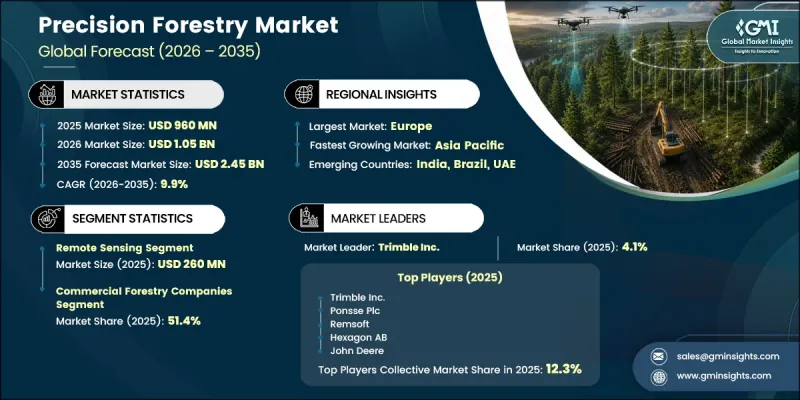
임업 사업자, 정부 및 업계 이해관계자들이 자원 관리, 업무 효율성, 지속가능성 실천을 개선하기 위해 디지털 기술 도입을 확대함에 따라 정밀 임업 시장은 성장을 거듭하고 있습니다. 책임감 있는 산림 이용과 투명한 자원 모니터링에 대한 중요성이 커짐에 따라, 산림 상태에 대한 정확한 데이터를 제공하고 정보에 기반한 의사결정을 지원하는 첨단 솔루션에 대한 수요가 확대되고 있습니다. 정밀 임업 기술은 산림 자산의 가시성을 높이고, 규정 준수 능력을 강화하며, 조직이 임업 라이프사이클 전반에 걸쳐 활동을 최적화할 수 있도록 지원합니다. 환경 문제에 대한 관심 증가, 자원 관리 정책의 엄격화, 그리고 증거 기반 임업 실천에 대한 수요 증가로 인해 지리 공간 기술, 자동 모니터링 시스템, 데이터 기반 관리 플랫폼의 도입이 가속화되고 있습니다. 임업 운영이 기술을 활용한 프로세스로 계속 전환됨에 따라, 산림 매핑, 재고 관리, 성장 모니터링, 벌채 의사결정 및 공급망 추적성을 지원하는 통합 솔루션의 중요성이 점점 더 커지고 있습니다. 상업적 임업 활동과 환경에 대한 책임 간의 균형을 맞출 필요성이 높아짐에 따라, 예측 기간 동안 전 세계 정밀 임업 시장에는 지속적인 기회가 창출될 것으로 전망됩니다.
| 시장 범위 | |
|---|---|
| 시작 연도 | 2025년 |
| 예측 기간 | 2026-2035년 |
| 초기 시장 규모 | 9억 6,000만 달러 |
| 예측액 | 24억 5,000만 달러 |
| CAGR | 9.9% |
원격 감지 분야는 2025년에 2억 6,000만 달러의 시장 규모를 기록하고, 2035년까지 5억 9,000만 달러에 달할 것으로 예측됩니다. 원격 감지는 기존의 현장 조사에 대한 의존도를 낮추면서도 정확하고 광범위한 산림 정보를 제공할 수 있기 때문에 정밀 임업 시장에서 계속해서 주도적인 위치를 차지하고 있습니다. 이 부문에 포함된 기술은 LiDAR, 위성 이미지, 무인항공기(UAV) 탑재 센서 등 첨단 데이터 수집 기법을 활용하여 산림 모니터링 및 관리에 필요한 상세한 정보를 제공합니다. 대규모 데이터를 효율적으로 수집하고 자원 계획 개선을 지원할 수 있다는 점이 이 부문의 성장을 지속적으로 뒷받침하고 있습니다.
2025년에는 상업 임업 기업이 시장 점유율의 51.4%를 차지했습니다. 이러한 조직들은 대규모 사업 운영, 생산성 향상에 대한 집중 강화, 그리고 지속가능성 및 보고 의무에 대한 대응 필요성이 높아짐에 따라 주요 사용자층으로 자리 잡고 있습니다. 임업 기업들은 산림 자원 조사 분석, 사업 계획, 자원 추적, 공급망 검증을 통합한 디지털 플랫폼 도입을 점점 더 확대하고 있습니다. 기술 주도형 임업 관리로의 지속적인 전환이 전 세계 상업 사업자들 사이에서 정밀 솔루션의 추가적인 보급을 뒷받침하고 있습니다.
2025년, 미국의 정밀 임업 시장은 73.8%의 점유율을 차지했습니다. 북미 전역에 걸친 시장 확대는 미국 내 광범위한 상업 임업 활동과 첨단 산림 관리 기술의 조기 도입에 힘입은 결과입니다. 디지털 매핑 시스템, 원격 모니터링 도구, 자동 계획 솔루션의 도입 확대가 업계 성장을 더욱 뒷받침하고 있습니다. 산림 모니터링, 위험 관리 및 지속가능한 자원 이용 개선에 대한 수요 증가가 전미에서 정밀 임업 기술에 대한 투자 확대를 촉진하고 있습니다.
자주 묻는 질문
목차
제1장 조사 방법과 범위
제2장 주요 요약
제3장 업계 인사이트
제4장 경쟁 구도
제5장 시장 추정 및 예측 : 기술 유형별, 2022-2035년
제6장 시장 추정 및 예측 : 용도별, 2022-2035년
제7장 시장 추정 및 예측 : 최종사용별, 2022-2035년
제8장 시장 추정 및 예측 : 지역별, 2022-2035년
제9장 기업 개요
KSM 26.08.05The Global Precision Forestry Market was valued at USD 960 million in 2025 and is estimated to grow at a CAGR of 9.9% to reach USD 2.45 billion by 2035.
The precision forestry market is witnessing growth as forest operators, governments, and industry stakeholders increasingly adopt digital technologies to improve resource management, operational efficiency, and sustainability practices. Growing emphasis on responsible forest utilization and transparent resource monitoring is driving demand for advanced solutions that provide accurate data on forest conditions and support informed decision-making. Precision forestry technologies enable improved visibility into forest assets, enhance compliance capabilities, and help organizations optimize activities throughout the forestry lifecycle. Rising environmental concerns, stricter resource management policies, and increasing demand for evidence-based forestry practices are accelerating the adoption of geospatial technologies, automated monitoring systems, and data-driven management platforms. As forestry operations continue to transition toward technology-enabled processes, integrated solutions that support forest mapping, inventory management, growth monitoring, harvesting decisions, and supply chain traceability are becoming increasingly important. The growing need to balance commercial forestry activities with environmental responsibility is expected to create sustained opportunities for the global precision forestry market throughout the forecast period.
| Market Scope | |
|---|---|
| Start Year | 2025 |
| Forecast Year | 2026-2035 |
| Start Value | $960 Million |
| Forecast Value | $2.45 Billion |
| CAGR | 9.9% |
The remote sensing segment generated USD 260 million in 2025 and is projected to reach USD 590 million by 2035. Remote sensing continues to hold the leading position within the precision forestry market due to its ability to provide accurate and extensive forest coverage while reducing dependence on traditional field-based assessments. Technologies included in this segment utilize advanced data collection methods such as LiDAR, satellite-based imaging, and UAV-mounted sensors to deliver detailed information for forest monitoring and management. The ability to collect large-scale data efficiently and support improved resource planning continues to strengthen segment growth.
The commercial forestry companies accounted for 51.4% share in 2025. These organizations represent the dominant user group due to their large-scale operations, increasing focus on productivity improvement, and growing requirement to meet sustainability and reporting obligations. Forestry companies are increasingly adopting integrated digital platforms that combine forest inventory analysis, operational planning, resource tracking, and supply chain verification. The continued shift toward technology-driven forestry management is supporting greater adoption of precision solutions among commercial operators worldwide.
United States Precision Forestry Market held 73.8% share in 2025. Market expansion across North America is supported by the country's extensive commercial forestry activities and early adoption of advanced forest management technologies. Increasing implementation of digital mapping systems, remote monitoring tools, and automated planning solutions continues to strengthen industry growth. Growing demand for improved forest monitoring, risk management, and sustainable resource utilization is encouraging greater investment in precision forestry technologies across the country.
Major players operating in the global precision forestry market include Arbonaut, CollectiveCrunch, Deep Forestry, Dryad Networks, F4 Tech, Hexagon AB, John Deere, Komatsu Ltd., OroraTech, Ponsse Plc, Remsoft, Satelligence, Silvacom Ltd., Softree Technical Systems, Tesera Systems, Timbeter, Topcon Corporation, Treemetrics, Treevia Forest Technologies, Trimble Inc., and Vibrant Planet. Companies operating in the precision forestry market are strengthening their market presence through technology innovation, strategic partnerships, and expansion of digital forestry solutions. Industry participants are investing in advanced analytics, remote sensing capabilities, automation tools, and cloud-based platforms to improve forest monitoring and operational efficiency. Businesses are also developing integrated solutions that combine mapping, data management, and decision-support capabilities to address evolving forestry requirements. Strategic collaborations, acquisitions, and geographic expansion initiatives are helping companies increase their customer base and strengthen competitive positioning.
Table of Contents
Chapter 1 Methodology & Scope
- 1.1 Research approach
- 1.2 Quality Commitments
- 1.2.1 GMI AI policy & data integrity commitment
- 1.2.1.1 Source consistency protocol
- 1.2.1 GMI AI policy & data integrity commitment
- 1.3 Research Trail & Confidence Scoring
- 1.3.1 Research Trail Components
- 1.3.2 Scoring Components
- 1.4 Data Collection
- 1.4.1 Partial list of primary sources
- 1.5 Data mining sources
- 1.5.1 Paid sources
- 1.5.1.1 Sources, by region
- 1.5.1 Paid sources
- 1.6 Base estimates and calculations
- 1.6.1 Base year calculation for any one approach
- 1.7 Forecast model
- 1.7.1 Quantified market impact analysis
- 1.7.1.1 Mathematical impact of growth parameters on forecast
- 1.7.1 Quantified market impact analysis
- 1.8 Research transparency addendum
- 1.8.1 Source attribution framework
- 1.8.2 Quality assurance metrics
- 1.8.3 Our commitment to trust
Chapter 2 Executive Summary
- 2.1 Industry 360° synopsis
- 2.2 Key market trends
- 2.2.1 Regional
- 2.2.2 Technology Type
- 2.2.3 Application
- 2.2.4 End Use
Chapter 3 Industry Insights
- 3.1 Industry ecosystem analysis
- 3.1.1 Supplier landscape
- 3.1.2 Profit margin
- 3.1.3 Value addition at each stage
- 3.1.4 Factor affecting the value chain
- 3.2 Industry impact forces
- 3.2.1 Growth drivers
- 3.2.1.1 Rapid digitization & automation in forest management operations
- 3.2.1.2 Government initiatives & policies supporting forestry digitization
- 3.2.1.3 Increasing demand for sustainable forest management & ESG compliance
- 3.2.2 Industry pitfalls & challenges
- 3.2.2.1 Fragmented land ownership limiting large-scale platform deployment
- 3.2.2.2 Interoperability issues across multi-vendor precision forestry ecosystems
- 3.2.3 Opportunities
- 3.2.3.1 Carbon credit & sequestration monitoring as emerging revenue stream
- 3.2.3.2 Integration of AI/ML for predictive forest health & yield optimization
- 3.2.1 Growth drivers
- 3.3 Growth potential analysis
- 3.4 Regulatory framework
- 3.5 Major market trends and disruptions
- 3.6 Technology/innovation landscape
- 3.6.1 Current trends
- 3.6.2 Emerging trends
- 3.7 Pricing Analysis (driven by primary research)
- 3.7.1 Historical price trend analysis (driven by primary research)
- 3.7.2 Pricing strategy by player type (premium / value / cost-plus) (driven by primary research)
- 3.8 Future market trends
- 3.9 Impact of AI & Generative AI on the Market
- 3.9.1 AI-driven disruption of existing business models
- 3.9.2 Gen-AI use cases & adoption roadmap by segment
- 3.9.3 Risks, limitations & regulatory considerations
- 3.10 Porter's analysis
- 3.11 PESTEL analysis
- 3.12 Infrastructure & deployment landscape(driven by primary research)
- 3.12.1 Deployment penetration by region & buyer segment (driven by primary research)
- 3.12.2 Scalability constraints & infrastructure investment trends (driven by primary research)
Chapter 4 Competitive landscape, 2025
- 4.1 Introduction
- 4.2 Company market share analysis
- 4.2.1 By region
- 4.2.1.1 North America
- 4.2.1.2 Europe
- 4.2.1.3 Asia Pacific
- 4.2.1.4 Latin America
- 4.2.1.5 Middle East and Africa
- 4.2.1 By region
- 4.3 Company matrix analysis
- 4.4 Competitive analysis of major market players
- 4.5 Competitive positioning matrix
- 4.6 Key developments
- 4.6.1 Mergers & acquisitions
- 4.6.2 Partnerships & collaborations
- 4.6.3 New product launches
- 4.6.4 Expansion plans
Chapter 5 Market Estimates & Forecast, By Technology Type, 2022 - 2035 (USD Billion)
- 5.1 Key trends
- 5.2 Remote sensing
- 5.2.1 LIDAR systems and point cloud analytics
- 5.2.2 Satellite imagery platforms and processing software
- 5.2.3 UAV/drone-based sensing and analytics platforms
- 5.3 GIS and mapping
- 5.3.1 Geographic information system (GIS) software
- 5.3.2 GPS/GNSS positioning solutions
- 5.3.3 Digital mapping and forest cartography software
- 5.4 Data management and analytics
- 5.4.1 Cloud-based forest data platforms
- 5.4.2 Big data analytics and decision support systems
- 5.4.3 Machine learning and AI-powered forest intelligence tools
- 5.5 Smart harvesting intelligence and telematics
- 5.5.1 CTL onboard software and harvesting prescription systems
- 5.5.2 Machine telematics and fleet management platforms
- 5.5.3 Harvesting route optimization and logistics software
- 5.6 IoT and sensor networks
- 5.6.1 Environmental and microclimate monitoring sensors
- 5.6.2 RFID and timber chain-of-custody tracking systems
- 5.6.3 Connected ground monitoring devices and edge computing
- 5.7 Inventory and yield monitoring
- 5.7.1 AI-powered tree measurement and biomass estimation platforms
- 5.7.2 Growth prediction and yield forecasting software
Chapter 6 Market Estimates & Forecast, By Application, 2022 - 2035 (USD Billion)
- 6.1 Key trends
- 6.2 Forest management
- 6.3 Timber harvesting
- 6.4 Wildlife and habitat management
- 6.5 Reforestation and afforestation
- 6.6 Silviculture management
- 6.7 Carbon sequestration and environmental monitoring
Chapter 7 Market Estimates & Forecast, By End Use, 2022 - 2035 (USD Billion)
- 7.1 Key trends
- 7.2 Government and public forest agencies
- 7.3 Commercial forestry companies
- 7.4 Forestry contractors
- 7.5 Academic and research institutes
- 7.6 Non-profit and conservation organizations
Chapter 8 Market Estimates & Forecast, By Region, 2022 - 2035 (USD Billion)
- 8.1 Key trends
- 8.2 North America
- 8.2.1 U.S.
- 8.2.2 Canada
- 8.3 Europe
- 8.3.1 Germany
- 8.3.2 UK
- 8.3.3 France
- 8.3.4 Spain
- 8.3.5 Italy
- 8.4 Asia Pacific
- 8.4.1 China
- 8.4.2 Japan
- 8.4.3 India
- 8.4.4 Australia
- 8.4.5 South Korea
- 8.5 Latin America
- 8.5.1 Brazil
- 8.5.2 Mexico
- 8.5.3 Argentina
- 8.6 MEA
- 8.6.1 South Africa
- 8.6.2 Saudi Arabia
- 8.6.3 UAE
Chapter 9 Company Profiles
- 9.1 Global Companies
- 9.1.1 Hexagon AB
- 9.1.1.1 Business Overview
- 9.1.1.2 Financial Data
- 9.1.1.3 Product Landscape
- 9.1.1.4 Strategic Outlook
- 9.1.1.5 SWOT Analysis
- 9.1.2 John Deere
- 9.1.3 Komatsu Ltd.
- 9.1.4 Ponsse Plc
- 9.1.5 Remsoft
- 9.1.6 Topcon Corporation
- 9.1.7 Trimble Inc.
- 9.1.1 Hexagon AB
- 9.2 Regional Companies
- 9.2.1 John Deere
- 9.2.2 Komatsu Ltd.
- 9.2.3 Ponsse Plc
- 9.2.4 Remsoft
- 9.2.5 Topcon Corporation
- 9.2.6 Trimble Inc.
- 9.3 Emerging Companies
- 9.3.1 Deep Forestry
- 9.3.2 Dryad Networks
- 9.3.3 OroraTech
- 9.3.4 Satelligence
- 9.3.5 Timbeter
- 9.3.6 Treevia Forest Technologies
- 9.3.7 Vibrant Planet