

|
시장보고서
상품코드
2101947
철도 차량 언로더 시장 기회, 성장 촉진요인, 업계 동향 분석 및 예측(2026-2035년)Railcar Unloader Market Opportunity, Growth Drivers, Industry Trend Analysis, and Forecast 2026 - 2035 |
||||||

세계의 철도 차량 언로더 시장은 2025년에 151억 달러 규모에 달하고, CAGR 4.3%로 성장하여 2035년까지 232억 달러에 달할 것으로 추정됩니다.
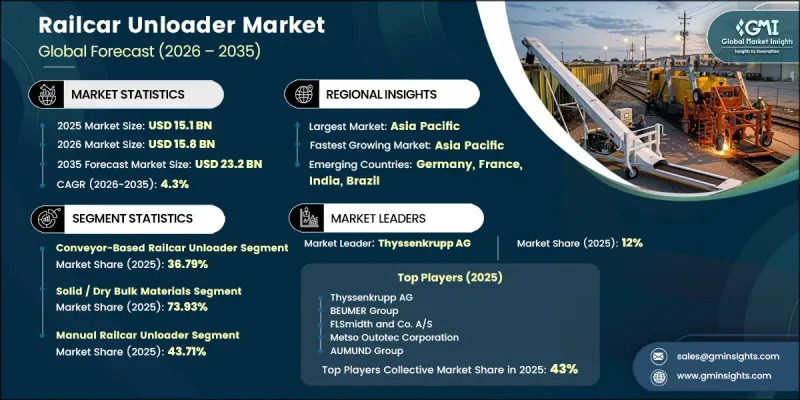
각 업계가 노동력 부족 문제, 더욱 엄격해진 산업 안전 기준, 그리고 철도 화물 네트워크의 지속적인 현대화에 대응함에 따라, 시장에서는 기존의 하역 방식에서 첨단 반자동 및 자동 솔루션으로의 전환이 점차 진행되고 있습니다. 철도 운송을 통한 벌크 상품의 수송량 증가는 여전히 설비 수요를 뒷받침하는 주요 요인으로 작용하고 있습니다. 광물 자원, 농산물, 건설자재, 산업용 상품 등을 대량으로 취급하는 업계에서는 터미널 및 물류 시설에 효율적인 하역 인프라가 요구되고 있습니다. 최신 철도 화물차 언로더에는 자동화 제어, 센서, 원격 모니터링 기능, 운영 데이터 분석 도구가 통합되어 있으며, 스마트 자재 운반 기술에 대한 투자 확대가 시장 기회를 더욱 넓히고 있습니다. 이러한 기술은 하역 시간 단축, 생산성 향상, 공정 신뢰성 제고에 기여할 뿐만 아니라, 수작업 부담을 줄여 더 안전한 작업 환경을 조성하는 데 도움을 줍니다.
| 시장 범위 | |
|---|---|
| 시작 연도 | 2025년 |
| 예측 기간 | 2026-2035년 |
| 시작 시점 시장 규모 | 151억 달러 |
| 예측액 | 232억 달러 |
| CAGR | 4.3% |
2025년에는 컨베이어식 철도 차량 언로더 부문이 36.79%의 점유율을 차지했습니다. 컨베이어 구동식 하역 시스템은 안정적인 자재 흐름과 대용량 처리 능력을 제공할 수 있어, 대규모 건식 벌크 화물 취급 작업에서 계속해서 널리 채택되고 있습니다. 이러한 시스템은 벨트, 스크류, 드래그 체인, 버킷 엘리베이터 등 다양한 이송 기술을 통해 화물의 이동을 지원함과 동시에 기존 터미널 인프라와 통합되어 있습니다. 그 유연성, 확장성, 그리고 가혹한 산업 환경에 대한 적응성 덕분에 주요 벌크 화물 취급 시설 전반에 걸쳐 도입이 지속적으로 촉진되고 있습니다.
고체 및 건조 벌크 자재 부문은 2025년에 73.93%의 점유율을 차지했으며, 2035년까지 70%를 유지하면서 연평균 성장률(CAGR) 3.8%로 성장할 것으로 전망됩니다. 이 부문에는 철도망을 통해 운송되는 광범위한 벌크 상품이 포함되며, 오랜 기간 확립된 물류 인프라와 산업 부문 전반에 걸친 정기적인 설비 갱신 수요에 힘입어 성장하고 있습니다. 광업, 에너지 생산, 건설자재 및 중공업의 중요성이 여전히 높기 때문에 입상, 미립자상 및 대용량 고체 물질을 효율적으로 처리하도록 설계된 하역 시스템에 대한 수요가 지속되고 있습니다. 이 부문의 견고한 시장 지위는 산업용 장비의 긴 수명과 효율성 및 신뢰성을 향상시키기 위한 정기적인 업그레이드의 필요성에 의해 뒷받침되고 있습니다.
북미 철도 차량 언로더 시장은 2025년에 31.8%의 점유율을 차지했으며, 2035년까지 연평균 성장률(CAGR) 4.1%로 성장할 것으로 전망됩니다. 이 지역의 시장 성장은 철도 물류 인프라의 발전, 벌크 화물 처리 터미널의 효율성 요구 증가, 그리고 화물 운송 업무에 영향을 미치는 규제 동향에 힘입고 있습니다. 상호 스위칭에 관한 미국 육상교통위원회(Surface Transportation Board)의 2024년 4월 최종 규정은 특정 조건 하에서 운송업체의 접근을 확대함으로써 벌크 화물 사업자가 서비스 성과를 향상시키도록 촉진하고 있습니다. 이러한 규제 변화로 인해 터미널 운영사들은 하역 작업 최적화, 철도 차량 대기 시간 단축, 그리고 자재 취급 전반의 생산성 향상을 요구받는 압박이 커지고 있습니다.
자주 묻는 질문
목차
제1장 조사 방법
제2장 주요 요약
제3장 업계 인사이트
제4장 경쟁 구도
제5장 시장 추정 및 예측 : 하역 방식별, 2022-2035년
제6장 시장 추정 및 예측 : 취급 소재별, 2022-2035년
제7장 시장 추정 및 예측 : 용도별, 2022-2035년
제8장 시장 추정 및 예측 : 자동화 레벨별, 2022-2035년
제9장 시장 추정 및 예측 : 판매 채널별, 2022-2035년
제10장 예측 : 지역별, 2022-2035년
제11장 기업 개요
KSM 26.08.05The Global Railcar Unloader Market was valued at USD 15.1 billion in 2025 and is estimated to grow at a CAGR of 4.3% to reach USD 23.2 billion by 2035.
The market is undergoing a gradual shift from conventional unloading methods toward advanced semi-automated and automated solutions as industries respond to workforce challenges, stricter workplace safety requirements, and ongoing modernization of rail freight networks. The rising movement of bulk commodities through rail transportation remains a major factor supporting equipment demand. Industries handling large volumes of mineral resources, agricultural products, construction materials, and industrial commodities require efficient unloading infrastructure at terminals and distribution facilities. Increasing investments in smart material handling technologies are further improving market opportunities, as modern railcar unloaders integrate automation controls, sensors, remote monitoring capabilities, and operational data analysis tools. These technologies help reduce unloading durations, enhance productivity, improve process reliability, and support safer working environments with reduced manual involvement.
| Market Scope | |
|---|---|
| Start Year | 2025 |
| Forecast Year | 2026-2035 |
| Start Value | $15.1 Billion |
| Forecast Value | $23.2 Billion |
| CAGR | 4.3% |
The conveyor-based railcar unloader segment held 36.79% share in 2025. Conveyor-driven unloading systems continue to be widely preferred for large-scale dry bulk handling operations due to their ability to provide consistent material flow and high-volume processing capabilities. These systems support the movement of commodities through different conveying technologies, including belt, screw, drag chain, and bucket elevator mechanisms, while integrating with existing terminal infrastructure. Their flexibility, scalability, and compatibility with demanding industrial environments continue to support adoption across major bulk material handling facilities.
The solid and dry bulk materials segment accounted for 73.93% share in 2025 and is projected to hold 70% by 2035, growing at a CAGR of 3.8%. This segment includes a wide range of bulk commodities transported through rail networks, supported by long-established logistics infrastructure and recurring equipment replacement requirements across industrial sectors. The continued importance of mining, energy production, construction materials, and heavy manufacturing industries contributes to sustained demand for unloading systems designed to handle granular, particulate, and large-volume solid materials efficiently. The segment's strong market position is supported by the long operating life of industrial equipment and the need for periodic upgrades to improve efficiency and reliability.
North America Railcar Unloader Market accounted for 31.8% share in 2025 and is anticipated to grow at a CAGR of 4.1% through 2035. Regional market growth is supported by advancements in rail logistics infrastructure, increasing efficiency requirements at bulk handling terminals, and regulatory developments influencing freight operations. The Surface Transportation Board's April 2024 Final Rule regarding reciprocal switching has encouraged bulk freight operators to improve service performance by enabling greater carrier access under specific conditions. This regulatory shift is increasing pressure on terminal operators to optimize unloading operations, reduce railcar waiting periods, and improve overall material handling productivity.
Major players operating in the global railcar unloader industry are BEUMER Group, Ashton Bulk Ltd, Kawasaki Heavy Industries Ltd., FLSmidth & Co. A/S, AUMUND Group, McLanahan Corporation, Metso Corporation, Cambelt International Corporation, TAKRAF Group, Richmond Engineering Works, Martin Engineering, Elecon Engineering Company Ltd., Thyssenkrupp AG, Heyl & Patterson Inc., TAIM WESER, Hewitt Robins International, Proman Infrastructure Ltd., ENFI-CEMSA, Frigate Teknologies Pvt. Ltd., Tehnoros Group, and TKIL Industries. Companies operating in the railcar unloader market are adopting strategies centered around automation, product innovation, strategic partnerships, and expansion into emerging industrial markets to strengthen their competitive position. Manufacturers are focusing on developing advanced unloading systems with improved efficiency, reduced maintenance requirements, and enhanced automation capabilities to meet evolving customer expectations. Companies are also investing in research and development activities to introduce equipment that supports higher throughput, operational reliability, and safer working conditions. Expanding global distribution networks, forming collaborations with industrial operators, and providing customized solutions for specific bulk handling requirements are helping market participants increase their presence.
Table of Contents
Chapter 1 Research Methodology
- 1.1 Research approach
- 1.2 Quality Commitments
- 1.2.1 GMI AI policy & data integrity commitment
- 1.2.1.1 Source consistency protocol
- 1.2.1 GMI AI policy & data integrity commitment
- 1.3 Research Trail & Confidence Scoring
- 1.3.1 Research Trail Components
- 1.3.2 Scoring Components
- 1.4 Data Collection
- 1.4.1 Partial list of primary sources
- 1.5 Data mining sources
- 1.5.1 Paid sources
- 1.5.1.1 Sources, by region
- 1.5.1 Paid sources
- 1.6 Base estimates and calculations
- 1.6.1 Base year calculation for any one approach
- 1.7 Forecast model
- 1.7.1 Quantified market impact analysis
- 1.7.1.1 Mathematical impact of growth parameters on forecast
- 1.7.1 Quantified market impact analysis
- 1.8 Research transparency addendum
- 1.8.1 Source attribution framework
- 1.8.2 Quality assurance metrics
- 1.8.3 Our commitment to trust
Chapter 2 Executive Summary
- 2.1 Industry 360° synopsis, 2022 – 2035
- 2.2 Key market trends
- 2.2.1 Regional
- 2.2.2 Unloading Mechanism
- 2.2.3 Material Handled
- 2.2.4 Application
- 2.2.5 Automation Level
- 2.2.6 Sales Channel
Chapter 3 Industry Insights
- 3.1 Industry ecosystem analysis
- 3.1.1 Factor affecting the value chain
- 3.1.2 Profit margin analysis
- 3.1.3 Disruptions
- 3.1.4 Future outlook
- 3.1.5 Manufacturers
- 3.1.6 Distributors
- 3.2 Supplier landscape
- 3.3 Key news & initiatives
- 3.4 Technology & Innovation Landscape
- 3.5 Regulatory landscape
- 3.6 Impact on forces
- 3.6.1 Growth drivers
- 3.6.2 Industry pitfalls & challenges
- 3.6.3 Opportunities
- 3.7 Porter’s analysis
- 3.8 PESTEL analysis
- 3.9 Pricing analysis (driven by primary research)
- 3.9.1 Historical Price Trend Analysis, 2019–2024 (Driven by Primary Research)
- 3.9.2 Pricing Strategy by Player Type (Driven by Primary Research)
- 3.10 Trade data analysis (driven by paid database)
- 3.10.1 Import/Export Volume & Value Trends (Driven by Primary Research)
- 3.10.2 Key Trade Corridors & Tariff Impact (Driven by Primary Research)
- 3.11 Impact of AI & Generative AI on the Market
- 3.11.1 AI-Driven Disruption of Existing Business Models
- 3.11.2 GenAI Use Cases & Adoption Roadmap by Segment
- 3.11.3 Risks, Limitations & Regulatory Considerations
- 3.12 Capacity & Production Landscape (Driven by Primary Research)
- 3.12.1 Manufacturing Capacity Installed by Region & Key Producer (Driven by Primary Research)
- 3.12.2 Capacity Utilization Rates & Expansion Pipelines (Driven by Primary Research)
Chapter 4 Competitive Landscape, 2025
- 4.1 Introduction
- 4.2 Company market share analysis
- 4.3 Competitive positioning matrix
- 4.4 Strategic outlook matrix
- 4.5 Competitive analysis of major market players
- 4.6 Key developments
- 4.6.1 Mergers & acquisitions
- 4.6.2 Partnerships & collaborations
- 4.6.3 New product launches
- 4.6.4 Expansion plans
Chapter 5 Market Estimates and Forecast, By Unloading Mechanism, 2022 – 2035 (USD Billion, Units)
- 5.1 Key trends
- 5.2 C-Type Railcar Unloader
- 5.3 Rotary Railcar Unloader
- 5.4 Turnover Railcar Unloader
- 5.5 Conveyor-Based Railcar Unloader
- 5.6 Pneumatic Railcar Unloader
Chapter 6 Market Estimates and Forecast, By Material Handled, 2022 – 2035 (USD Billion, Units)
- 6.1 Key trends
- 6.2 Solid / Dry Bulk Materials
- 6.3 Liquid / Fluid Materials
Chapter 7 Market Estimates and Forecast, By Application, 2022 – 2035 (USD Billion, Units)
- 7.1 Key trends
- 7.2 Mining
- 7.3 Energy
- 7.4 Agriculture
- 7.5 Chemicals & Petrochemicals
- 7.6 Construction
- 7.7 Food & Beverage
- 7.8 Others
Chapter 8 Market Estimates and Forecast, By Automation Level, 2022 – 2035 (USD Billion, Units)
- 8.1 Key trends
- 8.2 Manual Railcar Unloader
- 8.3 Semi-Automated Railcar Unloader
- 8.4 Fully Automated Railcar Unloader
Chapter 9 Market Estimates and Forecast, By Sales Channel, 2022 – 2035 (USD Billion, Units)
- 9.1 Key trends
- 9.2 Direct Sales
- 9.3 Indirect Sales
Chapter 10 Forecast, By Region, 2022 – 2035, (USD Billion, Units)
- 10.1 Key trends
- 10.2 North America
- 10.2.1 U.S.
- 10.2.2 Canada
- 10.3 Europe
- 10.3.1 Germany
- 10.3.2 U.K.
- 10.3.3 France
- 10.3.4 Italy
- 10.3.5 Spain
- 10.4 Asia Pacific
- 10.4.1 China
- 10.4.2 India
- 10.4.3 Japan
- 10.4.4 South Korea
- 10.4.5 Australia
- 10.5 Latin America
- 10.5.1 Brazil
- 10.5.2 Mexico
- 10.5.3 Argentina
- 10.6 MEA
- 10.6.1 UAE
- 10.6.2 Saudi Arabia
- 10.6.3 South Africa
Chapter 11 Company Profiles
- 11.1 Global players
- 11.1.1 Thyssenkrupp AG
- 11.1.2 BEUMER Group
- 11.1.3 FLSmidth & Co. A/S
- 11.1.4 Metso Corporation
- 11.1.5 AUMUND Group
- 11.1.6 TAKRAF Group
- 11.1.7 Kawasaki Heavy Industries Ltd.
- 11.2 Regional players
- 11.2.1 Heyl & Patterson Inc.
- 11.2.2 McLanahan Corporation
- 11.2.3 Cambelt International Corporation
- 11.2.4 Martin Engineering
- 11.2.5 Richmond Engineering Works
- 11.2.6 TAIM WESER
- 11.2.7 Hewitt Robins International
- 11.2.8 Ashton Bulk Ltd
- 11.3 Emerging players
- 11.3.1 Elecon Engineering Company Ltd.
- 11.3.2 ENFI-CEMSA
- 11.3.3 Frigate Teknologies Pvt. Ltd.
- 11.3.4 Proman Infrastructure Ltd.
- 11.3.5 TKIL Industries
- 11.3.6 Tehnoros Group


