

|
시장보고서
상품코드
2101953
드론용 배터리 시장 기회, 성장 촉진요인, 업계 동향 분석 및 예측(2026-2035년)Drone Battery Market Opportunity, Growth Drivers, Industry Trend Analysis, and Forecast 2026 - 2035 |
||||||

세계의 드론용 배터리 시장은 2025년에 53억 달러 규모에 달하고, 2035년까지 CAGR 16.1%로 성장하여 221억 달러에 달할 것으로 예측됩니다.
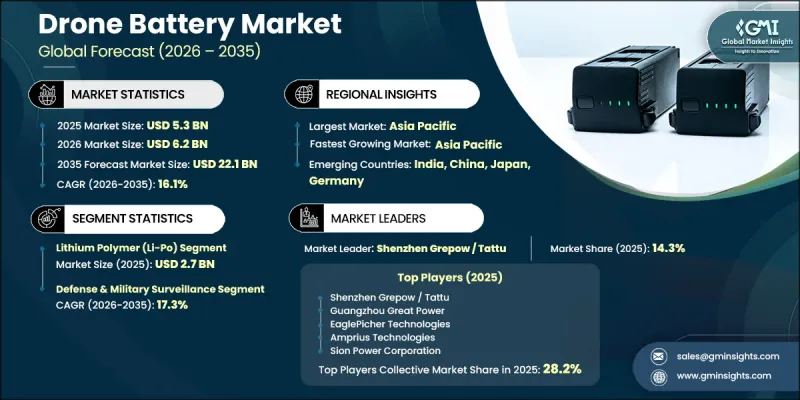
무인항공기 시스템이 기업 및 정부 업무에 점점 더 널리 보급되면서, 기존의 수작업이나 유인 점검 방식을 보다 효율적인 공중 점검 기법으로 대체함에 따라 드론용 배터리 시장은 강력한 성장세를 보이고 있습니다. 장시간 비행 능력, 적재 효율 향상 및 운용 신뢰성 향상에 대한 수요 증가가 도입 확대의 원동력이 되고 있습니다. 또한, 무인항공기 프로그램에 대한 정부 투자의 증가와 상용 드론의 이용 확대를 가능하게 하는 규제 체계의 정비도 시장 성장을 뒷받침하고 있습니다. 배터리의 화학적 조성, 에너지 밀도, 방전 효율의 지속적인 개선을 통해 비행 시간 연장 및 임무 수행 능력 향상이 실현되고 있습니다. 동시에, 측정 가능한 비용 절감과 안전성 향상으로 인해 각 산업 분야에서는 드론을 활용한 운영 모델로의 전환이 가속화되고 있습니다. 상업용 드론 도입 대수의 증가는 안정적인 교체 수요도 창출하고 있으며, 배터리 생태계 내의 지속적인 수익 사이클을 강화하고 있습니다. 드론의 용도가 상업, 산업, 국방 각 분야에서 계속 다양화되는 가운데, 예측 기간 동안에는 첨단 고성능 에너지 저장 솔루션에 대한 수요가 크게 가속화될 것으로 예상됩니다.
| 시장 범위 | |
|---|---|
| 시작 연도 | 2025년 |
| 예측 기간 | 2026-2035년 |
| 초기 시장 규모 | 53억 달러 |
| 예측액 | 221억 달러 |
| CAGR | 16.1% |
리튬 폴리머(Li-Po) 부문은 27억 달러의 매출을 기록하며 시장 점유율의 51.1%를 차지하고 있으며, 2035년까지 연평균 성장률(CAGR) 14.6%로 성장할 것으로 예측됩니다. 이 부문은 높은 에너지 밀도, 경량성, 그리고 컴팩트한 드론 설계를 뒷받침하는 유연한 형상 특성 덕분에 계속해서 시장을 주도하고 있습니다. 확립된 생산 생태계와 광범위한 접근성은 전 세계 드론용 배터리 공급망에서 이 부문의 견고한 입지를 더욱 강화하고 있습니다. 상업용 드론 분야에서 성능, 효율 및 비용 대비 성능의 균형을 추구하는 제조사들에게 Li-Po 배터리는 여전히 최적의 선택지입니다.
방위·군사 감시 부문은 2025년에 11억 달러(시장 점유율 21.7%)를 차지했으며, 2035년까지 연평균 성장률(CAGR) 17.3%로 성장할 것으로 전망됩니다. 이 부문은 정보 수집, 감시, 정찰 및 임무상 극히 중요한 작전에서 무인 항공 시스템에 대한 의존도가 높아짐에 따라 계속해서 확대되고 있습니다. 이 분야의 배터리 요구 사항으로는 높은 신뢰성, 긴 수명, 그리고 가혹한 조건 하에서의 성능 안정성이 중시되고 있으며, 이는 상업용 용도에 비해 고부가가치 제품에 대한 수요로 이어지고 있습니다. 전 세계적으로 확대되는 국방 현대화 프로그램으로 인해 첨단 드론용 배터리 기술에 대한 수요는 더욱 높아지고 있습니다.
북미 드론용 배터리 시장은 2025년에 15억 달러 규모에 달해 시장 점유율 28.4%를 차지했으며, 2035년까지 연평균 성장률(CAGR) 14.4%로 성장할 것으로 전망됩니다. 이 지역의 성장은 상용 드론 도입 확대, 강력한 기술 혁신 능력, 그리고 산업 및 국방 분야에서의 무인 시스템 통합이 진행되고 있는 데 힘입고 있습니다. 규제 체계의 지속적인 정비로 드론의 운용 범위가 확대되고 있으며, 이는 다양한 용도에 걸친 고성능 배터리 시스템에 대한 수요를 더욱 부추기고 있습니다.
자주 묻는 질문
목차
제1장 조사 방법과 범위
제2장 주요 요약
제3장 업계 인사이트
제4장 경쟁 구도
제5장 시장 규모 및 예측 : 배터리 유형별, 2022-2035년
제6장 시장 규모 및 예측 : 용량 범위별, 2022-2035년
제7장 시장 규모 및 예측 : 드론 종류별, 2022-2035년
제8장 시장 규모 및 예측 : 용도별, 2022-2035년
제9장 시장 규모 및 예측 : 판매 채널별, 2022-2035년
제10장 시장 규모 및 예측 : 지역별, 2022-2035년
제11장 기업 개요
KSM 26.08.05The Global Drone Battery Market was valued at USD 5.3 billion in 2025 and is estimated to grow at a CAGR of 16.1% to reach USD 22.1 billion by 2035.
The drone battery market is gaining strong momentum as unmanned aerial systems become increasingly embedded across enterprise and government operations, replacing conventional manual and crewed inspection methods with more efficient aerial alternatives. Expanding adoption is being driven by rising demand for long-endurance flight capabilities, higher payload efficiency, and improved operational reliability. Growth is further supported by increasing government investments in unmanned aerial vehicle programs and evolving regulatory frameworks that enable broader commercial drone usage. Continuous improvements in battery chemistry, energy density, and discharge efficiency are enabling longer flight times and enhanced mission capabilities. At the same time, industries are increasingly shifting toward drone-based operational models due to measurable cost reductions and improved safety outcomes. The growing installed base of commercial drones is also generating consistent replacement demand, reinforcing recurring revenue cycles within the battery ecosystem. As drone applications continue to diversify across commercial, industrial, and defense sectors, the demand for advanced, high-performance energy storage solutions is expected to accelerate significantly over the forecast period.
| Market Scope | |
|---|---|
| Start Year | 2025 |
| Forecast Year | 2026-2035 |
| Start Value | $5.3 Billion |
| Forecast Value | $22.1 Billion |
| CAGR | 16.1% |
The lithium polymer (Li-Po) segment generated USD 2.7 billion, representing 51.1% share, and is projected to grow at a CAGR of 14.6% through 2035. This segment continues to dominate due to its high energy density, lightweight characteristics, and adaptable form factor that supports compact drone designs. Its well-established production ecosystem and widespread availability further reinforce its strong position in the global drone battery supply chain. Li-Po batteries remain a preferred choice for manufacturers seeking a balance between performance, efficiency, and cost-effectiveness in commercial drone applications.
The defense and military surveillance segment accounted for USD 1.1 billion in 2025, representing 21.7% share, and is projected to grow at a CAGR of 17.3% through 2035. This segment continues to expand due to increasing reliance on unmanned aerial systems for intelligence gathering, surveillance, reconnaissance, and mission-critical operations. Battery requirements in this segment emphasize high reliability, extended operational life, and performance stability under extreme conditions, which contributes to higher-value product demand compared to commercial applications. Growing defense modernization programs worldwide are further strengthening the need for advanced drone battery technologies.
North America Drone Battery Market was valued at USD 1.5 billion in 2025, accounting for 28.4% share, and is projected to grow at a CAGR of 14.4% through 2035. Regional growth is supported by expanding commercial drone deployment, strong technological innovation capabilities, and increasing integration of unmanned systems across industrial and defense sectors. Continuous advancements in regulatory frameworks are enabling broader operational use of drones, which is further supporting demand for high-performance battery systems across multiple applications.
Key companies operating in the global drone battery market include EaglePicher Technologies, Amprius Technologies, Shenzhen Grepow Battery Co., Ltd. (Tattu), Guangzhou Great Power Energy & Technology Co., Ltd., Foxtech Energy, Sion Power Corporation, Denchi Group, Epsilor Electric Fuel, Amicell-Amit Industries, Custom Power, RRC Power Solutions GmbH, Huizhou Fullymax Battery Technology Co., Ltd., LiTrue Battery Technology, UFO-Power, and MaxAmps LLC. Companies operating in the drone battery market are strengthening their market position by focusing on improving energy density, extending battery lifecycle, and enhancing safety performance under high-load operating conditions. Manufacturers are investing heavily in advanced lithium-based chemistries and next-generation solid-state technologies to achieve longer flight durations and faster charging capabilities. Strategic partnerships with drone OEMs and aerospace firms are enabling co-development of optimized battery systems tailored to specific mission profiles. Companies are also expanding production capacities and strengthening global supply chain integration to meet rising demand across commercial and defense applications.
Table of Contents
Chapter 1 Methodology & Scope
- 1.1 Research approach
- 1.2 Quality commitments
- 1.2.1 GMI AI policy & data integrity commitment
- 1.2.1.1 Source consistency protocol
- 1.2.1 GMI AI policy & data integrity commitment
- 1.3 Research trail & confidence scoring
- 1.3.1 Research trail components
- 1.3.2 Scoring components
- 1.4 Data collection
- 1.4.1 Partial list of primary sources
- 1.5 Data mining sources
- 1.5.1 Paid sources
- 1.5.1.1 Sources, by region
- 1.5.1 Paid sources
- 1.6 Base estimates and calculations
- 1.6.1 Base year calculation for any one approach
- 1.7 Market estimates & forecasts parameters
- 1.8 Forecast model
- 1.8.1 Quantified market impact analysis
- 1.8.1.1 Mathematical impact of growth parameters on forecast
- 1.8.1 Quantified market impact analysis
- 1.9 Research transparency addendum
- 1.9.1 Source attribution framework
- 1.9.2 Quality assurance metrics
- 1.9.3 Our commitment to trust
- 1.10 Market definitions
Chapter 2 Executive Summary
- 2.1 Industry synopsis, 2022 - 2035
- 2.1.1 Battery Type trends
- 2.1.2 Capacity Range trends
- 2.1.3 Drone Type trends
- 2.1.4 Sales Channel trends
- 2.1.5 Application trends
- 2.1.6 Regional trends
Chapter 3 Industry Insights
- 3.1 Industry ecosystem analysis
- 3.2 Industry impact forces
- 3.2.1 Growth drivers
- 3.2.1.1 Rising Adoption of Commercial Drones Across Industries
- 3.2.1.2 Growing Defense and Homeland Security Investments
- 3.2.1.3 Advancements in Battery Technology
- 3.2.1.4 Expansion of Drone Delivery and Urban Air Mobility (UAM)
- 3.2.2 Industry pitfalls and challenges
- 3.2.2.1 Limited Flight Time Due to Battery Capacity Constraints
- 3.2.2.2 High Cost of Advanced Battery Technologies
- 3.2.3 Market opportunities
- 3.2.3.1 Growing Demand for Long-Endurance Industrial and Delivery Drones
- 3.2.3.2 Expansion of Hydrogen Hybrid and Sustainable Energy Solutions
- 3.2.1 Growth drivers
- 3.3 Growth potential analysis
- 3.4 Regulatory landscape (Driven by primary research)
- 3.4.1 North America
- 3.4.2 Europe
- 3.4.3 Asia Pacific
- 3.4.4 Latin America
- 3.4.5 MEA
- 3.5 Technology landscape
- 3.5.1 Current technological trends
- 3.5.2 Emerging technologies
- 3.6 Pricing trend analysis (Driven by primary research)
- 3.7 Future market trends
- 3.8 Patent analysis
- 3.9 Porter's analysis
- 3.10 PESTEL analysis
- 3.11 Impact of AI and Generative AI on the market (Driven by primary research)
- 3.12 Value chain analysis (Driven by primary research)
- 3.13 Investment & funding analysis (Driven by primary research)
- 3.14 Consumer insights (Driven by primary research)
Chapter 4 Competitive Landscape, 2025
- 4.1 Introduction
- 4.2 Company market share analysis, by region, 2025
- 4.2.1 North America
- 4.2.2 Europe
- 4.2.3 Asia Pacific
- 4.2.4 Middle East & Africa
- 4.2.5 Latin America
- 4.3 Key developments
- 4.3.1 Key partnerships & collaborations
- 4.3.2 Major M&A activities
- 4.3.3 Product innovations & launches
- 4.3.4 Market expansion strategies
- 4.4 Competitive positioning matrix
Chapter 5 Market Size and Forecast, By Battery Type, 2022 - 2035 (USD Million)
- 5.1 Key trends
- 5.2 Lithium Polymer (Li-Po)
- 5.3 Lithium-ion (Li-ion)
- 5.4 Nickel-Based (NiCad / NiMH)
- 5.5 Solid-State
- 5.6 Others
Chapter 6 Market Size and Forecast, By Capacity Range, 2022 - 2035 (USD Million)
- 6.1 Key trends
- 6.2 Below 3,000 mAh
- 6.3 3,000-5,000 mAh
- 6.4 5,001-10,000 mAh
- 6.5 Above 10,000 mAh
Chapter 7 Market Size and Forecast, By Drone Type, 2022 - 2035 (USD Million)
- 7.1 Key trends
- 7.2 Rotary-Wing (Multi-rotor)
- 7.2.1 Quadcopter
- 7.2.2 Hexacopter
- 7.2.3 Octocopter
- 7.2.4 Others
- 7.3 Fixed-Wing
- 7.4 Others
Chapter 8 Market Size and Forecast, By Application, 2022 - 2035 (USD Million)
- 8.1 Aerial Imaging, Cinematography & Mapping
- 8.1.1 Commercial Photography & Videography
- 8.1.2 GIS & Topographic Surveying
- 8.1.3 Infrastructure & Construction Monitoring
- 8.1.4 Others
- 8.2 Defense & Military Surveillance
- 8.2.1 Intelligence, Surveillance & Reconnaissance (ISR)
- 8.2.2 Tactical & Combat Support UAVs
- 8.2.3 Border Patrol & Maritime Monitoring
- 8.2.4 Others
- 8.3 Public Safety & Emergency Response
- 8.3.1 Search & Rescue Operations
- 8.3.2 Firefighting Support & Disaster Relief
- 8.3.3 Others
- 8.4 Precision Agriculture
- 8.4.1 Crop Spraying & Fertilization
- 8.4.2 Crop Health Monitoring & Multispectral Imaging
- 8.4.3 Others
- 8.5 Logistics & Delivery
- 8.6 Infrastructure Inspection
- 8.7 Others
Chapter 9 Market Size and Forecast, By Sales Channel, 2022 - 2035 (USD Million)
- 9.1 OEM (Original Equipment Manufacturer)
- 9.2 Aftermarket / Replacement
Chapter 10 Market Size and Forecast, By Region, 2022 - 2035 (USD Million)
- 10.1 Key trends
- 10.2 North America
- 10.2.1 U.S.
- 10.2.2 Canada
- 10.3 Europe
- 10.3.1 Germany
- 10.3.2 France
- 10.3.3 UK
- 10.3.4 Netherlands
- 10.3.5 Spain
- 10.3.6 Italy
- 10.4 Asia Pacific
- 10.4.1 China
- 10.4.2 Japan
- 10.4.3 South Korea
- 10.4.4 India
- 10.4.5 Australia
- 10.5 Middle East & Africa
- 10.5.1 Saudi Arabia
- 10.5.2 UAE
- 10.5.3 South Africa
- 10.6 Latin America
- 10.6.1 Brazil
- 10.6.2 Argentina
- 10.6.3 Mexico
Chapter 11 Company Profiles
- 11.1 Shenzhen Grepow / Tattu
- 11.2 Guangzhou Great Power
- 11.3 EaglePicher Technologies
- 11.4 Amprius Technologies
- 11.5 Sion Power Corporation
- 11.6 Foxtech Energy
- 11.7 Denchi Group
- 11.8 Epsilor Electric Fuel
- 11.9 Amicell-Amit Industries
- 11.10 Custom Power
- 11.11 RRC Power Solutions GmbH
- 11.12 Huizhou Fullymax
- 11.13 LiTrue Battery Technology
- 11.14 UFO-Power
- 11.15 MaxAmps LLC


