

|
시장보고서
상품코드
2101955
지열 히트 펌프 시장 기회, 성장 촉진요인, 업계 동향 분석 및 예측(2026-2035년)Geothermal Heat Pump Market Opportunity, Growth Drivers, Industry Trend Analysis, and Forecast 2026 - 2035 |
||||||

세계의 지열 히트 펌프 시장은 2025년에 39억 달러 규모에 달하고, CAGR 4.4%로 성장하여 2035년까지 60억 달러에 달할 것으로 추정됩니다.
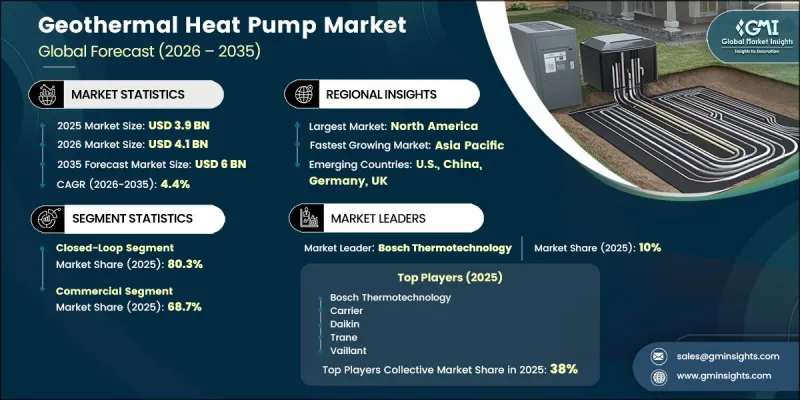
이 업계는 건물의 탈탄소화를 위한 노력 강화, 에너지 효율이 높은 HVAC 기술에 대한 수요 증가, 그리고 재생 가능 열 솔루션에 대한 정책 지원 강화의 혜택을 받고 있습니다. 시추 방법의 발전, 열 그라우트 재료의 개선, 가변 속도 압축기 기술의 진보로 시스템 효율이 향상되었을 뿐만 아니라, 기존 HVAC 대체 기술에 비해 비용 측면의 장벽이 낮아졌습니다. 특히, 기존 연료 공급망의 변동으로 인한 에너지 안보에 대한 우려가 높아짐에 따라 정부, 기업, 기관은 저탄소 난방 기술에 대한 투자를 촉진하고 있습니다. 지열 히트 펌프는 기존 HVAC 시스템에 비해 전력 소비량이 25-50% 적고, 가동 중 직접적인 연소 배출물을 발생시키지 않기 때문에 지속가능성 목표와 GHG 프로토콜 및 ISO 14064와 같은 배출량 보고 프레임워크를 지원하는 측면에서 점점 더 선호되고 있습니다. 공공 부문 및 민간 부문에서 기후 변화 대응 노력이 확대됨에 따라, 전 세계적으로 지열 히트 펌프 시스템에 대한 수요가 더욱 증가할 것으로 예상됩니다.
| 시장 범위 | |
|---|---|
| 시작 연도 | 2025년 |
| 예측 기간 | 2026-2035년 |
| 초기 시장 규모 | 39억 달러 |
| 예측액 | 60억 달러 |
| CAGR | 4.4% |
2025년에는 폐쇄형 루프 시스템 부문이 시장 점유율의 80.3%를 차지하며, 2035년까지 연평균 성장률(CAGR) 4.3%로 성장할 것으로 예측됩니다. 이러한 시스템은 지하수의 유무에 구애받지 않고 다양한 지반 조건에서 효과적으로 가동될 수 있어, 설치의 유연성이 높다는 점이 시장에서 주도적인 위치를 뒷받침하고 있습니다. 또한, 폐쇄형 지열 히트 펌프의 설계는 많은 지역에서 개방형 방식의 대안에 비해 규제상의 과제가 적다는 장점도 있습니다. 상업 시설 및 고밀도 주택 프로젝트에서 널리 채택되고 있는 수직 시추 시스템은 일반적인 시추 깊이에서 지하 온도가 대체로 8-12°C로 일정하게 유지되므로, 계절의 변화에도 불구하고 안정적인 열 성능을 발휘합니다.
상업용 부문은 2025년에 68.7%의 점유율을 차지했으며, 2035년까지 연평균 성장률(CAGR) 4.2%로 성장할 것으로 전망됩니다. 대규모 오피스 빌딩, 의료 시설, 호텔, 교육 기관, 데이터센터 등의 상업 시설은 안정적인 냉난방 수요를 창출하므로 지열 히트 펌프 도입에 매우 적합합니다. 이러한 시설의 예측 가능한 에너지 수요 추세는 장기적인 운영 효율과 비용 절감을 뒷받침합니다. 또한, 미국 소득세법(IRC) 제48조에 따른 상업 투자 세액 공제를 통해 설치 시스템 총 비용의 30%가 상한선 없이 공제되므로, 기존 냉난방 시스템 교체와 비교했을 때 지열 히트 펌프 프로젝트의 경제적 매력이 높아지고 있습니다.
북미 지열 히트 펌프 시장은 2025년에 55.9%의 점유율을 차지했으며, 2035년까지 연평균 성장률(CAGR) 3.3%로 성장할 것으로 전망됩니다. 이 지역의 성장은 확립된 지열 히트 펌프 도입 실적에 더해, 지속가능성에 대한 노력과 정부의 인센티브에 힘입은 개조 활동의 증가를 반영한 것입니다. 미국은 최대의 국내 시장으로, 약 127만 가구의 주택과 2만 7,300동의 상업용 건물에서 지열 히트 펌프 시스템이 활용되고 있어 세계 최대의 도입 실적을 자랑합니다. 미국 34개 주 및 워싱턴 D.C.의 인센티브 프로그램이 시장 발전을 지속적으로 뒷받침하고 있으며, 연방 소득세법(IRC) 제25D조 및 제48조에 따른 연방 정부의 세제 혜택 외에도 주 차원의 환급금, 보조금, 재산세 감면 조치가 시행되고 있습니다. 이러한 재정적 지원 체계를 통해 투자 수익률이 향상되어, 주거용 및 상업용 모두에서 보다 광범위한 도입이 촉진되고 있습니다.
자주 묻는 질문
목차
제1장 조사 방법과 범위
제2장 주요 요약
제3장 업계 인사이트
제4장 경쟁 구도
제5장 시장 규모 및 예측 : 제품별, 2022-2035년
제6장 시장 규모 및 예측 : 기술별, 2022-2035년
제7장 시장 규모 및 예측 : 지역별, 2022-2035년
제8장 기업 개요
KSM 26.08.05The Global Geothermal Heat Pump Market was valued at USD 3.9 billion in 2025 and is estimated to grow at a CAGR of 4.4% to reach USD 6 billion by 2035.
The industry is benefiting from increasing efforts toward building decarbonization, rising demand for energy-efficient HVAC technologies, and stronger policy support for renewable thermal solutions. Advancements in drilling methods, improved thermal grouting materials, and variable-speed compressor technologies have enhanced system efficiency while reducing cost barriers compared with traditional HVAC alternatives. Growing concerns around energy security, particularly due to volatility in conventional fuel supply chains, are encouraging governments, businesses, and institutions to invest in low-carbon heating technologies. Geothermal heat pumps are gaining preference because they use 25-50% less electricity than conventional HVAC systems and produce no direct combustion emissions during operation, supporting sustainability goals and emissions reporting frameworks such as the GHG Protocol and ISO 14064. Increasing climate commitments across public and private sectors are expected to further strengthen demand for geothermal heat pump systems worldwide.
| Market Scope | |
|---|---|
| Start Year | 2025 |
| Forecast Year | 2026-2035 |
| Start Value | $3.9 Billion |
| Forecast Value | $6 Billion |
| CAGR | 4.4% |
The closed-loop systems segment held 80.3% share in 2025 and is projected to grow at a CAGR of 4.3% through 2035. Their market leadership is supported by broad installation flexibility, as these systems can operate effectively across diverse ground conditions without depending on groundwater availability. Closed-loop geothermal heat pump designs also benefit from fewer regulatory challenges compared with open-loop alternatives in many regions. Vertical borehole systems, which are widely used in commercial facilities and high-density residential projects, provide stable thermal performance throughout seasonal changes because underground temperatures generally remain consistent at 8-12°C at typical drilling depths.
The commercial application segment captured 68.7% share in 2025 and is expected to grow at a CAGR of 4.2% through 2035. Commercial properties such as large office buildings, healthcare facilities, hotels, educational institutions, and data centers generate steady heating and cooling requirements, making them well suited for geothermal heat pump adoption. The predictable energy demand profile of these facilities supports long-term operational efficiency and cost savings. Additionally, the commercial investment tax credit under IRC Section 48 offers a 30% credit on the overall installed system cost without a maximum limit, improving the financial attractiveness of geothermal heat pump projects compared with conventional heating and cooling system replacements.
North America Geothermal Heat Pump Market accounted for 55.9% share in 2025 and is projected to grow at a CAGR of 3.3% through 2035. The region's growth reflects its established geothermal heat pump installation base, combined with increasing retrofit activities supported by sustainability initiatives and government incentives. The U.S. represents the largest national market, with approximately 1.27 million homes and 27,300 commercial buildings using geothermal heat pump systems, creating the largest installed base globally. Incentive programs across 34 U.S. states and Washington D.C. continue to support market development, with federal benefits under IRC Sections 25D and 48 complemented by state-level rebates, grants, and property tax incentives. These financial mechanisms are improving investment returns and encouraging wider adoption across both residential and commercial applications.
Major players operating in the global geothermal heat pump industry are Bosch Thermotechnology, Vaillant, Trane, Nibe Energy Systems, Daikin, and Carrier. Companies operating in the geothermal heat pump market are focusing on strategies such as product innovation, strategic partnerships, regional expansion, and improvements in system efficiency to strengthen their market position. Manufacturers are investing in advanced compressor technologies, smart controls, and integrated energy management solutions to improve performance and meet evolving consumer expectations. Businesses are also expanding their distribution networks and collaborating with construction firms, energy providers, and government programs to increase market penetration. Sustainability-focused product development, compliance with energy efficiency standards, and customized solutions for residential and commercial projects are helping companies differentiate their offerings.
Table of Contents
Chapter 1 Methodology & Scope
- 1.1 Research approach
- 1.2 Quality commitments
- 1.2.1 GMI AI policy & data integrity commitment
- 1.2.1.1 Source consistency protocol
- 1.2.1 GMI AI policy & data integrity commitment
- 1.3 Research trail & confidence scoring
- 1.3.1 Research trail components
- 1.3.2 Scoring components
- 1.4 Data collection
- 1.4.1 Partial list of primary sources
- 1.5 Data mining sources
- 1.5.1 Paid sources
- 1.5.1.1 Sources, by region
- 1.5.1 Paid sources
- 1.6 Base estimates and calculations
- 1.6.1 Base year calculation for any one approach
- 1.7 Market estimates & forecasts parameters
- 1.8 Forecast model
- 1.8.1 Quantified market impact analysis
- 1.8.1.1 Mathematical impact of growth parameters on forecast
- 1.8.1 Quantified market impact analysis
- 1.9 Research transparency addendum
- 1.9.1 Source attribution framework
- 1.9.2 Quality assurance metrics
- 1.9.3 Our commitment to trust
- 1.10 Market definitions
Chapter 2 Executive Summary
- 2.1 Industry synopsis, 2022 - 2035
- 2.1.1 Business trends
- 2.1.2 Product trends
- 2.1.3 Application trends
- 2.1.4 Regional trends
Chapter 3 Industry Insights
- 3.1 Industry ecosystem analysis
- 3.1.1 Raw material availability & sourcing analysis
- 3.1.2 Factors affecting the value chain
- 3.1.3 Disruptions
- 3.2 Regulatory landscape
- 3.2.1 North America
- 3.2.2 Europe
- 3.2.3 Asia Pacific
- 3.2.4 Middle East & Africa
- 3.2.5 Latin America
- 3.3 Industry impact forces
- 3.3.1 Growth drivers
- 3.3.1.1 Rising demand for energy-efficient building solutions
- 3.3.1.2 Supportive government incentives and decarbonization policies
- 3.3.1.3 Increasing focus on sustainable heating and cooling alternatives
- 3.3.1.4 Advancements in geothermal system technologies
- 3.3.2 Industry pitfalls and challenges
- 3.3.2.1 Limited availability of skilled professionals
- 3.3.2.2 Geological and land constraints coupled with availability of economical solutions
- 3.3.1 Growth drivers
- 3.4 Growth potential analysis
- 3.5 Technology and innovation landscape
- 3.5.1 Current technological trends
- 3.6 Porter's analysis
- 3.6.1 Bargaining power of suppliers
- 3.6.2 Bargaining power of buyers
- 3.6.3 Threat of new entrants
- 3.6.4 Threat of substitute
- 3.6.5 Intensity of competitive rivalry
- 3.7 PESTEL analysis
- 3.7.1 Political factors
- 3.7.2 Economic factors
- 3.7.3 Social factors
- 3.7.4 Technological factors
- 3.7.5 Environmental factors
- 3.7.6 Legal factors
- 3.8 Cost structure analysis of heat pump (Driven by Primary Research)
- 3.9 Price trend analysis, 2022-2035 (USD/Unit) (Driven by Primary Research)
- 3.9.1 By product
- 3.9.2 By region
- 3.10 Impact of AI and generative AI on the market (Driven by primary research)
- 3.10.1 AI-driven disruption of existing business models
- 3.10.2 GenAI use cases & adoption roadmap by segment
- 3.10.3 Risks, limitations & regulatory considerations
- 3.11 Emerging opportunities & trends
- 3.12 Digitalization and IoT integration
- 3.13 Investment analysis & future outlook
Chapter 4 Competitive Landscape, 2026
- 4.1 Introduction
- 4.2 Company market share analysis, by region, 2025
- 4.2.1 North America
- 4.2.2 Europe
- 4.2.3 Asia Pacific
- 4.2.4 Middle East & Africa
- 4.2.5 Latin America
- 4.3 Competitive analysis of major market players
- 4.4 Competitive positioning matrix
- 4.5 Key developments
- 4.5.1 Mergers & acquisitions
- 4.5.2 Partnerships & collaborations
- 4.5.3 New product launches
- 4.5.4 Expansion plans and funding
- 4.6 Company tier benchmarking
- 4.6.1 Tier classification criteria & qualifying thresholds
- 4.6.2 Tier positioning matrix by revenue, geography & innovation
Chapter 5 Market Size and Forecast, By Product, 2022 - 2035 (USD Million, '000 Units)
- 5.1 Key trends
- 5.2 Open loop
- 5.3 Closed loop
- 5.3.1 Vertical
- 5.3.2 Horizontal
- 5.4 Pond loop
Chapter 6 Market Size and Forecast, By Technology, 2022 - 2035 (USD Million, '000 Units)
- 6.1 Key trends
- 6.2 Residential
- 6.3 Commercial
- 6.3.1 Healthcare
- 6.3.2 Retail
- 6.3.3 Logistics & transportation
- 6.3.4 Offices
- 6.3.5 Hospitality
- 6.3.6 Others
Chapter 7 Market Size and Forecast, By Region, 2022 - 2035 (USD Million, '000 Units)
- 7.1 Key trends
- 7.2 North America
- 7.2.1 U.S.
- 7.2.2 Canada
- 7.3 Europe
- 7.3.1 Germany
- 7.3.2 UK
- 7.3.3 France
- 7.3.4 Italy
- 7.3.5 Sweden
- 7.4 Asia Pacific
- 7.4.1 China
- 7.4.2 Japan
- 7.4.3 Australia
- 7.4.4 South Korea
- 7.5 Middle East & Africa
- 7.5.1 Saudi Arabia
- 7.5.2 Turkey
- 7.5.3 South Africa
- 7.6 Latin America
- 7.6.1 Brazil
- 7.6.2 Mexico
- 7.6.3 Argentina
Chapter 8 Company Profiles
- 8.1 AAON
- 8.2 AIREDALE INTERNATIONAL AIR CONDITIONING
- 8.3 Bard HVAC
- 8.4 Bosch Thermotechnology
- 8.5 Carrier
- 8.6 CHOFU SEISAKUSHO
- 8.7 Daikin
- 8.8 De Dietrich
- 8.9 Finn Geotherm
- 8.10 Kensa Heat Pumps
- 8.11 Nibe Energy Systems
- 8.12 Nordic Heat Pumps
- 8.13 Guangzhou SPRSUN New Energy Technology Development
- 8.14 Ochsner
- 8.15 Stiebel Eltron
- 8.16 Trane
- 8.17 Vaillant
- 8.18 Viessmann
- 8.19 Waterfurnace International
- 8.20 Wolf


