

|
시장보고서
상품코드
2101970
통합형 공조 시스템 시장 기회, 성장 촉진요인, 업계 동향 분석 및 예측(2026-2035년)Integrated Air Conditioning Systems Market Opportunity, Growth Drivers, Industry Trend Analysis, and Forecast 2026 - 2035 |
||||||

세계의 통합형 공조 시스템 시장은 2025년에 125억 달러 규모에 달하고, CAGR 5.4%로 성장하여 2035년까지 211억 달러에 달할 것으로 예측됩니다.
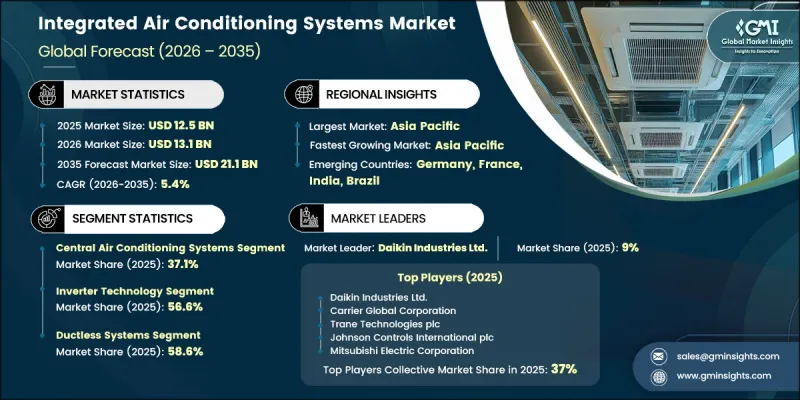
시장 확대의 요인으로는 아시아태평양의 건설 활동 활성화는 물론, 북미 및 유럽 전역에서 강화되고 있는 에너지 성능 규제가 HVAC(난방·환기·공조) 시스템의 구매 결정 및 기술 업그레이드에 영향을 미치고 있기 때문입니다. 도시 지역의 인구 증가, 개발도상국 소비자의 구매력 향상, 그리고 지구온난화지수(GWP)가 높은 냉매 사용을 줄이기 위한 규제 조치로 인해, 첨단 인버터 구동형 및 지능형 통합 공조 솔루션에 대한 수요가 증가하고 있습니다. 스마트 빌딩 인프라의 도입 확대 또한 네트워크로 연결된 멀티존 냉방 시스템의 도입을 가속화하고 있습니다. 미국의 상업용 빌딩을 대상으로 한 ‘ASHRAE 표준 90.1-2025’를 비롯한 에너지 효율 기준에 따라, 개발업자와 시설 소유주는 초기 계획 및 설계 단계부터 고성능 HVAC 시스템을 도입하도록 권장받고 있습니다. 상업용 부동산에서 LEED 및 BREEAM 인증이 확산됨에 따라 북미, 유럽, 동아시아 전역에서 지속가능한 냉방 기술에 대한 수요가 더욱 높아지고 있습니다. 아시아태평양은 상업 건축의 풍부한 파이프라인과 신규 건축 개발의 급속한 확대로 인해 계속해서 큰 비즈니스 기회가 있는 지역으로 자리 잡고 있습니다.
| 시장 범위 | |
|---|---|
| 시작 연도 | 2025년 |
| 예측 기간 | 2026-2035년 |
| 시작 시점 시장 규모 | 125억 달러 |
| 예측액 | 211억 달러 |
| CAGR | 5.4% |
2025년, 중앙 공조 시스템 부문은 37.1%의 점유율을 차지했습니다. 이 부문의 시장에서 확고한 입지는 중앙 집중식 냉각 인프라, 공기 분배 네트워크, 그리고 대용량 성능이 필수적인 대규모 상업 시설 및 공공 시설에서의 보급에 기인합니다. 선진국 시장에서 상업 건축 프로젝트의 확대와 리모델링 수요가 이 부문의 성장을 뒷받침하고 있습니다. 캐리어(Carrier)사의 ‘AquaForce’ 칠러 시리즈나 트레인(Trane)사의 ‘CenTraVac’ 원심식 칠러 플랫폼과 같은 프리미엄 상업용 냉각 솔루션은, 신뢰성 높은 냉각 성능과 확장 가능한 용량이 중요한 요소가 되는 용도에서 계속해서 이 부문의 선도적인 솔루션으로 자리매김하고 있습니다.
인버터식 시스템 부문은 2025년에 56.6%의 점유율을 차지했으며, 2035년까지 연평균 성장률(CAGR) 7.7%로 성장할 것으로 전망됩니다. 이 부문은 에너지 효율 요건의 강화, 전력 비용에 대한 인식 제고, 그리고 기존 시스템과 인버터식 시스템 간의 가격 격차 축소로 인해 모든 기술 및 제품 카테고리 중에서 가장 빠른 성장을 이룰 것으로 예측됩니다. 많은 개발도상국에서 고효율 인버터식 에어컨의 가격이 합리적으로 형성되면서 기존의 비용적 제약이 완화됨에 따라, 소비자 및 기업에서의 보급이 촉진되고 있습니다.
2025년, 아시아태평양의 통합 공조 시스템 시장은 34.96%의 점유율을 차지했습니다. 중국과 인도는 여전히 주요 수요 거점으로 남아 있지만, 양국 간의 시장 상황에는 차이가 보입니다. 중국의 시장 성장은 데이터센터, 산업 시설, 복합 용도 프로젝트 등 광범위한 상업 인프라 개발에 힘입어 이루어지고 있으며, 이러한 분야에서는 VRF 및 중앙 공조 기술이 여전히 선호되는 선택지로 자리 잡고 있습니다. Midea사의 VRF ‘Multi V’ 및 Gree사의 ‘GMV6’ 플랫폼은 수많은 대규모 상업 시설에서 실용화되고 있습니다.
자주 묻는 질문
목차
제1장 조사 방법
제2장 주요 요약
제3장 업계 인사이트
제4장 경쟁 구도
제5장 시장 추정 및 예측 : 제품 유형별, 2022-2035년
제6장 시장 추정 및 예측 : 기술별, 2022-2035년
제7장 시장 추정 및 예측 : 에너지원별, 2022-2035년
제8장 시장 추정 및 예측 : 용도별, 2022-2035년
제9장 시장 추정 및 예측 : 유통 시스템별, 2022-2035년
제10장 예측 : 지역별, 2022-2035년
제11장 기업 개요
KSM 26.08.05The Global Integrated Air Conditioning Systems Market was valued at USD 12.5 billion in 2025 and is estimated to grow at a CAGR of 5.4% to reach USD 21.1 billion by 2035.
Market expansion is shaped by rising construction activity in Asia Pacific, along with stricter energy performance regulations across North America and Europe that are influencing HVAC purchasing decisions and technology upgrades. Growing urban populations, improving consumer purchasing power in developing economies, and regulatory efforts to reduce the use of high-global warming potential (GWP) refrigerants are increasing demand for advanced inverter-driven and intelligent integrated air conditioning solutions. The growing adoption of smart building infrastructure is also accelerating the deployment of connected, multi-zone cooling systems. Energy efficiency standards, including ASHRAE Standard 90.1-2025 for commercial buildings in the United States, are encouraging developers and facility owners to incorporate higher-performance HVAC systems during initial planning and design stages. Increasing acceptance of LEED and BREEAM certifications in commercial properties is further strengthening the need for sustainable cooling technologies across North America, Europe, and East Asia. Asia Pacific continues to represent a major opportunity area due to its strong commercial construction pipeline and rapid growth in new building developments.
| Market Scope | |
|---|---|
| Start Year | 2025 |
| Forecast Year | 2026-2035 |
| Start Value | $12.5 Billion |
| Forecast Value | $21.1 Billion |
| CAGR | 5.4% |
The central air conditioning systems segment held 37.1% share in 2025. Their strong market presence is attributed to widespread adoption in large commercial and institutional buildings where centralized cooling infrastructure, air distribution networks, and high-capacity performance are essential. Expansion of commercial construction projects and replacement activities in developed markets are supporting segment growth. Premium commercial cooling solutions, including Carrier's AquaForce chiller series and Trane's CenTraVac centrifugal chiller platform, continue to represent advanced solutions within this segment, serving applications where dependable cooling performance and scalable capacity are important considerations.
The inverter-based systems segment held 56.6% share in 2025 and is expected to grow at a CAGR of 7.7% through 2035. This segment is projected to experience the fastest expansion among all technology and product categories due to increasing energy efficiency requirements, rising electricity cost awareness, and declining price differences between conventional and inverter-based systems. In many developing economies, efficient inverter air conditioning units have become more affordable, reducing the previous cost-related limitations and encouraging broader adoption among consumers and businesses.
Asia Pacific Integrated Air Conditioning Systems Market held 34.96% share in 2025. China and India continue to act as key demand centers, although market conditions vary between the two countries. China's market growth is supported by extensive commercial infrastructure development, including data centers, industrial facilities, and mixed-use projects, where VRF and central air conditioning technologies remain preferred choices. Midea's VRF Multi V and Gree's GMV6 platform are commercially utilized across several large-scale commercial installations.
Major players operating in the global integrated air conditioning systems industry are AAON Inc., Daikin Industries Ltd., Mitsubishi Electric Corporation, Carrier Global Corporation, Gree Electric Appliances Inc. of Zhuhai, LG Electronics Inc., Trane Technologies plc, AUX Group, Haier Smart Home Co., Ltd., Johnson Controls International plc, Midea Group Co., Ltd., Panasonic Holdings Corporation, Blue Star Limited, Rheem Manufacturing Company, Lennox International Inc., Samsung Electronics Co., Ltd., Systemair AB, TCL, GENERAL Inc., Qingdao Hisense HVAC Equipment Co., Ltd. Companies operating in the integrated air conditioning systems market are focusing on strategies such as product innovation, energy-efficient technology development, smart connectivity integration, and expansion into emerging markets to improve their competitive position. Manufacturers are investing in advanced inverter technologies, IoT-enabled HVAC platforms, and environmentally friendly refrigerant solutions to address changing customer expectations and regulatory requirements. Strategic partnerships, regional manufacturing expansion, mergers, acquisitions, and strengthened distribution networks are also being used to increase market penetration.
Table of Contents
Chapter 1 Research Methodology
- 1.1 Research approach
- 1.2 Quality Commitments
- 1.2.1 GMI AI policy & data integrity commitment
- 1.2.1.1 Source consistency protocol
- 1.2.1 GMI AI policy & data integrity commitment
- 1.3 Research Trail & Confidence Scoring
- 1.3.1 Research Trail Components
- 1.3.2 Scoring Components
- 1.4 Data Collection
- 1.4.1 Partial list of primary sources
- 1.5 Data mining sources
- 1.5.1 Paid sources
- 1.5.1.1 Sources, by region
- 1.5.1 Paid sources
- 1.6 Base estimates and calculations
- 1.6.1 Base year calculation for any one approach
- 1.7 Forecast model
- 1.7.1 Quantified market impact analysis
- 1.7.1.1 Mathematical impact of growth parameters on forecast
- 1.7.1 Quantified market impact analysis
- 1.8 Research transparency addendum
- 1.8.1 Source attribution framework
- 1.8.2 Quality assurance metrics
- 1.8.3 Our commitment to trust
Chapter 2 Executive Summary
- 2.1 Industry 360° synopsis, 2022 - 2035
- 2.2 Key market trends
- 2.2.1 Regional
- 2.2.2 Product Type
- 2.2.3 Technology
- 2.2.4 Energy Source
- 2.2.5 Application
- 2.2.6 Distribution System
Chapter 3 Industry Insights
- 3.1 Industry ecosystem analysis
- 3.1.1 Factor affecting the value chain
- 3.1.2 Profit margin analysis
- 3.1.3 Disruptions
- 3.1.4 Future outlook
- 3.1.5 Manufacturers
- 3.1.6 Distributors
- 3.2 Supplier landscape
- 3.3 Key news & initiatives
- 3.4 Technology & Innovation Landscape
- 3.5 Regulatory landscape
- 3.6 Impact on forces
- 3.6.1 Growth drivers
- 3.6.2 Industry pitfalls & challenges
- 3.6.3 Opportunities
- 3.7 Porter's analysis
- 3.8 PESTEL analysis
- 3.9 Pricing analysis (driven by primary research)
- 3.9.1 Historical Price Trend Analysis, 2019-2024 (Driven by Primary Research)
- 3.9.2 Pricing Strategy by Player Type (Driven by Primary Research)
- 3.10 Trade data analysis (driven by paid database)
- 3.10.1 Import/Export Volume & Value Trends (Driven by Primary Research)
- 3.10.2 Key Trade Corridors & Tariff Impact (Driven by Primary Research)
- 3.11 Impact of AI & Generative AI on the Market
- 3.11.1 AI-Driven Disruption of Existing Business Models
- 3.11.2 GenAI Use Cases & Adoption Roadmap by Segment
- 3.11.3 Risks, Limitations & Regulatory Considerations
- 3.12 Capacity & Production Landscape (Driven by Primary Research)
- 3.12.1 Manufacturing Capacity Installed by Region & Key Producer (Driven by Primary Research)
- 3.12.2 Capacity Utilization Rates & Expansion Pipelines (Driven by Primary Research)
Chapter 4 Competitive Landscape, 2025
- 4.1 Introduction
- 4.2 Company market share analysis
- 4.3 Competitive positioning matrix
- 4.4 Strategic outlook matrix
- 4.5 Competitive analysis of major market players
- 4.6 Key developments
- 4.6.1 Mergers & acquisitions
- 4.6.2 Partnerships & collaborations
- 4.6.3 New product launches
- 4.6.4 Expansion plans
Chapter 5 Market Estimates and Forecast, By Product Type, 2022 - 2035 (USD Billion, Units)
- 5.1 Key trends
- 5.2 Central air conditioning systems
- 5.3 Ductless split systems:
- 5.4 Hybrid systems
- 5.5 Packaged air conditioning systems
- 5.6 VRF (Variable Refrigerant Flow) systems
Chapter 6 Market Estimates and Forecast, By Technology, 2022 - 2035 (USD Billion, Units)
- 6.1 Key trends
- 6.2 Inverter technology
- 6.3 Non-inverter technology
Chapter 7 Market Estimates and Forecast, By Energy Source, 2022 - 2035 (USD Billion, Units)
- 7.1 Key trends
- 7.2 Electric
- 7.3 Gas
- 7.4 Hybrid systems
Chapter 8 Market Estimates and Forecast, By Application, 2022 - 2035 (USD Billion, Units)
- 8.1 Key trends
- 8.2 Residential
- 8.3 Commercial
- 8.4 Industrial
- 8.5 Others (transportation, etc.)
Chapter 9 Market Estimates and Forecast, By Distribution System, 2022 - 2035 (USD Billion, Units)
- 9.1 Key trends
- 9.2 Ducted systems
- 9.3 Ductless systems
Chapter 10 Forecast, By Region, 2022 - 2035, (USD Billion, Units)
- 10.1 Key trends
- 10.2 North America
- 10.2.1 U.S.
- 10.2.2 Canada
- 10.3 Europe
- 10.3.1 Germany
- 10.3.2 U.K.
- 10.3.3 France
- 10.3.4 Italy
- 10.3.5 Spain
- 10.4 Asia Pacific
- 10.4.1 China
- 10.4.2 India
- 10.4.3 Japan
- 10.4.4 South Korea
- 10.4.5 Australia
- 10.5 Latin America
- 10.5.1 Brazil
- 10.5.2 Mexico
- 10.5.3 Argentina
- 10.6 MEA
- 10.6.1 UAE
- 10.6.2 Saudi Arabia
- 10.6.3 South Africa
Chapter 11 Company Profiles
- 11.1 Global players
- 11.1.1 Daikin Industries Ltd.
- 11.1.2 Carrier Global Corporation
- 11.1.3 Trane Technologies plc
- 11.1.4 Johnson Controls International plc
- 11.1.5 Mitsubishi Electric Corporation
- 11.1.6 LG Electronics Inc.
- 11.1.7 Midea Group Co., Ltd.
- 11.1.8 Panasonic Holdings Corporation
- 11.2 Regional players
- 11.2.1 Gree Electric Appliances Inc. of Zhuhai
- 11.2.2 GENERAL Inc.
- 11.2.3 Lennox International Inc.
- 11.2.4 Voltas Limited
- 11.2.5 Blue Star Limited
- 11.2.6 Samsung Electronics Co., Ltd.
- 11.3 Emerging players
- 11.3.1 AAON Inc.
- 11.3.2 Haier Smart Home Co., Ltd.
- 11.3.3 Rheem Manufacturing Company
- 11.3.4 Qingdao Hisense HVAC Equipment Co., Ltd.
- 11.3.5 TCL
- 11.3.6 AUX Group
- 11.3.7 Systemair AB


