

|
시장보고서
상품코드
2102000
헬리컬 스크류 블로어 시장 기회, 성장 촉진요인, 업계 동향 분석 및 예측(2026-2035년)Helical Screw Blowers Market Opportunity, Growth Drivers, Industry Trend Analysis, and Forecast 2026 - 2035 |
||||||

세계의 헬리컬 스크류 블로어 시장은 2025년에 13억 달러 규모에 달하고, CAGR 5.8%로 성장하여 2035년까지 23억 달러에 달할 것으로 예측됩니다.
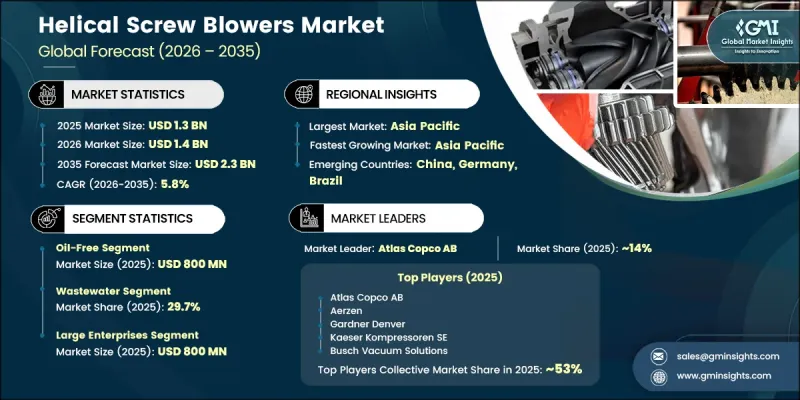
각 산업 분야에서 에너지 소비를 줄이면서 운영 성능을 향상시키는 에너지 절약형 공기 압축 기술이 점점 더 중요시됨에 따라 시장의 성장세는 계속해서 높아지고 있습니다. 산업 현대화를 위한 투자 확대에 더해, 비용 대비 효과가 높고 신뢰성이 뛰어난 블로어 시스템에 대한 수요가 증가함에 따라 여러 최종 용도 분야에서 헬리컬 스크류 블로어의 도입이 진행되고 있습니다. 폐수처리 인프라 확충, 운영비 절감에 대한 관심 증가, 그리고 지속가능한 산업 운영에 대한 중요성 증대가 시장 성장에 호재를 제공하고 있습니다. 또한, 첨단 제어 기술, 지능형 모니터링 기능, 가변 속도 구동(VSD) 시스템의 통합을 통해 장비의 효율, 운영 유연성 및 수명주기 성능이 향상되고 있습니다. 각 제조사들도 유지보수 요구 사항 감소, 풍량의 일관성 향상, 신뢰성 강화를 실현하는 고성능 블로어 솔루션 제공에 주력하고 있습니다. 각 산업이 생산 시설의 현대화를 추진하고 효율적인 공정 장비에 대한 투자를 지속하는 가운데, 산업용 전반에 걸친 첨단 용적식 블로어 기술에 대한 수요 확대에 힘입어 헬리컬 스크류 블로어 시장은 예측 기간 동안 꾸준한 성장이 예상됩니다.
| 시장 범위 | |
|---|---|
| 시작 연도 | 2025년 |
| 예측 기간 | 2026-2035년 |
| 시작 시점 시장 규모 | 13억 달러 |
| 예측액 | 23억 달러 |
| CAGR | 5.8% |
2025년, 오일 프리 분야의 시장 규모는 8억 달러에 달했습니다. 많은 산업 분야에서 중요한 제조 공정을 지원하고 높은 운영 기준을 유지하기 위해 오염이 없는 압축 공기가 요구됨에 따라, 오일 프리 블로어 시스템에 대한 수요는 지속적으로 증가하고 있습니다. 이러한 시스템은 유지보수 요구 사항을 최소화하면서 전체 공정의 신뢰성을 향상시키고, 깨끗한 공기 흐름을 공급합니다. 안정적인 성능, 효율 향상, 그리고 신뢰성 높은 가동을 실현하는 능력 덕분에, 공기의 순도가 주요 운영 요건인 용도에서 이러한 시스템은 최적의 선택지가 되고 있습니다. 첨단 오일 프리 기술에 대한 지속적인 투자로 인해, 이 부문의 장기적인 성장 전망은 더욱 강화될 것으로 예상됩니다.
2025년, 폐수처리 부문은 29.7%의 점유율을 차지했습니다. 생물학적 처리 공정에서는 제어된 압력 조건 하에서 안정적인 압축 공기의 연속 공급이 필요하기 때문에 폐수처리는 여전히 헬리컬 스크류 블로어의 가장 중요한 응용 분야 중 하나입니다. 폐수처리 시설의 확대, 기존 인프라의 현대화, 그리고 수자원 관리 프로젝트에 대한 투자 증가는 이러한 시스템에 대한 지속적인 수요를 뒷받침하고 있습니다. 신뢰할 수 있는 공기 유량을 공급하면서도 에너지 효율을 높일 수 있기 때문에 지자체 및 산업용 폐수처리 시설의 장기적인 운영에 최적입니다.
미국 헬리컬 스크류 블로어 시장은 2025년에 3억 달러 규모에 도달했으며, 2026년부터 2035년까지 연평균 성장률(CAGR) 5.9%로 성장할 것으로 전망됩니다. 시장 확대는 산업 인프라에 대한 지속적인 투자, 하수 처리 시설의 현대화, 그리고 전반적인 제조 업무에서 에너지 효율이 높은 설비에 대한 수요 증가에 힘입고 있습니다. 노후화된 블로어 시스템의 교체 작업이 진행되고 있는 데다, 지속적인 산업 개발 및 공정 자동화 노력의 확대가 더해지면서 전미에서 첨단 헬리컬 스크류 블로어 기술의 도입이 촉진되고 있습니다.
자주 묻는 질문
목차
제1장 조사 방법과 범위
제2장 주요 요약
제3장 업계 인사이트
제4장 경쟁 구도
제5장 시장 추정 및 예측 : 윤활 방식별, 2022-2035년
제6장 시장 추정 및 예측 : 구동 방식별, 2022-2035년
제7장 시장 추정 및 예측 : 로터 프로파일 종류별, 2022-2035년
제8장 시장 추정 및 예측 : 용량별, 2022-2035년
제9장 시장 추정 및 예측 : 모터 출력 범위별, 2022-2035년
제10장 시장 추정 및 예측 : 속도 제어별, 2022-2035년
제11장 시장 추정 및 예측 : 용도별, 2022-2035년
제12장 시장 추정 및 예측 : 최종사용자 규모별, 2022-2035년
제13장 시장 추정 및 예측 : 유통 채널별, 2022-2035년
제14장 시장 추정 및 예측 : 지역별, 2022-2035년
제15장 기업 개요
KSM 26.08.05The Global Helical Screw Blowers Market was valued at USD 1.3 billion in 2025 and is estimated to grow at a CAGR of 5.8% to reach USD 2.3 billion by 2035.
The market continues to gain momentum as industries increasingly prioritize energy-efficient air compression technologies that improve operational performance while lowering energy consumption. Growing investment in industrial modernization, combined with the need for cost-effective and reliable blower systems, is encouraging the adoption of helical screw blowers across multiple end-use sectors. The expansion of wastewater treatment infrastructure, rising focus on reducing operating expenses, and increasing emphasis on sustainable industrial operations are creating favorable opportunities for market growth. In addition, the integration of advanced control technologies, intelligent monitoring capabilities, and variable speed drive (VSD) systems is improving equipment efficiency, operational flexibility, and lifecycle performance. Manufacturers are also focusing on delivering high-performance blower solutions that offer lower maintenance requirements, improved airflow consistency, and enhanced reliability. As industries continue to modernize production facilities and invest in efficient process equipment, the Helical Screw Blower Market is expected to witness steady expansion throughout the forecast period, supported by growing demand for advanced positive displacement blower technologies across industrial applications.
| Market Scope | |
|---|---|
| Start Year | 2025 |
| Forecast Year | 2026-2035 |
| Start Value | $1.3 Billion |
| Forecast Value | $2.3 Billion |
| CAGR | 5.8% |
The oil-free segment generated USD 800 million in 2025. Demand for oil-free blower systems continues to increase because many industries require contamination-free compressed air to support critical manufacturing processes and maintain high operational standards. These systems deliver clean airflow while minimizing maintenance requirements and improving overall process reliability. Their ability to provide consistent performance, enhanced efficiency, and dependable operation makes them preferred choice for applications where air purity remains a primary operational requirement. Continued investment in advanced oil-free technologies is expected to strengthen the segment's long-term growth prospects.
The wastewater segment accounted for 29.7% share in 2025. Wastewater treatment continues to represent one of the most significant application areas for helical screw blowers because biological treatment processes require a continuous supply of stable compressed airflow under controlled pressure conditions. The growing expansion of wastewater treatment facilities, modernization of existing infrastructure, and increasing investments in water management projects are supporting sustained demand for these systems. Their capability to deliver reliable airflow with improved energy efficiency makes them well suited for long-term operation across municipal and industrial wastewater treatment facilities.
U.S. Helical Screw Blowers Market was valued at USD 300 million in 2025 and is projected to grow at a CAGR of 5.9% between 2026 and 2035. Market expansion is supported by ongoing investments in industrial infrastructure, modernization of wastewater treatment facilities, and rising demand for energy-efficient equipment across manufacturing operations. Increasing replacement of aging blower systems, coupled with continued industrial development and expanding process automation initiatives, is encouraging the adoption of advanced helical screw blowers technologies throughout the country.
Key players operating in the Global Helical Screw Blowers Market include Atlas Copco AB, Aerzener Maschinenfabrik GmbH (Aerzen), Kaeser Kompressoren SE, Gardner Denver, Elmo Rietschle, Robuschi S.p.A., Busch Vacuum Solutions, Spencer Turbine Company, Tuthill Corporation, Hibon S.A.S., Sullair LLC, Continental Industrie SAS, Shandong Zhangqiu Blower Co., Ltd., Neuman & Esser Group, Piller Blowers & Compressors GmbH, Universal Blower Pac, Airtech International, Howden Group (Chart Industries), Everest Blowers Systems Pvt. Ltd., Neuros Co., Ltd., and SKF (Blower Systems Division). Companies operating in the Helical Screw Blowers Market are strengthening their market position by investing in product innovation, energy-efficient technologies, and intelligent blower systems that improve operational performance while lowering lifecycle costs. Manufacturers are expanding their product portfolios with advanced oil-free solutions, integrating digital monitoring capabilities, and incorporating variable speed drive technologies to enhance efficiency and reliability.
Table of Contents
Chapter 1 Methodology and Scope
- 1.1 Market scope and definition
- 1.2 Research design
- 1.2.1 Research approach
- 1.2.2 Data collection methods
- 1.3 Data mining sources
- 1.3.1 Global
- 1.3.2 Regional/Country
- 1.4 Base estimates and calculations
- 1.4.1 Base year calculation
- 1.4.2 Key trends for market estimation
- 1.5 Primary research and validation
- 1.5.1 Primary sources
- 1.6 Forecast model
- 1.7 Research assumptions and limitations
Chapter 2 Executive Summary
- 2.1 Industry 360° synopsis
- 2.2 Key market trends
- 2.3 Regional
- 2.4 Lubrication type
- 2.5 Drive configuration
- 2.6 Rotor profile type
- 2.7 Capacity
- 2.8 Motor power range
- 2.9 Speed control
- 2.10 Application
- 2.11 End user scale
- 2.12 Distribution channel
Chapter 3 Industry Insights
- 3.1 Industry ecosystem analysis
- 3.1.1 Supplier landscape
- 3.1.2 Factor affecting the value chain
- 3.1.3 Profit margin analysis by value chain stage
- 3.1.4 Disruptions
- 3.1.5 Future outlook
- 3.2 Industry impact forces
- 3.2.1 Growth drivers
- 3.2.1.1 Rising demand for energy-efficient industrial blower solutions over conventional lobe/roots technology
- 3.2.1.2 Expanding municipal & industrial wastewater treatment infrastructure globally
- 3.2.1.3 Stringent environmental & noise emission regulations driving technology shift
- 3.2.2 Market restraints
- 3.2.2.1 High initial capital investment deterring SME & emerging-market adoption
- 3.2.2.2 Shortage of skilled service technicians in remote & tier-II/III industrial regions
- 3.2.3 Market opportunities
- 3.2.3.1 Integration of IoT, smart sensors & predictive maintenance technologies in blower packages
- 3.2.3.2 Expanding applications in aquaculture & horticulture aeration
- 3.2.1 Growth drivers
- 3.3 Growth potential analysis
- 3.4 Future market trends
- 3.5 Technology and innovation landscape
- 3.5.1 Current technological trends
- 3.5.2 Emerging technologies
- 3.5.3 Emerging rotor profile technologies (3×5, VHX, hybrid profiles)
- 3.5.4 VFD/VSD integration & variable speed control trends
- 3.5.5 Smart blower systems
- 3.5.6 Acoustic enclosure & noise reduction innovations
- 3.6 Pricing analysis (driven by primary research)
- 3.6.1 Historical price trend analysis
- 3.6.2 Pricing strategy by player type (premium / value / cost-plus)
- 3.7 Regulatory landscape
- 3.7.1 Energy efficiency standards (ISO 1217, EU Ecodesign Directive)
- 3.7.2 Environmental & emission compliance regulations
- 3.7.3 Industrial noise compliance standards (EU Machinery Directive, OSHA)
- 3.7.4 Food & pharma grade air quality standards (FDA 21 CFR, EU GMP)
- 3.8 Trade data analysis (driven by paid database) (HS Code- 84145930)
- 3.8.1 Key trade corridors & tariff impact
- 3.8.2 Trade policy changes & regional trade agreements
- 3.9 Supply chain analysis
- 3.9.1 Raw material sourcing
- 3.9.2 Key Tier-1 & Tier-2 supplier landscape
- 3.9.3 Supply chain risk & disruption assessment
- 3.10 Impact of AI & generative AI on the market
- 3.10.1 AI-driven disruption of existing business models
- 3.10.2 GenAI use cases & adoption roadmap by segment
- 3.10.3 Risks, limitations & regulatory considerations
- 3.11 Capacity & production landscape (driven by primary research)
- 3.11.1 Installed capacity by region & key producer
- 3.11.2 Capacity utilization rates & expansion pipelines
- 3.12 Porter's five forces analysis
- 3.13 PESTEL analysis
Chapter 4 Competitive Landscape, 2025
- 4.1 Introduction
- 4.2 Company market share analysis
- 4.2.1 By region
- 4.2.1.1 North America
- 4.2.1.2 Europe
- 4.2.1.3 Asia Pacific
- 4.2.1.4 Latin America
- 4.2.1.5 Middle East and Africa
- 4.2.1 By region
- 4.3 Company matrix analysis
- 4.4 Competitive analysis of major market players
- 4.5 Competitive positioning matrix
- 4.6 Key developments
- 4.6.1 Mergers & acquisitions
- 4.6.2 Partnerships & collaborations
- 4.6.3 New product launches
- 4.6.4 Expansion plans
Chapter 5 Market Estimates & Forecast, By Lubrication Type, 2022-2035 (USD Billion) (Thousand Units)
- 5.1 Key trends
- 5.2 Oil-free
- 5.3 Oil-injected
Chapter 6 Market Estimates & Forecast, By Drive Configuration, 2022-2035 (USD Billion) (Thousand Units)
- 6.1 Key trends
- 6.2 Direct drive
- 6.3 Belt drive
Chapter 7 Market Estimates & Forecast, By Rotor Profile Type, 2022-2035 (USD Billion) (Thousand Units)
- 7.1 Key trends
- 7.2 Standard twin-screw (2×4 Profile)
- 7.3 High-efficiency twin-screw (3×5 Profile)
- 7.4 Variable helix profile (VHX)
- 7.5 Tri-lobe helical (3+4 Hybrid Profile)
Chapter 8 Market Estimates & Forecast, By Capacity, 2022-2035 (USD Billion) (Thousand Units)
- 8.1 Key trends
- 8.2 Low flow (up to 500 cfm / ≤ 14 m³/min)
- 8.3 Medium flow (500–2,500 cfm / 14–71 m³/min)
- 8.4 High flow (2,500–6,000 cfm / 71–170 m³/min)
Chapter 9 Market Estimates & Forecast, By Motor Power Range, 2022-2035 (USD Billion) (Thousand Units)
- 9.1 Key trends
- 9.2 Small power (up to 37 kW)
- 9.3 Medium power (37–160 kW)
- 9.4 Large power (above 160 kW)
Chapter 10 Market Estimates & Forecast, By Speed Control, 2022-2035 (USD Billion) (Thousand Units)
- 10.1 Key trends
- 10.2 Fixed speed
- 10.3 Variable speed drive (VSD/VFD)
Chapter 11 Market Estimates & Forecast, By Application, 2022-2035 (USD Billion) (Thousand Units)
- 11.1 Key trends
- 11.2 Wastewater treatment
- 11.2.1 Municipal wastewater treatment
- 11.2.2 Industrial wastewater treatment
- 11.3 Chemicals & petrochemicals
- 11.3.1 Process gas handling
- 11.3.2 Pneumatic conveying of chemicals
- 11.4 Food & beverage
- 11.4.1 Food-grade pneumatic conveying
- 11.4.2 Fermentation & process aeration
- 11.5 Pharmaceuticals
- 11.5.1 Sterile air supply
- 11.5.2 API process & tablet coating aeration
- 11.6 Power generation
- 11.6.1 Combustion air supply
- 11.6.2 Pneumatic ash handling
- 11.7 Cement
- 11.7.1 Pneumatic cement powder conveying
- 11.7.2 Kiln combustion air
- 11.8 Steel plants
- 11.9 Mining & ventilation
- 11.10 Others (aquaculture, horticulture, general industrial conveying)
Chapter 12 Market Estimates & Forecast, By End User Scale, 2022-2035 (USD Billion) (Thousand Units)
- 12.1 Key trends
- 12.2 Large enterprises
- 12.3 Small & medium enterprises (SMEs)
Chapter 13 Market Estimates & Forecast, By Distribution Channel, 2022-2035 (USD Billion) (Thousand Units)
- 13.1 Key trends
- 13.2 Direct sales
- 13.3 Indirect sales
Chapter 14 Market Estimates & Forecast, By Region, 2022-2035 (USD Billion) (Thousand Units)
- 14.1 Key trends
- 14.2 North America
- 14.2.1 U.S.
- 14.2.2 Canada
- 14.3 Europe
- 14.3.1 UK
- 14.3.2 Germany
- 14.3.3 France
- 14.3.4 Italy
- 14.3.5 Spain
- 14.3.6 Russia
- 14.4 Asia Pacific
- 14.4.1 China
- 14.4.2 India
- 14.4.3 Japan
- 14.4.4 South Korea
- 14.4.5 Australia
- 14.5 Latin America
- 14.5.1 Brazil
- 14.5.2 Mexico
- 14.6 MEA
- 14.6.1 South Africa
- 14.6.2 Saudi Arabia
- 14.6.3 UAE
Chapter 15 Company Profiles
- 15.1 Global Players
- 15.1.1 Atlas Copco AB
- 15.1.2 Aerzener Maschinenfabrik GmbH (Aerzen)
- 15.1.3 Kaeser Kompressoren SE
- 15.1.4 Gardner Denver
- 15.1.5 Elmo Rietschle
- 15.2 Regional Champions
- 15.2.1 Robuschi S.p.A.
- 15.2.2 Busch Vacuum Solutions
- 15.2.3 Spencer Turbine Company
- 15.2.4 Tuthill Corporation
- 15.2.5 Hibon S.A.S.
- 15.3 Emerging Players
- 15.3.1 Sullair LLC
- 15.3.2 Continental Industrie SAS
- 15.3.3 Shandong Zhangqiu Blower Co., Ltd.
- 15.3.4 Neuman & Esser Group
- 15.3.5 Piller Blowers & Compressors GmbH
- 15.3.6 Universal Blower Pac
- 15.3.7 Airtech International
- 15.3.8 Howden Group (Chart Industries)
- 15.3.9 Everest Blowers Systems Pvt. Ltd.
- 15.3.10 Neuros Co., Ltd.
- 15.3.11 SKF (Blower Systems Division)


