

|
시장보고서
상품코드
2109171
분뇨 처리 장비 시장 기회, 성장 촉진요인, 산업 동향 분석 및 예측(2026-2035년)Manure Processing Equipment Market Opportunity, Growth Drivers, Industry Trend Analysis, and Forecast 2026 - 2035 |
||||||

세계의 분뇨 처리 장비 시장은 2025년에 18억 2,000만 달러 규모로 평가되었고, CAGR 6.6%로 성장하여 34억 7,000만 달러에 이를 것으로 추정되고 있습니다.
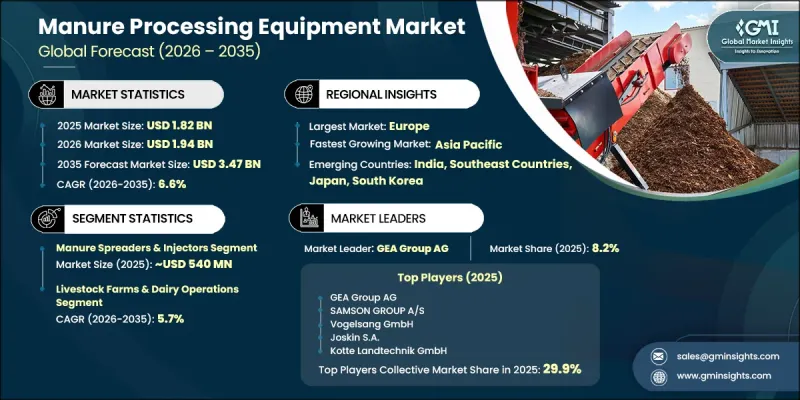
환경 규제 강화와 지속 가능한 축산 관리에 대한 투자 확대가 시장 수요를 지속적으로 재편하고 있는 가운데, 분뇨 처리 장비 시장은 꾸준히 성장하고 있습니다. 폐기물 관리 관행 개선에 초점을 맞춘 규제 체계에 따라, 축산 농가들은 환경 규제 준수를 지원하면서 업무 효율을 높이는 첨단 분뇨 처리 기술의 도입을 촉진하고 있습니다. 동시에, 전 세계 축산업의 지속적인 확장에 따라 가축 배설물 발생량이 증가하고 있어, 장비 제조업체에게는 장기적인 비즈니스 기회가 창출되고 있습니다. FAO(유엔 식량농업기구) 통계에 따르면, 지난 10년간 전 세계 가축 사육 두수가 대폭 증가하여 현대적인 가축 배설물 관리 인프라에 대한 수요 증가를 뒷받침하고 있습니다. 가축 분뇨를 폐기물이 아닌 귀중한 자원으로 활용하는 움직임이 확대되고 있는 것은 에너지 회수 및 자원 최적화 기술에 대한 투자를 촉진하여 시장 성장을 더욱 뒷받침하고 있습니다. 자동화, 디지털 모니터링 및 지능형 가축 분뇨 처리 시스템의 지속적인 발전 또한 상업적 축산 사업 전반에 걸쳐 생산성을 향상시키고 필요한 노동력을 줄이고 있습니다. 이러한 요인들은 지원적인 정책 이니셔티브 및 강화되는 지속가능성 목표와 맞물려, 전 세계 분뇨 처리 장비 시장의 장기적인 성장을 지속적으로 견인하고 있습니다.
| 시장 범위 | |
|---|---|
| 시작 연도 | 2025년 |
| 예측 기간 | 2026-2035년 |
| 초기 시장 규모 | 18억 2,000만 달러 |
| 예측 금액 | 34억 7,000만 달러 |
| CAGR | 6.6% |
퇴비 살포기·주입기 부문은 2025년에 5억 4,000만 달러 시장 규모를 기록했으며, 2026년부터 2035년에 걸쳐 연평균 성장률(CAGR) 5.2%로 성장할 것으로 전망됩니다. 이 부문은 퇴비 처리 방법에 관계없이, 효율적인 농지 시비가 퇴비 관리에 있어 필수적인 단계로 남아 있기 때문에 퇴비 처리 장비 시장에서 계속해서 가장 큰 점유율을 차지하고 있습니다. 영양 관리 및 보다 효율적인 비료 살포에 대한 규제 관심이 높아짐에 따라, 농업 경영자들은 기존 장비를 첨단 정밀 살포 시스템으로 교체하도록 권장받고 있습니다. 지속적인 기술 혁신을 통해 살포 정밀도, 운영 효율성, 환경 성능이 더욱 향상되어 이 제품 카테고리에 대한 지속적인 수요를 뒷받침하고 있습니다.
2025년, 축산 농장 및 낙농 사업 부문은 55.7%의 점유율을 차지했습니다. 이는 상업적 축산 사업에서 일상적인 생산 활동을 지원하고 규제 준수를 유지하기 위해 종합적인 가축 분뇨 관리 인프라가 필요하기 때문입니다. 수요는 가축 분뇨의 수집, 이송, 분리, 저장 및 토지 살포를 목적으로 하는 광범위한 장비에 걸쳐 있으며, 대규모 축산 시설 전반에 걸친 통합적인 폐기물 관리 솔루션에 대한 수요 증가를 반영하고 있습니다. 상업적 축산의 지속적인 확장으로 인해 예측 기간 동안 장비에 대한 견조한 수요가 유지될 것으로 전망됩니다.
북미의 분뇨 처리 장비 시장은 재생에너지 이니셔티브에 대한 투자 증가에 힘입어 2025년에 30%의 점유율을 차지했습니다. 이 지역 시장은 가축 분뇨 관리를 규정하는 확립된 환경 규제의 혜택을 받고 있으며, 이는 생산자들이 첨단 분뇨 처리 기술에 투자하도록 촉진하고 있습니다. 지속적인 규정 준수 요건과 더불어 지속 가능한 농업 관행 및 재생에너지 생산에 대한 중요성이 높아짐에 따라, 북미 전역에서 최신 분뇨 처리 및 관리 장비에 대한 안정적인 수요가 지속적으로 창출되고 있습니다.
자주 묻는 질문
목차
제1장 조사 방법과 범위
제2장 주요 요약
제3장 업계 인사이트
제4장 경쟁 구도
제5장 시장 규모 및 예측 : 기기 유형별(2022-2035년)
제6장 시장 규모 및 예측 : 처리 프로세스별(2022-2035년)
제7장 시장 규모 및 예측 : 구비 상태별(2022-2035년)
제8장 시장 규모 및 예측 : 가축 유형별(2022-2035년)
제9장 시장 규모 및 예측 : 최종 사용자별(2022-2035년)
제10장 시장 규모 및 예측 : 지역별(2022-2035년)
제11장 기업 개요
KTH 26.08.20The Global Manure Processing Equipment Market was valued at USD 1.82 billion in 2025 and is estimated to grow at a CAGR of 6.6% to reach USD 3.47 billion by 2035.
The manure processing equipment industry is expanding steadily as stricter environmental regulations and increasing investments in sustainable livestock management continue to reshape market demand. Regulatory frameworks focused on improving waste management practices are encouraging livestock producers to adopt advanced manure processing technologies that enhance operational efficiency while supporting environmental compliance. At the same time, the continued expansion of the global livestock industry is increasing manure generation, creating long-term opportunities for equipment manufacturers. According to FAO statistics, global livestock populations have increased considerably over the past decade, supporting greater demand for modern manure management infrastructure. The growing transition toward utilizing manure as a valuable resource rather than a waste product is further strengthening market growth by encouraging investment in energy recovery and resource optimization technologies. Continuous advancements in automation, digital monitoring, and intelligent manure handling systems are also improving productivity and reducing labor requirements across commercial livestock operations. These factors, combined with supportive policy initiatives and rising sustainability objectives, continue to drive long-term expansion of the global manure processing equipment market.
| Market Scope | |
|---|---|
| Start Year | 2025 |
| Forecast Year | 2026-2035 |
| Start Value | $1.82 Billion |
| Forecast Value | $3.47 Billion |
| CAGR | 6.6% |
The manure spreaders & injectors segment generated USD 540 million in 2025 and is expected to grow at a CAGR of 5.2% from 2026 to 2035. This segment continues to represent the largest share of the manure processing equipment market because efficient field application remains an essential stage of manure management regardless of the processing method used. Increasing regulatory focus on nutrient management and more efficient fertilizer application is encouraging agricultural operations to replace conventional equipment with advanced precision application systems. Ongoing technological improvements are further enhancing application accuracy, operational efficiency, and environmental performance, supporting continued demand for this product category.
The livestock farms & dairy operations segment held a 55.7% share in 2025, as commercial livestock operations require comprehensive manure management infrastructure to support daily production activities and maintain regulatory compliance. Demand spans a broad range of equipment designed for manure collection, transfer, separation, storage, and land application, reflecting the increasing need for integrated waste management solutions across large-scale livestock facilities. Continued expansion of commercial livestock production is expected to sustain strong equipment demand throughout the forecast period.
North America Manure Processing Equipment Market accounted for 30% share in 2025, supported by increasing investment in renewable energy initiatives. The regional market benefits from established environmental regulations governing livestock waste management, encouraging producers to invest in advanced manure processing technologies. Ongoing compliance requirements, combined with greater emphasis on sustainable agricultural practices and renewable energy production, continue to create consistent demand for modern manure handling and processing equipment across North America.
Major companies operating in the global manure processing equipment market include GEA Group AG, Vogelsang GmbH & Co. KG, Bauer Group, McLanahan Corporation, WAMGROUP S.p.A., WELTEC BIOPOWER GmbH, Borger GmbH, SAMSON GROUP A/S, DVO Inc., Joskin S.A., Kotte Landtechnik GmbH & Co. KG, Daritech Inc., CRI-MAN S.p.A., Fliegl Agrartechnik GmbH, NPHarvest Oy, Circuworld B.V., Renergon Biogas AG, FLOC Ammonia Solutions, RethaiN S.r.l., Boost Environmental Systems Inc., and NUNOS GmbH Companies operating in the manure processing equipment market are strengthening their market position by expanding product portfolios, investing in advanced equipment technologies, and enhancing automation capabilities to improve operational efficiency. Manufacturers are focusing on developing integrated manure management solutions that support sustainability goals while helping customers meet evolving environmental regulations. Strategic partnerships with agricultural organizations, technology providers, and renewable energy developers are expanding market reach and creating new business opportunities. Companies are also increasing investments in research and development to improve equipment performance, reduce maintenance requirements, and enhance digital monitoring capabilities.
Table of Contents
Chapter 1 Methodology & Scope
- 1.1 Research approach
- 1.2 Quality Commitments
- 1.2.1 GMI AI policy & data integrity commitment
- 1.2.1.1 Source consistency protocol
- 1.2.1 GMI AI policy & data integrity commitment
- 1.3 Research Trail & Confidence Scoring
- 1.3.1 Research Trail Components
- 1.3.2 Scoring Components
- 1.4 Data Collection
- 1.4.1 Partial list of primary sources
- 1.5 Data mining sources
- 1.5.1 Paid sources
- 1.5.1.1 Sources, by region
- 1.5.1 Paid sources
- 1.6 Base estimates and calculations
- 1.6.1 Base year calculation for any one approach
- 1.7 Forecast model
- 1.7.1 Quantified market impact analysis
- 1.7.1.1 Mathematical impact of growth parameters on forecast
- 1.7.1 Quantified market impact analysis
- 1.8 Research transparency addendum
- 1.8.1 Source attribution framework
- 1.8.2 Quality assurance metrics
- 1.8.2.1 Our commitment to trust
Chapter 2 Executive Summary
- 2.1 Industry 360° synopsis, 2022 – 2035
- 2.2 Key market trends
- 2.2.1 Region
- 2.2.2 Equipment Type
- 2.2.3 Treatment Process
- 2.2.4 Manure State
- 2.2.5 Livestock Source
- 2.2.6 End-user
Chapter 3 Industry Insights
- 3.1 Industry ecosystem analysis
- 3.2 Supply chain analysis
- 3.2.1 Supply Chain Structure & Key Nodes
- 3.2.2 Raw Material Sourcing & Critical Component Dependencies
- 3.2.3 Supply Chain Disruption Risks & Mitigation Strategies
- 3.2.4 Aftermarket Services & Spare Parts Ecosystem
- 3.3 Industry Impact Forces
- 3.3.1 Market drivers
- 3.3.1.1 Tightening Environmental Regulations on Livestock Waste Discharge Globally
- 3.3.1.2 Rising Livestock Population & Intensification of Animal Husbandry Operations
- 3.3.1.3 Growing Adoption of Biogas & Renewable Natural Gas (RNG) from Manure Feedstock
- 3.3.1.4 Increasing Demand for Nutrient Recovery & Circular Economy Practices
- 3.3.1.5 Precision Agriculture Adoption Driving Demand for Smart Manure Equipment
- 3.3.2 Market restraints
- 3.3.2.1 High Initial Capital Investment
- 3.3.2.2 Lack of Technical Expertise & Skilled Labor for Equipment Operation & Maintenance
- 3.3.3 Market opportunities
- 3.3.3.1 Emerging Markets
- 3.3.3.2 Retrofit & Upgrade Market for Aging Manure Management Infrastructure
- 3.3.1 Market drivers
- 3.4 Growth potential analysis
- 3.5 Technology & innovation landscape
- 3.5.1 Precision Manure Management Technologies
- 3.5.2 IoT & Remote Monitoring Integration
- 3.5.3 Nutrient Recovery & Valorization Technologies
- 3.5.4 Automation & Robotics in Manure Handling
- 3.5.5 Biogas Upgrading & Renewable Natural Gas (RNG) Technologies
- 3.6 Regulatory framework
- 3.6.1 North America
- 3.6.2 Europe
- 3.6.3 Asia Pacific
- 3.6.4 Emerging Market Regulatory Landscape
- 3.6.5 Impact of Regulatory Tightening on Equipment Upgrade Cycles
- 3.7 Future market trends
- 3.8 Pricing analysis (driven by primary research)
- 3.8.1 Historical Price Trend Analysis by Equipment Type (2022–2025) (Driven by Primary Research)
- 3.8.2 Pricing Strategy by Player Type (Premium / Value / Cost-plus) (Driven by Primary Research)
- 3.9 Trade data analysis (HS Code - 84324100) (driven by primary research)
- 3.9.1 Import/Export Volume & Value Trends by Equipment Category (Driven by Primary Research)
- 3.9.2 Key Trade Corridors & Tariff Impact on Cross-Border Equipment Sales (Driven by Primary Research)
- 3.10 Impact of AI & generative AI on the market
- 3.10.1 AI-Driven Disruption of Existing Manure Management Business Models
- 3.10.2 GenAI Use Cases & Adoption Roadmap by Equipment Segment
- 3.10.3 Risks, Limitations & Regulatory Considerations for AI in Agriculture
- 3.11 Porter’s analysis
- 3.12 PESTEL analysis
Chapter 4 Competitive Landscape, 2025
- 4.1 Introduction
- 4.2 Company market share analysis
- 4.2.1 By Region
- 4.2.1.1 North America
- 4.2.1.2 Europe
- 4.2.1.3 Asia Pacific
- 4.2.1.4 Latin America
- 4.2.1.5 Middle East and Africa
- 4.2.1 By Region
- 4.3 Company matrix analysis
- 4.4 Competitive analysis of major market players
- 4.5 Competitive positioning matrix
- 4.6 Key developments
- 4.6.1 Mergers & acquisitions
- 4.6.2 Partnerships & collaborations
- 4.6.3 New product launches
- 4.6.4 Expansion plans
Chapter 5 Market Estimates and Forecast, By Equipment Type, 2022 - 2035 (USD Billion) (Thousand Units)
- 5.1 Key Trends
- 5.2 Solid-Liquid Separators
- 5.2.1 Screw Press Separators
- 5.2.2 Drum Screen Separators
- 5.2.3 Belt Press Separators
- 5.2.4 Centrifugal Separators
- 5.3 Manure Spreaders & Injectors
- 5.3.1 Broadcast Surface Spreaders
- 5.3.2 Trailing Shoe & Shallow Injectors
- 5.3.3 Deep Injection Systems
- 5.4 Manure Pumps & Agitators
- 5.4.1 Centrifugal Pumps
- 5.4.2 Chopper/Macerator Pumps
- 5.4.3 Submersible Agitators
- 5.4.4 PTO-Driven Agitators
- 5.5 Anaerobic Digesters
- 5.5.1 Continuously Stirred Tank Reactors (CSTR)
- 5.5.2 Plug-Flow Digesters
- 5.5.3 Covered Lagoon Digesters
- 5.6 Composting Equipment
- 5.6.1 Windrow Turners
- 5.6.2 In-Vessel Composting Systems
- 5.6.3 Aerated Static Pile Systems
- 5.7 Barn Cleaners & Conveyors
- 5.7.1 Drag Chain & Scraper Cleaners
- 5.7.2 Robotic Barn Cleaning Systems
- 5.7.3 Belt & Screw Conveyors
- 5.8 Manure Dryers
- 5.8.1 Rotary Drum Dryers
- 5.8.2 Belt Dryers
- 5.8.3 Solar-Assisted Drying Systems
- 5.9 Storage & Containment Equipment
- 5.9.1 Slurry Storage Tanks & Silos
- 5.9.2 Lagoon Covers & Liner Systems
- 5.9.3 Manure Weeping Walls & Solid Storage Structures
Chapter 6 Market Estimates and Forecast, By Treatment Process, 2022 - 2035 (USD Billion) (Thousand Units)
- 6.1 Key Trends
- 6.2 Mechanical Treatment
- 6.2.1 Screening & Filtration
- 6.2.2 Pressing & Dewatering
- 6.2.3 Centrifugation
- 6.3 Biological Treatment
- 6.3.1 Anaerobic Digestion
- 6.3.2 Aerobic Composting
- 6.3.3 Microbial Treatment Systems
- 6.4 Chemical Treatment
- 6.4.1 Acidification Systems
- 6.4.2 Struvite Precipitation & Phosphorus Recovery
- 6.4.3 Polymer Flocculation & Coagulation
- 6.5 Thermal Treatment
- 6.5.1 Thermal Drying Systems
- 6.5.2 Pyrolysis & Biochar Production Systems
- 6.5.3 Gasification Systems
- 6.6 Combined/Integrated Treatment Systems
Chapter 7 Market Estimates and Forecast, By Manure State, 2022 - 2035 (USD Billion) (Thousand Units)
- 7.1 Key Trends
- 7.2 Solid Manure Processing Equipment
- 7.2.1 Small Farm Scale (<500 Animal Units)
- 7.2.2 Commercial Farm Scale (500–5,000 Animal Units)
- 7.2.3 Large/Industrial Farm Scale (>5,000 Animal Units)
- 7.3 Liquid & Slurry Manure Processing Equipment
- 7.3.1 Small Farm Scale
- 7.3.2 Commercial Farm Scale
- 7.3.3 Large/Industrial Farm Scale
- 7.4 Semi-Solid Manure Processing Equipment
- 7.5 Small Farm Scale
- 7.6 Commercial Farm Scale
- 7.7 Large/Industrial Farm Scale
Chapter 8 Market Estimates and Forecast, By Livestock Source, 2022 - 2035 (USD Billion) (Thousand Units)
- 8.1 Key Trends
- 8.2 Cattle & Dairy Manure
- 8.3 Poultry Manure
- 8.4 Swine & Pig Manure
- 8.5 Horse Manure
- 8.6 Others
Chapter 9 Market Estimates and Forecast, By End-user, 2022 - 2035 (USD Billion) (Thousand Units)
- 9.1 Key Trends
- 9.2 Livestock Farms & Dairy Operations
- 9.3 Poultry Farms
- 9.4 Biogas & Renewable Energy Plants
- 9.5 Municipal & Industrial Waste Management
- 9.6 Agricultural Cooperatives & Contract Farming Operations
Chapter 10 Market Estimates & Forecast, By Region, 2022 – 2035, (USD Billion) (Thousand Units)
- 10.1 Key trends
- 10.2 North America
- 10.2.1 U.S.
- 10.2.2 Canada
- 10.3 Europe
- 10.3.1 Germany
- 10.3.2 U.K.
- 10.3.3 France
- 10.3.4 Italy
- 10.3.5 Spain
- 10.4 Asia Pacific
- 10.4.1 China
- 10.4.2 India
- 10.4.3 Japan
- 10.4.4 South Korea
- 10.4.5 Australia
- 10.5 Latin America
- 10.5.1 Brazil
- 10.5.2 Mexico
- 10.5.3 Argentina
- 10.6 MEA
- 10.6.1 UAE
- 10.6.2 Saudi Arabia
- 10.6.3 South Africa
Chapter 11 Company Profiles
- 11.1 Global Leader
- 11.1.1 GEA Group AG
- 11.1.2 Vogelsang GmbH & Co. KG
- 11.1.3 Bauer Group
- 11.1.4 McLanahan Corporation
- 11.1.5 WAMGROUP S.p.A.
- 11.1.6 WELTEC BIOPOWER GmbH
- 11.1.7 Borger GmbH
- 11.2 Regional Players
- 11.2.1 SAMSON GROUP A/S
- 11.2.2 DVO Inc
- 11.2.3 Joskin S.A.
- 11.2.4 Kotte Landtechnik GmbH & Co. KG
- 11.2.5 Daritech Inc.
- 11.2.6 CRI-MAN S.p.A.
- 11.2.7 Fliegl Agrartechnik GmbH
- 11.3 Emerging Players
- 11.3.1 NPHarvest Oy
- 11.3.2 Circuworld B.V.
- 11.3.3 Renergon Biogas AG
- 11.3.4 FLOC Ammonia Solutions
- 11.3.5 RethaiN S.r.l.
- 11.3.6 Boost Environmental Systems Inc.
- 11.3.7 NUNOS GmbH


