

|
시장보고서
상품코드
2109198
농업용 처리 폐수 재이용 시장 기회, 성장 촉진요인, 산업 동향 분석 및 예측(2026-2035년)Treated Wastewater Reuse for Agriculture Market Opportunity, Growth Drivers, Industry Trend Analysis, and Forecast 2026 - 2035 |
||||||

세계의 농업용 처리 폐수 재이용 시장은 2025년에 89억 달러 규모로 평가되었고, CAGR 8.1%로 성장하여 196억 달러에 이를 것으로 추정되고 있습니다.
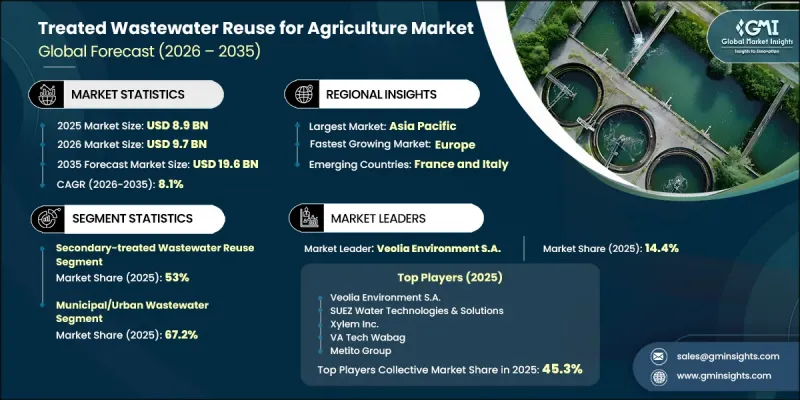
물 부족이 심화되고, 담수 자원에 대한 압박이 커지며, 지속 가능한 관개 방식에 대한 수요가 증가함에 따라 농업 분야 전반에서 처리 폐수의 이용이 확대되고 있으며, 시장은 꾸준한 성장을 이루고 있습니다. 각국 정부와 수자원 관리 당국은 농업의 회복력을 높이고 물 안보를 강화하기 위해 장기적인 수자원 관리 전략에 폐수 재사용을 점점 더 많이 포함시키고 있습니다. 막 여과, 자외선 소독, 지능형 모니터링 시스템 등 수처리 기술의 발전으로 수질이 개선됨에 따라 관개 용도로 재생수에 대한 신뢰도 높아지고 있습니다. 최신 처리 솔루션을 통해 사업자는 더 높은 정화 기준을 달성하고, 운영 효율을 높이며, 수질 모니터링을 신속하게 수행할 수 있게 되었습니다. 또한, 순환형 수자원 관리 추진을 목적으로 한 정부의 지원 규제, 재정적 인센티브 및 투자 프로그램이 공공 부문과 민간 부문 모두의 보다 적극적인 참여를 촉진하고 있습니다. 이러한 노력으로 프로젝트 위험이 감소하고, 처리 인프라가 확충되며, 농업용수 재이용 시장의 장기적인 성장을 위한 유리한 여건이 마련되고 있습니다.
| 시장 범위 | |
|---|---|
| 시작 연도 | 2025년 |
| 예측 기간 | 2026-2035년 |
| 시작 연도 시장 규모 | 89억 달러 |
| 예측 금액 | 196억 달러 |
| CAGR | 8.1% |
2025년에는 2차 처리 폐수 재이용 부문이 53%의 점유율을 차지했습니다. 이 부문이 주도적인 위치를 유지하고 있는 이유는 많은 지역에서 지자체에 의한 처리 인프라가 광범위하게 구축되어 있으며, 농업용 관개에 2차 처리된 물이 널리 이용되고 있기 때문입니다. 기존 하수 처리 시설은 특히 수질 규제에 따라 2차 처리수 공급이 허용된 용도에서 폐수 재이용 프로그램을 위한 활용하기 쉬운 기반을 제공합니다. 작물 적합성에 관한 규제적 제약으로 인해 일부 시장에서는 성장이 둔화될 가능성이 있지만, 수요는 안정적입니다. 동시에, 고도 처리 폐수의 활용도도 증가하는 추세이며, 처리 기준이 강화됨에 따라 재생수가 더 폭넓은 농업 용도로 이용될 수 있게 되었습니다.
2025년, 지자체 및 도시 하수 부문은 67.2%의 점유율을 차지했습니다. 이 부문은 중앙 집중식 지자체 처리 시설을 통해 생성된 하수가 안정적으로 공급된다는 장점이 있어, 농업용 재사용을 위한 신뢰성 높은 공급이 보장됩니다. 하수의 특성이 안정적이기 때문에 처리 과정이 간소화되어 대규모 재이용 인프라 구축이 가능해집니다. 또한, 농업 배수 시스템에서의 물 회수에 대한 관심이 높아지는 것도 시장 발전에 기여하고 있으며, 수자원의 보다 효율적인 이용을 지원할 뿐만 아니라 농업 경영 전반에 걸친 폐쇄형 물 관리의 실천을 촉진하고 있습니다.
북미의 농업용 처리 폐수 재이용 시장은 2025년에 13.7%의 점유율을 차지했습니다. 이 지역 시장은 절수 이니셔티브에 대한 투자 증가, 지속 가능한 관개 기법에 대한 수요 증가, 그리고 재생수 이용을 촉진하는 지원적인 규제 정비에 힘입어 계속해서 성장하고 있습니다. 물 재이용 정책의 개선과 인프라 투자 확대로 인해 농업용 고도 처리 기술의 도입이 촉진되고 있습니다. 장기적인 담수 공급 확보에 대한 우려가 커지고 효율적인 수자원 관리에 대한 중요성이 부각됨에 따라, 예측 기간 동안 해당 지역 시장 성장이 더욱 가속화될 것으로 전망됩니다.
자주 묻는 질문
목차
제1장 조사 방법과 범위
제2장 주요 요약
제3장 업계 인사이트
제4장 경쟁 구도
제5장 시장 규모 및 예측 : 처리 기술별(2022-2035년)
제6장 시장 규모 및 예측 : 폐수원별(2022-2035년)
제7장 시장 규모 및 예측 : 농업 용도별(2022-2035년)
제8장 시장 규모 및 예측 : 지역별(2022-2035년)
제9장 기업 개요
KTH 26.08.20The Global Treated Wastewater Reuse for Agriculture Market was valued at USD 8.9 billion in 2025 and is estimated to grow at a CAGR of 8.1% to reach USD 19.6 billion by 2035.
The market is experiencing steady expansion as growing water scarcity, increasing pressure on freshwater resources, and the need for sustainable irrigation practices encourage wider adoption of treated wastewater across agricultural operations. Governments and water authorities are increasingly incorporating wastewater reuse into long-term water resource management strategies to improve agricultural resilience and strengthen water security. Advances in water treatment technologies, including membrane filtration, ultraviolet disinfection, and intelligent monitoring systems, are improving water quality while enhancing confidence in reclaimed water for irrigation purposes. Modern treatment solutions enable operators to achieve higher purification standards, improve operational efficiency, and accelerate water quality monitoring. In addition, supportive government regulations, financial incentives, and investment programs aimed at promoting circular water management are encouraging greater participation from both public and private sectors. These initiatives are reducing project risks, expanding treatment infrastructure, and creating favorable conditions for long-term market growth in agricultural water reuse.
| Market Scope | |
|---|---|
| Start Year | 2025 |
| Forecast Year | 2026-2035 |
| Start Value | $8.9 Billion |
| Forecast Value | $19.6 Billion |
| CAGR | 8.1% |
The secondary-treated wastewater reuse segment held a 53% share in 2025. The segment maintains its leading position due to the extensive availability of municipal treatment infrastructure across many regions and the widespread use of secondary-treated water for agricultural irrigation. Existing treatment facilities provide an accessible foundation for wastewater reuse programs, particularly for applications where water quality regulations permit secondary-treated supplies. Although regulatory limitations on crop eligibility may moderate growth in some markets, demand remains stable. At the same time, advanced treated wastewater is gaining momentum as higher treatment standards allow reclaimed water to be utilized across a broader range of agricultural applications.
The municipal and urban wastewater segment captured a 67.2% share in 2025. This segment benefits from the consistent availability of wastewater generated through centralized municipal treatment facilities, ensuring reliable supply for agricultural reuse. Stable wastewater characteristics simplify treatment processes and support large-scale reuse infrastructure. Growing interest in recovering water from agricultural drainage systems is also contributing to market development, supporting more efficient water resource utilization and encouraging closed-loop water management practices across farming operations.
North America Treated Wastewater Reuse for Agriculture Market held a 13.7% share in 2025. The regional market continues to expand due to increasing investments in water conservation initiatives, growing demand for sustainable irrigation practices, and supportive regulatory developments promoting reclaimed water use. Improvements in water reuse policies and expanding infrastructure investments are strengthening the adoption of advanced treatment technologies for agricultural applications. Rising concerns over long-term freshwater availability and increasing emphasis on efficient water resource management are expected to further support regional market growth throughout the forecast period.
Major players operating in the global treated wastewater reuse for agriculture industry are Xylem Inc., Evoqua Water Technologies (Xylem), Veolia Environment S.A., SUEZ Water Technologies & Solutions, Pentair plc, VA Tech Wabag, Kurita Water Industries, IDE Technologies, Gradiant Corporation, Metito Group, Mekorot Water Company, Organica Water, WPL International, Aquacycl, and Axine Water Technologies. Companies operating in the treated wastewater reuse for agriculture market are focusing on expanding advanced treatment capabilities, investing in innovative purification technologies, and strengthening strategic partnerships to improve their competitive position. Manufacturers and service providers are developing efficient membrane filtration systems, digital monitoring solutions, and automated treatment technologies to enhance water quality and operational performance. Companies are also expanding their presence through collaborations with government agencies, utilities, and agricultural organizations to support large-scale water reuse projects.
Table of Contents
Chapter 1 Methodology & Scope
- 1.1 Research approach
- 1.2 Quality Commitments
- 1.2.1 GMI AI policy & data integrity commitment
- 1.2.1.1 Source consistency protocol
- 1.2.1 GMI AI policy & data integrity commitment
- 1.3 Research Trail & Confidence Scoring
- 1.3.1 Research Trail Components
- 1.3.2 Scoring Components
- 1.4 Data Collection
- 1.4.1 Partial list of primary sources
- 1.5 Data mining sources
- 1.5.1 Paid sources
- 1.5.1.1 Sources, by region
- 1.5.1 Paid sources
- 1.6 Base estimates and calculations
- 1.6.1 Base year calculation for any one approach
- 1.7 Forecast model
- 1.7.1 Quantified market impact analysis
- 1.7.1.1 Mathematical impact of growth parameters on forecast
- 1.7.1 Quantified market impact analysis
- 1.8 Research transparency addendum
- 1.8.1 Source attribution framework
- 1.8.2 Quality assurance metrics
- 1.8.3 Our commitment to trust
Chapter 2 Executive Summary
- 2.1 Industry 360° synopsis
- 2.2 Key market trends
- 2.2.1 Regional
- 2.2.2 Treatment technology
- 2.2.3 Wastewater source
- 2.2.4 Agricultural application
Chapter 3 Industry Insights
- 3.1 Industry ecosystem analysis
- 3.1.1 Supplier landscape
- 3.1.2 Profit margin
- 3.1.3 Value addition at each stage
- 3.1.4 Factor affecting the value chain
- 3.1.5 Disruptions
- 3.2 Industry impact forces
- 3.2.1 Growth drivers
- 3.2.2 Industry pitfalls and challenges
- 3.2.3 Market opportunities
- 3.3 Growth potential analysis
- 3.4 Regulatory landscape
- 3.4.1 North America
- 3.4.2 Europe
- 3.4.3 Asia Pacific
- 3.4.4 Latin America
- 3.4.5 Middle East & Africa
- 3.5 Porter’s analysis
- 3.6 PESTEL analysis
- 3.7 Price trends
- 3.7.1 By region
- 3.7.2 By wastewater source
- 3.8 Future market trends
- 3.9 Technology and innovation landscape
- 3.9.1 Current technological trends
- 3.9.2 Emerging technologies
- 3.10 Patent Landscape
- 3.11 Trade statistics (HS code)
- 3.11.1 Major importing countries
- 3.11.2 Major exporting countries
- 3.12 Sustainability and environmental aspects
- 3.12.1 Sustainable practices
- 3.12.2 Waste reduction strategies
- 3.12.3 Energy efficiency in production
- 3.12.4 Eco-friendly initiatives
- 3.13 Carbon footprint consideration
Chapter 4 Competitive Landscape, 2025
- 4.1 Introduction
- 4.2 Company market share analysis
- 4.2.1 By region
- 4.2.1.1 North America
- 4.2.1.2 Europe
- 4.2.1.3 Asia Pacific
- 4.2.1.4 LATAM
- 4.2.1.5 MEA
- 4.2.1 By region
- 4.3 Competitive analysis of major market players
- 4.4 Competitive positioning matrix
- 4.5 Key developments
- 4.5.1 Mergers & acquisitions
- 4.5.2 Partnerships & collaborations
- 4.5.3 New Product Launches
- 4.5.4 Expansion Plans
Chapter 5 Market Estimates and Forecast, By Treatment Technology, 2022–2035 (USD Billion) (Kilo Tons)
- 5.1 Key trends
- 5.2 Secondary-treated wastewater reuse
- 5.3 Tertiary-treated wastewater reuse
- 5.4 Advanced-treated wastewater reuse
Chapter 6 Market Estimates and Forecast, By Wastewater Source, 2022–2035 (USD Billion) (Kilo Tons)
- 6.1 Key trends
- 6.2 Municipal/urban wastewater
- 6.3 Industrial wastewater
- 6.4 Agricultural drainage water
- 6.5 Greywater
Chapter 7 Market Estimates and Forecast, By Agricultural Application, 2022–2035 (USD Billion) (Kilo Tons)
- 7.1 Key trends
- 7.2 Food crop irrigation — raw consumption
- 7.3 Food crop irrigation — processed & cooked
- 7.4 Non-food crop irrigation
- 7.5 Livestock & fodder crop irrigation
- 7.6 Aquaculture
- 7.7 Greenhouse & nursery cultivation
Chapter 8 Market Estimates and Forecast, By Region, 2022–2035 (USD Billion) (Kilo Tons)
- 8.1 Key trends
- 8.2 North America
- 8.2.1 U.S.
- 8.2.2 Canada
- 8.3 Europe
- 8.3.1 Germany
- 8.3.2 UK
- 8.3.3 France
- 8.3.4 Spain
- 8.3.5 Italy
- 8.3.6 Rest of Europe
- 8.4 Asia Pacific
- 8.4.1 China
- 8.4.2 India
- 8.4.3 Japan
- 8.4.4 Australia
- 8.4.5 South Korea
- 8.4.6 Rest of Asia Pacific
- 8.5 Latin America
- 8.5.1 Brazil
- 8.5.2 Mexico
- 8.5.3 Argentina
- 8.5.4 Rest of Latin America
- 8.6 Middle East and Africa
- 8.6.1 Saudi Arabia
- 8.6.2 South Africa
- 8.6.3 UAE
- 8.6.4 Rest of Middle East and Africa
Chapter 9 Company Profiles
- 9.1 Aquacycl
- 9.2 Axine Water Technologies
- 9.3 Evoqua Water Technologies (Xylem)
- 9.4 Gradiant Corporation
- 9.5 IDE Technologies
- 9.6 Kurita Water Industries
- 9.7 Mekorot Water Company
- 9.8 Metito Group
- 9.9 Organica Water
- 9.10 Pentair plc
- 9.11 SUEZ Water Technologies & Solutions
- 9.12 VA Tech Wabag
- 9.13 Veolia Environnement S.A
- 9.14 WPL International
- 9.15 Xylem Inc.

(주말 및 공휴일 제외)


