

|
시장보고서
상품코드
2109200
해상 풍력발전 설치선 시장 기회, 성장 촉진요인, 산업 동향 분석 및 예측(2026-2035년)Offshore Wind Installation Vessel Market Opportunity, Growth Drivers, Industry Trend Analysis, and Forecast 2026 - 2035 |
||||||

세계의 해상 풍력발전 설치선 시장은 2025년에 90억 달러 규모로 평가되었고, 연평균 복합 성장률(CAGR) 10.3%로 성장하여 329억 달러에 이를 것으로 추정되고 있습니다.
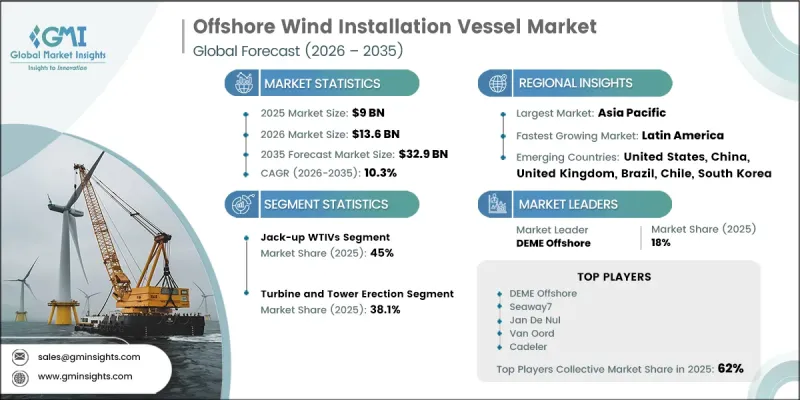
세계 해상 풍력 발전 프로젝트에 대한 투자가 계속해서 가속화됨에 따라 시장은 놀라운 성장세를 보이고 있으며, 점점 더 복잡해지는 해양 건설 활동을 지원할 수 있는 전문 설치선에 대한 지속적인 수요가 발생하고 있습니다. 대형 풍력 터빈의 도입, 대용량 해상 프로젝트, 그리고 심해 지역에서의 개발이 진행됨에 따라 더 높은 양력 능력, 강화된 안정성, 그리고 향상된 운영 효율을 갖춘 기술적으로 진보된 선박에 대한 수요가 높아지고 있습니다. 재생에너지 발전에 대한 관심 증가, 해상 풍력 인프라의 지속적인 확대, 그리고 프로젝트 규모의 확대가 업계 성장을 더욱 뒷받침하고 있습니다. 또한, 시장 진출기업들은 진화하는 설치 요건에 대응하기 위해 첨단 위치 측정 시스템, 더 높은 갑판 적재 능력, 그리고 운영상의 유연성을 갖춘 차세대 선박에 대한 투자도 진행하고 있습니다.
| 시장 범위 | |
|---|---|
| 시작 연도 | 2025년 |
| 예측 기간 | 2026-2035년 |
| 초기 시장 규모 | 90억 달러 |
| 예측 금액 | 329억 달러 |
| CAGR | 10.3% |
2025년 시점에서 크레인 용량이 1,200톤 이하인 잭업식 풍력발전 설치선(WTIV) 부문은 시장 점유율의 45%를 차지했습니다. 이 부문은 광범위한 해상 풍력 발전 설비 설치 프로젝트를 효율적으로 지원할 수 있을 뿐만 아니라, 운영상의 유연성과 신뢰성 높은 인양 성능을 겸비하고 있어 계속해서 큰 시장 점유율을 유지하고 있습니다. 이러한 선박들은 안정적인 설치 플랫폼, 효율적인 운송 능력, 그리고 다양한 해상 환경에서도 신뢰할 수 있는 운용 성능을 제공하기 때문에 계속해서 널리 활용되고 있습니다. 해상 풍력 발전소 건설에 대한 지속적인 투자와 특수 해양 장비에 대한 수요 증가가 맞물려, 향후 몇 년간 이 부문의 성장이 지속될 것으로 예측됩니다.
터빈 및 타워 설치 부문은 2025년에 38.1%의 점유율을 차지했습니다. 이 부문이 계속해서 주도적인 위치를 유지하고 있는 이유는 타워, 나셀, 허브, 블레이드 등 주요 풍력 터빈 구성 부품을 안전하게 운송 및 설치할 수 있는 선박에 대한 수요가 증가하고 있기 때문입니다. 충분한 크레인 높이, 대용량 인양 능력, 광활한 갑판 공간, 그리고 선박의 안정성은 이 부문의 주도적 지위를 뒷받침하는 중요한 요소로 계속 작용하고 있습니다. 해상 풍력 발전 프로젝트에서 더 대형의 터빈 플랫폼이 채택되고 설치 요건이 복잡해짐에 따라, 더 무겁고 대형의 구성 부품을 취급할 수 있는 전용 선박에 대한 수요는 예측 기간 동안 꾸준히 증가할 것으로 전망됩니다.
미국의 해상 풍력발전 설치선 시장은 2025년에 90%의 점유율을 기록했으며, 연평균 성장률(CAGR) 14%로 성장할 것으로 전망됩니다. 이러한 강력한 성장은 해상 재생에너지 인프라에 대한 투자 확대, 해상 풍력 프로젝트의 지속적인 개발, 그리고 전문적인 해상 설치 서비스에 대한 수요 증가에 힘입은 것입니다. 항만 인프라 확충, 해상 건설 역량의 현대화, 그리고 첨단 설치선의 도입 확대가 업계 전망을 더욱 견고하게 하고 있습니다. 또한, 선단 확충, 선박 업그레이드, 첨단 해상 설치 기술에 대한 지속적인 투자가 장기적인 시장 성장을 가속하는 동시에 미국 내 프로젝트 실행 능력 향상을 뒷받침할 것으로 예측됩니다.
자주 묻는 질문
목차
제1장 조사 방법과 범위
제2장 주요 요약
제3장 업계 인사이트
제4장 경쟁 구도
제5장 시장 규모 및 예측 : 선박 유형별(2022-2035년)
제6장 시장 규모 및 예측 : 설치 활동별(2022-2035년)
제7장 시장 규모 및 예측 : 수심별(2022-2035년)
제8장 시장 규모 및 예측 : 지역별(2022-2035년)
제9장 기업 개요
KTH 26.08.20The Global Offshore Wind Installation Vessel Market was valued at USD 9 billion in 2025 and is estimated to grow at a CAGR of 10.3% to reach USD 32.9 billion by 2035.
The market is gaining significant momentum as global investments in offshore wind energy projects continue to accelerate, creating sustained demand for specialized installation vessels capable of supporting increasingly complex marine construction activities. The deployment of larger wind turbines, higher-capacity offshore projects, and deeper-water developments is driving the need for technologically advanced vessels with greater lifting capabilities, enhanced stability, and improved operational efficiency. Growing emphasis on renewable energy generation, continuous expansion of offshore wind infrastructure, and increasing project sizes are further supporting industry growth. Market participants are also investing in next-generation vessels equipped with advanced positioning systems, higher deck load capacity, and improved operational flexibility to accommodate evolving installation requirements.
| Market Scope | |
|---|---|
| Start Year | 2025 |
| Forecast Year | 2026-2035 |
| Start Value | $9 Billion |
| Forecast Value | $32.9 Billion |
| CAGR | 10.3% |
The jack-up wind turbine installation vessel (WTIV) segment with crane capacities of 1,200 tonnes or below held a 45% share in 2025. This segment continues to maintain a significant share due to its ability to efficiently support a wide range of offshore wind installation projects while offering operational flexibility and reliable lifting performance. These vessels remain widely utilized because they provide stable installation platforms, efficient transportation capabilities, and dependable operational performance under varying offshore conditions. Continued investments in offshore wind farm construction, combined with increasing demand for specialized marine equipment, are expected to sustain growth for this segment over the coming years.
The turbine and tower erection segment captured a 38.1% share in 2025. The segment continues to lead due to the increasing demand for vessels capable of safely transporting and installing major wind turbine components, including towers, nacelles, hubs, and blades. Adequate crane height, substantial lifting capacity, extensive deck space, and vessel stability remain essential factors supporting this segment's leadership. As offshore wind projects continue to utilize larger turbine platforms and more complex installation requirements, demand for specialized vessels capable of handling heavier and larger components is expected to increase steadily throughout the forecast period.
U.S. Offshore Wind Installation Vessel Market recorded a 90% share in 2025 and is forecast to grow at a 14% CAGR through 2035. Strong growth is supported by increasing investments in offshore renewable energy infrastructure, continued development of offshore wind projects, and rising demand for specialized marine installation services. Expanding port infrastructure, modernization of offshore construction capabilities, and growing deployment of advanced installation vessels are further strengthening the industry's outlook. In addition, ongoing investments in fleet expansion, vessel upgrades, and advanced offshore installation technologies are expected to reinforce long-term market growth while supporting increasing project execution capabilities across the U.S.
Major participants operating in the global offshore wind installation vessel market include Cadeler, CG Wind, COSCO Shipping, Damen Shipyards Group, DEME Offshore, GustoMSC (NOV), HuaDian Heavy Industries, Jiangsu Hantong Ship Heavy Industry, Jingjiang Nanyang Shipbuilding, Jan De Nul, Keppel, MacGregor, Nantong Rainbow Offshore, Royal IHC, RWE, Seajacks (Eneti), Seaway7, Ulstein Group, Van Oord, and ZPMC. Companies participating in the global offshore wind installation vessel market are reinforcing their competitive position by investing in technologically advanced vessels, expanding fleet capabilities, and strengthening engineering expertise. Industry participants are focusing on developing larger installation vessels with enhanced lifting capacity, improved deck layouts, advanced dynamic positioning systems, and greater operational efficiency to meet evolving offshore project requirements. Strategic partnerships, long-term vessel charter agreements, and collaborations with offshore wind developers are helping companies secure new business opportunities and strengthen customer relationships. Manufacturers and vessel operators are also investing in fleet modernization, digital monitoring systems, predictive maintenance technologies, and automation solutions to improve operational reliability and reduce project execution time. Furthermore, companies are expanding their geographic presence, increasing production and shipbuilding capacity, and enhancing integrated project support services to strengthen their market foothold, improve competitiveness, and capture emerging opportunities across the global offshore wind installation vessel market.
Table of Contents
Chapter 1 Methodology & Scope
- 1.1 Research design
- 1.1.1 Research approach
- 1.1.2 Data collection methods
- 1.2 Base estimates and calculations
- 1.2.1 Base year calculation
- 1.2.2 Key trends for market estimates
- 1.3 Forecast model
- 1.3.1 Quantified market impact analysis
- 1.3.2 Mathematical impact of growth parameters on forecast
- 1.4 Primary research & validation
- 1.4.1 Some of the primary sources (but not limited to)
- 1.5 Data mining sources
- 1.5.1 Paid sources
- 1.5.2 Sources, by region
- 1.6 Research trail & scoring components
- 1.6.1 Research trail components
- 1.6.2 Scoring components
- 1.7 Research transparency addendum
- 1.7.1 Source attribution framework
- 1.7.2 Quality assurance metrics
- 1.7.3 Our commitment to trust
- 1.8 Market definitions
Chapter 2 Executive Summary
- 2.1 Industry 360-degree synopsis, 2022 – 2035
- 2.2 Business trends
- 2.3 Vessel type trends
- 2.4 Installation activity trends
- 2.5 Water depth trends
- 2.6 Regional trends
Chapter 3 Industry Insights
- 3.1 Industry ecosystem
- 3.1.1 Raw material availability & sourcing analysis
- 3.1.2 Manufacturing capacity assessment
- 3.1.3 Supply chain resilience & risk factors
- 3.1.4 Distribution network analysis
- 3.2 Regulatory landscape
- 3.3 Industry impact forces
- 3.3.1 Growth drivers
- 3.3.2 Industry pitfalls & challenges
- 3.4 Growth potential analysis
- 3.5 Price trend analysis
- 3.5.1 By water depth
- 3.5.2 By region
- 3.6 Porter's analysis
- 3.6.1 Bargaining power of suppliers
- 3.6.2 Bargaining power of buyers
- 3.6.3 Threat of new entrants
- 3.6.4 Threat of substitutes
- 3.7 PESTEL analysis
- 3.7.1 Political factors
- 3.7.2 Economic factors
- 3.7.3 Social factors
- 3.7.4 Technological factors
- 3.7.5 Legal factors
- 3.8 Emerging opportunities and trends
- 3.8.1 Digitization & IoT integration
- 3.8.2 Emerging market penetration
- 3.9 Investment analysis & future outlook
Chapter 4 Competitive landscape, 2026
- 4.1 Introduction
- 4.2 Company market share analysis, 2025
- 4.2.1 North America
- 4.2.2 Europe
- 4.2.3 Asia pacific
- 4.2.4 Middle East & Africa
- 4.2.5 Latin America
- 4.3 Strategic dashboard
- 4.4 Strategic initiatives
- 4.5 Company benchmarking
- 4.6 Innovation & technology landscape
Chapter 5 Market Size and Forecast, By Vessel type, 2022 – 2035 (USD Million)
- 5.1 Key trends
- 5.2 Jack-Up WTIV
- 5.3 High-Spec WTIV
- 5.4 Ultra-WTIV
- 5.5 Heavy Lift Vessel (HLV)
- 5.6 Multi-Purpose Offshore Support
Chapter 6 Market Size and Forecast, By Installation activity, 2022 – 2035 (USD Million)
- 6.1 Key trends
- 6.2 Foundation Installation
- 6.3 Turbine & Tower Erection
- 6.4 Cable Pull-In & Scour
- 6.5 Substation Installation
- 6.6 Decommissioning & Repowering
Chapter 7 Market Size and Forecast, By Water depth, 2022 – 2035 (USD Million & MW)
- 7.1 Key trends
- 7.2 ≤60m
- 7.3 >60–150m
- 7.4 150m
Chapter 8 Market Size and Forecast, By Region, 2022 – 2035 (USD Million & MW)
- 8.1 Key trends
- 8.2 North America
- 8.2.1 U.S.
- 8.2.2 Canada
- 8.3 Europe
- 8.3.1 United Kingdom
- 8.3.2 Germany
- 8.3.3 Netherlands
- 8.3.4 Denmark
- 8.3.5 Belgium
- 8.3.6 France
- 8.4 Asia Pacific
- 8.4.1 China
- 8.4.2 Taiwan
- 8.4.3 Japan
- 8.4.4 South Korea
- 8.5 Middle East & Africa
- 8.5.1 South Africa
- 8.5.2 South Africa
- 8.6 Latin America
- 8.6.1 Brazil
- 8.6.2 Chile
Chapter 9 Company Profiles
- 9.1 Cadeler
- 9.2 CG Wind
- 9.3 COSCO Shipping
- 9.4 Damen ShipyardsGroup
- 9.5 DEME Offshore
- 9.6 GustoMSC (NOV)
- 9.7 HuaDian Heavy Industries
- 9.8 Jiangsu Hantong Ship Heavy Industry
- 9.9 Jingjiang Nanyang Shipbuilding
- 9.10 Jan De Nul
- 9.11 Keppel
- 9.12 MacGregor
- 9.13 Nantong Rainbow Offshore
- 9.14 Royal IHC
- 9.15 RWE
- 9.16 Seajacks
- 9.17 Seaway7
- 9.18 Ulstein Group
- 9.19 Van Oord
- 9.20 ZPMC


