

|
시장보고서
상품코드
2109211
대함 미사일 방어 시스템 시장 : 시장 기회, 성장 촉진요인, 산업 동향 분석, 예측(2026-2035년)Anti-Ship Missile Defense System Market Opportunity, Growth Drivers, Industry Trend Analysis, and Forecast 2026 - 2035 |
||||||

세계의 대함 미사일 방어 시스템 시장은 2025년에 126억 달러로 평가되었고, CAGR 5.8%로 성장할 전망이며, 2035년까지 218억 달러에 이를 것으로 추정되고 있습니다.
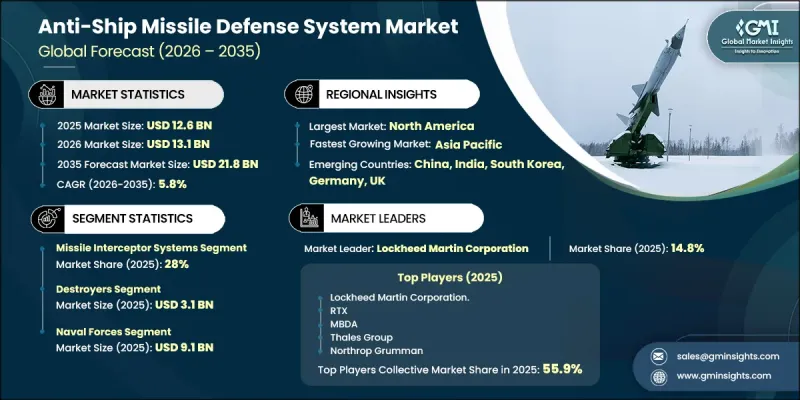
시장의 성장은 지속적인 해군 현대화 노력, 첨단 장거리 및 초음속 대함 미사일 기술의 배치 확대, 그리고 통합된 방공·미사일 방어 능력에 대한 투자 증가에 힘입고 있습니다. 전 세계 각국 정부는 점점 더 정교해지는 위협에 대응할 수 있는 첨단 감지, 추적, 요격 시스템을 활용해 해군 함대를 업그레이드함으로써 해상 안보를 강화하고 있습니다. 레이더 플랫폼, 요격 기술, 전투 관리 시스템 및 해상 감시 솔루션 분야의 급속한 기술 발전이 시장 성장을 더욱 가속화하고 있습니다. 또한, 다자간 해상 안보 협력의 확대와 국방비 증가는 차세대 해군 방어 플랫폼의 조달을 뒷받침하고 있습니다. 지정학적 긴장이 국방 우선순위에 계속 영향을 미치는 가운데, 해군 자산과 중요한 해상 인프라를 보호하기 위한 첨단 방어 시스템에 대한 수요는 계속해서 견조할 것으로 예측됩니다. 이러한 요인들은 대함 미사일 방어 시스템 시장의 전략적 중요성을 더욱 높여 전 세계의 기술 공급업체, 방위 관련 기업 및 해군 시스템 제조업체에 장기적인 기회를 제공합니다.
| 시장 범위 | |
|---|---|
| 개시 연도 | 2025년 |
| 예측 기간 | 2026-2035년 |
| 개시 연도 시장 규모 | 126억 달러 |
| 예측액 | 218억 달러 |
| CAGR | 5.8% |
대함 미사일 방어 시스템 업계는 공격용 미사일 기술의 급속한 발전에 힘입어 지속적인 혜택을 받고 있으며, 이에 따라 각국 해군은 함재 방어 능력 강화를 추진하고 있습니다. 방위 기관들은 복잡한 해상 위협을 보다 신속하고 정확하게 감지, 추적, 무력화할 수 있는 통합 시스템에 대한 투자를 확대되고 있습니다. 첨단 대함 미사일 기술의 배치 확대에 따라, 다층적인 해상 방어 전략을 뒷받침할 수 있는 최신 요격 솔루션에 대한 수요가 더욱 가속화되고 있습니다. 동시에, 여러 발의 미사일을 탑재할 수 있는 수직 발사 시스템의 도입으로 해군 플랫폼이 통합된 발사 아키텍처를 통해 다양한 유형의 요격 미사일을 전개할 수 있게 되어 작전상의 유연성이 향상되고 있습니다. 통합형 해상 방어 기술에 대한 지속적인 투자를 통해 예측 기간 동안 시장의 지속적인 확장이 뒷받침될 것으로 전망됩니다.
2025년에는 미사일 요격 시스템 부문이 시장 점유율의 28%를 차지했습니다. 이러한 시스템은 끊임없이 진화하는 광범위한 항공 위협 및 미사일 위협으로부터 방어함으로써 해상 방어의 중요한 계층을 담당하고 있습니다. 진행 중인 함대 현대화 노력에 따라, 현대 전투 작전에 대응할 수 있는 해군 함정에 첨단 요격 기술이 통합되고 있습니다. 다층적 방어 능력, 요격 정밀도 향상, 신속한 대응 능력에 대한 중요성이 높아지고 있는 것이 첨단 미사일 요격 시스템에 대한 수요를 지속적으로 견인하고 있습니다. 해군이 종합적인 방어 능력을 우선시하는 가운데, 이 부문은 예측 기간 동안 세계 시장에서 견고한 입지를 유지할 것으로 전망됩니다.
해군 부문은 2025년에 91억 달러에 달했습니다. 함대 현대화, 통합된 항공·미사일 방어 능력, 그리고 첨단 다층 요격 기술에 대한 투자 확대가 계속해서 이 부문의 성장을 뒷받침하고 있습니다. 각국 정부가 해양 안보 강화와 함대 생존성 향상을 위해 국방비를 확대함에 따라, 해군 조직은 여전히 최대의 최종 사용자로 자리 잡고 있습니다. 첨단 해군 함정의 조달 증가에 더해, 전략적 해상 자산 및 작전 함대를 보호해야 할 필요성이 높아지면서 첨단 대함 미사일 방어 기술에 대한 지속적인 수요를 견인하고 있습니다. 해군의 전투 준비 태세 강화에 대한 지속적인 집중이 예측 기간 동안 이 부문의 주도적 지위를 더욱 공고히할 것으로 예측됩니다.
2025년, 북미의 대함 미사일 방어 시스템 시장은 40.9%의 점유율을 기록했습니다. 지역별 성장은 국방비 증가, 진행 중인 해군 현대화 프로그램, 그리고 통합 방공·미사일 방어 능력에 대한 투자 확대에 의해 주도되고 있습니다. 정부 기관과 방위 관련 기업들은 진화하는 해양 안보 과제에 대처하기 위해 첨단 해군 전투 시스템, 최첨단 레이더 기술, 강화된 전투 관리 플랫폼 및 차세대 요격 능력을 계속해서 우선시하고 있습니다. 인공지능(AI)을 활용한 방위 솔루션, 첨단 센서 기술, 다기능 레이더 시스템, 그리고 신흥 방위 능력에 대한 투자 확대가 해당 지역 전체 시장 확대를 더욱 촉진하고 있습니다.
자주 묻는 질문
목차
제1장 조사 방법 및 범위
제2장 주요 요약
제3장 업계 인사이트
제4장 경쟁 구도
제5장 시장 추산 및 예측 : 시스템 유형별(2022-2035년)
제6장 시장 추산 및 예측 : 플랫폼별(2022-2035년)
제7장 시장 추산 및 예측 : 최종 사용자별(2022-2035년)
제8장 시장 추산 및 예측 : 지역별(2022-2035년)
제9장 기업 개요
AJY 26.08.20The Global Anti-Ship Missile Defense System Market was valued at USD 12.6 billion in 2025 and is estimated to grow at a CAGR of 5.8% to reach USD 21.8 billion by 2035.
Market growth is supported by continuous naval modernization initiatives, increasing deployment of advanced long-range and hypersonic anti-ship missile technologies, and rising investments in integrated air and missile defense capabilities. Governments across the world are strengthening maritime security by upgrading naval fleets with advanced detection, tracking, and interception systems capable of responding to increasingly sophisticated threats. Rapid technological progress in radar platforms, interceptor technologies, combat management systems, and maritime surveillance solutions is further accelerating market development. In addition, expanding multinational maritime security cooperation and increasing defense spending are encouraging procurement of next-generation naval defense platforms. As geopolitical tensions continue to influence defense priorities, demand for advanced protection systems to safeguard naval assets and critical maritime infrastructure is expected to remain strong. These factors continue to reinforce the strategic importance of the anti-ship missile defense systems market, creating long-term opportunities for technology providers, defense contractors, and naval system manufacturers worldwide.
| Market Scope | |
|---|---|
| Start Year | 2025 |
| Forecast Year | 2026-2035 |
| Start Value | $12.6 Billion |
| Forecast Value | $21.8 Billion |
| CAGR | 5.8% |
The anti-ship missile defense system industry continues to benefit from rapid advancements in offensive missile technologies, prompting naval forces to strengthen shipborne defensive capabilities. Defense organizations are increasingly investing in integrated systems that can detect, track, and neutralize complex maritime threats with greater speed and accuracy. The growing deployment of advanced anti-ship missile technologies has further accelerated demand for modern interception solutions capable of supporting layered maritime defense strategies. At the same time, the adoption of vertical launch systems with multi-missile capability is improving operational flexibility by allowing naval platforms to deploy multiple interceptor types from a unified launch architecture. Continued investment in integrated naval defense technologies is expected to support sustained market expansion throughout the forecast period.
The missile interceptor systems segment accounted for a 28% share in 2025. These systems represent a critical layer of maritime defense by protecting a wide range of evolving aerial and missile threats. Ongoing fleet modernization initiatives are driving increased integration of advanced interceptor technologies into naval vessels equipped for modern combat operations. Growing emphasis on multi-layered defense capabilities, improved interception accuracy, and rapid response performance continues to support demand for advanced missile interceptor systems. As naval forces prioritize comprehensive defensive capabilities, this segment is expected to maintain a strong position within the global market over the forecast period.
The naval forces segment reached USD 9.1 billion in 2025. Rising investments in fleet modernization, integrated air and missile defense capabilities, and advanced multi-layer interception technologies continue to support segment growth. Naval organizations remain the largest end users as governments expand defense spending to strengthen maritime security and improve fleet survivability. Increasing procurement of advanced naval vessels, combined with growing requirements to protect strategic maritime assets and operational fleets, is driving sustained demand for sophisticated anti-ship missile defense technologies. Continued focus on strengthening naval combat readiness is expected to reinforce the segment's leadership during the forecast period.
North America Anti-Ship Missile Defense System Market accounted for a 40.9% share in 2025. Regional growth is driven by higher defense expenditures, ongoing naval modernization programs, and increasing investment in integrated air and missile defense capabilities. Government agencies and defense contractors continue to prioritize advanced naval combat systems, modern radar technologies, enhanced battle management platforms, and next-generation interception capabilities to address evolving maritime security challenges. Rising investments in artificial intelligence-enabled defense solutions, advanced sensor technologies, multifunction radar systems, and emerging defensive capabilities are further supporting market expansion across the region.
Prominent companies operating in the global anti-ship missile defense system market include Aselsan (Turkey), BAE Systems, Boeing, Denel Dynamics, Elbit Systems, General Dynamics, Hanwha Aerospace, Israel Aerospace Industries, Kawasaki Heavy Industries, Kongsberg Defence & Aerospace, Leonardo S.p.A., LIG Nex1, Lockheed Martin Corporation, MBDA, Mitsubishi Heavy Industries Ltd., Naval Group, Northrop Grumman, Rafael Advanced Defense Systems Ltd., Rheinmetall, Roketsan (Turkey), RTX, Saab AB, Terma (Denmark), and Thales Group. Companies active in the anti-ship missile defense system market are strengthening their competitive position through continuous investment in advanced defense technologies, product innovation, and long-term research and development programs. Manufacturers are expanding their portfolios by developing integrated interception systems, advanced radar platforms, intelligent combat management solutions, and next-generation maritime defense technologies that address evolving operational requirements. Strategic collaborations with defense agencies, naval organizations, and technology partners are helping companies secure long-term contracts and expand their global presence. Businesses are also increasing production capabilities, enhancing system integration expertise, and focusing on modular, upgradeable platforms that improve lifecycle value. In addition, investments in artificial intelligence, advanced sensors, digital battlefield technologies, and operational efficiency are enabling companies to strengthen customer relationships, improve competitiveness, and reinforce their long-term position within the global anti-ship missile defense system industry.
Table of Contents
Chapter 1 Methodology and Scope
- 1.1 Market scope and definition
- 1.2 Research design
- 1.2.1 Research approach
- 1.2.2 Data collection methods
- 1.3 Data mining sources
- 1.3.1 Global
- 1.3.2 Regional/Country
- 1.4 Base estimates and calculations
- 1.4.1 Base year calculation
- 1.4.2 Key trends for market estimation
- 1.5 Primary research and validation
- 1.5.1 Primary sources
- 1.6 Forecast model
- 1.7 Research assumptions and limitations
Chapter 2 Executive Summary
- 2.1 Industry 360° synopsis, 2022 – 2035
- 2.2 Key market trends
- 2.2.1 System type trends
- 2.2.2 Platform trends
- 2.2.3 End-user trends
- 2.2.4 Regional trends
- 2.3 TAM Analysis, 2026-2035
- 2.4 CXO perspectives: Strategic imperatives
Chapter 3 Industry Insights
- 3.1 Industry ecosystem analysis
- 3.1.1 Supplier Landscape
- 3.1.2 Profit Margin
- 3.1.3 Cost structure
- 3.1.4 Value addition at each stage
- 3.1.5 Factor affecting the value chain
- 3.1.6 Disruptions
- 3.2 Industry impact forces
- 3.2.1 Growth drivers
- 3.2.1.1 Rising naval modernization and fleet expansion programs
- 3.2.1.2 Increasing deployment of hypersonic and advanced anti-ship missile threats
- 3.2.1.3 Growing investments in integrated air and missile defense (IAMD) for naval platforms
- 3.2.1.4 Expansion of multinational naval security alliances and interoperability programs
- 3.2.1.5 Advancements in AI-enabled radar, combat management, and interceptor technologies
- 3.2.2 Industry pitfalls and challenges
- 3.2.2.1 High development and lifecycle costs of advanced missile defense systems
- 3.2.2.2 Complex integration with legacy naval platforms
- 3.2.3 Market opportunities
- 3.2.3.1 Growing demand for counter-hypersonic and multi-layer naval defense capabilities
- 3.2.3.2 Expansion of indigenous defense manufacturing and international defense collaborations
- 3.2.1 Growth drivers
- 3.3 Growth potential analysis
- 3.4 Pricing Analysis (Driven by Primary Research)
- 3.4.1 Historical Price Trend Analysis
- 3.4.2 Pricing Strategy by Player Type (Premium / Value / Cost-plus)
- 3.5 Regulatory landscape
- 3.5.1 North America
- 3.5.2 Europe
- 3.5.3 Asia Pacific
- 3.5.4 Latin America
- 3.5.5 Middle East & Africa
- 3.6 Porter’s analysis
- 3.7 PESTEL analysis
- 3.8 Trade Data Analysis (Based on Paid Database)
- 3.8.1 Import/Export Volume & Value Trends
- 3.8.2 Key Trade Corridors & Tariff Impact
- 3.9 Impact of AI & Generative AI on the Market (Driven by Primary Research)
- 3.9.1 AI-Driven Disruption of Existing Business Models
- 3.9.2 GenAI Use Cases & Adoption Roadmap by Segment
- 3.10 Capacity & Production Landscape (Driven by Primary Research)
- 3.10.1 Production Capacity by Key Producer
- 3.10.2 Capacity Utilization Rates & Expansion Pipelines
Chapter 4 Competitive Landscape, 2025
- 4.1 Introduction
- 4.2 Company market share analysis, 2025
- 4.2.1 By Region
- 4.2.1.1 North America
- 4.2.1.2 Europe
- 4.2.1.3 Asia-Pacific
- 4.2.1.4 Latin America
- 4.2.1.5 Middle East and Africa
- 4.2.2 Market Concentration Analysis
- 4.2.1 By Region
- 4.3 Competitive analysis of major market players
- 4.4 Competitive positioning matrix
- 4.5 Key developments
- 4.5.1 Mergers & acquisitions
- 4.5.2 Partnerships & collaborations
- 4.5.3 New product launches
- 4.5.4 Expansion plans and funding
- 4.6 Company tier benchmarking
- 4.6.1 Tier classification criteria & qualifying thresholds
- 4.6.2 Tier positioning matrix by revenue, geography & innovation
- 4.7 Key developments
- 4.7.1 Mergers and acquisitions
- 4.7.2 Partnerships and collaborations
- 4.7.3 Technological advancements
- 4.7.4 Expansion and investment strategies
- 4.7.5 Digital transformation initiatives
- 4.8 Emerging/ startup competitors landscape
Chapter 5 Market Estimates and Forecast, By System Type, 2022 – 2035 (USD Million)
- 5.1 Key trends
- 5.2 Missile interceptor systems
- 5.2.1 Short-range interceptors (≤15 km)
- 5.2.2 Medium-range interceptors (15–80 km)
- 5.2.3 Long-range interceptors (>80 km)
- 5.3 Close-in weapon systems (CIWS)
- 5.4 Electronic warfare (EW) systems
- 5.5 Directed energy weapons (DEW)
- 5.6 Radar & sensor systems
- 5.7 Combat management systems (CMS)
- 5.8 Others (emerging / hybrid defense systems)
Chapter 6 Market Estimates and Forecast, By Platform, 2022 – 2035 (USD Million)
- 6.1 Key trends
- 6.2 Destroyers
- 6.3 Frigates
- 6.4 Corvettes
- 6.5 Aircraft carriers
- 6.6 Amphibious warfare ships
- 6.7 Offshore patrol vessels (OPVs)
- 6.8 Land-based coastal defense installations
- 6.9 Others (submarines, airborne & unmanned maritime systems)
Chapter 7 Market Estimates and Forecast, By End-User, 2022 – 2035 (USD Million)
- 7.1 Key trends
- 7.2 Naval forces
- 7.3 Coast guard & maritime security agencies
- 7.4 Coastal defense forces
Chapter 8 Market Estimates and Forecast, By Region, 2022 – 2035 (USD Million)
- 8.1 Key trends
- 8.2 North America
- 8.2.1 U.S.
- 8.2.2 Canada
- 8.3 Europe
- 8.3.1 Germany
- 8.3.2 UK
- 8.3.3 France
- 8.3.4 Spain
- 8.3.5 Italy
- 8.4 Asia Pacific
- 8.4.1 China
- 8.4.2 India
- 8.4.3 Japan
- 8.4.4 Australia
- 8.4.5 South Korea
- 8.5 Latin America
- 8.5.1 Brazil
- 8.5.2 Mexico
- 8.5.3 Argentina
- 8.6 Middle East and Africa
- 8.6.1 South Africa
- 8.6.2 Saudi Arabia
- 8.6.3 UAE
Chapter 9 Company Profiles
- 9.1 Global Key Players
- 9.1.1 Lockheed Martin Corporation.
- 9.1.2 RTX
- 9.1.3 MBDA
- 9.1.4 Thales Group
- 9.1.5 Northrop Grumman
- 9.2 Regional key players
- 9.2.1 North America
- 9.2.1.1 Boeing
- 9.2.1.2 General Dynamics
- 9.2.1.3 RAFAEL Advanced Defense Systems Ltd.
- 9.2.1.4 Israel Aerospace Industries
- 9.2.1.5 Elbit Systems
- 9.2.2 Asia Pacific
- 9.2.2.1 Mitsubishi Heavy Industries, Ltd.
- 9.2.2.2 Kawasaki Heavy Industries
- 9.2.2.3 Hanwha Aerospace
- 9.2.2.4 LIG Nex1
- 9.2.2.5 Aselsan (Turkey)
- 9.2.2.6 Roketsan (Turkey)
- 9.2.3 Europe
- 9.2.3.1 BAE Systems
- 9.2.3.2 Leonardo S.p.A.
- 9.2.3.3 Saab AB
- 9.2.3.4 Rheinmetall
- 9.2.3.5 Naval Group
- 9.2.3.6 Kongsberg Defence & Aerospace
- 9.2.3.7 Terma (Denmark)
- 9.2.1 North America
- 9.3 Niche Players/Disruptors
- 9.3.1 Denel Dynamics


