

|
시장보고서
상품코드
2109221
콤포스트 터너 시장 : 시장 기회, 성장 촉진요인, 산업 동향 분석, 예측(2026-2035년)Compost Turners Market Opportunity, Growth Drivers, Industry Trend Analysis, and Forecast 2026 - 2035 |
||||||

세계의 콤포스트 터너 시장은 2025년에 2억 8,000만 달러 규모로 평가되었고, CAGR 5.2%로 성장할 전망이며, 2035년까지 4억 6,700만 달러에 이를 것으로 예측됩니다.
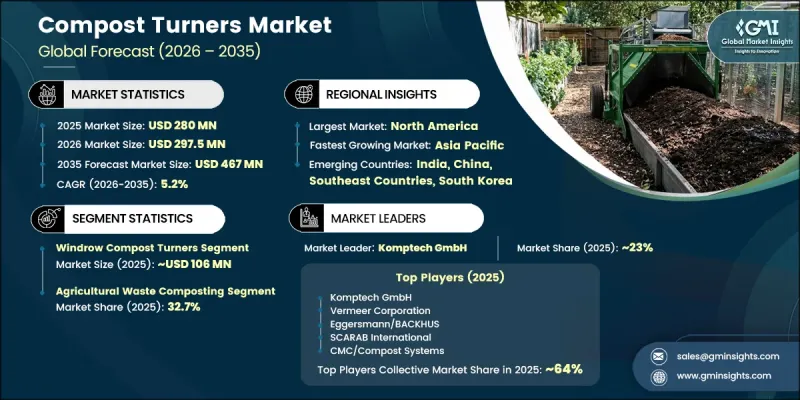
선진국과 개발도상국을 막론하고 지속 가능한 유기성 폐기물 관리에 대한 관심이 지속적으로 높아짐에 따라, 해당 시장은 꾸준한 성장을 이루고 있습니다. 시장 확장을 뒷받침하는 주요 요인은 유기성 폐기물의 매립 처분을 피하고, 환경을 고려한 퇴비화 실천을 촉진하는 점점 더 엄격해지는 규제의 도입입니다. 폐기물 처리 인프라에 대한 투자 확대, 자원 회수에 대한 인식 제고, 그리고 순환형 경제 모델로의 전환 또한 제품 수요를 더욱 부추기고 있습니다. 또한, 각 제조업체들은 업무 생산성을 향상시키고 더 많은 처리량을 처리할 수 있는 고효율 장비를 도입하고 있으며, 이를 통해 퇴비화 작업의 비용 대비 효과가 향상되고 있습니다. 농업, 도시 폐기물 관리 및 상업용 퇴비화 시설에서 기계화된 퇴비화 시스템의 도입이 확대되고 있는 것은 업계 관계자들에게 더 큰 성장 기회를 창출하고 있습니다. 지속적인 기술 혁신, 우호적인 환경 정책, 그리고 지속 가능한 폐기물 처리 솔루션에 대한 수요 증가가 예측 기간 동안 콤포스트 터너 시장의 장기적인 성장을 뒷받침할 것으로 예측됩니다.
| 시장 범위 | |
|---|---|
| 개시 연도 | 2025년 |
| 예측 기간 | 2026-2035년 |
| 초기 시장 규모 | 2억 8,000만 달러 |
| 예측액 | 4억 6,700만 달러 |
| CAGR | 5.2% |
윈드로우식 콤포스트 터너 부문은 2025년에 1억 600만 달러 시장 규모를 기록한 것으로 평가되었으며, 2035년까지 연평균 성장률(CAGR) 6%로 성장할 것으로 전망됩니다. 이 기계 카테고리는 예측 기간 동안 전 세계 콤포스트 터너 시장에서 가장 큰 점유율을 유지할 뿐만 아니라, 가장 견실한 성장 전망을 보이고 있습니다. 최종 사용자가 더 높은 효율, 더 큰 처리 능력, 그리고 향상된 운영 성능을 실현하는 장비를 요구함에 따라, 자주식 윈드로우식 콤포스트 터너에 대한 수요는 계속해서 증가하고 있습니다. 퇴비화 사업이 지속적으로 확대됨에 따라, 첨단 윈드로우식 터너에 대한 투자는 계속해서 견조할 것으로 예상되며, 이는 해당 부문 시장 내 주도적 지위를 더욱 공고히할 것입니다.
농업 폐기물 퇴비화 부문은 2025년에 32.7%의 점유율을 차지한 것으로 평가되었으며, 2035년까지 연평균 성장률(CAGR) 3.5%로 성장할 것으로 전망됩니다. 이 용도는 농업 유기 폐기물의 효과적인 처리에 대한 지속적인 수요에 힘입어 시장 수익에 가장 크게 기여하는 원천으로 자리매김하고 있습니다. 지속 가능한 농업 관행, 유기 폐기물의 효율적인 활용, 그리고 토양 개량에 대한 관심 증대가 이 부문의 장비 도입을 지속적으로 촉진하고 있습니다. 운영 효율성 향상과 대규모 퇴비 생산에 대한 수요로 인해, 예측 기간 동안 농업 용도 전반에 걸친 콤포스트 터너에 대한 투자가 유지될 것으로 전망됩니다.
북미의 콤포스트 터너 시장은 2025년에 8,710만 달러 규모에 도달했습니다. 이 지역 시장은 확립된 장비 유통망, 제조업체의 강력한 입지, 그리고 첨단 퇴비화 기술에 대한 지속적인 투자의 혜택을 받고 있습니다. 유기 폐기물의 자원화를 촉진하는 규제 조치와 퇴비화 인프라의 지속적인 확충은 지역 전체 시장 성장에 유리한 환경을 지속적으로 조성하는 동시에, 장기적인 장비 수요를 뒷받침하고 있습니다.
자주 묻는 질문
목차
제1장 조사 방법 및 범위
제2장 주요 요약
제3장 업계 인사이트
제4장 경쟁 구도
제5장 시장 추산 및 예측 : 머신 유형별(2022-2035년)
제6장 시장 추산 및 예측 : 전력별(2022-2035년)
제7장 시장 추산 및 예측 : 용량별(2022-2035년)
제8장 시장 추산 및 예측 : 용도별(2022-2035년)
제9장 시장 추산 및 예측 : 최종 사용자별(2022-2035년)
제10장 시장 추산 및 예측 : 유통 채널별(2022-2035년)
제11장 시장 추산 및 예측 : 지역별(2022-2035년)
제12장 기업 개요
AJY 26.08.20The Global Compost Turners Market was valued at USD 280 million in 2025 and is estimated to grow at a CAGR of 5.2% to reach USD 467 million by 2035.
The market is experiencing steady growth as the focus on sustainable organic waste management continues to intensify across developed and developing economies. A key factor supporting market expansion is the implementation of increasingly stringent regulations that encourage the diversion of organic waste from landfills and promote environmentally responsible composting practices. Growing investments in waste processing infrastructure, rising awareness of resource recovery, and the transition toward circular economy models are further contributing to product demand. Manufacturers are also introducing more efficient equipment capable of improving operational productivity and handling greater processing volumes, making composting operations more cost-effective. The increasing adoption of mechanized composting systems across agriculture, municipal waste management, and commercial composting facilities is creating additional growth opportunities for industry participants. Continuous technological improvements, favorable environmental policies, and rising demand for sustainable waste treatment solutions are expected to support the long-term expansion of the compost turners market throughout the forecast period.
| Market Scope | |
|---|---|
| Start Year | 2025 |
| Forecast Year | 2026-2035 |
| Start Value | $280 Million |
| Forecast Value | $467 Million |
| CAGR | 5.2% |
The windrow compost turners segment generated a USD 106 million share in 2025 and is forecast to grow at a 6% CAGR through 2035. This machine category continues to hold the largest share of the global compost turners market while maintaining the strongest growth outlook over the forecast period. Demand for self-propelled windrow compost turners continues to increase as end users seek equipment that delivers greater efficiency, higher processing capacity, and improved operational performance. As composting operations continue to expand, investments in advanced windrow turning equipment are expected to remain strong, reinforcing the segment's leading market position.
The agricultural waste composting segment accounted for a 32.7% share in 2025 and is forecast to grow at a 3.5% CAGR through 2035. This application remains the largest contributor to market revenue, supported by the ongoing demand for effective processing of agricultural organic waste. Increasing emphasis on sustainable farming practices, efficient organic waste utilization, and improved soil enrichment continues to drive equipment adoption within this segment. The need for higher operational efficiency and large-scale compost production is expected to sustain investment in compost turning equipment across agricultural applications during the forecast period.
North America Compost Turners Market reached USD 87.1 million share in 2025. The regional market benefits from an established equipment distribution network, strong manufacturer presence, and continued investments in advanced composting technologies. Regulatory initiatives encouraging organic waste diversion and the ongoing expansion of composting infrastructure continue to create favorable conditions for market growth across the region while supporting long-term equipment demand.
Major companies operating in the global compost turners market include Eggersmann Group, Vermeer Corporation, MENART, Brown Bear Corporation, Gujer Innotec AG, Komptech GmbH, Compost Systems GmbH, Midwest Bio-Systems, Frontier Industrial Corp, SCARAB International, SEKO Industries Srl, Nufab Industries Pty Ltd., J. Willibald GmbH, A.TOM, JT RecTec GmbH, Kooima Ag, TAGRM (Nanning Tagrm Co., Ltd.), EZ Machinery, Zhengzhou Shunxin Engineering Equipment, Qingdao Zhonghengda Machinery Co., Ltd., and Henan Richentek Industry Co., Ltd. Companies operating in the compost turners market are focusing on product innovation, technological advancements, and portfolio expansion to strengthen their competitive position. Manufacturers continue to invest in research and development to improve equipment efficiency, reliability, durability, and operational performance while addressing evolving customer requirements. Businesses are also expanding their dealer and distribution networks to improve market reach and enhance customer service capabilities across key regions. Strategic partnerships with distributors and industry participants are helping companies strengthen brand visibility and increase product accessibility. Many manufacturers are introducing equipment designed for a broader range of composting capacities to address diverse customer needs. In addition, continuous investments in manufacturing capabilities, after-sales support, and operational efficiency initiatives are enabling market participants to reinforce their presence and sustain long-term growth within the global compost turners market.
Table of Contents
Chapter 1 Methodology & Scope
- 1.1 Research approach
- 1.2 Quality Commitments
- 1.2.1 GMI AI policy & data integrity commitment
- 1.2.2 Source consistency protocol
- 1.3 Research Trail & Confidence Scoring
- 1.3.1 Research Trail Components
- 1.3.2 Scoring Components
- 1.4 Data Collection
- 1.4.1 Partial list of primary sources
- 1.5 Data mining sources
- 1.5.1 Paid sources
- 1.5.1.1 Sources, by region
- 1.5.1 Paid sources
- 1.6 Base estimates and calculations
- 1.6.1 Base year calculation
- 1.7 Forecast model
- 1.7.1 Quantified market impact analysis
- 1.7.1.1 Mathematical impact of growth parameters on forecast
- 1.7.1 Quantified market impact analysis
- 1.8 Research transparency addendum
- 1.8.1 Source attribution framework
- 1.8.2 Quality assurance metrics
- 1.8.3 Our commitment to trust
Chapter 2 Executive Summary
- 2.1 Industry 360° synopsis
- 2.2 Key market trends
- 2.2.1 Region
- 2.2.2 Machine Type
- 2.2.3 Power Source
- 2.2.4 Capacity
- 2.2.5 Application
- 2.2.6 End-user
- 2.2.7 Distribution Channel
Chapter 3 Industry Insights
- 3.1 Industry ecosystem analysis
- 3.1.1 Supplier landscape
- 3.1.2 Profit margin
- 3.1.3 Value addition at each stage
- 3.1.4 Factor affecting the value chain
- 3.2 Industry impact forces
- 3.2.1 Growth drivers
- 3.2.1.1 Stringent Organic Waste Diversion Regulations & Landfill Ban Mandates
- 3.2.1.2 Surging Demand for Organic Compost in Regenerative & Precision Agriculture
- 3.2.1.3 Expansion of Municipal & Commercial Composting Infrastructure Globally
- 3.2.1.4 Government Subsidies & Incentive Programs for Sustainable Waste Management Equipment
- 3.2.2 Restraints
- 3.2.2.1 High Capital Expenditure & Total Cost of Ownership Deterring Small-Scale Operators
- 3.2.2.2 Volatility in Raw Material Costs
- 3.2.2.3 Competition from Alternative Organic Waste Treatment Technologies
- 3.2.2.4 Skilled Labor Shortage for Equipment Operation & Maintenance in Emerging Markets
- 3.2.3 Opportunities
- 3.2.3.1 Electrification of Compost Turners
- 3.2.3.2 Growing Municipal Composting Programs in Asia Pacific & Latin America
- 3.2.3.3 Rental & Leasing Models Enabling Adoption Among Small & Mid-Sized Operators
- 3.2.3.4 Integration of Smart Sensors & Automation Driving Next-Generation Premium Offerings
- 3.2.1 Growth drivers
- 3.3 Growth potential analysis
- 3.4 Supply Chain Analysis
- 3.4.1 Key Raw Material Inputs (Steel, Hydraulic Components, Drive Systems)
- 3.4.2 Component Sourcing & Supplier Concentration Risk
- 3.4.3 Supply Chain Disruption Assessment & Resilience Strategies
- 3.5 Future market trends
- 3.6 Technology and innovation landscape
- 3.6.1 Automation & IoT-Enabled Turning Systems
- 3.6.2 GPS & Telematics Integration in Compost Turners
- 3.6.3 Fuel Efficiency & Engine Technology Advancements
- 3.6.4 Emission Control & Tier 4/Euro Stage V Compliance Technologies
- 3.7 Regulatory landscape
- 3.7.1 Organic Waste Diversion & Landfill Ban Regulations (EU, US, Asia)
- 3.7.2 Emission Standards for Agricultural & Construction Equipment
- 3.7.3 Organic Farming Certification Standards & Compost Quality Regulations
- 3.7.4 Subsidies, Incentives & Government Support Programs
- 3.8 Trade data analysis
- 3.8.1 Import/Export Volume & Value Trends by Region (Driven by Primary Research)
- 3.8.2 Key Trade Corridors & Tariff Impact on Compost Turner Equipment (Driven by Primary Research)
- 3.9 Impact of AI & Generative AI on the market
- 3.9.1 AI-Driven Disruption of Existing Composting Equipment Business Models
- 3.9.2 GenAI Use Cases & Adoption Roadmap by Segment (Precision Turning, Predictive Maintenance, Smart Scheduling)
- 3.9.3 Risks, Limitations & Regulatory Considerations
- 3.10 Pricing Analysis
- 3.10.1 Historical Price Trend Analysis (2020–2025) (Driven by Primary Research)
- 3.10.2 Pricing Strategy by Player Type (Premium / Value / Cost-plus) (Driven by Primary Research)
- 3.11 Porter’s analysis
- 3.12 PESTEL analysis
Chapter 4 Competitive Landscape, 2025
- 4.1 Introduction
- 4.2 Company market share analysis
- 4.3 Company matrix analysis
- 4.4 Competitive analysis of major market players
- 4.5 Competitive positioning matrix
- 4.6 Key developments
- 4.6.1 Mergers & acquisitions
- 4.6.2 Partnerships & collaborations
- 4.6.3 New product launches
- 4.6.4 Expansion plans
Chapter 5 Market Estimates & Forecast, By Machine Type, 2022 – 2035, (USD Million) (Thousand Units)
- 5.1 Key Trends
- 5.2 Windrow Compost Turners
- 5.2.1 Self-Propelled Windrow Turners
- 5.2.2 Tow-Behind / Pull-Type Windrow Turners
- 5.2.3 Straddle Windrow Turners
- 5.3 Drum Compost Turners
- 5.3.1 Stationary Drum Turners
- 5.3.2 Mobile Drum Turners
- 5.4 Elevating Face Compost Turners
- 5.4.1 Standard Elevating Face Turners
- 5.4.2 High-Capacity Elevating Face Turners
- 5.5 Tractor-Mounted / Tow-Behind Compost Turners
- 5.5.1 3-Point Hitch Mounted Turners
- 5.5.2 PTO-Driven Tow-Behind Turners
- 5.6 Others
Chapter 6 Market Estimates & Forecast, By Power Source, 2022 – 2035, (USD Million) (Thousand Units)
- 6.1 Key Trends
- 6.2 Diesel-Powered
- 6.2.1 Tier 4 / Stage V Compliant Diesel Turners
- 6.2.2 Conventional Diesel Turners
- 6.3 Electric-Powered
- 6.3.1 Battery Electric Turners
- 6.3.2 Grid-Connected Electric Turners
- 6.4 Gasoline-Powered
- 6.5 Hybrid (Diesel-Electric)
Chapter 7 Market Estimates & Forecast, By Capacity, 2022 – 2035, (USD Million) (Thousand Units)
- 7.1 Key Trends
- 7.2 Small Capacity (Below 500 m³/hour)
- 7.3 Medium Capacity (500–1,000 m³/hour)
- 7.4 Large Capacity (Above 1,000 m³/hour)
Chapter 8 Market Estimates & Forecast, By Application, 2022 – 2035, (USD Million) (Thousand Units)
- 8.1 Key Trends
- 8.2 Agricultural Waste Composting
- 8.2.1 Crop Residue & Green Waste Management
- 8.2.2 Livestock Manure Management (Dairy, Poultry, Swine)
- 8.2.3 Greenhouse & Nursery Waste Processing
- 8.3 Municipal Solid Waste (MSW) Composting
- 8.3.1 Green & Yard Waste Composting
- 8.3.2 Mixed Organics & Biowaste Composting
- 8.4 Food Waste Composting
- 8.4.1 Food Processing Plant Waste
- 8.4.2 Institutional & Commercial Kitchen Waste
- 8.5 Industrial Waste Composting
- 8.5.1 Pulp & Paper Mill Organic By-products
- 8.5.2 Beverage & Food Manufacturing Waste
- 8.6 Others
Chapter 9 Market Estimates & Forecast, By End-user, 2022 – 2035, (USD Million) (Thousand Units)
- 9.1 Key Trends
- 9.2 Agricultural Farms & Cooperatives
- 9.2.1 Large Commercial Farms
- 9.2.2 Small & Medium-Scale Farms
- 9.2.3 Agricultural Cooperatives & Associations
- 9.3 Municipal & Government Bodies
- 9.3.1 Public Composting Facilities
- 9.3.2 Urban Organic Waste Management Programs
- 9.4 Commercial Composting Facilities
- 9.4.1 Large-Scale Independent Composting Operators
- 9.4.2 Organic Fertilizer Producers
- 9.5 Waste Management Companies
- 9.5.1 Integrated Waste Management Service Providers
- 9.5.2 Industrial Waste Processors
- 9.6 Landscaping & Horticulture Companies
Chapter 10 Market Estimates & Forecast, By Distribution Channel, 2022 – 2035, (USD Million) (Thousand Units)
- 10.1 Key Trends
- 10.2 Direct Sale
- 10.3 Indirect Sale
Chapter 11 Market Estimates & Forecast, By Region, 2022 – 2035, (USD Million) (Thousand Units)
- 11.1 Key Trends
- 11.2 North America
- 11.2.1 U.S.
- 11.2.2 Canada
- 11.3 Europe
- 11.3.1 Germany
- 11.3.2 France
- 11.3.3 UK
- 11.3.4 Italy
- 11.3.5 Spain
- 11.4 Asia Pacific
- 11.4.1 China
- 11.4.2 Japan
- 11.4.3 India
- 11.4.4 Australia
- 11.4.5 South Korea
- 11.5 Latin America
- 11.5.1 Brazil
- 11.5.2 Mexico
- 11.5.3 Argentina
- 11.6 MEA
- 11.6.1 Saudi Arabia
- 11.6.2 UAE
- 11.6.3 South Africa
Chapter 12 Company Profiles
- 12.1 Global Leaders
- 12.1.1 Komptech GmbH
- 12.1.2 Eggersmann Group
- 12.1.3 SCARAB International
- 12.1.4 Compost Systems GmbH
- 12.1.5 Frontier Industrial Corp
- 12.1.6 Brown Bear Corporation
- 12.1.7 Vermeer Corporation
- 12.2 Regional Players
- 12.2.1 MENART
- 12.2.2 Gujer Innotec AG
- 12.2.3 Midwest Bio-Systems
- 12.2.4 SEKO Industries Srl
- 12.2.5 Nufab Industries Pty Ltd
- 12.2.6 J. Willibald GmbH
- 12.2.7 A.TOM
- 12.3 Emerging players
- 12.3.1 JT RecTec GmbH
- 12.3.2 Kooima Ag
- 12.3.3 TAGRM (Nanning Tagrm Co., Ltd.)
- 12.3.4 EZ Machinery
- 12.3.5 Zhengzhou Shunxin Engineering Equipment
- 12.3.6 Qingdao Zhonghengda Machinery Co., Ltd.
- 12.3.7 Henan Richentek Industry Co., Ltd.


