

|
시장보고서
상품코드
2109223
크릴 오일 생산 유래 크릴 밀 부산물 시장 : 시장 기회, 성장 촉진요인, 산업 동향 분석, 예측(2026-2035년)Krill Meal Co-Product from Krill Oil Production Market Opportunity, Growth Drivers, Industry Trend Analysis, and Forecast 2026 - 2035 |
||||||

세계의 크릴 오일 생산 유래 크릴 밀 부산물 시장 규모는 2025년에 1억 4,800만 달러로 평가되었고, CAGR 7%로 확대될 전망이며, 2035년에는 2억 9,100만 달러에 이를 것으로 예측됩니다.
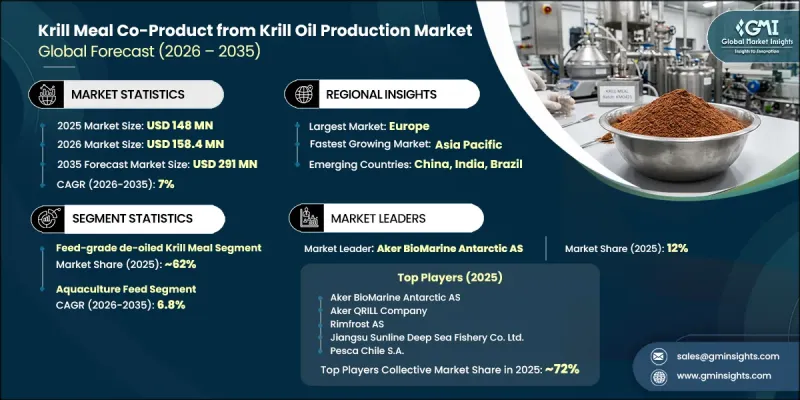
탈유 크릴 밀이 크릴 오일 생산 부산물에서 남극 크릴 가공 산업 전반에 걸친 중요한 수익원으로 진화함에 따라, 이 시장은 계속해서 성장세를 보이고 있습니다. 사료 제조업체들 사이에서 품질에 대한 기대가 높아짐에 따라 전문 크릴 밀 제품의 상업적 가치가 향상되고 있으며, 특히 양식용 사료에 사용되는 인증된 저불소 함유 제품이 주목받고 있습니다. 남극의 어획 능력에 대한 지속적인 투자가 생산량 증가를 뒷받침하는 한편, 세계 공급 구조를 재편하고 국제 시장 공급량을 확대하고 있습니다. 동시에, 반려동물 사료 분야에서 고품질 원료에 대한 수요가 증가함에 따라 고품질 크릴 밀에는 더 많은 비즈니스 기회가 창출되고 있습니다. 규제 당국의 감독과 지속가능성 인증은 생산 및 공급 상황에 영향을 미치는 중요한 요인으로 남아 있습니다. 부가가치가 높은 해양 원료에 대한 수요가 계속 증가하는 가운데, 크릴 오일 생산 유래 크릴 밀 부산물 시장은 제품 품질 향상, 상업적 수요 증가 및 가공 능력 확충에 힘입어 업계 수익에서 점점 더 중요한 역할을 수행하고 있습니다.
| 시장 범위 | |
|---|---|
| 개시 연도 | 2025년 |
| 예측 기간 | 2026-2035년 |
| 초기 시장 규모 | 1억 4,800만 달러 |
| 예측액 | 2억 9,100만 달러 |
| CAGR | 7% |
사료용 탈유 크릴 밀 부문은 2025년에 62%의 점유율을 차지한 것으로 평가되었으며, 2026-2035년 연평균 성장률(CAGR) 6.2%로 성장할 것으로 전망됩니다. 이 카테고리에는 기존 단백질 제품 외에도 해당 부문의 약 20%를 차지하는 저불소 강화 등급도 포함되어 있으며, 이는 시장 전체 판매량의 주요 견인차 역할을 계속하고 있습니다. 양식 사료 제조업체들의 견조한 수요가 계속해서 이 부문의 성장을 뒷받침하고 있습니다. 이는 사료용 크릴 밀이 귀중한 해양 유래 영양소를 제공하는 동시에 사료의 기호성을 높인다는 사실이 널리 인정받고 있기 때문입니다. 이러한 제품들은 주요 단백질 성분으로 기능하기보다는 사료의 성능, 영양 품질 및 전체 배합의 효율을 향상시키기 위해 점점 더 많이 배합되고 있습니다. 인증된 고사양 원료에 대한 수요 증가 또한 생산자들이 프리미엄 사료용 제품 라인업을 확대하는 데 박차를 가하고 있으며, 이는 예측 기간 동안 이 부문 시장 입지를 더욱 공고히 하고 있습니다.
수산물 양식용 사료 용도는 2025년에 58%의 점유율을 차지한 것으로 평가되었으며, 2026-2035년 연평균 성장률(CAGR) 6.8%로 성장할 것으로 전망됩니다. 크릴 밀은 수산 양식용 사료 배합에 있어 영양적 및 기능적 측면에서 여러 가지 이점을 제공하기 때문에 이 용도는 계속해서 전체 소비량을 주도하고 있습니다. 사료의 기호성을 향상시키고, 해양성 인지질 및 천연 아스타잔틴을 공급하며, 소화 흡수율이 높은 단백질을 공급하는 능력 덕분에 크릴밀은 현대 수산 영양 분야에서 선호되는 원료가 되었습니다. 사료 효율, 동물 건강, 제품 품질에 대한 중요성이 커짐에 따라, 상업 양식 사업 전반에서 크릴 밀의 채택이 더욱 확대되고 있습니다. 생산자들이 영양 성능을 향상시키면서 지속 가능한 생산을 뒷받침할 원료를 찾는 가운데, 양식용 사료 부문 수요는 시장 전체 성장에 가장 큰 기여 요인으로 계속될 것으로 예측됩니다.
북미의 크릴 오일 생산에 따른 제품별 크릴 밀 시장은 2025년에 16%의 점유율을 차지한 것으로 평가되었으며, 2035년까지 연평균 성장률(CAGR) 6.8%로 성장할 것으로 전망됩니다. 이 지역의 성장은 수산 양식용 사료보다는 주로 프리미엄 반려동물사료 및 영양 보조제 용도 수요 증가에 의해 뒷받침되고 있습니다. 각 제조업체들은 기능성 영양 및 원재료의 투명성을 중시하는 프리미엄 반려동물사료 배합에 인증된 저불소 크릴 밀을 점점 더 많이 도입하고 있습니다. 또한, 해양 유래 영양 제품에 대한 소비자의 관심이 지속됨에 따라, 영양 보조제 업계에서 크릴 유래 단백질 및 생리활성 성분의 채택이 확대되고 있습니다. 이러한 동향은 해당 지역 수요를 강화하는 동시에, 공급업체들이 부가가치가 높은 영양 시장에서 입지를 확대하도록 촉진하고 있습니다.
자주 묻는 질문
목차
제1장 조사 방법 및 범위
제2장 주요 요약
제3장 업계 인사이트
제4장 경쟁 구도
제5장 시장 추산 및 예측 : 제품 등급별(2022-2035년)
제6장 시장 추산 및 예측 : 제품 형태별(2022-2035년)
제7장 시장 추산 및 예측 : 용도별(2022-2035년)
제8장 시장 추산 및 예측 : 지역별(2022-2035년)
제9장 기업 개요
AJY 26.08.20The Global Krill Meal Co-Product from Krill Oil Production Market was valued at USD 148 million in 2025 and is estimated to grow at a CAGR of 7% to reach USD 291 million by 2035.
The market continues to gain momentum as de-oiled krill meal evolves from a by-product of krill oil manufacturing into a significant revenue-generating component across the Antarctic krill processing industry. Rising quality expectations among feed manufacturers are increasing the commercial value of specialized krill meal products, particularly certified, low-fluoride variants used in aquaculture nutrition. Ongoing investments in Antarctic harvesting capacity are supporting higher production volumes while reshaping global supply dynamics and expanding availability across international markets. At the same time, the growing preference for premium ingredients in companion animal nutrition is opening additional opportunities for high-quality krill meal. Regulatory oversight and sustainability certification remain key factors influencing production and supply conditions. As demand for value-added marine ingredients continues to rise, the krill oil production co-product krill meal market is becoming an increasingly important contributor to industry revenue, supported by product quality improvements, stronger commercial demand, and expanding processing capabilities.
| Market Scope | |
|---|---|
| Start Year | 2025 |
| Forecast Year | 2026-2035 |
| Start Value | $148 Million |
| Forecast Value | $291 Million |
| CAGR | 7% |
The feed-grade de-oiled krill meal segment held a 62% share in 2025 and is projected to grow at a 6.2% CAGR during 2026-2035. This category, which includes both conventional protein products and enhanced low-fluoride grades accounting for nearly 20% of the segment, remained the leading contributor to overall market volume. Strong demand from aquaculture feed manufacturers continues to support segment growth, as feed-grade krill meal is widely recognized for enhancing feed attractiveness while providing valuable marine-derived nutrients. Rather than functioning as the primary protein component, these products are increasingly incorporated to improve feed performance, nutritional quality, and overall formulation efficiency. Growing demand for certified, higher-specification ingredients is also encouraging producers to expand premium feed-grade offerings, further strengthening the commercial position of this segment throughout the forecast period.
The aquaculture feed application captured a 58% share in 2025 and is forecast to grow at a 6.8% CAGR from 2026 to 2035. This application continues to dominate overall consumption because krill meal delivers multiple nutritional and functional advantages within aquaculture feed formulations. Its ability to improve feed acceptance, provide marine phospholipids, supply naturally occurring astaxanthin, and contribute highly digestible protein makes it a preferred ingredient for modern aquatic nutrition. Increasing emphasis on feed efficiency, animal health, and product quality is encouraging broader adoption of krill meal across commercial aquaculture operations. As producers seek ingredients that support sustainable production while improving nutritional performance, demand within the aquaculture feed segment is expected to remain the largest contributor to overall market growth.
North America Krill Meal Co-Product from Krill Oil Production Market accounted for a 16% share in 2025 and is anticipated to grow at 6.8% CAGR through 2035. Regional growth is primarily supported by rising demand from premium pet nutrition and dietary supplement applications rather than aquaculture feed. Manufacturers are increasingly incorporating certified, low-fluoride krill meal into premium companion animal formulations that emphasize functional nutrition and ingredient transparency. In addition, continued consumer interest in marine-based nutritional products is supporting greater adoption of krill-derived protein and bioactive ingredients within the dietary supplement industry. These trends are strengthening regional demand while encouraging suppliers to expand their presence across value-added nutrition markets.
Major companies operating in the global krill meal co-product from krill oil production market include Aker BioMarine Antarctic AS, Aker QRILL Company, Rimfrost AS, Liaoning Pelagic Fisheries / Liaoyu Antarctic Krill Tech, Jiangsu Sunline Deep Sea Fishery Co., Ltd., Pesca Chile S.A., Neptune Technologies & Bioressources Inc., Hestia (Shandong) Biotech Co., Ltd., Bioextraction Technology LLC / Best Krill, Shandong Hailongyuan Bio-Tech Co., Ltd., Qingdao Kangjing Marine Biotechnology Co., Ltd., Zhongguan Biotechnology (Hunchun) Co., Ltd., Guangzhou Beyond Fishery Co., Ltd., Jeong-Il Corporation, and Kitin AS. Leading participants in the krill meal co-product from krill oil production market are strengthening their competitive position by expanding production capacity, improving processing technologies, and developing premium-grade de-oiled krill meal with enhanced quality specifications. Companies are investing in sustainable harvesting practices, certification programs, and traceable supply chains to address growing customer demand for responsibly sourced marine ingredients. Many manufacturers are broadening their product portfolios to serve aquaculture, pet food, and nutritional applications while increasing investments in research and product innovation to enhance functional performance. Strategic collaborations with feed manufacturers, long-term supply agreements, and geographic expansion into high-growth regional markets are also supporting stronger market penetration.
Table of Contents
Chapter 1 Methodology & Scope
- 1.1 Market scope and definition
- 1.2 Research design
- 1.2.1 Research approach
- 1.2.2 Data collection methods
- 1.3 Data mining sources
- 1.3.1 Global
- 1.3.2 Regional/Country
- 1.4 Base estimates and calculations
- 1.4.1 Base year calculation
- 1.4.2 Key trends for market estimation
- 1.5 Primary research and validation
- 1.5.1 Primary sources
- 1.6 Forecast model
- 1.7 Research assumptions and limitations
Chapter 2 Executive Summary
- 2.1 Industry 360° synopsis
- 2.2 Key market trends
- 2.2.1 Product Grade
- 2.2.2 Application
- 2.2.3 Regional
- 2.3 TAM Analysis, 2026-2035
- 2.4 CXO perspectives: Strategic imperatives
- 2.5 Future outlook and strategic recommendations
Chapter 3 Industry Insights
- 3.1 Industry ecosystem analysis
- 3.1.1 Supplier landscape
- 3.1.2 Profit margin
- 3.1.3 Value addition at each stage
- 3.1.4 Factor affecting the value chain
- 3.1.5 Disruptions
- 3.2 Industry impact forces
- 3.2.1 Growth drivers
- 3.2.2 Industry pitfalls and challenges
- 3.2.3 Market opportunities
- 3.3 Growth potential analysis
- 3.4 Regulatory landscape
- 3.4.1 North America
- 3.4.2 Europe
- 3.4.3 Asia Pacific
- 3.4.4 Latin America
- 3.4.5 Middle East & Africa
- 3.5 Porter’s analysis
- 3.6 PESTEL analysis
- 3.7 Technology and innovation landscape
- 3.7.1 Current technological trends
- 3.7.2 Emerging technologies
- 3.8 Price trends
- 3.8.1 By region
- 3.8.2 By Product grade
- 3.9 Future market trends
- 3.10 Patent landscape
- 3.11 Trade statistics (HS code)
- 3.11.1 Major importing countries
- 3.11.2 Major exporting countries
- 3.12 Sustainability and environmental aspects
- 3.12.1 Sustainable practices
- 3.12.2 Waste reduction strategies
- 3.12.3 Energy efficiency in production
- 3.12.4 Eco-friendly initiatives
Chapter 4 Competitive Landscape, 2025
- 4.1 Introduction
- 4.2 Company market share analysis
- 4.2.1 By region
- 4.2.1.1 North America
- 4.2.1.2 Europe
- 4.2.1.3 Asia Pacific
- 4.2.1.4 LATAM
- 4.2.1.5 MEA
- 4.2.1 By region
- 4.3 Company matrix analysis
- 4.4 Competitive analysis of major market players
- 4.5 Competitive positioning matrix
- 4.6 Key developments
- 4.6.1 Mergers & acquisitions
- 4.6.2 Partnerships & collaborations
- 4.6.3 New product launches
- 4.6.4 Expansion plans
Chapter 5 Market Estimates and Forecast, By Product Grade, 2022–2035 (USD Million) (Kilo Tons)
- 5.1 Key trends
- 5.2 Feed-Grade De-oiled Krill Meal
- 5.2.1 Standard Protein
- 5.2.2 Enhanced-Specification Low-Fluoride
- 5.3 High-Protein De-oiled Krill Meal
- 5.3.1 Salmon & Salmonid-Optimized
- 5.3.2 Shrimp & Shellfish-Optimized
- 5.4 Nutraceutical-Grade De-oiled Krill Meal
- 5.4.1 Human Protein Supplement Base
- 5.4.2 Astaxanthin-Enriched Functional Grade
Chapter 6 Market Estimates and Forecast, By Product Form, 2022–2035 (USD Million) (Kilo Tons)
- 6.1 Key trends
- 6.2 Solvent Extraction
- 6.3 Supercritical CO2 Extraction
- 6.4 Aqueous/Water-Based Extraction
- 6.5 Enzymatic Extraction
- 6.6 Chromatography-Based Separation & Purification
- 6.7 Others
Chapter 7 Market Estimates and Forecast, By Application, 2022–2035 (USD Million) (Kilo Tons)
- 7.1 Key trends
- 7.2 Aquaculture Feed
- 7.2.1 Finfish Feed
- 7.2.2 Shrimp & Shellfish Feed
- 7.2.3 Other Species
- 7.3 Pet Food
- 7.3.1 Dog Food
- 7.3.2 Cat Food
- 7.3.3 Others
- 7.4 Livestock & Poultry Feed
- 7.4.1 Swine Feed
- 7.4.2 Poultry Feed
- 7.4.3 Other Livestock
- 7.5 Nutraceuticals & Dietary Supplements
- 7.5.1 Human Protein Powder
- 7.5.2 Functional Food & Beverage
- 7.5.3 Astaxanthin & Bioactive Extraction
- 7.6 Agricultural Fertilizers
- 7.6.1 Organic Soil Amendment
- 7.6.2 Slow-Release Nitrogen
- 7.7 Others
Chapter 8 Market Estimates and Forecast, By Region, 2022–2035 (USD Million) (Kilo Tons)
- 8.1 Key trends
- 8.2 North America
- 8.2.1 U.S.
- 8.2.2 Canada
- 8.3 Europe
- 8.3.1 Germany
- 8.3.2 UK
- 8.3.3 France
- 8.3.4 Spain
- 8.3.5 Italy
- 8.3.6 Rest of Europe
- 8.4 Asia Pacific
- 8.4.1 China
- 8.4.2 India
- 8.4.3 Japan
- 8.4.4 Australia
- 8.4.5 South Korea
- 8.4.6 Rest of Asia Pacific
- 8.5 Latin America
- 8.5.1 Brazil
- 8.5.2 Mexico
- 8.5.3 Argentina
- 8.5.4 Rest of Latin America
- 8.6 Middle East and Africa
- 8.6.1 Saudi Arabia
- 8.6.2 South Africa
- 8.6.3 UAE
- 8.6.4 Rest of Middle East and Africa
Chapter 9 Company Profiles
- 9.1 Aker BioMarine Antarctic AS
- 9.2 Aker QRILL Company
- 9.3 Rimfrost AS
- 9.4 Liaoning Pelagic Fisheries / Liaoyu Antarctic Krill Tech
- 9.5 Jiangsu Sunline Deep Sea Fishery Co., Ltd.
- 9.6 Pesca Chile S.A.
- 9.7 Neptune Technologies & Bioressources Inc.
- 9.8 Hestia (Shandong) Biotech Co., Ltd.
- 9.9 Bioextraction Technology LLC / Best Krill
- 9.10 Shandong Hailongyuan Bio-Tech Co., Ltd.
- 9.11 Qingdao Kangjing Marine Biotechnology Co., Ltd.
- 9.12 Zhongguan Biotechnology (Hunchun) Co., Ltd.
- 9.13 Guangzhou Beyond Fishery Co., Ltd.
- 9.14 Jeong-Il Corporation
- 9.15 Kitin AS


