
|
시장보고서
상품코드
2109224
항공 조기 경보 및 제어 시스템 시장 : 시장 기회, 성장 촉진요인, 산업 동향 분석, 예측(2026-2035년)Airborne Early Warning and Control (AEWandC) System Market Opportunity, Growth Drivers, Industry Trend Analysis, and Forecast 2026 - 2035 |
||||||

세계의 항공 조기 경보 및 제어 시스템 시장은 2025년에 64억 달러 규모로 평가되었고, CAGR 5.9%로 성장할 전망이며, 2035년에는 115억 달러에 이를 것으로 추정되고 있습니다.
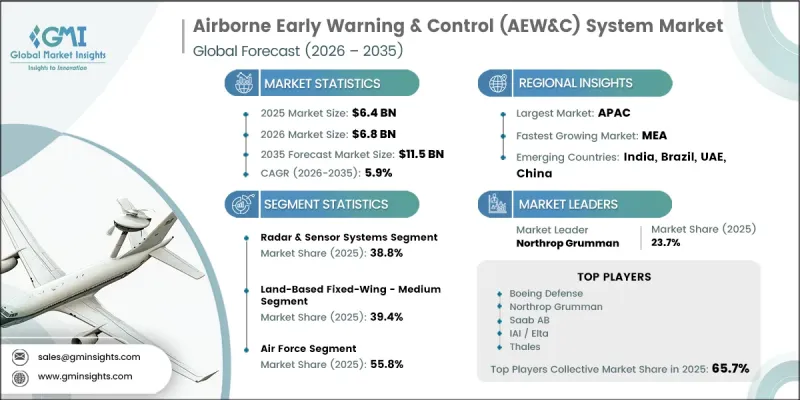
시장의 성장은 지정학적 불확실성 증가, 전 세계 국방비 증가, 그리고 각 국방 기관의 항공 감시 능력에 대한 지속적인 현대화에 의해 주도되고 있습니다. 노후화된 항공 감시기단의 교체에 더해, 공역 감시 및 작전 준비 태세 강화에 대한 수요가 높아지면서 장기적인 조달 활동을 지속적으로 뒷받침하고 있습니다. 국방 현대화 이니셔티브의 확대와 첨단 감시 기술에 대한 투자 증가 또한 유리한 성장 기회를 창출하고 있습니다. 또한, 현대 항공 위협의 복잡화와 통합된 네트워크 중심 군사 작전에 대한 중요성이 높아짐에 따라, 국방 기관들은 차세대 항공 지휘 및 감시 시스템에 대한 투자를 촉진하고 있습니다. 일부 지역에서는 국내 방위 제조 역량을 강화하기 위한 노력이 활발해지고 있으며, 이 또한 시장 확장을 더욱 뒷받침하고 있습니다. 항공 조기 경보 및 제어 시스템 시장은 항공전자 장비, 감시 기술, 임무 시스템 및 디지털 통신의 지속적인 발전으로부터도 혜택을 받고 있습니다. 이러한 기술들은 운영 효율을 높이고, 상황 인식을 향상시키며, 점점 더 복잡해지는 작전 환경에서 보다 효과적인 국방 협력을 지원합니다.
| 시장 범위 | |
|---|---|
| 개시 연도 | 2025년 |
| 예측 기간 | 2026-2035년 |
| 초기 시장 규모 | 64억 달러 |
| 예측액 | 1,150만 달러 |
| CAGR | 5.9% |
방위 예산의 확대는 항공 조기 경보 및 제어 시스템 시장에 대해 지속적으로 장기적인 견인 역할을 하고 있으며, 각국 정부가 첨단 공중 감시 플랫폼 및 최신 방위 능력에 대한 투자를 가능하게 하고 있습니다. 노후화된 항공기의 지속적인 퇴역과 작전 준비 태세 유지의 필요성으로 인해, 단기적인 예산 변동의 영향을 비교적 덜 받는 안정적인 교체 수요가 발생하고 있습니다. 동시에, 항공기 탑재형 감시 기술의 발전과 임무 요건의 진화로 인해 보다 유연하고 효율적인 플랫폼 구성의 개발이 촉진되고 있으며, 이는 지속적인 혁신을 뒷받침하고 전 세계 방위 시장 전반에 걸쳐 조달 기회를 확대되고 있습니다.
2025년에는 레이더 및 센서 시스템 분야가 38.8%의 점유율을 차지했습니다. 이러한 주도적 지위는 항공기의 감지, 감시, 추적 및 임무 수행 효율성 측면에서 레이더 및 센서 기술이 수행하는 필수적인 역할에 의해 뒷받침되고 있습니다. 이러한 시스템은 기술적 복잡성과 성능 요건으로 인해 전체 프로그램 투자액에서 큰 비중을 차지하고 있습니다. 감지 능력 강화, 추적 정밀도 향상, 감시 성능 개선에 대한 수요 증가는 신형 항공기 및 현대화 프로그램 모두에서 첨단 레이더 및 센서 기술에 대한 지속적인 투자를 뒷받침하고 있습니다.
2025년에는 지상 배치형 고정익기(중형) 부문이 39.4%의 점유율을 차지했습니다. 이 부문은 작전 반경, 감시 능력, 탑재 능력 및 총 운용 비용의 균형이 뛰어나기 때문에 계속해서 시장을 주도하고 있습니다. 중형 고정익 플랫폼은 배치 유연성이 높고, 정비 효율이 향상되었으며, 뛰어난 임무 수행 능력을 갖추고 있어 비용 대비 효과가 높은 공중 감시 능력을 추구하는 각국의 국방 기관에게 매력적인 솔루션으로 자리 잡고 있습니다. 광범위한 운용 요건에 대한 적응성 덕분에 여러 지역에서 도입 확대가 지속적으로 촉진되고 있습니다.
2025년, 북미의 항공 조기 경보 및 제어 시스템 시장은 29.5%의 점유율을 차지했습니다. 이 지역의 성장은 국방 현대화에 대한 지속적인 투자, 첨단 공중 감시 플랫폼의 지속적인 조달, 그리고 장기적인 군사 능력 강화 프로그램에 의해 뒷받침되고 있습니다. 작전 준비 태세 향상, 공역 감시 강화, 통합 방위 능력 확대를 위한 지속적인 노력이 첨단 AEW&C 시스템에 대한 안정적인 수요를 지속적으로 창출하고 있습니다. 장기적인 방위 계획과 전략적 감시 기술에 대한 지속적인 투자가 예측 기간 동안 시장의 지속적인 성장을 뒷받침할 것으로 예측됩니다.
자주 묻는 질문
목차
제1장 조사 방법 및 범위
제2장 주요 요약
제3장 업계 인사이트
제4장 경쟁 구도
제5장 시장 추산 및 예측 : 컴포넌트별(2022-2035년)
제6장 시장 추산 및 예측 : 플랫폼 유형별(2022-2035년)
제7장 시장 추산 및 예측 : 용도별(2022-2035년)
제8장 시장 추산 및 예측 : 최종 사용자별(2022-2035년)
제9장 시장 추산 및 예측 : 지역별(2022-2035년)
제10장 기업 개요
AJY 26.08.20The Global Airborne Early Warning & Control (AEW&C) System Market was valued at USD 6.4 billion in 2025 and estimated to grow at a CAGR of 5.9% to reach USD 11.5 billion by 2035.
Market growth is driven by rising geopolitical uncertainties, increasing global defense spending, and continuous modernization of airborne surveillance capabilities across defense organizations. The replacement of aging airborne surveillance fleets, combined with the growing need to strengthen airspace monitoring and operational readiness, continues to support long-term procurement activities. Expanding defense modernization initiatives and increasing investments in advanced surveillance technologies are also creating favorable growth opportunities. In addition, the rising complexity of modern aerial threats and the growing emphasis on integrated, network-centric military operations are encouraging defense agencies to invest in next-generation airborne command and surveillance systems. Increasing efforts to strengthen domestic defense manufacturing capabilities across several regions are further supporting market expansion. The airborne early warning & control (AEW&C) system market is also benefiting from continuous advancements in avionics, surveillance technologies, mission systems, and digital communications that enhance operational efficiency, improve situational awareness, and support more effective defense coordination across increasingly complex operational environments.
| Market Scope | |
|---|---|
| Start Year | 2025 |
| Forecast Year | 2026-2035 |
| Start Value | $6.4 Billion |
| Forecast Value | $11.5 Million |
| CAGR | 5.9% |
Growing defense budgets continue to provide long-term support for the airborne early warning & control (AEW&C) system market, enabling governments to invest in advanced airborne surveillance platforms and modern defense capabilities. The ongoing retirement of aging aircraft and the need to maintain operational readiness are creating consistent replacement opportunities that remain relatively unaffected by short-term budget fluctuations. At the same time, advancements in airborne surveillance technologies and evolving mission requirements are encouraging the development of more flexible and efficient platform configurations, supporting continuous innovation and expanding procurement opportunities across global defense markets.
The radar and sensor systems segment accounted for 38.8% share in 2025. This leadership is supported by the essential role of radar and sensor technologies in aircraft detection, surveillance, tracking, and mission effectiveness. These systems represent a significant portion of overall program investment due to their technical complexity and performance requirements. Increasing demand for enhanced detection capabilities, improved tracking accuracy, and stronger surveillance performance continues to support sustained investments in advanced radar and sensor technologies for both new aircraft and modernization programs.
The land-based fixed-wing - medium segment held 39.4% share in 2025. The segment continues to lead the market by offering an effective balance of operational range, surveillance capability, payload capacity, and overall operating costs. Medium-sized fixed-wing platforms provide greater deployment flexibility, improved maintenance efficiency, and strong mission performance, making them an attractive solution for national defense organizations seeking cost-effective airborne surveillance capabilities. Their adaptability to a wide range of operational requirements continues to support growing adoption across multiple regions.
North America Airborne Early Warning & Control (AEW&C) System Market accounted for 29.5% share in 2025. Regional growth is supported by sustained investments in defense modernization, continued procurement of advanced airborne surveillance platforms, and long-term military capability enhancement programs. Ongoing efforts to improve operational readiness, strengthen airspace surveillance, and expand integrated defense capabilities continue to create stable demand for advanced AEW&C systems. Long-term defense planning and consistent investments in strategic surveillance technologies are expected to support continued market growth throughout the forecast period.
Major companies operating in the global airborne early warning & control (AEW&C) system market include Airbus Defence & Space, Boeing Defense, Space & Security, Elbit Systems, Embraer Defence & Security, General Atomics Aeronautical Systems, Hindustan Aeronautics Limited (HAL), Indra Sistemas, Israel Aerospace Industries (IAI) / Elta Systems, L3Harris Technologies, Leonardo S.p.A., Northrop Grumman Corporation, Raytheon Intelligence & Space (RTX), Saab AB, Thales Group, Turkish Aerospace Industries (TAI/TUSAS), and Viasat Inc. Companies operating in the airborne early warning & control (AEW&C) system market are focusing on continuous technology innovation, platform modernization, and strategic partnerships to strengthen their competitive position. Leading manufacturers are investing in research and development to enhance surveillance capabilities, mission systems, digital communications, and operational efficiency while meeting evolving defense requirements. Businesses are expanding collaboration with defense agencies, aircraft manufacturers, and technology providers to accelerate product development and improve program execution. Companies also prioritize long-term maintenance, upgrade, and lifecycle support services to strengthen customer relationships and generate recurring revenue.
Table of Contents
Chapter 1 Methodology and Scope
- 1.1 Market scope and definition
- 1.2 Research design
- 1.2.1 Research approach
- 1.2.2 Data collection methods
- 1.3 Data mining sources
- 1.3.1 Global
- 1.3.2 Regional/Country
- 1.4 Base estimates and calculations
- 1.4.1 Base year calculation
- 1.4.2 Key trends for market estimation
- 1.5 Primary research and validation
- 1.5.1 Primary sources
- 1.6 Forecast model
- 1.7 Research assumptions and limitations
Chapter 2 Executive Summary
- 2.1 Industry 360° synopsis, 2022 – 2035
- 2.2 Key market trends
- 2.2.1 Component trends
- 2.2.2 Platform Type trends
- 2.2.3 Application trends
- 2.2.4 End-user trends
- 2.2.5 Regional trends
- 2.3 TAM Analysis, 2026-2035
- 2.4 CXO perspectives: Strategic imperatives
Chapter 3 Industry Insights
- 3.1 Industry ecosystem analysis
- 3.1.1 Supplier Landscape
- 3.1.2 Profit Margin
- 3.1.3 Cost structure
- 3.1.4 Value addition at each stage
- 3.1.5 Factor affecting the value chain
- 3.1.6 Disruptions
- 3.2 Industry impact forces
- 3.2.1 Growth drivers
- 3.2.1.1 Escalating Geopolitical Tensions and Rising Defense Budgets Worldwide
- 3.2.1.2 Modernization and Replacement of Aging AEW&C Fleets
- 3.2.1.3 Increasing Threat from Drones, Cruise Missiles, and Low-Observable Aircraft
- 3.2.1.4 Growing Demand for Network-Centric, Interoperable Coalition Operations
- 3.2.1.5 Expansion of Indigenous Defense Manufacturing in Asia-Pacific (India, China, South Korea, Japan)
- 3.2.2 Industry pitfalls and challenges
- 3.2.2.1 High Procurement, Development, and Maintenance Costs
- 3.2.2.2 Aging Fleets with Long Delivery Timelines and Rising Sustainment Costs
- 3.2.3 Market opportunities
- 3.2.3.1 Rise of Missionized Business Jets as Cost-Effective AEW&C Platforms
- 3.2.3.2 Integration of AI and Manned-Unmanned Teaming Technologies
- 3.2.1 Growth drivers
- 3.3 Growth potential analysis
- 3.4 Pricing Analysis (Driven by Primary Research)
- 3.4.1 Historical Price Trend Analysis
- 3.4.2 Pricing Strategy by Player Type (Premium / Value / Cost-plus)
- 3.5 Regulatory landscape
- 3.5.1 North America
- 3.5.2 Europe
- 3.5.3 Asia Pacific
- 3.5.4 Latin America
- 3.5.5 Middle East & Africa
- 3.6 Porter’s analysis
- 3.7 PESTEL analysis
- 3.8 Trade Data Analysis (Based on Paid Database)
- 3.8.1 Import/Export Volume & Value Trends
- 3.8.2 Key Trade Corridors & Tariff Impact
- 3.9 Impact of AI & Generative AI on the Market (Driven by Primary Research)
- 3.9.1 AI-Driven Disruption of Existing Business Models
- 3.9.2 GenAI Use Cases & Adoption Roadmap by Segment
- 3.10 Capacity & Production Landscape (Driven by Primary Research)
- 3.10.1 Production Capacity by Key Producer
- 3.10.2 Capacity Utilization Rates & Expansion Pipelines
Chapter 4 Competitive Landscape, 2025
- 4.1 Company market share analysis, 2025
- 4.1.1 By Region
- 4.1.1.1 North America
- 4.1.1.2 Europe
- 4.1.1.3 Asia-Pacific
- 4.1.1.4 Latin America
- 4.1.1.5 Middle East and Africa
- 4.1.2 Market Concentration Analysis
- 4.1.1 By Region
- 4.2 Competitive analysis of major market players
- 4.3 Competitive positioning matrix
- 4.4 Key developments
- 4.4.1 Mergers & acquisitions
- 4.4.2 Partnerships & collaborations
- 4.4.3 New product launches
- 4.4.4 Expansion plans and funding
- 4.5 Company tier benchmarking
- 4.5.1 Tier classification criteria & qualifying thresholds
- 4.5.2 Tier positioning matrix by revenue, geography & innovation
Chapter 5 Market Estimates and Forecast, By Component, 2022 – 2035 (USD Million)
- 5.1 Key trends
- 5.2 Radar & Sensor Systems
- 5.3 Mission Systems & Software
- 5.4 Communication & Data Link Systems
- 5.5 Electronic Support Measures (ESM)
- 5.6 Identification Friend or Foe (IFF)
Chapter 6 Market Estimates and Forecast, By Platform Type, 2022 – 2035 (USD Million)
- 6.1 Key trends
- 6.2 Land-Based Fixed-Wing - Large (Transport-Class)
- 6.3 Land-Based Fixed-Wing - Medium
- 6.4 Land-Based Fixed-Wing - Light
- 6.5 Carrier-Based Fixed-Wing
Chapter 7 Market Estimates and Forecast, By Application, 2022 – 2035 (USD Million)
- 7.1 Key trends
- 7.2 Air Defense & Threat Detection
- 7.3 Command, Control & Battle Management (C2/BM)
- 7.4 Maritime Domain Awareness
- 7.5 Border & Homeland Security
Chapter 8 Market Estimates and Forecast, By End-User, 2022 – 2035 (USD Million)
- 8.1 Key trends
- 8.2 Air Force
- 8.3 Navy
- 8.4 Joint & Allied Defense Commands
- 8.5 Homeland Security & Border Agencies
Chapter 9 Market Estimates and Forecast, By Region, 2022 – 2035 (USD Million)
- 9.1 Key trends
- 9.2 North America
- 9.2.1 U.S.
- 9.2.2 Canada
- 9.3 Europe
- 9.3.1 Germany
- 9.3.2 UK
- 9.3.3 France
- 9.3.4 Spain
- 9.3.5 Italy
- 9.4 Asia Pacific
- 9.4.1 China
- 9.4.2 India
- 9.4.3 Japan
- 9.4.4 Australia
- 9.4.5 South Korea
- 9.5 Latin America
- 9.5.1 Brazil
- 9.5.2 Mexico
- 9.5.3 Argentina
- 9.6 Middle East and Africa
- 9.6.1 South Africa
- 9.6.2 Saudi Arabia
- 9.6.3 UAE
Chapter 10 Company Profiles
- 10.1 Global Key Players
- 10.1.1 Boeing Defense, Space & Security
- 10.1.2 Northrop Grumman Corporation
- 10.1.3 Thales Group
- 10.1.4 Airbus Defence & Space
- 10.1.5 Raytheon Intelligence & Space (RTX)
- 10.1.6 Israel Aerospace Industries (IAI) / Elta Systems
- 10.1.7 Elbit Systems
- 10.1.8 Embraer Defence & Security
- 10.2 Regional key players
- 10.2.1 North America
- 10.2.1.1 L3Harris Technologies
- 10.2.2 Asia Pacific
- 10.2.2.1 Hindustan Aeronautics Limited (HAL)
- 10.2.3 Europe
- 10.2.3.1 Saab AB
- 10.2.3.2 Leonardo S.p.A.
- 10.2.3.3 Indra Sistemas
- 10.2.3.4 Turkish Aerospace Industries (TAI/TUSAS)
- 10.2.1 North America
- 10.3 Niche Players/Disruptors
- 10.3.1 General Atomics Aeronautical Systems
- 10.3.2 Viasat Inc.