

|
시장보고서
상품코드
2109245
스마트 농업 시장 : 시장 기회, 성장요인, 업계 동향 분석 및 예측(2026-2035년)Smart Agriculture Market Opportunity, Growth Drivers, Industry Trend Analysis, and Forecast 2026 - 2035 |
||||||

세계의 스마트 농업 시장은 2025년에 232억 달러 규모로 평가되었고, CAGR 9.7%로 성장할 전망이며, 2035년까지 596억 달러에 이를 것으로 추정되고 있습니다.
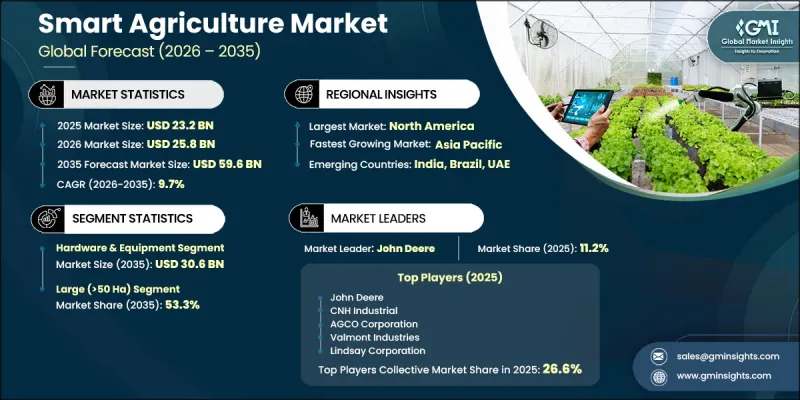
시장의 성장은 주요 농업 경제권에서 첨단 농업 기술의 도입을 지속적으로 촉진하는 우호적인 규제 정책에 힘입고 있습니다. 정밀 농업 및 디지털 농업을 추진하는 공공 부문의 노력으로 기술 투자에 대한 접근성이 높아지면서, 더 많은 농업 경영자가 생산 방식을 현대화할 수 있게 되었습니다. 또한, 세계 식량 안보, 인구 증가, 경작 가능 면적 감소에 대한 우려가 커짐에 따라, 농업 자원의 활용을 최적화하면서 생산성을 향상시키는 스마트 농업 솔루션에 대한 수요가 증가하고 있습니다. 농가에서는 비료, 농약, 관개를 보다 효율적으로 적용할 수 있는 정밀 기술의 도입이 진행되고 있으며, 이는 불필요한 자원 소비를 줄이면서 수확량을 극대화하는 데 기여하고 있습니다. 동시에, 커넥티드 기기, 자동화, 데이터 분석, 디지털 농장 관리 플랫폼의 급속한 발전으로 농업 경영이 혁신되고 의사 결정의 질도 향상되고 있습니다. 이러한 동향은 스마트 농업 시장의 장기적인 전망을 더욱 공고히 하고 있으며, 첨단 농업 기술은 전 세계 농업 부문 전반에서 업무 효율, 지속가능성, 생산성을 향상시키기 위한 필수적인 도구로서의 입지를 확립해 가고 있습니다.
| 시장 범위 | |
|---|---|
| 개시 연도 | 2025 |
| 예측 기간 | 2026-2035년 |
| 개시 연도 시장 규모 | 232억 달러 |
| 예측액 | 596억 달러 |
| CAGR | 9.7% |
생산자들이 농장 관리, 업무 효율, 장기적인 생산성을 향상시키기 위한 디지털 기술에 대한 투자를 확대함에 따라, 스마트 농업 산업은 계속해서 성장하고 있습니다. 연결형 기기, 정밀 모니터링 시스템, 자동화, 고급 분석 기술의 도입은 농업 사업자가 자원 활용을 최적화하는 동시에, 보다 정보에 기반한 업무상 의사결정을 내릴 수 있도록 지원하고 있습니다. 디지털 인프라 및 커넥티드 농업 기술에 대한 투자 확대에 힘입어, 상업 농업 사업 전반에 걸쳐 스마트 농업 솔루션의 도입이 더욱 확산되고 있습니다. 정밀 농업 기술의 지속적인 발전으로 생산성 향상, 운영 비용 절감, 지속 가능한 농업 관행 강화가 도모되어 시장 성장이 더욱 가속화될 것으로 예측됩니다.
하드웨어 및 장비 부문은 2025년에 135억 달러 시장 규모를 기록하였고, 2035년까지 306억 달러에 달할 것으로 예측됩니다. 이는 물리적 기술이 디지털 농업 운영을 뒷받침하는 데 필수적이기 때문입니다. 정밀 농업에 사용되는 장비는 농지 데이터 수집, 농업 활동의 자동화, 그리고 농장의 전반적인 성과를 향상시키는 지능형 관리 시스템의 도입을 가능하게 합니다. 소프트웨어 플랫폼과 디지털 서비스를 충분히 활용하려면 일반적으로 하드웨어 인프라가 먼저 도입되어야 하므로, 첨단 농업 장비에 대한 수요가 계속해서 시장 확장을 주도하고 있습니다. 현대적인 농업 기술에 대한 투자가 증가함에 따라, 예측 기간 동안 이 부문의 성장이 더욱 가속화될 것으로 전망됩니다.
2025년에는 대규모 농장(50헥타르 이상) 부문이 53.3%의 점유율을 차지하며, 농장 규모별로는 가장 큰 카테고리가 되었습니다. 대규모 농업 경영체는 첨단 장비 및 디지털 농업 솔루션에 투자할 수 있는 재정적 여력이 더 강하기 때문에 계속해서 기술 도입을 주도하고 있습니다. 정밀 농업 기술의 경제적 이점은 경영 규모가 커질수록 두드러지며, 대규모 농장에서는 효율성과 생산성 향상을 통해 기술 투자에 대한 더 높은 수익을 실현할 수 있습니다. 자원 소비를 줄이면서 생산량을 극대화하는 데 대한 관심이 높아짐에 따라, 대규모 상업 농업 사업 전반에 걸쳐 스마트 농업 기술에 대한 수요가 지속될 것으로 예측됩니다.
2025년, 미국의 스마트 농업 시장은 73.8%의 점유율을 차지했습니다. 시장 성장은 고도로 발달한 농업 부문, 정밀 농업 기술의 광범위한 도입, 그리고 첨단 디지털 농업 솔루션에 대한 적극적인 투자에 힘입고 있습니다. 커넥티드 농업 인프라, 디지털 농장 관리 시스템, 그리고 정밀 농업 기술에 대한 민관 양측의 지속적인 투자가 상업 농업 경영 전반에 걸친 기술 도입을 가속화하고 있습니다. 또한, 미국은 농업 기계 제조업체, 기술 개발자, 혁신적인 애그리테크 기업으로 구성된 확고한 생태계의 혜택을 누리고 있으며, 지역 시장에서 주도적인 입지를 공고히 하고 있습니다.
자주 묻는 질문
목차
제1장 조사 방법과 범위
제2장 주요 요약
제3장 업계 인사이트
제4장 경쟁 구도
제5장 시장 추산 및 예측 : 제품별(2022-2035년)
제6장 시장 추산 및 예측 : 기술별(2022-2035년)
제7장 시장 추산 및 예측 : 농장 규모별(2022-2035년)
제8장 시장 추산 및 예측 : 용도별(2022-2035년)
제9장 시장 추산 및 예측 : 지역별(2022-2035년)
제10장 기업 개요
AJY 26.08.18The Global Smart Agriculture Market was valued at USD 23.2 billion in 2025 and is estimated to grow at a CAGR of 9.7% to reach USD 59.6 billion by 2035.
Market growth is supported by favorable regulatory policies that continue to encourage the adoption of advanced farming technologies across major agricultural economies. Public-sector initiatives promoting precision farming and digital agriculture are making technology investments more accessible, enabling a greater number of agricultural operations to modernize production practices. Rising concerns regarding global food security, population growth, and declining arable land availability are also strengthening demand for smart farming solutions that improve productivity while optimizing the use of agricultural resources. Farmers are increasingly adopting precision technologies that enable more efficient application of fertilizers, crop protection products, and irrigation, helping maximize yields while reducing unnecessary resource consumption. At the same time, rapid advancements in connected devices, automation, data analytics, and digital farm management platforms are transforming agricultural operations and improving decision-making. These trends continue to reinforce the long-term outlook for the smart farming market, positioning advanced agricultural technologies as essential tools for improving operational efficiency, sustainability, and productivity across the global agricultural sector.
| Market Scope | |
|---|---|
| Start Year | 2025 |
| Forecast Year | 2026-2035 |
| Start Value | $23.2 Billion |
| Forecast Value | $59.6 Billion |
| CAGR | 9.7% |
The smart agriculture industry continues to expand as producers increasingly invest in digital technologies that improve farm management, operational efficiency, and long-term productivity. The adoption of connected equipment, precision monitoring systems, automation, and advanced analytics is helping agricultural businesses optimize resource utilization while supporting more informed operational decisions. Growing investment in digital infrastructure and connected farming technologies is enabling wider adoption of smart agriculture solutions across commercial farming operations. Continued advancements in precision farming technologies are expected to further strengthen market growth by improving productivity, reducing operational costs, and enhancing sustainable agricultural practices.
The hardware & equipment segment generated USD 13.5 billion in 2025 and is expected to reach USD 30.6 billion by 2035, as physical technologies are essential for supporting digital farming operations. Equipment used for precision agriculture enables the collection of field data, automation of farming activities, and implementation of intelligent management systems that improve overall farm performance. Since hardware infrastructure is typically installed before software platforms and digital services can be fully utilized, demand for advanced agricultural equipment continues to lead market expansion. Increasing investments in modern farming technologies are expected to further strengthen the segment throughout the forecast period.
The large farm (>50 Ha) segment accounted for a 53.3% share in 2025, making it the largest farm-size category. Large-scale agricultural operations continue to lead technology adoption because they have greater financial capacity to invest in advanced equipment and digital farming solutions. The economic benefits of precision agriculture technologies become more significant as operational scale increases, allowing larger farms to achieve stronger returns on technology investments through improved efficiency and productivity. Growing emphasis on maximizing output while reducing resource consumption is expected to sustain demand for smart agriculture technologies across large commercial farming operations.
United States Smart Agriculture Market held a 73.8% share in 2025. Market growth is supported by a highly developed agricultural sector, widespread adoption of precision farming technologies, and strong investment in advanced digital agriculture solutions. Continued public and private investment in connected farming infrastructure, digital farm management systems, and precision agriculture technologies is accelerating technology adoption across commercial farming operations. The country also benefits from a well-established ecosystem of agricultural equipment manufacturers, technology developers, and innovative agritech companies, reinforcing its leadership position within the regional market.
Major companies operating in the global smart agriculture market include Ag Leader Technology, AGCO Corporation, AgEagle Aerial Systems, Carbon Robotics, CLAAS KGaA mbH, CNH Industrial, Delair, DeLaval, FarmDroid, GEA Group, Hemisphere GNSS, John Deere, Kubota Corporation, Lely Industries, Lindsay Corporation, METER Group, Netafim, Pessl Instruments, Saga Robotics, Sentek Technologies, Topcon Agriculture, Trimble Agriculture, Valmont Industries, and Yanmar Holdings. Companies participating in the smart agriculture market are strengthening their competitive position by expanding precision farming technologies, developing connected equipment, and investing in advanced automation solutions. Manufacturers are increasing research and development efforts to improve data analytics, artificial intelligence, remote monitoring, and autonomous farming capabilities that enhance productivity and resource efficiency. Strategic collaborations with technology providers, agricultural organizations, and distribution partners are helping companies broaden their market presence and accelerate product adoption. Many businesses are also expanding their digital platforms by integrating farm management software, sensor technologies, connectivity solutions, and cloud-based analytics into comprehensive agricultural ecosystems.
Table of Contents
Chapter 1 Methodology & Scope
- 1.1 Research approach
- 1.2 Quality Commitments
- 1.2.1 GMI AI policy & data integrity commitment
- 1.2.1.1 Source consistency protocol
- 1.2.1 GMI AI policy & data integrity commitment
- 1.3 Research Trail & Confidence Scoring
- 1.3.1 Research Trail Components
- 1.3.2 Scoring Components
- 1.4 Data Collection
- 1.4.1 Partial list of primary sources
- 1.5 Data mining sources
- 1.5.1 Paid sources
- 1.5.1.1 Sources, by region
- 1.5.1 Paid sources
- 1.6 Base estimates and calculations
- 1.6.1 Base year calculation for any one approach
- 1.7 Forecast model
- 1.7.1 Quantified market impact analysis
- 1.7.1.1 Mathematical impact of growth parameters on forecast
- 1.7.1 Quantified market impact analysis
- 1.8 Research transparency addendum
- 1.8.1 Source attribution framework
- 1.8.2 Quality assurance metrics
- 1.8.3 Our commitment to trust
Chapter 2 Executive Summary
- 2.1 Industry 360° synopsis
- 2.2 Key market trends
- 2.2.1 Regional
- 2.2.2 Product
- 2.2.3 Technology
- 2.2.4 Farm Size
- 2.2.5 Application
Chapter 3 Industry Insights
- 3.1 Industry ecosystem analysis
- 3.1.1 Supplier landscape
- 3.1.2 Profit margin
- 3.1.3 Value addition at each stage
- 3.1.4 Factor affecting the value chain
- 3.2 Industry impact forces
- 3.2.1 Growth drivers
- 3.2.1.1 AI/ML & precision agriculture technology proliferation
- 3.2.1.2 Rising agricultural labor costs & structural workforce shortages
- 3.2.1.3 Government subsidies & digital agriculture policy programs
- 3.2.2 Industry pitfalls & challenges
- 3.2.2.1 High upfront capital expenditure & extended ROI horizon
- 3.2.2.2 Digital literacy gap & skilled workforce deficit in agriculture
- 3.2.3 Opportunities
- 3.2.3.1 Carbon credit & environmental service markets
- 3.2.3.2 Autonomous farming systems development
- 3.2.1 Growth drivers
- 3.3 Growth potential analysis
- 3.4 Regulatory framework
- 3.5 Major market trends and disruptions
- 3.6 Technology/innovation landscape
- 3.6.1 Current trends
- 3.6.2 Emerging trends
- 3.7 Pricing Analysis (driven by primary research)
- 3.7.1 Historical price trend analysis (driven by primary research)
- 3.7.2 Pricing strategy by player type (premium / value / cost-plus) (driven by primary research)
- 3.8 Future market trends
- 3.9 Trade data analysis (driven by paid database) (HS Code- 8806, 8701, 8432, 8433, 9015, 8424, 8517)
- 3.9.1 Import/export volume & value trends (driven by primary research)
- 3.9.2 Key trade corridors & tariff impact (driven by primary research)
- 3.10 Impact of AI & Generative AI on the Market
- 3.10.1 AI-driven disruption of existing business models
- 3.10.2 Gen-AI use cases & adoption roadmap by segment
- 3.10.3 Risks, limitations & regulatory considerations
- 3.11 Porter’s analysis
- 3.12 PESTEL analysis
- 3.13 Infrastructure & deployment landscape(driven by primary research)
- 3.13.1 Deployment penetration by region & buyer segment (driven by primary research)
- 3.13.2 Scalability constraints & infrastructure investment trends (driven by primary research)
Chapter 4 Competitive landscape, 2025
- 4.1 Introduction
- 4.2 Company market share analysis
- 4.2.1 By region
- 4.2.1.1 North America
- 4.2.1.2 Europe
- 4.2.1.3 Asia Pacific
- 4.2.1.4 Latin America
- 4.2.1.5 Middle East and Africa
- 4.2.1 By region
- 4.3 Company matrix analysis
- 4.4 Competitive analysis of major market players
- 4.5 Competitive positioning matrix
- 4.6 Key developments
- 4.6.1 Mergers & acquisitions
- 4.6.2 Partnerships & collaborations
- 4.6.3 New product launches
- 4.6.4 Expansion plans
Chapter 5 Market Estimates and Forecast, By Product, 2022 - 2035 (USD Billion)
- 5.1 Key trends
- 5.2 Hardware & Equipment
- 5.2.1 Drones & Unmanned Aerial Vehicles (UAVs)
- 5.2.2 Precision Irrigation Systems
- 5.2.3 GPS/GNSS Guidance & Auto-Steering Systems
- 5.2.4 IoT Sensors & Connected Field Devices
- 5.2.5 Automated & Robotic Farm Machinery
- 5.2.6 AI-Integrated Intelligent Farm Equipment
- 5.3 Software & Farm Management Platforms
- 5.3.1 Farm Management Information Systems (FMIS)
- 5.3.2 Precision Agriculture Analytics Platforms
- 5.3.3 AI-Driven Crop Advisory & Decision Support Software
- 5.4 Connectivity & Services
- 5.4.1 Remote Monitoring & Telematics Services
- 5.4.2 Maintenance & After-Sales Service Platforms
- 5.4.3 Data-as-a-Service (DaaS) & Subscription Models
Chapter 6 Market Estimates and Forecast, By Technology, 2022 - 2035 (USD Billion)
- 6.1 Key trends
- 6.2 Precision Farming Technology
- 6.2.1 Variable Rate Technology (VRT)
- 6.2.2 GPS/GNSS-Based Precision Guidance Systems
- 6.2.3 Remote Sensing & Satellite Imagery for Field Analytics
- 6.3 Artificial Intelligence & Machine Learning
- 6.3.1 AI-Powered Crop Yield Prediction Models
- 6.3.2 Computer Vision for Crop Disease & Pest Detection
- 6.3.3 Machine Learning in Autonomous Farm Equipment Navigation
- 6.3.4 Generative AI in Agricultural Advisory Platforms
- 6.4 Internet of Things (IoT) & Connectivity
- 6.4.1 Agricultural IoT Sensor Networks
- 6.4.2 5G & LPWAN Connectivity for Smart Farm Devices
- 6.4.3 Edge Computing in On-Farm IoT Data Processing
- 6.5 Robotics & Automation
- 6.5.1 Field Robotics
- 6.5.2 Greenhouse Automation Systems
- 6.5.3 Swarm Robotics in Large-Scale Crop Production
- 6.6 Remote Sensing & Aerial Technology
- 6.6.1 UAV/Drone-Based Remote Sensing- Multispectral & Thermal Imaging
- 6.6.2 Satellite-Based Crop Monitoring Platforms
- 6.6.3 LiDAR Applications in Agricultural Terrain Mapping
- 6.7 Blockchain & Data Management Technology
- 6.7.1 Blockchain for Agricultural Supply Chain Transparency
- 6.7.2 Farm Data Ownership & Interoperability Standards
Chapter 7 Market Estimates and Forecast, By Farm Size, 2022 - 2035 (USD Billion)
- 7.1 Key trends
- 7.2 Large Farms (>50 Hectares)
- 7.3 Medium Farms (5-50 Hectares)
- 7.4 Small Farms (<5 Hectares)
Chapter 8 Market Estimates and Forecast, By Application, 2022 - 2035 (USD Billion)
- 8.1 Key trends
- 8.2 Crop Production
- 8.2.1 Cereal & Grain Crops
- 8.2.2 Fruits & Vegetables
- 8.2.3 Oilseeds & Pulses
- 8.2.4 Specialty & High-Value Crops
- 8.3 Livestock Monitoring
- 8.3.1 Precision Livestock Farming
- 8.3.2 Dairy Farm Automation
- 8.4 Aquaculture
- 8.5 Forestry & Land Management
Chapter 9 Market Estimates and Forecast, By Region, 2022 - 2035 (USD Billion)
- 9.1 Key trends
- 9.2 North America
- 9.2.1 US
- 9.2.2 Canada
- 9.3 Europe
- 9.3.1 Germany
- 9.3.2 UK
- 9.3.3 France
- 9.3.4 Italy
- 9.3.5 Spain
- 9.3.6 Netherlands
- 9.3.7 Rest of Europe
- 9.4 Asia Pacific
- 9.4.1 China
- 9.4.2 India
- 9.4.3 Japan
- 9.4.4 Australia
- 9.4.5 South Korea
- 9.4.6 Indonesia
- 9.4.7 Philippines
- 9.4.8 Rest of Asia Pacific
- 9.5 Latin America
- 9.5.1 Brazil
- 9.5.2 Mexico
- 9.5.3 Argentina
- 9.5.4 Rest of Latin America
- 9.6 Middle East and Africa
- 9.6.1 South Africa
- 9.6.2 Turkey
- 9.6.3 Israel
- 9.6.4 Rest of MEA
Chapter 10 Company Profiles
- 10.1 Global Companies
- 10.1.1 AGCO Corporation
- 10.1.2 CLAAS KGaA mbH
- 10.1.3 CNH Industrial
- 10.1.4 DeLaval
- 10.1.5 GEA Group
- 10.1.6 John Deere
- 10.1.7 Kubota Corporation
- 10.1.8 Lely Industries
- 10.1.9 Lindsay Corporation
- 10.1.10 METER Group
- 10.1.11 Netafim
- 10.1.12 Topcon Agriculture
- 10.1.13 Trimble Agriculture
- 10.1.14 Valmont Industries
- 10.1.15 Yanmar Holdings
- 10.2 Regional Companies
- 10.2.1 Ag Leader Technology
- 10.2.2 Hemisphere GNSS
- 10.2.3 Pessl Instruments
- 10.2.4 Sentek Technologies
- 10.3 Emerging Companies
- 10.3.1 AgEagle Aerial Systems
- 10.3.2 Carbon Robotics
- 10.3.3 Delair
- 10.3.4 FarmDroid
- 10.3.5 Saga Robotics


