

|
시장보고서
상품코드
2109250
교량 건설 시장 기회, 성장 촉진요인, 산업 동향 분석, 예측(2026-2035년)Bridge Construction Market Opportunity, Growth Drivers, Industry Trend Analysis, and Forecast 2026 - 2035 |
||||||

세계의 교량 건설 시장은 2025년에 1,287억 달러 규모에 달하며, CAGR 5.2%로 성장하며, 2035년까지 2,150억 달러에 달할 것으로 예측됩니다.
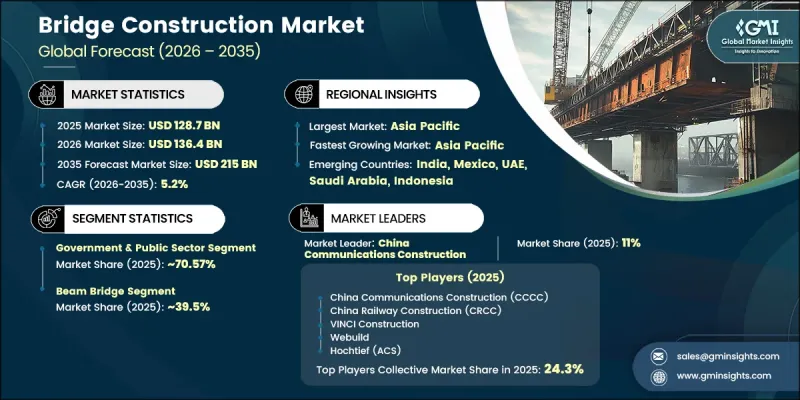
각국 정부와 인프라 개발 사업자들이 교통망 및 현대화 프로젝트에 대한 투자를 확대함에 따라 해당 시장은 성장을 거듭하고 있습니다. 이 업계는 기존의 건설 방식에서 벗어나 디지털화가 더욱 진전되며, 효율적이고 지속가능한 프로젝트 수행으로 진화하고 있습니다. 첨단인 건설 기술의 도입으로 프로젝트 계획 수립, 설계 정밀도, 시공 효율 및 장기적인 인프라 관리가 향상되는 동시에, 프로젝트 공사 기간 단축과 전체 수명 주기 비용 절감이 도모되고 있습니다. 또한 회복력 있는 인프라에 대한 관심이 높아지고 있는 점도 구조물의 내구성과 장기적인 성능을 향상시킬 수 있는 엔지니어링 솔루션의 도입을 지원하고 있습니다. 환경 문제의 심각화와 교통량 증가에 따라 더 큰 운영상 및 환경적 부하를 견딜 수 있도록 설계된 교량에 대한 수요가 높아지고 있습니다. 또한 인프라 소유주는 지속적인 상태 평가, 구조적 문제의 조기 발견, 그리고 예측 정비를 가능하게 하는 지능형 모니터링 솔루션을 도입함으로써 효율적인 자산 관리를 우선시하고 있습니다. 전 세계에서 교통 인프라에 대한 투자가 계속 증가하는 가운데, 교량 건설 시장은 지속적인 기술 혁신, 지속가능한 건설 방식, 그리고 내구성이 높고 고성능인 교량 인프라에 대한 수요 증가의 혜택을 받을 것으로 예상됩니다.
| 시장 범위 | |
|---|---|
| 시작연도 | 2025년 |
| 예측 기간 | 2026-2035년 |
| 초기 시장 규모 | 1,287억 달러 |
| 예측액 | 2,150억 달러 |
| CAGR | 5.2% |
정부 및 공공 부문 부문은 2025년에 70.57%의 점유율을 차지하며, 2035년까지 연평균 성장률(CAGR) 4.5%로 성장할 것으로 전망됩니다. 교량 건설 프로젝트에는 막대한 설비 투자가 필요하며, 그 자금은 주로 정부의 인프라 정비 프로그램을 통해 조달되므로 이 부문은 계속해서 시장을 주도하고 있습니다. 교량은 경제 성장, 지역 간 연계, 화물 운송, 그리고 공공안전을 지원하는 필수적인 교통 인프라로 자리매김하고 있습니다. 교량의 유지 관리, 개보수 및 재건축 프로젝트에 대한 지속적인 투자를 통해 장기적인 시장 수요가 유지될 것으로 전망됩니다.
거더 교량 부문은 2025년에 39.5%의 점유율을 차지하며, 2026-2035년 연평균 성장률(CAGR) 4.9%로 성장할 것으로 전망됩니다. 이 부문은 높은 비용 효율성, 구조의 단순성, 그리고 교통 인프라 프로젝트 전반에 걸친 폭넓은 적용 가능성 덕분에 선도적인 위치를 유지하고 있습니다. 거더 교량은 효율적인 시공이 가능하고 유지 관리 비용이 비교적 낮으며, 다양한 교량 재시공 및 확장 프로젝트에 실용적인 해결책을 제공할 수 있으며, 계속해서 널리 채택되고 있습니다. 이러한 범용성과 경제적 이점은 선진국 및 신흥 시장 모두에서 지속적으로 높은 채택률을 지원하고 있습니다.
2025년, 중국의 교량 건설 시장은 64.2%의 점유율을 차지하며 332억 달러 규모 시장 규모를 기록했습니다. 중국의 선도적 지위는 교통 인프라에 대한 지속적인 투자, 진행 중인 고속도로 및 철도 확장, 그리고 지역 간 연결성 향상에 초점을 맞춘 정부의 노력에 힘입은 것입니다. 급속한 도시화, 화물 운송 수요 증가, 대규모 교통망의 지속적인 개발로 인해 예측 기간 중 중국 전역에서 교량 건설 프로젝트에 대한 견고한 수요가 유지될 것으로 예상됩니다.
자주 묻는 질문
목차
제1장 조사 방법
제2장 개요
제3장 업계 인사이트
제4장 경쟁 구도
제5장 시장 추산·예측 : 교량 유형별, 2022-2035년
제6장 시장 추산·예측 : 재료별, 2022-2035년
제7장 시장 추산·예측 : 교량 스판별, 2022-2035년
제8장 시장 추산·예측 : 프로젝트 종별, 2022-2035년
제9장 시장 추산·예측 : 용도별, 2022-2035년
제10장 시장 추산·예측 : 최종 용도별, 2022-2035년
제11장 시장 추산·예측 : 지역별, 2022-2035년
제12장 기업 개요
KSA 26.08.19The Global Bridge Construction Market was valued at USD 128.7 billion in 2025 and is estimated to grow at a CAGR of 5.2% to reach USD 215 billion by 2035.
The market is experiencing growth as governments and infrastructure developers increase investments in transportation networks and modernization projects. The industry is evolving from traditional construction practices toward more digital, efficient, and sustainable project execution. The integration of advanced construction technologies is improving project planning, design accuracy, construction efficiency, and long-term infrastructure management while reducing project timelines and overall lifecycle costs. Growing emphasis on resilient infrastructure is also encouraging the adoption of engineering solutions capable of improving structural durability and long-term performance. Increasing environmental challenges and rising traffic volumes are driving demand for bridges designed to withstand greater operational and environmental stresses. Infrastructure owners are also prioritizing efficient asset management by adopting intelligent monitoring solutions that enable continuous condition assessment, early identification of structural issues, and predictive maintenance. As investment in transportation infrastructure continues to increase worldwide, the Bridge Construction Market is expected to benefit from ongoing technological innovation, sustainable construction practices, and the growing need for durable, high-performance bridge infrastructure.
| Market Scope | |
|---|---|
| Start Year | 2025 |
| Forecast Year | 2026-2035 |
| Start Value | $128.7 Billion |
| Forecast Value | $215 Billion |
| CAGR | 5.2% |
The government and public sector segment accounted for 70.57% share in 2025 and is anticipated to grow at a CAGR of 4.5% through 2035. This segment continues to lead the market because bridge construction projects require significant capital investment, with funding primarily provided through government infrastructure programs. Bridges remain essential transportation assets that support economic growth, regional connectivity, freight movement, and public safety. Continuous investment in bridge maintenance, rehabilitation, and replacement projects is expected to sustain long-term market demand.
The beam bridge segment held a 39.5% share in 2025 and is projected to grow at a CAGR of 4.9% from 2026 to 2035. The segment maintains its leading position due to its cost-effectiveness, structural simplicity, and broad applicability across transportation infrastructure projects. Beam bridges continue to be widely selected because they can be constructed efficiently, require comparatively lower maintenance, and provide practical solutions for a variety of bridge replacement and expansion projects. Their versatility and economic advantages continue to support strong adoption across both developed and emerging markets.
China Bridge Construction Market accounted for 64.2% share in 2025, generating USD 33.2 billion. The country's leadership is supported by continued investment in transportation infrastructure, ongoing highway and railway expansion, and government initiatives focused on improving regional connectivity. Rapid urbanization, increasing freight transportation requirements, and continued development of large-scale transportation networks are expected to maintain strong demand for bridge construction projects across the country throughout the forecast period.
Key companies operating in the global bridge construction market include AECOM, China Communications Construction Group (CCCC), China Railway Construction Corporation Limited (CRCC), Hochtief AG (ACS Group), Kawada Industries Inc., Kiewit Corporation, Larsen & Toubro (L&T), Mageba Group, VINCI Construction, and Webuild. Companies operating in the bridge construction market are strengthening their competitive position by investing in advanced construction technologies, expanding engineering capabilities, and improving project execution efficiency. Market participants are focusing on digital design tools, automation, and innovative construction methods to reduce project timelines and optimize lifecycle performance. Strategic partnerships, joint ventures, and long-term government infrastructure contracts are helping companies expand their market presence and secure large-scale projects. Businesses are also increasing investments in sustainable construction materials, resilient infrastructure solutions, and intelligent bridge monitoring technologies to address evolving customer requirements.
Table of Contents
Chapter 1 Methodology
- 1.1 Research approach
- 1.2 Quality Commitments
- 1.2.1 GMI AI policy & data integrity commitment
- 1.2.1.1 Source consistency protocol
- 1.2.1 GMI AI policy & data integrity commitment
- 1.3 Research Trail & Confidence Scoring
- 1.3.1 Research Trail Components
- 1.3.2 Scoring Components
- 1.4 Data Collection
- 1.4.1 Partial list of primary sources
- 1.5 Data mining sources
- 1.5.1 Paid sources
- 1.5.1.1 Sources, by region
- 1.5.1 Paid sources
- 1.6 Base estimates and calculations
- 1.6.1 Base year calculation
- 1.7 Forecast Model
- 1.7.1 Quantified market impact analysis
- 1.7.1.1 Mathematical impact of growth parameters on forecast
- 1.7.1 Quantified market impact analysis
- 1.8 Research transparency addendum
- 1.8.1 Source attribution framework
- 1.8.2 Quality assurance metrics
- 1.8.3 Our commitment to trust
Chapter 2 Executive Summary
- 2.1 Industry 360° synopsis, 2022 – 2035
- 2.2 Key market trends
- 2.2.1 Regional
- 2.2.2 Bridge Type
- 2.2.3 Material
- 2.2.4 Bridge Span
- 2.2.5 Project Type
- 2.2.6 Application
- 2.2.7 End Use
- 2.3 TAM Analysis, 2026-2035
- 2.4 CXO perspectives: Strategic imperatives
Chapter 3 Industry Insights
- 3.1 Industry ecosystem analysis
- 3.1.1 Supplier landscape
- 3.1.2 Profit margin analysis
- 3.1.3 Cost structure
- 3.1.4 Value addition at each stage
- 3.1.5 Factor affecting the value chain
- 3.1.6 Disruptions
- 3.2 Industry impact forces
- 3.2.1 Growth drivers
- 3.2.1.1 Government Investment in Transportation Infrastructure
- 3.2.1.2 Aging Bridge Replacement & Rehabilitation Programs
- 3.2.1.3 Rapid Urbanization and Expansion of Transportation Networks
- 3.2.1.4 Adoption of Accelerated Bridge Construction (ABC) & Modular Construction
- 3.2.1.5 Growth in Cross-Border Connectivity and Economic Corridor Project
- 3.2.2 Industry pitfalls and challenges
- 3.2.2.1 High Capital Investment and Long Project Execution Cycles
- 3.2.2.2 Fluctuating Raw Material Prices and Skilled Labor Shortages
- 3.2.3 Market opportunities
- 3.2.3.1 Expansion of High-Speed Rail and Metro Bridge Infrastructure
- 3.2.3.2 Increasing Public-Private Partnership (PPP) Bridge Projects
- 3.2.3.3 Growing Demand for Long-Span and Mega Bridge Construction
- 3.2.3.4 Rising Adoption of Modular Bridges for Defense and Emergency Applications
- 3.2.3.5 Growth in Smart Bridge Asset Management and Lifecycle Services
- 3.2.1 Growth drivers
- 3.3 Growth potential analysis
- 3.4 Technology and Innovation landscape
- 3.4.1 Current technological trends
- 3.4.2 Emerging technologies
- 3.5 Pricing Analysis (Driven by Primary Research)
- 3.5.1 Historical Price Trend Analysis, 2022-2025
- 3.5.2 Pricing Strategy by Player Type (Premium / Value / Cost-plus)
- 3.6 Regulatory guideline
- 3.6.1 North America
- 3.6.1.1 U.S.: AASHTO LRFD Bridge Design Specifications & FHWA National Bridge Inspection Standards (NBIS)
- 3.6.1.2 Canada: Canadian Highway Bridge Design Code (CSA S6) & Transport Canada Infrastructure Safety Guidelines
- 3.6.2 Europe
- 3.6.2.1 Germany: Eurocode EN 1990/1991/1992/1993 Bridge Design Standards & DIN Bridge Construction Standards
- 3.6.2.2 UK: Design Manual for Roads and Bridges (DMRB) & UK National Annex to Eurocodes
- 3.6.2.3 France: Eurocodes for Bridge Design & CEREMA Bridge Inspection and Maintenance Guidelines
- 3.6.2.4 Italy: Italian Technical Standards for Construction (NTC 2018) & Eurocode Bridge Compliance Framework
- 3.6.3 Asia Pacific
- 3.6.3.1 China: JTG Highway Bridge Design Code & Ministry of Transport (MOT) Bridge Construction Specifications
- 3.6.3.2 India: IRC Bridge Codes (IRC 5, IRC 6, IRC 112) & Ministry of Road Transport & Highways (MoRTH) Specifications
- 3.6.3.3 Japan: Japan Road Association (JRA) Bridge Specifications & MLIT Bridge Engineering Standards
- 3.6.3.4 South Korea: Korean Design Standards (KDS) for Bridges & MOLIT Infrastructure Construction Regulations
- 3.6.3.5 Australia: AS 5100 Bridge Design Standards & Austroads Bridge Engineering Guidelines
- 3.6.4 Latin America
- 3.6.4.1 Brazil: DNIT Bridge Design Standards & ABNT Structural Engineering Standards
- 3.6.4.2 Mexico: SCT Bridge Design Manual & Mexican Official Standards (NOM) for Infrastructure Projects
- 3.6.4.3 Argentina: National Highway Directorate (DNV) Bridge Design Standards & CIRSOC Structural Codes
- 3.6.5 Middle East & Africa (MEA)
- 3.6.5.1 UAE: Dubai Municipality Infrastructure Design Standards & Abu Dhabi Department of Municipalities and Transport (DMT) Bridge Guidelines
- 3.6.5.2 Saudi Arabia: Saudi Building Code (SBC) Structural Standards & Ministry of Transport and Logistic Services (MOTLS) Bridge Design Specifications
- 3.6.5.3 South Africa: TMH7 Code of Practice for Highway Bridges & South African National Standards (SANS) for Structural Design
- 3.6.1 North America
- 3.7 Porter’s analysis
- 3.8 PESTEL analysis
- 3.9 Patent Landscape (Driven by Primary Research)
- 3.10 Impact of AI & Generative AI on the Market (Driven by Primary Research)
- 3.10.1 AI-Driven Disruption of Existing Business Models
- 3.10.2 GenAI Use Cases & Adoption Roadmap by Segment
- 3.10.3 Risks, Limitations & Regulatory Considerations
- 3.11 Procurement & contracting landscape
- 3.11.1 Dominant contracting models
- 3.11.2 Performance-based & outcome-based contracting trends
- 3.11.3 Local content requirements & domestic contractor preference policies by region
- 3.11.4 International competitive bidding dynamics & cross-border contractor strategies
- 3.12 Public-private partnership (PPP) investment landscape
- 3.13 Digital construction landscape
- 3.13.1 Bim adoption rates & maturity levels by region
- 3.13.2 Digital project management & construction monitoring platforms
- 3.13.3 Drone & remote sensing in bridge inspection & surveying
- 3.13.4 IOT & connected construction site technologies
- 3.13.5 Digital twin deployment
- 3.14 Forecast assumptions & scenario analysis (Driven by Primary Research)
- 3.14.1 Base Case - Key Macro & Industry Variables Driving CAGR
- 3.14.2 Optimistic Scenarios - Favourable macro and industry tailwinds
- 3.14.3 Pessimistic Scenario - Macroeconomic slowdown or industry headwinds
Chapter 4 Competitive Landscape, 2025
- 4.1 Introduction
- 4.2 Company market share analysis
- 4.2.1 North America
- 4.2.2 Europe
- 4.2.3 Asia Pacific
- 4.2.4 Latin America
- 4.2.5 MEA
- 4.3 Competitive analysis of major market players
- 4.4 Competitive positioning matrix
- 4.5 Key developments
- 4.5.1 Mergers & acquisitions
- 4.5.2 Partnerships & collaborations
- 4.5.3 New Product Launches
- 4.5.4 Expansion Plans and funding
- 4.6 Company Tier Benchmarking
- 4.6.1 Tier Classification Criteria & Qualifying Thresholds
- 4.6.2 Tier Positioning Matrix by Revenue, Geography & Innovation
Chapter 5 Market Estimates & Forecast, By Bridge Type, 2022 - 2035 ($Bn, Units)
- 5.1 Key trends
- 5.2 Beam Bridge
- 5.3 Truss Bridge
- 5.4 Arch Bridge
- 5.5 Suspension Bridge
- 5.6 Cable-Stayed Bridge
- 5.7 Others
Chapter 6 Market Estimates & Forecast, By Material, 2022 - 2035 ($Bn)
- 6.1 Key trends
- 6.2 Steel
- 6.3 Concrete
- 6.4 Composite Materials
- 6.5 Timber & Advanced Materials
- 6.6 Others
Chapter 7 Market Estimates & Forecast, By Bridge Span, 2022 - 2035 ($Bn)
- 7.1 Key trends
- 7.2 Short Span (<50 m)
- 7.3 Medium Span (50–200 m)
- 7.4 Long Span (200–500 m)
- 7.5 Very Long Span (>500 m)
Chapter 8 Market Estimates & Forecast, By Project Type, 2022 – 2035 ($Bn)
- 8.1 Key trends
- 8.2 New Bridge Construction
- 8.3 Bridge Replacement
- 8.4 Bridge Expansion & Widening
- 8.5 Bridge Rehabilitation & Major Reconstruction
Chapter 9 Market Estimates & Forecast, By Application, 2022 – 2035 ($Bn, Units)
- 9.1 Key trends
- 9.2 Road & Highway Bridges
- 9.3 Railway Bridges
- 9.4 Metro & Transit Bridges
- 9.5 Pedestrian & Bicycle Bridges
- 9.6 Utility Bridges
- 9.7 Marine & Port Bridges
- 9.8 Others
Chapter 10 Market Estimates & Forecast, By End Use, 2022 – 2035 ($Bn)
- 10.1 Key trends
- 10.2 Government & Public Sector
- 10.2.1 Federal/National Government
- 10.2.2 State/Provincial & Municipal Government
- 10.2.3 Public Transport Authorities
- 10.2.4 Defense & Military
- 10.3 Private Sector
- 10.3.1 Private Infrastructure & Toll Road Operators
- 10.3.2 Industrial & Mining Facility Owners
- 10.3.3 Real Estate & Commercial Developers
- 10.4 Others
- 10.4.1 Public-Private Partnership (PPP)
- 10.4.2 Development Bank-Funded Projects
- 10.4.3 NGO Rural Bridge Programs
Chapter 11 Market Estimates & Forecast, By Region, 2022 - 2035 ($Bn, Units)
- 11.1 Key trends
- 11.2 North America
- 11.2.1 US
- 11.2.2 Canada
- 11.3 Europe
- 11.3.1 Germany
- 11.3.2 UK
- 11.3.3 France
- 11.3.4 Italy
- 11.3.5 Spain
- 11.3.6 Russia
- 11.3.7 Netherlands
- 11.3.8 Belgium
- 11.4 Asia Pacific
- 11.4.1 China
- 11.4.2 India
- 11.4.3 Japan
- 11.4.4 Australia
- 11.4.5 South Korea
- 11.4.6 New Zealand
- 11.5 Latin America
- 11.5.1 Brazil
- 11.5.2 Mexico
- 11.5.3 Argentina
- 11.6 MEA
- 11.6.1 South Africa
- 11.6.2 Saudi Arabia
- 11.6.3 UAE
Chapter 12 Company Profiles
- 12.1 Global Players
- 12.1.1 AECOM
- 12.1.2 China Communications Construction (CCCC)
- 12.1.3 DYWIDAG Systems International (DSI)
- 12.1.4 Freyssinet (Vinci)
- 12.1.5 Hochtief (ACS)
- 12.1.6 Mageba
- 12.1.7 Maurer
- 12.1.8 VINCI Construction
- 12.1.9 VSL International
- 12.1.10 Webuild
- 12.2 Regional Players
- 12.2.1 China Railway Construction (CRCC)
- 12.2.2 COWI
- 12.2.3 High Steel Structures
- 12.2.4 Kawada Industries
- 12.2.5 Kiewit
- 12.2.6 Larsen & Toubro (L&T)
- 12.2.7 Skanska
- 12.3 Emerging Players
- 12.3.1 Afcons Infrastructure
- 12.3.2 Algonquin Bridge
- 12.3.3 BERD (Bridge Engineering Research & Design)


