

|
시장보고서
상품코드
2109262
건설기계 진단 시장 기회, 성장 촉진요인, 산업 동향 분석, 예측(2026-2035년)Construction Equipment Diagnostics Market Opportunity, Growth Drivers, Industry Trend Analysis, and Forecast 2026 - 2035 |
||||||

세계의 건설기계 진단 시장은 2025년에 28억 달러 규모에 달하며, CAGR 9.4%로 성장하며, 2035년까지 69억 달러에 달할 것으로 예측됩니다.
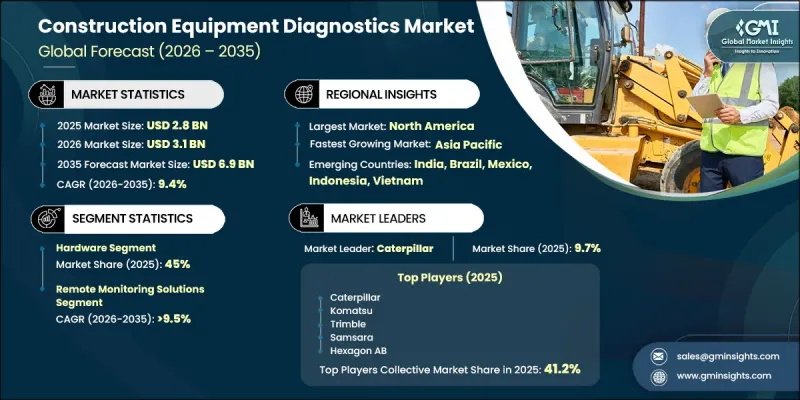
인프라 개발에 대한 투자 확대와 장비 성능 기준의 엄격화가 진행됨에 따라 건설사들은 보유 중인 모든 장비에 대해 첨단 진단 및 텔레매틱스 솔루션 도입을 촉진하고 있습니다. 규제 준수, 운영 효율성 및 장비 신뢰성에 대한 중요성이 커짐에 따라 OEM이 탑재하는 진단용 하드웨어, 클라우드 기반 차량 관리 플랫폼 및 지능형 모니터링 기술의 통합이 추진되고 있습니다. 동시에, 환경 규제의 강화와 장비 효율성에 대한 기대가 높아짐에 따라 사후 대응형 유지보수에서 실시간 모니터링에 기반한 예측 유지보수로의 전환이 가속화되고 있습니다. IoT 지원 센서 및 클라우드 연결의 도입 확대에 따라 건설 현장 전체에서 건설 기계의 가시성이 향상됨과 동시에, 예방적 유지보수 전략이 가능해졌습니다. 예기치 못한 건설 기계 고장, 프로젝트 지연, 긴급 수리에 따른 비용 증가 역시 자산 활용률을 높이고 업무 중단을 최소화하는 진단 기술에 대한 투자를 소유주들에게 촉진하는 요인이 되고 있습니다. 건설 회사가 예방 정비 및 데이터베이스 차량 관리를 점점 더 중시함에 따라 건설 기계 진단 시장은 예측 기간 중 지속적인 성장을 이룰 것으로 전망됩니다.
| 시장 범위 | |
|---|---|
| 시작연도 | 2025년 |
| 예측 기간 | 2026-2035년 |
| 초기 시장 규모 | 28억 달러 |
| 예측액 | 69억 달러 |
| CAGR | 9.4% |
하드웨어 부문은 2025년에 45%의 점유율을 차지하며, 2035년까지 연평균 성장률(CAGR) 8.3%를 기록할 것으로 예상됩니다. 이 부문은 중장비에 대한 센서, 제어 모듈, 통신 장비, 진단 부품의 통합이 진행되고 있으며, 계속해서 시장을 주도하고 있습니다. 이러한 하드웨어 요소들은 기계의 성능 모니터링, 운영 데이터 수집, 고도화된 진단 기능 지원에 필요한 기반을 제공하며, 신규 기계 생산 및 보유 기계의 현대화 노력 모두에서 필수적인 요소로 자리 잡고 있습니다.
원격 모니터링 솔루션 부문은 2025년에 35.1%의 시장 점유율을 차지하며, 2026-2035년 연평균 성장률(CAGR) 9.5%로 성장할 것으로 전망됩니다. 이 부문은 기계 상태에 대한 지속적인 모니터링, 고장의 조기 탐지, 효율적인 유지보수 계획 수립을 가능하게 함으로써 현대 장비 유지보수에서 계속해서 중요한 요소로 자리 잡고 있습니다. 장비 제어 모듈에 직접 연결된 진단 시스템은 신뢰할 수 있는 성능 데이터를 제공하는 동시에, 기존 및 신규 도입 건설 기계 플리트 모두에서 비용 효율적인 유지보수 업무를 지원합니다.
미국 건설기계 진단 시장은 2025년에 92.5%의 점유율을 차지하며 8억 달러의 시장 규모를 기록했습니다. 시장의 성장은 첨단 건설기계에 대한 활발한 수요, 커넥티드 기계의 보급, 그리고 디지털 차량 관리 기술에 대한 지속적인 투자에 힘입고 있습니다. 잘 구축된 텔레매틱스 생태계, 첨단 유지보수 인프라, 그리고 데이터베이스 자산 관리 솔루션의 도입 확대가 미국이 지역 시장에서 주도적인 위치를 계속 유지하는 요인이 되고 있습니다.
자주 묻는 질문
목차
제1장 조사 방법
제2장 개요
제3장 업계 인사이트
제4장 경쟁 구도
제5장 시장 추산·예측 : 컴포넌트별, 2022-2035년
제6장 시장 추산·예측 : 진단별, 2022-2035년
제7장 시장 추산·예측 : 장비별, 2022-2035년
제8장 시장 추산·예측 : 접속 방식별, 2022-2035년
제9장 시장 추산·예측 : 최종 용도별, 2022-2035년
제10장 시장 추산·예측 : 지역별, 2022-2035년
제11장 기업 개요
KSA 26.08.19The Global Construction Equipment Diagnostics Market was valued at USD 2.8 billion in 2025 and is estimated to grow at a CAGR of 9.4% to reach USD 6.9 billion by 2035.
Growing investments in infrastructure development and increasingly stringent equipment performance standards are encouraging construction companies to adopt advanced diagnostic and telematics solutions across their equipment fleets. Greater emphasis on regulatory compliance, operational efficiency, and equipment reliability is driving the integration of OEM-installed diagnostic hardware, cloud-based fleet management platforms, and intelligent monitoring technologies. At the same time, stricter environmental regulations and higher expectations for equipment efficiency are accelerating the transition from reactive maintenance to predictive diagnostics supported by real-time monitoring. Expanding deployment of IoT-enabled sensors and cloud connectivity is improving equipment visibility across construction sites while enabling proactive maintenance strategies. Rising costs associated with unexpected equipment failures, project delays, and emergency repairs are also motivating fleet owners to invest in diagnostic technologies that improve asset utilization and minimize operational disruptions. As construction companies increasingly prioritize preventive maintenance and data-driven fleet management, the construction equipment diagnostics market is expected to experience sustained growth throughout the forecast period.
| Market Scope | |
|---|---|
| Start Year | 2025 |
| Forecast Year | 2026-2035 |
| Start Value | $2.8 Billion |
| Forecast Value | $6.9 Billion |
| CAGR | 9.4% |
The hardware segment accounted for a 45% share in 2025 and is expected to register a CAGR of 8.3% through 2035. The segment continues to lead the market due to increasing integration of sensors, control modules, communication devices, and diagnostic components into heavy construction equipment. These hardware elements provide the essential infrastructure required for monitoring machine performance, collecting operational data, and supporting advanced diagnostic capabilities, making them indispensable across both new equipment production and fleet modernization initiatives.
The remote monitoring solutions segment held a 35.1% share in 2025 and is projected to grow at a CAGR of 9.5% from 2026 to 2035. The segment remains a key component of modern equipment maintenance by enabling continuous monitoring of machine health, early fault detection, and efficient maintenance planning. Diagnostic systems connected directly to equipment control modules provide reliable performance data while supporting cost-effective maintenance practices across both existing and newly deployed construction fleets.
United States Construction Equipment Diagnostics Market held a 92.5% share, generating USD 800 million in 2025. Market growth is supported by strong demand for advanced construction equipment, widespread adoption of connected machinery, and continued investment in digital fleet management technologies. A well-developed telematics ecosystem, advanced maintenance infrastructure, and increasing implementation of data-driven equipment management solutions continue to reinforce the country's leading position in the regional market.
Key players operating in the global construction equipment diagnostics market include Caterpillar Inc., CNH Industrial, Deere & Company, Hexagon AB, Hitachi Construction Machinery, Jaltest, Komatsu Ltd., TEXA S.p.A., Trimble Inc., and Volvo Construction Equipment. Companies operating in the construction equipment diagnostics market are strengthening their market position by investing in advanced telematics technologies, predictive maintenance platforms, and intelligent diagnostic solutions that improve equipment performance and fleet efficiency. Manufacturers are expanding research and development efforts to integrate artificial intelligence, IoT connectivity, cloud-based analytics, and real-time monitoring capabilities into their diagnostic systems. Strategic collaborations with construction companies, equipment manufacturers, and technology providers are helping businesses broaden their customer reach and accelerate solution adoption. Companies are also enhancing software functionality, expanding aftermarket support services, and developing scalable diagnostic platforms that support both new equipment and existing fleets.
Table of Contents
Chapter 1 Methodology
- 1.1 Research approach
- 1.2 Quality Commitments
- 1.2.1 GMI AI policy & data integrity commitment
- 1.2.1.1 Source consistency protocol
- 1.2.1 GMI AI policy & data integrity commitment
- 1.3 Research Trail & Confidence Scoring
- 1.3.1 Research Trail Components
- 1.3.2 Scoring Components
- 1.4 Data Collection
- 1.4.1 Partial list of primary sources
- 1.5 Data mining sources
- 1.5.1 Paid sources
- 1.5.1.1 Sources, by region
- 1.5.1 Paid sources
- 1.6 Base estimates and calculations
- 1.6.1 Base year calculation
- 1.7 Forecast Model
- 1.7.1 Quantified market impact analysis
- 1.7.1.1 Mathematical impact of growth parameters on forecast
- 1.7.1 Quantified market impact analysis
- 1.8 Research transparency addendum
- 1.8.1 Source attribution framework
- 1.8.2 Quality assurance metrics
- 1.8.3 Our commitment to trust
Chapter 2 Executive Summary
- 2.1 Industry 360° synopsis, 2022 – 2035
- 2.2 Key market trends
- 2.2.1 Regional
- 2.2.2 Component
- 2.2.3 Diagnostic
- 2.2.4 Equipment
- 2.2.5 Connectivity
- 2.2.6 End Use
- 2.3 TAM Analysis, 2026-2035
- 2.4 CXO perspectives: Strategic imperatives
Chapter 3 Industry Insights
- 3.1 Industry ecosystem analysis
- 3.1.1 Supplier landscape
- 3.1.2 Profit margin analysis
- 3.1.3 Cost structure
- 3.1.4 Value addition at each stage
- 3.1.5 Factor affecting the value chain
- 3.1.6 Disruptions
- 3.2 Industry impact forces
- 3.2.1 Growth drivers
- 3.2.1.1 Rising demand for predictive maintenance to reduce equipment downtime & project cost overruns
- 3.2.1.2 Stringent emission compliance regulations (Stage V, Tier 4 final) mandating diagnostic integration
- 3.2.1.3 Growing construction activity & fleet expansion in emerging economies
- 3.2.1.4 OEM push for factory-integrated telematics & aftermarket diagnostics ecosystems
- 3.2.2 Market Restraints
- 3.2.2.1 High initial investment & total cost of ownership concerns among SME contractors
- 3.2.2.2 Cybersecurity & data privacy risks in IoT-connected diagnostic systems
- 3.2.3 Market Opportunities
- 3.2.3.1 Rapid adoption of AI & edge computing for on-site real-time fault prediction
- 3.2.3.2 Expansion of equipment-as-a-service (EaaS) & subscription-based diagnostic models
- 3.2.3.3 Untapped retrofitting opportunity in aging legacy fleet base across developing markets
- 3.2.3.4 Integration of diagnostics with bim & smart construction site management platforms
- 3.2.1 Growth drivers
- 3.3 Growth potential analysis
- 3.4 Technology and Innovation landscape
- 3.4.1 Current technological trends
- 3.4.2 Emerging technologies
- 3.5 Pricing Analysis (Driven by Primary Research)
- 3.5.1 Historical Price Trend Analysis
- 3.5.2 Pricing Strategy by Player Type (Premium / Value / Cost-plus)
- 3.6 Regulatory landscape
- 3.6.1 North America
- 3.6.1.1 U.S.: EPA Tier 4 Final Non-Road Emission Standards & OSHA Equipment Safety and Inspection Standards
- 3.6.1.2 Canada: Transport Canada Off-Road Equipment Emission Regulations & Provincial Workplace Equipment Safety Guidelines
- 3.6.2 Europe
- 3.6.2.1 Germany: EU Stage V Emission Standards & German Federal Emission Control Act (BImSchG)
- 3.6.2.2 UK: Non-Road Mobile Machinery (NRMM) Regulations & Health and Safety Executive (HSE) Equipment Standards
- 3.6.2.3 France: EU Machinery Regulation 2023/1230 & French Environmental Code Equipment Emission Requirements
- 3.6.2.4 Italy: EU Stage V Compliance & Codice della Strada Equipment Operational Regulations
- 3.6.3 Asia Pacific
- 3.6.3.1 China: China Stage IV Non-Road Emission Standards & China Compulsory Certification (CCC)
- 3.6.3.2 India: Bharat CEV Stage IV/V Non-Road Emission Standards & FAME III/PM E-DRIVE Incentive Scheme
- 3.6.3.3 Japan: Japan Off-Road Emission Regulations & JCMA Telematics Data Standard (ISO/TS 15143-4)
- 3.6.3.4 South Korea: Korea Off-Road Emission Standards & KCs Certification for Construction Machinery Electronics
- 3.6.3.5 Australia: Australian Non-Road Diesel Emission Standards & State/Territory Equipment Safety Regulations
- 3.6.4 Latin America
- 3.6.4.1 Brazil: CONAMA Diesel Emission Resolutions & INMETRO Equipment Certification
- 3.6.4.2 Mexico: NOM Safety and Emission Standards for Industrial Machinery
- 3.6.4.3 Argentina: National Road Safety Agency (ANSV) Heavy Equipment Operating Guidelines
- 3.6.5 MEA
- 3.6.5.1 UAE: UAE Municipal Construction Equipment Standards & MOHAP Occupational Safety Frameworks
- 3.6.5.2 Saudi Arabia: SASO Equipment Certification Standards & Vision 2030 Compliance Requirements
- 3.6.5.3 South Africa: National Regulator for Compulsory Specifications (NRCS) Machinery Safety Standards & SABS Equipment Certification
- 3.6.1 North America
- 3.7 Porter’s analysis
- 3.8 PESTEL analysis
- 3.9 Patent Landscape (Driven by Primary Research)
- 3.10 Impact of AI & Generative AI on the Market (Driven by Primary Research)
- 3.10.1 AI-driven disruption of existing business models
- 3.10.2 GenAI use cases & adoption roadmap by segment
- 3.10.3 Risks, limitations & regulatory considerations
- 3.11 Electrification & alternative propulsion impact
- 3.11.1 Diagnostics requirements for battery-electric & hybrid equipment
- 3.11.2 Battery health monitoring as an emerging diagnostics sub-segment
- 3.11.3 OEM roadmap for electrified fleet diagnostics
- 3.12 Sustainability & ESG impact analysis
- 3.12.1 Role of diagnostics in emissions reduction & compliance reporting
- 3.12.2 Fuel efficiency & carbon footprint optimization through predictive maintenance
- 3.12.3 ESG reporting requirements driving diagnostics adoption
- 3.13 Forecast assumptions & scenario analysis (Driven by Primary Research)
- 3.13.1 Base Case - Key Macro & Industry Variables Driving CAGR
- 3.13.2 Optimistic Scenarios - Favourable macro and industry tailwinds
- 3.13.3 Pessimistic Scenario - Macroeconomic slowdown or industry headwinds
Chapter 4 Competitive Landscape, 2025
- 4.1 Introduction
- 4.2 Company market share analysis
- 4.2.1 North America
- 4.2.2 Europe
- 4.2.3 Asia Pacific
- 4.2.4 Latin America
- 4.2.5 MEA
- 4.3 Competitive analysis of major market players
- 4.4 Competitive positioning matrix
- 4.5 Key developments
- 4.5.1 Mergers & acquisitions
- 4.5.2 Partnerships & collaborations
- 4.5.3 New product launches
- 4.5.4 Expansion plans and funding
- 4.6 Company Tier Benchmarking
- 4.6.1 Tier classification criteria & qualifying thresholds
- 4.6.2 Tier positioning matrix by revenue, geography & innovation
Chapter 5 Market Estimates & Forecast, By Component, 2022 - 2035 ($Bn, Units)
- 5.1 Key trends
- 5.2 Hardware
- 5.2.1 Sensors
- 5.2.2 Telematics devices
- 5.2.3 Control units
- 5.2.4 Display & interface units
- 5.2.5 Others
- 5.3 Software
- 5.4 Services
- 5.4.1 Professional services
- 5.4.2 Managed services
Chapter 6 Market Estimates & Forecast, By Diagnostic, 2022 - 2035 ($Bn)
- 6.1 Key trends
- 6.2 Onboard diagnostics (OBD)
- 6.3 Remote monitoring solutions
- 6.4 Predictive diagnostics
- 6.5 Real-time performance tracking
Chapter 7 Market Estimates & Forecast, By Equipment, 2022 - 2035 ($Bn)
- 7.1 Key trends
- 7.2 Earthmoving equipment
- 7.2.1 Onboard diagnostics (OBD)
- 7.2.2 Remote monitoring solutions
- 7.2.3 Predictive diagnostics
- 7.2.4 Real-time performance tracking
- 7.3 Material handling equipment
- 7.3.1 Onboard diagnostics (OBD)
- 7.3.2 Remote monitoring solutions
- 7.3.3 Predictive diagnostics
- 7.3.4 Real-time performance tracking
- 7.4 Road construction equipment
- 7.4.1 Onboard diagnostics (OBD)
- 7.4.2 Remote monitoring solutions
- 7.4.3 Predictive diagnostics
- 7.4.4 Real-time performance tracking
- 7.5 Concrete equipment
- 7.5.1 Onboard diagnostics (OBD)
- 7.5.2 Remote monitoring solutions
- 7.5.3 Predictive diagnostics
- 7.5.4 Real-time performance tracking
Chapter 8 Market Estimates & Forecast, By Connectivity, 2022 – 2035 ($Bn)
- 8.1 Key trends
- 8.2 Wired
- 8.3 Wireless
Chapter 9 Market Estimates & Forecast, By End Use, 2022 – 2035 ($Bn)
- 9.1 Key trends
- 9.2 Construction contractors
- 9.3 Equipment rental companies
- 9.4 OEMs
- 9.5 Fleet management providers
Chapter 10 Market Estimates & Forecast, By Region, 2022 - 2035 ($Bn, Units)
- 10.1 Key trends
- 10.2 North America
- 10.2.1 US
- 10.2.2 Canada
- 10.3 Europe
- 10.3.1 Germany
- 10.3.2 UK
- 10.3.3 France
- 10.3.4 Italy
- 10.3.5 Spain
- 10.3.6 Russia
- 10.3.7 Belgium
- 10.3.8 Netherlands
- 10.3.9 Sweden
- 10.4 Asia Pacific
- 10.4.1 China
- 10.4.2 India
- 10.4.3 Japan
- 10.4.4 ANZ
- 10.4.5 South Korea
- 10.4.6 Indonesia
- 10.4.7 Thailand
- 10.4.8 Vietnam
- 10.5 Latin America
- 10.5.1 Brazil
- 10.5.2 Mexico
- 10.5.3 Argentina
- 10.6 MEA
- 10.6.1 South Africa
- 10.6.2 Saudi Arabia
- 10.6.3 UAE
Chapter 11 Company Profiles
- 11.1 Global Players
- 11.1.1 Caterpillar Inc.
- 11.1.2 Komatsu Ltd.
- 11.1.3 Volvo Construction Equipment
- 11.1.4 Deere & Company
- 11.1.5 CNH Industrial
- 11.1.6 Hitachi Construction Machinery
- 11.1.7 Trimble Inc.
- 11.1.8 Hexagon AB
- 11.1.9 TEXA S.p.A.
- 11.1.10 Jaltest
- 11.2 Regional Players
- 11.2.1 JCB
- 11.2.2 HD Hyundai Construction Equipment
- 11.2.3 Doosan Bobcat
- 11.2.4 SANY Heavy Industry
- 11.2.5 XCMG Group
- 11.2.6 ACTIA Group
- 11.2.7 Proemion
- 11.2.8 Samsara
- 11.2.9 CalAmp
- 11.2.10 ORBCOMM


