
|
시장보고서
상품코드
2109273
펄프 성형기 시장 : 시장 비즈니스 기회, 성장요인, 업계 동향 분석 및 예측(2026-2035년)Pulp Molding Machine Market Opportunity, Growth Drivers, Industry Trend Analysis, and Forecast 2026 - 2035 |
||||||

세계의 펄프 성형기 시장은 2025년에 9억 500만 달러 규모로 평가되었고, 2035년까지 연평균 복합 성장률(CAGR) 6.5%로 성장할 전망이며, 17억 2,000만 달러에 이를 것으로 예측됩니다.
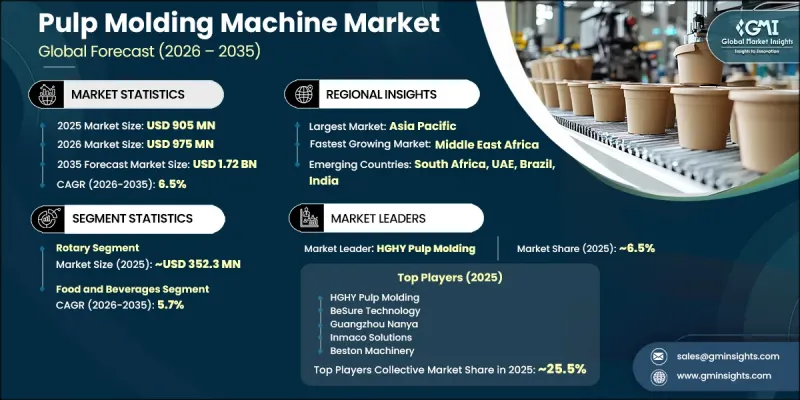
제조업체, 소매업체, 소비자 사이에서 지속가능성을 중시하는 포장 방식의 중요성이 높아짐에 따라 이 시장은 성장세를 보이고 있습니다. 특히 선진국의 젊은 소비자층을 중심으로 친환경 포장 솔루션에 대한 수요가 증가하고 있는 것이 각 브랜드의 펄프 성형 제품 채택을 촉진하고 있습니다. 소비재(FMCG) 부문의 기업들은 포장 지속가능성에 관한 목표를 잇달아 수립하고 있으며, 섬유 기반 소재로의 전환이 가속화되고 있습니다. 또한, 전자상거래의 지속적인 확대도 운송 중 제품 보호에 사용되는 성형 펄프 포장 솔루션에 대한 수요를 뒷받침하고 있습니다. 기업들은 제품의 안전성을 유지하면서 환경 성능을 향상시키기 위해 기존의 보호재를 재활용 가능한 섬유 기반 소재로 대체하고 있습니다. 게다가 제조업체들이 생산성, 균일성 및 포장 품질 향상을 추구하는 가운데, 업계에서는 자동 펄프 성형 시스템의 도입이 가속화되고 있습니다. 첨단 열성형 기술을 통해 생산자는 더 우수한 표면 품질, 정확한 치수 및 제품 성능 향상을 실현하여 프리미엄 용도에 대응할 수 있게 되었으며, 여러 최종 이용 산업에서 새로운 기회가 창출되고 있습니다.
| 시장 범위 | |
|---|---|
| 개시 연도 | 2025년 |
| 예측 기간 | 2026-2035년 |
| 초기 시장 규모 | 9억 500만 달러 |
| 예측액 | 17억 2,000만 달러 |
| CAGR | 6.5% |
로터리 펄프 성형기 부문은 2025년에 3억 5,230만 달러 시장 규모를 기록한 것으로 평가되었으며, 2026-2035년 연평균 성장률(CAGR) 5.4%로 성장할 것으로 전망됩니다. 이 부문의 성장은 기존 섬유 포장 솔루션에 비해 외관, 강도, 치수 정밀도가 향상된 고품질 성형 섬유 제품에 대한 수요 증가에 힘입고 있습니다. 각 제조업체가 고품질의 마감과 일관된 생산 기준을 요구하는 포장 용도로 전환함에 따라, 첨단 로터리 시스템의 도입이 확대되고 있습니다. 이러한 기계들은 특수 제품에 대한 성능 요건을 유지하면서도 기존 포장재를 대체할 대안을 모색하는 업계에서 점점 더 중요해지고 있습니다.
식품 및 음료 부문은 2025년에 43.14%의 점유율을 차지한 것으로 평가되었으며, 2026-2035년 연평균 성장률(CAGR) 5.7%로 성장할 것으로 전망됩니다. 이 부문 수요는 포장 식품 소비 증가와 지속 가능한 식품 포장 솔루션의 채택 확대에 힘입어 뒷받침되고 있습니다. 개발도상 지역에서의 상업적 식품 생산 활동 확대는 성형 펄프 포장 설비에 대한 투자를 촉진하고 있습니다. 또한, 외식 산업에서 친환경 포장 형태로의 전환에 따라 다양한 제공 요건을 충족할 수 있는 내구성, 기능성, 고품질을 겸비한 섬유 제품을 생산할 수 있는 첨단 펄프 성형 라인에 대한 수요가 발생하고 있습니다.
북미의 펄프 성형기 시장은 2025년에 18%의 점유율을 차지했습니다. 이 지역 시장 성장은 견고한 포장 제조 인프라와 플라스틱 폐기물 감축을 위한 규제 강화에 힘입고 있습니다. 기업들이 변화하는 지속가능성 요건과 소비자의 기대에 부응함에 따라, 각 제조업체들은 섬유 기반 포장 기술의 도입을 확대되고 있습니다.
자주 묻는 질문
목차
제1장 조사 방법 및 범위
제2장 주요 요약
제3장 업계 인사이트
제4장 경쟁 구도
제5장 시장 추산 및 예측 : 기계 유형별(2022-2035년)
제6장 시장 추산 및 예측 : 제품 유형별(2022-2035년)
제7장 시장 추산 및 예측 : 용도별(2022-2035년)
제8장 시장 추산 및 예측 : 최종 사용자 산업별(2022-2035년)
제9장 시장 추산 및 예측 : 유통 채널별(2022-2035년)
제10장 시장 추산 및 예측 : 지역별(2022-2035년)
제11장 기업 개요
AJY 26.08.18The Global Pulp Molding Machine Market was valued at USD 905 million in 2025 and is estimated to grow at a CAGR of 6.5% to reach USD 1.72 billion by 2035.
The market is gaining momentum as sustainability-focused packaging practices become increasingly important among manufacturers, retailers, and consumers. Growing preference for environmentally responsible packaging solutions, especially among younger consumer groups in developed markets, is encouraging brands to adopt molded fiber alternatives. Companies across the fast-moving consumer goods sector are increasingly establishing packaging sustainability objectives, accelerating the shift toward fiber-based materials. The continued expansion of e-commerce is also supporting demand for molded fiber packaging solutions used for product protection during transportation. Businesses are replacing conventional protective materials with recyclable fiber-based options to improve environmental performance while maintaining product safety. In addition, the industry is witnessing faster adoption of automated pulp molding systems as manufacturers seek improved productivity, consistency, and packaging quality. Advanced thermoforming technologies are enabling producers to serve premium applications by delivering better surface quality, precise dimensions, and enhanced product performance, creating new opportunities across multiple end-use industries.
| Market Scope | |
|---|---|
| Start Year | 2025 |
| Forecast Year | 2026-2035 |
| Start Value | $905 Million |
| Forecast Value | $1.72 Billion |
| CAGR | 6.5% |
Rotary pulp molding machines segment generated USD 352.3 million in 2025 and is expected to grow at a CAGR of 5.4% between 2026 and 2035. Growth in this segment is supported by increasing demand for high-quality molded fiber products that offer improved appearance, strength, and dimensional accuracy compared with traditional fiber packaging solutions. The adoption of advanced rotary systems is increasing as manufacturers move toward packaging applications requiring premium finishes and consistent production standards. These machines are becoming increasingly important for industries seeking alternatives to conventional packaging materials while maintaining performance requirements for specialized products.
The food and beverages segment held a 43.14% share in 2025 and is projected to grow at a CAGR of 5.7% from 2026 to 2035. Demand within this segment is supported by rising consumption of packaged food products and increasing adoption of sustainable food packaging solutions. Growing commercial food production activities across developing regions are encouraging investment in molded fiber packaging equipment. In addition, the transition toward environmentally friendly packaging formats in food service applications is creating demand for advanced pulp molding lines capable of producing durable, functional, and high-quality fiber products for various serving requirements.
North America Pulp Molding Machine Market captured an 18% share in 2025. The region's market growth is supported by its strong packaging manufacturing infrastructure and increasing regulatory focus on reducing plastic waste. Manufacturers are expanding their adoption of fiber-based packaging technologies as businesses respond to changing sustainability requirements and consumer expectations.
Major players operating in the global pulp molding machine industry are Kiefel GmbH, Hartmann Packaging A/S, ANDRITZ AG, BeSure Technology Co., Ltd., HGHY Pulp Molding Pack Co., Ltd., Guangzhou Nanya Pulp Molding Equipment Co., Ltd., DKM Machine Manufacturing Inc., Inmaco Solutions B.V., Beston (Henan) Machinery Co., Ltd., Taiwan Pulp Moulding Co., Ltd., SODALTECH, Southern Pulp Machinery, EAMC, Hunan Shuanghuan Fiber Molding Machinery Co., Ltd., Maspack Limited, PulPac AB, Aviridi Inc., Ecosure Pulpmolding Technologies Pvt. Ltd., Yangi AB, Acorn Industry Co., Ltd., and Qingdao Perfect Equipment & Parts Co., Ltd. Companies operating in the pulp molding machine market are strengthening their competitive position through technology development, automation upgrades, regional expansion, and strategic partnerships. Manufacturers are focusing on improving machine efficiency, production capacity, and product quality to address rising demand for sustainable packaging solutions. Companies are investing in advanced forming technologies, energy-efficient equipment designs, and customized solutions to serve diverse industries. Expansion of distribution networks and stronger customer support services are helping businesses improve market penetration across developed and emerging regions.
Table of Contents
Chapter 1 Methodology & Scope
- 1.1 Market scope and definition
- 1.2 Research design
- 1.2.1 Research approach
- 1.2.2 Data collection methods
- 1.3 Data mining sources
- 1.3.1 Global
- 1.3.2 Regional/Country
- 1.4 Base estimates and calculations
- 1.4.1 Base year calculation
- 1.4.2 Key trends for market estimation
- 1.5 Primary research and validation
- 1.5.1 Primary sources
- 1.6 Forecast model
- 1.7 Research assumptions and limitations
Chapter 2 Executive Summary
- 2.1 Industry 360° synopsis
- 2.2 Key market trends
- 2.2.1 Region
- 2.2.2 Machine Type
- 2.2.3 Product Type
- 2.2.4 Application
- 2.2.5 End-user Industry
- 2.2.6 Distribution channel
Chapter 3 Industry Insights
- 3.1 Industry ecosystem analysis
- 3.1.1 Supplier landscape
- 3.1.2 Profit margin
- 3.1.3 Value addition at each stage
- 3.1.4 Factor affecting the value chain
- 3.2 Industry impact forces
- 3.2.1 Growth drivers
- 3.2.1.1 Surge in global plastic bans & regulatory mandates driving shift to molded pulp packaging
- 3.2.1.2 Rapid growth of e-commerce & food delivery services accelerating packaging demand
- 3.2.1.3 Rising consumer preference for eco-friendly & biodegradable packaging solutions
- 3.2.1.4 Expanding electronics & consumer goods industries requiring protective fiber packaging
- 3.2.2 Industry pitfalls & challenges
- 3.2.2.1 High initial capital investment & long payback periods for fully automatic lines
- 3.2.2.2 Design limitations of molded pulp products vs. Plastic in aesthetic & complex geometries
- 3.2.2.3 Significant water consumption in pulp molding processes raising sustainability concerns
- 3.2.3 Opportunities
- 3.2.3.1 Premiumization of molded pulp products opening market for thermoforming machine segment
- 3.2.3.2 Emerging economies in southeast asia & africa representing greenfield machine investment opportunities
- 3.2.1 Growth drivers
- 3.3 Growth potential analysis
- 3.4 Supply Chain Analysis
- 3.4.1 Upstream: Raw Material Sourcing & Pulp Supply Dynamics
- 3.4.2 Midstream: Machine Component Manufacturing & Assembly
- 3.4.3 Downstream: Distribution Channels & After-Sales Service Network
- 3.4.4 Supply Chain Disruption Risks & Mitigation Strategies
- 3.5 Future market trends
- 3.6 Technology and innovation landscape
- 3.6.1 Current technological trends
- 3.6.2 Emerging technologies
- 3.7 Regulatory landscape
- 3.7.1 Global Plastic Ban & Single-Use Plastic Regulations
- 3.7.2 Food-Contact Material Safety Standards (FDA, EFSA, REACH)
- 3.7.3 VOC Emission & Energy Efficiency Standards for Industrial Machinery
- 3.7.4 Regional Environmental Compliance Requirements (EU, North America, Asia Pacific)
- 3.8 Trade data analysis
- 3.8.1 Import/Export Volume & Value Trends (HS Code 8477 - Pulp Molding Machinery)
- 3.8.2 Key Trade Corridors & Tariff Impact (China, Europe, North America Flows)
- 3.9 Impact of AI & generative AI on the market
- 3.9.1 AI-Driven Disruption of Existing Pulp Molding Machine Business Models
- 3.9.2 GenAI Use Cases & Adoption Roadmap by Segment (Predictive Maintenance, Mold Design, Process Optimization)
- 3.9.3 Risks, Limitations & Regulatory Considerations
- 3.10 Pricing Analysis
- 3.10.1 Historical Price Trend Analysis by Machine Type (2019-2024) (Driven by Primary Research)
- 3.10.2 Pricing Strategy by Player Type (Premium / Value / Cost-plus) (Driven by Primary Research)
- 3.11 Porter's analysis
- 3.12 PESTEL analysis
- 3.13 Consumer Behavior Analysis
Chapter 4 Competitive Landscape, 2025
- 4.1 Introduction
- 4.2 Company market share analysis
- 4.3 Company matrix analysis
- 4.4 Competitive analysis of major market players
- 4.5 Competitive positioning matrix
- 4.6 Key developments
- 4.6.1 Mergers & acquisitions
- 4.6.2 Partnerships & collaborations
- 4.6.3 New product launches
- 4.6.4 Expansion plans
Chapter 5 Market Estimates & Forecast, By Machine Type, 2022 - 2035, (USD Million) (Thousand Units)
- 5.1 Key Trends
- 5.2 Fully Automatic Pulp Molding Machines
- 5.2.1 High-Speed Fully Automatic Lines (>2,000 pcs/hr)
- 5.2.2 Standard Fully Automatic Lines
- 5.3 Semi-Automatic Pulp Molding Machines
- 5.3.1 Semi-Automatic with Integrated Hot Press
- 5.3.2 Semi-Automatic with Separate Drying
- 5.4 Manual Pulp Molding Machines
- 5.4.1 Small-Scale / Entry-Level Manual Machines
- 5.4.2 Artisanal & Niche Application Manual Machines
Chapter 6 Market Estimates & Forecast, By Product Type, 2022 - 2035, (USD Million) (Thousand Units)
- 6.1 Key Trends
- 6.2 Rotary Pulp Molding Machines
- 6.2.1 4-Side Rotary Machines
- 6.2.2 8-Side Rotary Machines
- 6.2.3 Multi-Side High-Speed Rotary Machines
- 6.3 Reciprocating Pulp Molding Machines
- 6.3.1 Standard Reciprocating Machines
- 6.3.2 Precision Reciprocating Machines (Complex Shapes)
- 6.4 Thermoforming Pulp Molding Machines
- 6.4.1 Integrated Thermoforming Lines (Forming + Hot Press in Single Unit)
- 6.4.2 Standalone Thermoforming Presses (Post-Processing)
Chapter 7 Market Estimates & Forecast, By Application, 2022 - 2035, (USD Million) (Thousand Units)
- 7.1 Key Trends
- 7.2 Trays (Egg Trays, Fruit Trays, Beverage Trays)
- 7.2.1 Egg Trays & Cartons
- 7.2.2 Fruit & Vegetable Protective Trays
- 7.2.3 Beverage & Bottle Trays
- 7.3 End Caps & Protective Inserts
- 7.3.1 Electronics Protective Inserts
- 7.3.2 Industrial Component End Caps
- 7.4 Cups, Bowls & Plates
- 7.4.1 Disposable Food Service Cups & Bowls
- 7.4.2 Disposable Plates & Platters
- 7.5 Clamshells & Containers
- 7.5.1 Takeaway Food Clamshells
- 7.5.2 Consumer Goods Retail Containers
- 7.6 Custom & Industrial Packaging
- 7.6.1 Automotive Component Packaging
- 7.6.2 Medical Device Trays & Packaging
- 7.6.3 Cosmetics & Personal Care Packaging
- 7.7 Others (Agricultural, E-commerce, Emerging Applications)
Chapter 8 Market Estimates & Forecast, By End-user Industry, 2022 - 2035, (USD Million) (Thousand Units)
- 8.1 Key Trends
- 8.2 Food & Beverage
- 8.2.1 Egg Processing & Poultry Packaging
- 8.2.2 Fresh Produce & Fruit Packaging
- 8.2.3 Food Service & Quick Service Restaurants (QSR)
- 8.2.4 Bakery & Dairy Packaging
- 8.3 Electronics & Electrical
- 8.3.1 Consumer Electronics Packaging
- 8.3.2 Industrial & Electrical Component Packaging
- 8.4 Healthcare & Pharmaceuticals
- 8.4.1 Medical Device Trays
- 8.4.2 Pharmaceutical & Diagnostic Product Packaging
- 8.5 Consumer Goods & Cosmetics
- 8.5.1 Personal Care & Beauty Product Packaging
- 8.5.2 Household Goods Packaging
- 8.6 Industrial & Automotive
- 8.6.1 Automotive Parts Protective Packaging
- 8.6.2 Heavy-Duty Industrial Packaging
- 8.7 Others (Agriculture, E-commerce, Specialty)
Chapter 9 Market Estimates & Forecast, By Distribution Channel, 2022 - 2035, (USD Million) (Thousand Units)
- 9.1 Key Trends
- 9.2 Direct
- 9.3 Indirect
Chapter 10 Market Estimates & Forecast, By Region, 2022 - 2035, (USD Million) (Thousand Units)
- 10.1 Key Trends
- 10.2 North America
- 10.2.1 U.S.
- 10.2.2 Canada
- 10.3 Europe
- 10.3.1 Germany
- 10.3.2 France
- 10.3.3 UK
- 10.3.4 Italy
- 10.3.5 Spain
- 10.4 Asia Pacific
- 10.4.1 China
- 10.4.2 Japan
- 10.4.3 India
- 10.4.4 Australia
- 10.4.5 South Korea
- 10.5 Latin America
- 10.5.1 Brazil
- 10.5.2 Mexico
- 10.5.3 Argentina
- 10.6 MEA
- 10.6.1 Saudi Arabia
- 10.6.2 UAE
- 10.6.3 South Africa
Chapter 11 Company Profiles
- 11.1 Global Players
- 11.1.1 Hartmann Packaging A/S
- 11.1.2 BeSure Technology Co., Ltd.
- 11.1.3 HGHY Pulp Molding Pack Co., Ltd.
- 11.1.4 Guangzhou Nanya Pulp Molding Equipment Co., Ltd.
- 11.1.5 DKM Machine Manufacturing Inc.
- 11.1.6 Inmaco Solutions B.V.
- 11.1.7 Kiefel GmbH
- 11.2 Regional Players
- 11.2.1 Beston (Henan) Machinery Co., Ltd.
- 11.2.2 Taiwan Pulp Moulding Co., Ltd.
- 11.2.3 SODALTECH
- 11.2.4 Southern Pulp Machinery
- 11.2.5 EAMC
- 11.2.6 Hunan Shuanghuan Fiber Molding Machinery Co., Ltd.
- 11.2.7 Maspack Limited
- 11.3 Emerging Players
- 11.3.1 PulPac AB
- 11.3.2 ANDRITZ AG
- 11.3.3 Aviridi Inc.
- 11.3.4 Ecosure Pulpmolding Technologies Pvt. Ltd.
- 11.3.5 Yangi AB
- 11.3.6 Acorn Industry Co., Ltd.
- 11.3.7 Qingdao Perfect Equipment & Parts Co., Ltd.