|
시장보고서
상품코드
2109313
항공기용 와이어 및 케이블 시장 : 기회, 성장요인, 업계 동향 분석 및 예측(2026-2035년)Aircraft Wire and Cable Market Opportunity, Growth Drivers, Industry Trend Analysis, and Forecast 2026 - 2035 |
||||||

세계의 항공기용 와이어 및 케이블 시장은 2025년에 19억 달러 규모가 되어, CAGR 6.1%로 성장하여 2035년까지 34억 달러에 이를 것으로 추정되고 있습니다.
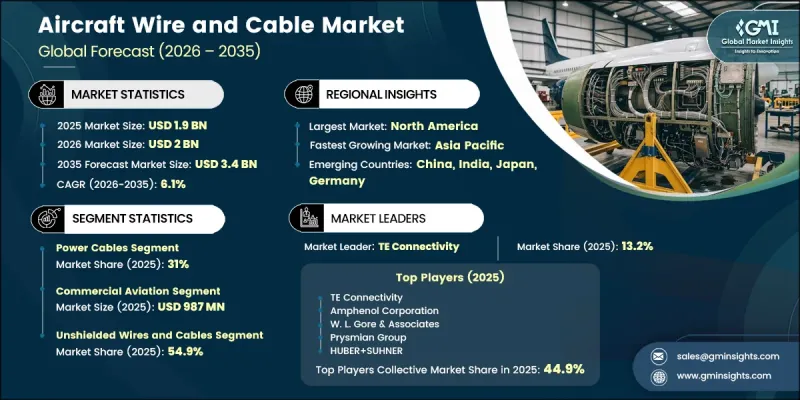
항공기용 와이어 및 케이블 시장의 성장은 항공기 생산 증가, 지속적인 기체 수 확대, 그리고 차세대 항공우주 기술에 대한 투자 확대에 힘입고 있습니다. 항공기 제조업체들이 기내 전기 시스템 강화와 운영 효율 향상을 지속함에 따라, 업계에서는 첨단 전기 연결 솔루션에 대한 수요가 높아지고 있습니다. '모어 일렉트릭 에어크래프트(MEA)' 플랫폼의 채택 확대, 첨단 항공전자 장비 통합의 진전, 그리고 선진적인 기내 통신 기술의 도입 증가로 인해 고성능 와이어 및 케이블 솔루션에 대한 지속적인 수요가 발생하고 있습니다. 또한, 전기 배선 상호 연결 시스템(EWIS)을 규정하는 항공 안전 요건의 발전으로 인해 항공기 배선 인프라의 정기적인 점검, 교체 및 현대화가 촉진되고 있습니다. 진행 중인 개조 프로그램과 기체 군 현대화 이니셔티브는 항공기의 신뢰성, 전기적 성능 및 장기적인 운항 안전성을 향상시킴으로써 시장 확대를 더욱 가속화하고 있습니다. 경량 소재, 전기적 효율 향상 및 내구성이 뛰어난 절연 기술에 대한 관심이 높아짐에 따라, 첨단 항공우주용 배선 솔루션의 채택이 지속적으로 확대되고 있으며, 이는 전 세계 항공기용 와이어 및 케이블 산업 전반의 장기적인 성장을 뒷받침하고 있습니다.
| 시장 범위 | |
|---|---|
| 시작 연도 | 2025년 |
| 예측 기간 | 2026-2035년 |
| 초기 시장 규모 | 19억 달러 |
| 예측 시장 규모 | 34억 달러 |
| CAGR | 6.1% |
항공기용 와이어 및 케이블 업계는 더욱 전동화된 항공기(MEA) 및 하이브리드 전기 추진 기술로의 전환이 진행됨에 따라 계속해서 혜택을 받고 있습니다. 항공기 시스템의 전동화가 진행됨에 따라, 각 제조업체들은 가혹한 운용 조건 하에서도 신뢰성을 유지하면서 더 높은 전기 효율을 실현할 수 있는 경량 고전압 배선 솔루션을 필요로 하고 있습니다. 기존의 기계식 동력 시스템에서 전기 구동식으로의 전환이 진행됨에 따라, 절연 성능 향상과 경량화를 실현한 첨단 케이블에 대한 수요가 높아지고 있습니다. 동시에, 엄격한 EWIS(항공기 배선 시스템) 적합성 요건은 항공기의 전체 수명 주기 동안 지속적인 비행 적합성과 규제 준수를 보장하기 위해 항공기 배선 시스템의 정기적인 유지보수, 점검, 수리 및 교체를 촉진하며, 시장의 성장을 지속적으로 뒷받침하고 있습니다.
2025년에는 전력 케이블 부문이 31%의 점유율을 차지하며 최대 제품 카테고리가 되었습니다. 이 부문이 주도적인 위치를 유지하고 있는 이유는 전력 케이블이 현대 항공기 전체에 전력을 분배하는 데 필수적일 뿐만 아니라, 기내 시스템의 전기화가 진행됨에 따라 그 기반을 뒷받침하고 있기 때문입니다. 전기화된 항공기 기술의 도입이 확대됨에 따라, 전기 효율을 향상시키면서 항공기 전체의 중량을 경감시키는 경량·고전압·내고온 케이블 솔루션에 대한 수요는 계속해서 증가하고 있습니다. 진행 중인 기체 현대화 노력과 점점 더 엄격해지는 항공 안전 기준으로 인해, 신조 항공기 및 개조 프로그램 모두에서 수요가 지속될 것으로 예측됩니다.
2025년, 민간 항공 부문 시장 규모는 9억 8,700만 달러에 달했습니다. 이 부문의 지속적인 성장은 효율적인 전력 전송을 가능하게 하고 기내의 중요한 기능을 뒷받침하는 신뢰성 높은 전기 배선 시스템에 대한 수요 증가에 힘입은 것입니다. 전 세계 항공 여행의 확대, 항공기 인도 대수 증가, 진행 중인 기단 확대, 그리고 ‘모어 일렉트릭(More Electric)’ 항공기 기술에 대한 투자 확대에 힘입어 첨단 항공기용 와이어 및 케이블 제품에 대한 수요는 계속해서 강세를 보이고 있습니다. 항공기 전기 아키텍처의 지속적인 발전 또한 예측 기간 동안 시장의 지속적인 성장에 더욱 기여하고 있습니다.
2025년, 북미 항공기용 와이어 및 케이블 시장은 35.1%의 점유율을 차지했습니다. 지역별 시장 성장은 민간 항공기 생산 증가, 진행 중인 국방 분야의 현대화 노력, 그리고 ‘모어 일렉트릭(More Electric)’ 항공기 기술의 도입 가속화에 의해 주도되고 있습니다. 경량이며 고성능인 전기 연결 솔루션에 대한 수요 증가와 더불어, 첨단 항공전자 장비 및 차세대 항공기 전기 시스템의 지속적인 통합이 민간 및 방위 항공 부문 모두에서 시장 확장을 뒷받침하고 있습니다. 항공우주 분야의 혁신과 항공기 현대화에 대한 지속적인 투자가 해당 지역 시장의 선도적 지위를 더욱 공고히 하고 있습니다.
자주 묻는 질문
목차
제1장 조사 방법과 범위
제2장 주요 요약
제3장 업계 인사이트
제4장 경쟁 구도
제5장 시장 추산 및 예측 : 유형별, 2022-2035년
제6장 시장 추산 및 예측 : 항공기 유형별, 2022-2035년
제7장 시장 추산 및 예측 : 용도별, 2022-2035년
제8장 시장 추산 및 예측 : 최종 사용자별, 2022-2035년
제9장 시장 추산 및 예측 : 지역별, 2022-2035년
제10장 기업 개요
JHS 26.08.18The Global Aircraft Wire and Cable Market was valued at USD 1.9 billion in 2025 and is estimated to grow at a CAGR of 6.1% to reach USD 3.4 billion by 2035.
Growth in the aircraft wire & cable market is supported by increasing aircraft production, continuous fleet expansion, and rising investments in next-generation aerospace technologies. The industry is witnessing greater demand for advanced electrical interconnection solutions as aircraft manufacturers continue to enhance onboard electrical systems and improve operational efficiency. Growing adoption of more-electric aircraft (MEA) platforms, expanding integration of sophisticated avionics, and increasing installation of advanced in-flight communication technologies are creating sustained demand for high-performance wire and cable solutions. In addition, evolving aviation safety requirements governing electrical wiring interconnection systems (EWIS) are encouraging regular inspection, replacement, and modernization of aircraft wiring infrastructure. Ongoing retrofit programs and fleet modernization initiatives are further accelerating market expansion by improving aircraft reliability, electrical performance, and long-term operational safety. Increasing emphasis on lightweight materials, enhanced electrical efficiency, and durable insulation technologies continues to strengthen the adoption of advanced aerospace wiring solutions, supporting long-term growth across the global aircraft wire and cable industry.
| Market Scope | |
|---|---|
| Start Year | 2025 |
| Forecast Year | 2026-2035 |
| Start Value | $1.9 Billion |
| Forecast Value | $3.4 Billion |
| CAGR | 6.1% |
The aircraft wire and cable industry continues to benefit from the growing transition toward more-electric aircraft (MEA) and hybrid-electric propulsion technologies. As aircraft systems become increasingly electrified, manufacturers require lightweight, high-voltage wiring solutions capable of delivering greater electrical efficiency while maintaining reliability under demanding operating conditions. The replacement of conventional mechanical power systems with electrically powered alternatives is increasing demand for advanced cables featuring improved insulation performance and reduced weight. At the same time, stringent EWIS compliance requirements continue to support market growth by driving regular maintenance, inspection, repair, and replacement of aircraft wiring systems to ensure continued airworthiness and regulatory compliance throughout the aircraft lifecycle.
The power cables segment accounted for a 31% share in 2025, making it the largest product category. The segment maintains its leadership because power cables are essential for distributing electrical energy throughout modern aircraft while supporting the increasing electrification of onboard systems. Rising adoption of more-electric aircraft technologies continues to increase demand for lightweight, high-voltage, and high-temperature cable solutions that improve electrical efficiency while reducing overall aircraft weight. Ongoing fleet modernization initiatives and increasingly rigorous aviation safety standards are expected to sustain demand across both newly manufactured aircraft and retrofit programs.
The commercial aviation segment generated USD 987 million in 2025. Continued growth in this segment is supported by the increasing requirement for reliable electrical wiring systems that enable efficient power transmission and support critical onboard functions. Expanding global air travel, rising aircraft deliveries, ongoing fleet expansion, and increasing investment in more-electric aircraft technologies continue to strengthen demand for advanced aerospace wire and cable products. Continuous advancements in aircraft electrical architectures further contribute to sustained market growth throughout the forecast period.
North America Aircraft Wire and Cable Market accounted for 35.1% share in 2025. Regional market growth is driven by increasing commercial aircraft production, ongoing defense modernization initiatives, and accelerated adoption of more-electric aircraft technologies. Rising demand for lightweight, high-performance electrical interconnection solutions, together with continuous integration of advanced avionics and next-generation aircraft electrical systems, continues to support market expansion across both commercial and defense aviation sectors. Continued investment in aerospace innovation and aircraft modernization further reinforces the region's leading market position.
Major companies operating in the global aircraft wire and cable market include Aerospace Wire & Cable Inc., Ametek, Inc., Amphenol Corporation, Axon Cable (Axon'), Glenair, Inc., Habia Cable, Harbour Industries, LLC, HUBER+SUHNER, Judd Wire Inc., Lynxeo, Marmon Defense, PIC Wire & Cable, Prysmian Group, SANGHVI AEROSPACE (P.) LTD., Specialty Cable Corporation (SCC), TE Connectivity, and W.L. Gore & Associates. Companies competing in the aircraft wire and cable market are strengthening their market position through continuous investment in advanced material technologies, product innovation, and manufacturing capabilities. Manufacturers are focused on developing lightweight, high-performance wire and cable solutions with improved thermal resistance, electrical efficiency, and long-term durability to meet evolving aerospace requirements. Many organizations are expanding production capacity, enhancing regional distribution networks, and strengthening technical support services to improve customer engagement and market reach. Strategic partnerships, long-term supply agreements, and sustained investment in research and development remain essential approaches for accelerating innovation and expanding product portfolios.
Table of Contents
Chapter 1 Methodology and Scope
- 1.1 Market scope and definition
- 1.2 Research design
- 1.2.1 Research approach
- 1.2.2 Data collection methods
- 1.3 Data mining sources
- 1.3.1 Global
- 1.3.2 Regional/Country
- 1.4 Base estimates and calculations
- 1.4.1 Base year calculation
- 1.4.2 Key trends for market estimation
- 1.5 Primary research and validation
- 1.5.1 Primary sources
- 1.6 Forecast model
- 1.7 Research assumptions and limitations
Chapter 2 Executive Summary
- 2.1 Industry 360° synopsis, 2022 – 2035
- 2.2 Key market trends
- 2.2.1 Type trends
- 2.2.2 Aircraft type trends
- 2.2.3 Shielding type trends
- 2.2.4 Application trends
- 2.2.5 Regional trends
- 2.3 TAM Analysis, 2026-2035
- 2.4 CXO perspectives: Strategic imperatives
Chapter 3 Industry Insights
- 3.1 Industry ecosystem analysis
- 3.1.1 Supplier Landscape
- 3.1.2 Profit Margin
- 3.1.3 Cost structure
- 3.1.4 Value addition at each stage
- 3.1.5 Factor affecting the value chain
- 3.1.6 Disruptions
- 3.2 Industry impact forces
- 3.2.1 Growth drivers
- 3.2.1.1 Transition toward More Electric Aircraft (MEA) and hybrid-electric aircraft
- 3.2.1.2 Increasing aircraft production and fleet expansion
- 3.2.1.3 Growing integration of advanced avionics and digital connectivity systems
- 3.2.1.4 Stringent aviation safety regulations for Electrical Wiring Interconnection Systems (EWIS)
- 3.2.1.5 Fleet modernization, retrofit, and MRO activities
- 3.2.2 Industry pitfalls and challenges
- 3.2.2.1 High cost of aerospace-grade wire and cable materials
- 3.2.2.2 Complex certification and regulatory compliance requirements
- 3.2.3 Market opportunities
- 3.2.3.1 Expansion of More Electric Aircraft (MEA) and hybrid-electric aviation
- 3.2.3.2 Growing aircraft fleet modernization and retrofit programs
- 3.2.1 Growth drivers
- 3.3 Growth potential analysis
- 3.4 Regulatory landscape
- 3.4.1 North America
- 3.4.2 Europe
- 3.4.3 Asia Pacific
- 3.4.4 Latin America
- 3.4.5 Middle East & Africa
- 3.5 Porter’s analysis
- 3.6 PESTEL analysis
- 3.7 Technology and Innovation landscape
- 3.7.1 Current technological trends
- 3.7.2 Emerging technologies
- 3.8 Price trends
- 3.8.1 By region
- 3.8.2 By product
- 3.9 Pricing Strategies
- 3.10 Emerging Business Models
- 3.11 Compliance Requirements
- 3.12 Patent and IP analysis
Chapter 4 Competitive Landscape, 2025
- 4.1 Introduction
- 4.2 Company market share analysis
- 4.2.1 By region
- 4.2.1.1 North America
- 4.2.1.2 Europe
- 4.2.1.3 Asia Pacific
- 4.2.1.4 Latin America
- 4.2.1.5 Middle East & Africa
- 4.2.2 Market concentration analysis
- 4.2.1 By region
- 4.3 Competitive benchmarking of key players
- 4.3.1 Financial performance comparison
- 4.3.1.1 Revenue
- 4.3.1.2 Profit margin
- 4.3.1.3 R&D
- 4.3.2 Product portfolio comparison
- 4.3.2.1 Product range breadth
- 4.3.2.2 Technology
- 4.3.2.3 Innovation
- 4.3.3 Geographic presence comparison
- 4.3.3.1 Global footprint analysis
- 4.3.3.2 Service network coverage
- 4.3.3.3 Market penetration by region
- 4.3.4 Competitive positioning matrix
- 4.3.4.1 Leaders
- 4.3.4.2 Challengers
- 4.3.4.3 Followers
- 4.3.4.4 Niche players
- 4.3.5 Strategic outlook matrix
- 4.3.1 Financial performance comparison
- 4.4 Key developments
- 4.4.1 Mergers and acquisitions
- 4.4.2 Partnerships and collaborations
- 4.4.3 Technological advancements
- 4.4.4 Expansion and investment strategies
- 4.4.5 Digital transformation initiatives
- 4.5 Emerging/ startup competitors landscape
Chapter 5 Market Estimates and Forecast, By Type, 2022 – 2035 (USD Million)
- 5.1 Key trends
- 5.2 Coaxial cables
- 5.3 Data cables
- 5.4 Power cables
- 5.5 Fiber optic cables
- 5.6 Rf cables
- 5.7 Others
Chapter 6 Market Estimates and Forecast, By Aircraft Type, 2022 – 2035 (USD Million)
- 6.1 Key trends
- 6.2 Commercial aviation
- 6.2.1 Narrowbody aircraft
- 6.2.2 Widebody aircraft
- 6.2.3 Very large aircraft
- 6.2.4 Regional aircraft
- 6.3 Military aircraft
- 6.4 Business & general aviation
- 6.5 Unmanned aerial vehicles (UAV)
Chapter 7 Market Estimates and Forecast, By Application, 2022 – 2035 (USD Million)
- 7.1 Key trends
- 7.2 Shielded wires & cables
- 7.2.1 Traditional shielding
- 7.2.2 Lightweight shielding materials
- 7.2.2.1 Composite shielding materials
- 7.2.2.2 Carbon nanotube (CNT) shielding
- 7.2.2.3 Metalized polymer shielding
- 7.2.2.4 Hybrid shielding solutions
- 7.3 Unshielded wires & cables
Chapter 8 Market Estimates and Forecast, By End-User, 2022 – 2035 (USD Million)
- 8.1 Key trends
- 8.2 Avionics
- 8.3 Flight control systems
- 8.4 Power distribution & transfer
- 8.5 Data & communication systems
- 8.6 Cabin & interior systems
- 8.7 Propulsion systems
- 8.8 Airframe
- 8.9 Others
Chapter 9 Market Estimates and Forecast, By Region, 2022 – 2035 (USD Million)
- 9.1 Key trends
- 9.2 North America
- 9.2.1 U.S.
- 9.2.2 Canada
- 9.3 Europe
- 9.3.1 Germany
- 9.3.2 UK
- 9.3.3 France
- 9.3.4 Spain
- 9.3.5 Italy
- 9.4 Asia Pacific
- 9.4.1 China
- 9.4.2 India
- 9.4.3 Japan
- 9.4.4 ANZ
- 9.4.5 South Korea
- 9.5 Latin America
- 9.5.1 Brazil
- 9.5.2 Mexico
- 9.5.3 Argentina
- 9.6 Middle East and Africa
- 9.6.1 South Africa
- 9.6.2 Saudi Arabia
- 9.6.3 UAE
Chapter 10 Company Profiles
- 10.1 Global Key Players
- 10.1.1 TE Connectivity
- 10.1.2 Amphenol Corporation
- 10.1.3 W. L. Gore & Associates
- 10.1.4 Prysmian Group
- 10.1.5 HUBER+SUHNER
- 10.2 Regional key players
- 10.2.1 North America
- 10.2.1.1 Ametek, Inc.
- 10.2.1.2 Aerospace Wire & Cable Inc.
- 10.2.1.3 Judd Wire Inc.
- 10.2.1.4 Specialty Cable Corporation (SCC)
- 10.2.1.5 Harbour Industries, LLC
- 10.2.1.6 Marmon Defense
- 10.2.1.7 Glenair, Inc.
- 10.2.2 Asia Pacific
- 10.2.2.1 SANGHVI AEROSPACE (P.) LTD.
- 10.2.3 Europe
- 10.2.3.1 Lynxeo
- 10.2.3.2 Axon Cable (Axon')
- 10.2.3.3 Habia Cable
- 10.2.1 North America
- 10.3 Niche Players/Disruptors
- 10.3.1 PIC Wire & Cable