
|
시장보고서
상품코드
2121176
건설 업계 IoT 시장 기회, 성장 촉진요인, 업계 동향 분석 및 예측(2026-2035년)IoT in Construction Market Opportunity, Growth Drivers, Industry Trend Analysis, and Forecast 2026 - 2035 |
||||||

세계의 건설 업계 IoT 시장은 2025년에 182억 달러 규모에 달하고, CAGR 12%로 성장하여 2035년까지 563억 달러에 달할 것으로 추정됩니다.
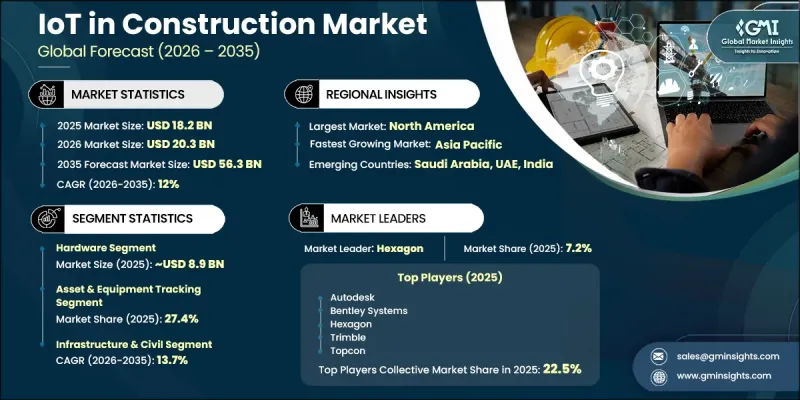
건설 업계에서는 각 건설사가 업무의 가시성과 의사결정을 향상시키는 지능적이고 상호연결된 생태계로, 파편화된 수작업 워크플로우를 점차 대체하고 있기 때문에 전 세계 건설 분야의 IoT 시장은 탄력을 받고 있습니다. 센서가 탑재된 인프라, 클라우드 기반 플랫폼, 실시간 분석, 인공지능의 보급으로 인해 건설 업계 전반에서 프로젝트 관리, 모니터링, 실행 방식이 크게 변화하고 있습니다. 디지털 전환이 가속화되는 가운데, IoT 기술은 자산의 지속적인 모니터링, 인력의 가시화, 그리고 보다 효율적인 프로젝트 관리를 가능하게함으로써 건설 업무에 필수적인 요소로 자리 잡고 있습니다. 하드웨어의 소형화, 클라우드 컴퓨팅, 그리고 지능형 데이터 처리의 발전으로 인해 조직은 건설 현장 전체에 확장 가능한 연결형 솔루션을 도입할 수 있게 되었으며, 이는 시장 성장을 더욱 촉진하고 있습니다. 작업장 안전 및 위험 관리에 대한 규제 당국의 강조 또한, 규정 준수 요건을 충족하는 지속적이고 실시간의 운영 데이터를 생성할 수 있는 IoT 기반 모니터링 시스템의 광범위한 도입을 촉진하고 있습니다. 동시에, AI와 IoT를 활용한 예측 유지보수는 건설 회사가 예상치 못한 설비 가동 중지 시간을 줄이고, 운영 효율을 높이며, 자산의 수명을 연장하고, 장기적인 유지보수 비용을 절감하는 데 도움이 되기 때문에 그 중요성이 계속해서 커지고 있습니다.
| 시장 범위 | |
|---|---|
| 시작 연도 | 2025년 |
| 예측 기간 | 2026-2035년 |
| 개시 금액 | 182억 달러 |
| 예측 금액 | 563억 달러 |
| CAGR | 12% |
하드웨어 부문은 48.9%의 점유율을 차지하며, 2025년에는 89억 달러의 매출을 창출했습니다. 하드웨어는 건설 현장 전반에 걸친 데이터 수집, 통신, 실시간 모니터링을 뒷받침하는 커넥티드 건설 환경의 기반으로서 계속해서 중요한 역할을 하고 있습니다. 이 부문에는 가혹한 건설 현장 환경에서도 안정적으로 작동하도록 설계된 다양한 커넥티드 기기, 감시 장비, 위치 파악 기술, 식별 시스템, 엣지 컴퓨팅 인프라, 통신 모듈 및 산업용 웨어러블 기술이 포함됩니다. 내구성이 뛰어나고 고성능인 커넥티드 하드웨어에 대한 지속적인 수요가 시장에서 이 부문의 선도적 위치를 더욱 공고히 하고 있습니다.
자산 및 장비 추적 부문은 2025년에 27.4%의 점유율을 차지했습니다. 전체 건설 프로젝트에서 장비의 효율적인 활용과 자산의 실시간 가시화는 여전히 중요한 우선순위이므로, 이 응용 분야는 계속해서 가장 큰 점유율을 유지하고 있습니다. 조직들은 운영 효율성 향상, 장비 배분 최적화, 자산 손실 최소화, 프로젝트 생산성 증대를 도모하는 동시에 불필요한 운영 비용을 절감하기 위해 커넥티드 추적 솔루션 도입을 점점 더 확대하고 있습니다.
2025년, 북미 건설 업계 IoT 시장은 38.6%의 점유율을 차지했습니다. 이 지역의 시장 주도적 지위는 확립된 건설 기술 생태계, 디지털 전환에 대한 지속적인 투자, 그리고 커넥티드 건설 플랫폼의 도입 확대에 의해 뒷받침되고 있습니다. 작업장 안전 및 규정 준수에 대한 규제 당국의 관심이 높아짐에 따라, 건설 기업들은 업무 투명성을 높이고, 위험 관리 관행을 강화하며, 보다 안전한 프로젝트 수행을 지원하는 첨단 IoT 기반 모니터링 솔루션의 도입을 촉진하고 있습니다. 디지털 인프라 및 지능형 건설 기술에 대한 지속적인 투자를 통해 향후 몇 년간 이 지역의 시장 성장이 더욱 가속화될 것으로 예상됩니다.
목차
제1장 조사 방법
제2장 주요 요약
제3장 업계 인사이트
제4장 경쟁 구도
제5장 시장 추정 및 예측 : 제공별, 2022-2035년
제6장 시장 추정 및 예측 : 용도별, 2022-2035년
제7장 시장 추정 및 예측 : 프로젝트별, 2022-2035년
제8장 시장 추정 및 예측 : 기업 규모별, 2022-2035년
제9장 시장 추정 및 예측 : 지역별, 2022-2035년
제10장 기업 개요
KSMThe Global IoT in Construction Market was valued at USD 18.2 billion in 2025 and is estimated to grow at a CAGR of 12% to reach USD 56.3 billion by 2035.
The global IoT in construction market is experiencing momentum as construction companies increasingly replace disconnected manual workflows with intelligent, connected ecosystems that improve operational visibility and decision-making. The widespread adoption of sensor-enabled infrastructure, cloud-based platforms, real-time analytics, and artificial intelligence is reshaping how projects are managed, monitored, and executed across the construction industry. As digital transformation accelerates, IoT technologies are becoming an integral part of construction operations by enabling continuous asset monitoring, workforce visibility, and more efficient project management. Advances in hardware miniaturization, cloud computing, and intelligent data processing are further strengthening market growth by allowing organizations to deploy scalable connected solutions across construction sites. Regulatory emphasis on workplace safety and risk management also encourages broader implementation of IoT-enabled monitoring systems capable of generating continuous, real-time operational data that supports compliance requirements. At the same time, predictive maintenance powered by AI and IoT continues to gain importance by helping construction companies reduce unexpected equipment downtime, improve operational efficiency, extend asset life cycles, and lower long-term maintenance costs.
| Market Scope | |
|---|---|
| Start Year | 2025 |
| Forecast Year | 2026-2035 |
| Start Value | $18.2 Billion |
| Forecast Value | $56.3 Billion |
| CAGR | 12% |
The hardware segment held a 48.9% share, generating USD 8.9 billion in 2025. Hardware remains the foundation of connected construction environments, supporting data collection, communication, and real-time monitoring across project sites. The segment includes a broad range of connected devices, monitoring equipment, positioning technologies, identification systems, edge computing infrastructure, communication modules, and industrial-grade wearable technologies designed to operate reliably under demanding construction site conditions. Continuous demand for durable, high-performance connected hardware continues to strengthen this segment's leadership within the market.
The asset & equipment tracking segment held a 27.4% share in 2025. This application area continues to maintain the largest share because efficient equipment utilization and real-time asset visibility remain critical priorities across construction projects. Organizations are increasingly deploying connected tracking solutions to improve operational efficiency, optimize equipment allocation, minimize asset losses, and enhance project productivity while reducing unnecessary operating costs.
North America IoT in Construction Market held a 38.6% share in 2025. Regional market leadership is supported by a well-established construction technology ecosystem, ongoing investment in digital transformation, and increasing adoption of connected construction platforms. Growing regulatory focus on workplace safety and compliance is encouraging construction companies to implement advanced IoT-enabled monitoring solutions that improve operational transparency, strengthen risk management practices, and support safer project execution. Continued investments in digital infrastructure and intelligent construction technologies are expected to reinforce regional market growth over the coming years.
Major companies operating in Global IoT in construction market include Trimble, Caterpillar, Autodesk, Bentley Systems, Hexagon, Komatsu, Procore Technologies, PTC, Topcon, and Trackunit. Leading companies in the IoT in construction market are strengthening their market position by investing in advanced IoT platforms, artificial intelligence, cloud-based construction management solutions, and connected hardware technologies. Businesses continue to expand research and development efforts to improve real-time analytics, predictive maintenance capabilities, and intelligent project management solutions. Strategic collaborations with technology providers, equipment manufacturers, and construction firms are accelerating product innovation and market penetration. Companies are also enhancing software interoperability, integrating connected ecosystems, and developing scalable platforms that simplify deployment across projects of varying sizes.
Table of Contents
Chapter 1 Research Methodology
- 1.1 Research approach
- 1.2 Quality Commitments
- 1.2.1 GMI AI policy & data integrity commitment
- 1.3 Research Trail & Confidence Scoring
- 1.3.1 Research Trail Components
- 1.3.2 Scoring Components
- 1.4 Data Collection
- 1.5 Data mining sources
- 1.5.1 Paid sources
- 1.6 Base estimates and calculations
- 1.6.1 Base year calculation
- 1.7 Forecast model
- 1.7.1 Quantified market impact analysis
- 1.8 Research transparency addendum
- 1.8.1 Source attribution framework
- 1.8.2 Quality assurance metrics
- 1.8.3 Our commitment to trust
Chapter 2 Executive Summary
- 2.1 Industry 360° synopsis
- 2.2 Key market trends
- 2.2.1 Regional
- 2.2.2 Offering
- 2.2.3 Application
- 2.2.4 Project
- 2.2.5 Enterprise Size
- 2.3 TAM analysis, 2026-2035
- 2.4 CXO perspectives: Strategic imperatives
Chapter 3 Industry Insights
- 3.1 Industry ecosystem analysis
- 3.1.1 Supplier landscape
- 3.1.2 Profit margin
- 3.1.3 Cost structure
- 3.1.4 Value addition at each stage
- 3.1.5 Factor affecting the value chain
- 3.1.6 Disruptions
- 3.2 Industry impact forces
- 3.2.1 Growth drivers
- 3.2.1.1 Stringent Worker Safety Regulations
- 3.2.1.2 Expansion of Connected Construction Equipment
- 3.2.1.3 Government Initiatives Supporting Digital Construction
- 3.2.1.4 Increasing Demand for Real-Time Project Monitoring
- 3.2.2 Industry pitfalls and challenges
- 3.2.2.1 High Upfront Capital Costs of IoT Hardware Deployment & Integration
- 3.2.2.2 Cybersecurity Vulnerabilities & Data Privacy Concerns
- 3.2.3 Market opportunities
- 3.2.3.1 Growing Adoption of Digital Twins & BIM-IoT Integration
- 3.2.3.2 Growing Adoption of AI-Enabled IoT Solutions
- 3.2.3.3 Expansion of Autonomous and Connected Construction Machinery
- 3.2.1 Growth drivers
- 3.3 Technology and innovation landscape
- 3.3.1 Current technological trends
- 3.3.1.1 IoT Sensors & Smart Monitoring Devices
- 3.3.1.2 GPS-Based Equipment Tracking Systems
- 3.3.1.3 Cloud-Based Construction Management Platforms
- 3.3.2 Emerging technologies
- 3.3.2.1 Connected Wearable Safety Devices
- 3.3.2.2 Digital Twin Technology
- 3.3.2.3 Autonomous Construction Equipment
- 3.3.1 Current technological trends
- 3.4 Growth potential analysis
- 3.5 Pricing Analysis (Driven by Primary Research)
- 3.5.1 Historical Price Trend Analysis, 2022-2025
- 3.5.2 Pricing Strategy by Player Type (Premium / Value / Cost-plus)
- 3.5.3 Pricing Models by IoT Offering
- 3.5.4 Hardware, Software, Connectivity & Services Pricing
- 3.6 Regulatory landscape
- 3.6.1 North America
- 3.6.1.1 FCC Radio Frequency and IoT Device Requirements – U.S.
- 3.6.1.2 OSHA Construction Safety and Wearable/Connected Worker Requirements – U.S.
- 3.6.1.3 Innovation, Science and Economic Development (ISED) Radio Equipment Requirements – Canada
- 3.6.2 Europe
- 3.6.2.1 EU Radio Equipment Directive (RED)
- 3.6.2.2 EU Cyber Resilience Act (CRA)
- 3.6.2.3 General Data Protection Regulation (GDPR)
- 3.6.2.4 EU Data Act
- 3.6.2.5 Product Security and Telecommunications Infrastructure (PSTI) Act 2022
- 3.6.2.6 IT Security Act 2.0
- 3.6.2.7 German Federal Data Protection Act (BDSG)
- 3.6.3 Asia Pacific
- 3.6.3.1 Chinese Ministry of Industry and Information Technology (MIIT)
- 3.6.3.2 Telecommunications Regulatory Authority of India (TRAI)
- 3.6.3.3 Radio Act (Japan)
- 3.6.3.4 Act on the Protection of Personal Information (APPI) (Japan)
- 3.6.4 LATAM
- 3.6.4.1 ANATEL (Brazil)
- 3.6.4.2 Instituto Federal de Telecomunicaciones (IFT) (Mexico)
- 3.6.5 MEA
- 3.6.5.1 Telecommunications and Digital Government Regulatory Authority (UAE)
- 3.6.5.2 Communications, Space and Technology Commission (Saudi Arabia)
- 3.6.1 North America
- 3.7 Porter’s analysis
- 3.8 PESTEL analysis
- 3.9 Cost breakdown analysis, 2025
- 3.10 Patent analysis (Driven by Primary Research)
- 3.11 Use Cases
- 3.12 Digital Transformation Readiness in Construction, 2022-2035
- 3.12.1 Digital Maturity Assessment Framework by Region & Enterprise Size
- 3.12.2 Barriers to Digital Adoption in the Construction Sector
- 3.12.3 Readiness Index by Project Type, 2022-2035
- 3.13 Impact of AI & generative AI on the market
- 3.13.1 AI-driven disruption of existing business models
- 3.13.2 GenAI use cases & adoption roadmap by segment
- 3.13.3 Risks, limitations & regulatory considerations
- 3.14 Forecast assumptions & scenario analysis (Driven by Primary Research)
- 3.14.1 Base Case- Key Macro & Industry Variables Driving CAGR
- 3.14.2 Optimistic Scenarios- Favorable macro and industry tailwinds
- 3.14.3 Pessimistic Scenario - Macroeconomic slowdown or industry headwinds
Chapter 4 Competitive Landscape, 2025
- 4.1 Introduction
- 4.2 Company market share analysis, 2022-2025
- 4.2.1 North America
- 4.2.2 Europe
- 4.2.3 Asia Pacific
- 4.2.4 LATAM
- 4.2.5 MEA
- 4.3 Competitive analysis of major market players
- 4.4 Competitive positioning matrix
- 4.5 Key developments
- 4.5.1 Mergers & acquisitions
- 4.5.2 Partnerships & collaborations
- 4.5.3 New product launches
- 4.5.4 Expansion plans and funding
- 4.6 Company tier benchmarking
- 4.6.1 Tier classification criteria & qualifying thresholds
- 4.6.2 Tier positioning matrix by revenue, geography & innovation
Chapter 5 Market Estimates and Forecast, By Offering, 2022 – 2035 ($ Mn, Units)
- 5.1 Key trends
- 5.2 Hardware
- 5.2.1 Sensors
- 5.2.2 Wearables
- 5.2.3 RFID Tags & Readers
- 5.2.4 GPS/GNSS Trackers
- 5.2.5 Telematics Units
- 5.2.6 Cameras & Drones
- 5.2.7 Others
- 5.3 Software
- 5.3.1 Project Management & Site Intelligence Platforms
- 5.3.2 Asset Tracking & Equipment Management Software
- 5.3.3 Safety & Compliance Management Software
- 5.3.4 Predictive Analytics & AI/ML Platforms
- 5.3.5 Others
- 5.4 Services
- 5.4.1 Professional Services
- 5.4.1.1 Consulting & Advisory
- 5.4.1.2 System Integration & Deployment
- 5.4.1.3 Training
- 5.4.2 Managed Services
- 5.4.1 Professional Services
Chapter 6 Market Estimates and Forecast, By Application, 2022 – 2035 ($ Mn)
- 6.1 Key trends
- 6.2 Safety & Worker Management
- 6.3 Asset & Equipment Tracking
- 6.4 Remote Equipment Control & Automation
- 6.5 Predictive Maintenance
- 6.6 Structural Health Monitoring
- 6.7 Environmental & Compliance Monitoring
- 6.8 Others
Chapter 7 Market Estimates and Forecast, By Project, 2022 – 2035 ($ Mn)
- 7.1 Key trends
- 7.2 Commercial
- 7.3 Residential
- 7.4 Infrastructure & Civil
- 7.5 Industrial
Chapter 8 Market Estimates and Forecast, By Enterprise Size, 2022 – 2035 ($ Mn)
- 8.1 Key trends
- 8.2 Large Enterprises
- 8.3 SMEs
Chapter 9 Market Estimates & Forecast, By Region, 2022 - 2035 ($Mn, Units)
- 9.1 Key trends
- 9.2 North America
- 9.2.1 US
- 9.2.2 Canada
- 9.3 Europe
- 9.3.1 Germany
- 9.3.2 UK
- 9.3.3 France
- 9.3.4 Italy
- 9.3.5 Spain
- 9.3.6 Russia
- 9.3.7 Netherlands
- 9.3.8 Sweden
- 9.3.9 Norway
- 9.4 Asia Pacific
- 9.4.1 China
- 9.4.2 India
- 9.4.3 Japan
- 9.4.4 South Korea
- 9.4.5 Australia
- 9.4.6 Singapore
- 9.4.7 New Zealand
- 9.4.8 Indonesia
- 9.4.9 Thailand
- 9.4.10 Vietnam
- 9.5 Latin America
- 9.5.1 Brazil
- 9.5.2 Mexico
- 9.5.3 Chile
- 9.6 MEA
- 9.6.1 South Africa
- 9.6.2 Saudi Arabia
- 9.6.3 UAE
Chapter 10 Company Profiles
- 10.1 Global players
- 10.1.1 Trimble
- 10.1.2 Topcon
- 10.1.3 Hexagon
- 10.1.4 Trackunit
- 10.1.5 Caterpillar
- 10.1.6 Komatsu
- 10.1.7 Hitachi Construction Machinery
- 10.1.8 Volvo CE
- 10.1.9 Microsoft
- 10.1.10 PTC
- 10.1.11 Bentley Systems
- 10.1.12 Oracle
- 10.2 Regional players
- 10.2.1 WorldSensing
- 10.2.2 WakeCap
- 10.2.3 DroneDeploy
- 10.2.4 36Zero
- 10.2.5 Procore Technologies
- 10.3 Emerging players
- 10.3.1 Buildots
- 10.3.2 Versatile
- 10.3.3 Kwant.ai