|
시장보고서
상품코드
2121193
수직형 카토닝 머신 시장 기회, 성장 촉진요인, 업계 동향 분석 및 예측(2026-2035년)Vertical Cartoning Machines Market Opportunity, Growth Drivers, Industry Trend Analysis, and Forecast 2026 - 2035 |
||||||

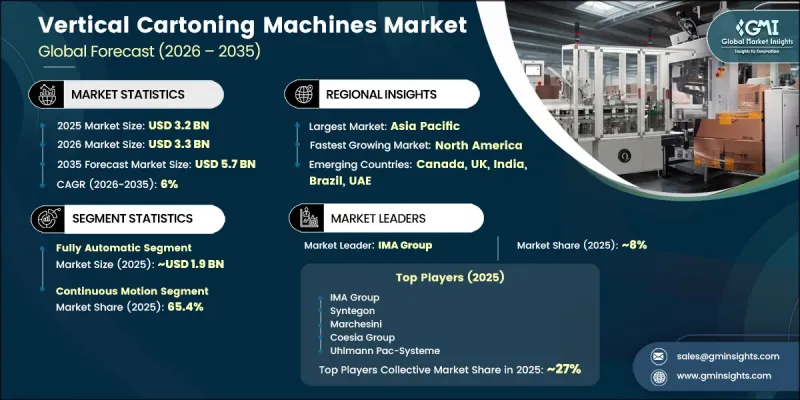
세계의 수직형 카토닝 머신 시장은 2025년에 32억 달러 규모에 달하고, CAGR 6%로 성장하여 2035년까지 57억 달러에 달할 것으로 예측됩니다.
포장 자동화에 대한 투자 확대는 각 제조사가 생산성 향상, 운영 비용 절감 및 일관된 포장 품질 유지에 주력하고 있기 때문에 수직형 카토닝 머신 시장의 성장을 지속적으로 뒷받침하고 있습니다. 노동력 부족의 심화와 인건비 급등으로 인해 기업들은 수작업 포장 공정을 더 높은 효율과 신뢰성을 제공하는 자동 카트닝 설비로 대체하도록 촉진받고 있습니다. 수직형 카토닝 머신은 생산 오류를 최소화하면서 카톤 성형, 제품 삽입, 카톤 밀봉, 코딩 및 검사를 빠르고 정확하게 수행할 수 있는 능력이 점점 더 높이 평가받고 있습니다. 또한, 첨단 자동화 시스템의 도입을 통해 제조업체는 생산 워크플로우 최적화, 설비 가동률 향상, 포장 폐기물 감소, 품질 관리 강화, 그리고 통합된 생산 라인 전반에 걸친 원활한 연동을 실현할 수 있습니다. 이러한 기능 덕분에 수직형 카토닝 기계는 업무 효율, 포장 일관성 및 비용 최적화가 여전히 중요한 우선순위인 현대 제조 시설에서 필수적인 구성요소가 되었습니다. 지속적인 기술 혁신과 지능형 포장 설비에 대한 수요 증가로 인해, 예측 기간 동안 수직형 카토닝 머신 시장에 유리한 성장 기회가 창출될 것으로 예상됩니다.
| 시장 범위 | |
|---|---|
| 시작 연도 | 2025년 |
| 예측 기간 | 2026-2035년 |
| 개시 금액 | 32억 달러 |
| 예측 금액 | 57억 달러 |
| CAGR | 6% |
완전 자동 수직형 카토닝 머신 시장은 2025년에 19억 달러의 시장 규모를 기록했으며, 2026년부터 2035년까지 연평균 성장률(CAGR) 6.3%로 성장할 것으로 전망됩니다. 제조 업무 전반에 걸친 자동화의 진전에 따라, 기업들이 생산 효율 향상, 수작업 감소 및 공정 신뢰성 제고를 도모함에 따라 완전 자동화 시스템에 대한 수요는 계속해서 가속화되고 있습니다. 이러한 기계는 생산능력 향상, 포장 일관성 제고, 지능형 공정 모니터링, 자동화된 제조 환경과의 원활한 통합 등 상당한 운영상의 이점을 제공하므로 대량 생산 시설에 매력적인 솔루션이 되고 있습니다.
2025년에는 연속 작동 부문이 시장 점유율의 65.4%를 차지했으며, 2026년부터 2035년까지 연평균 성장률(CAGR) 6.3%를 기록할 것으로 전망됩니다. 연속 작동 기술은 기계의 중단 없는 가동을 지원하여 제조업체가 더 높은 생산 속도, 운영 안정성 향상 및 포장 효율 향상을 실현할 수 있도록 합니다. 처리량 극대화, 생산 지연 최소화, 설비 종합 효율(OEE) 향상에 대한 중요성이 커짐에 따라, 다른 카터닝 기술에 비해 연속 모션 시스템의 채택이 더욱 확대될 것으로 전망됩니다.
미국의 수직형 카토닝 머신 시장은 2025년에 6억 3,120만 달러에 달했으며, 2026년부터 2035년까지 연평균 성장률(CAGR) 6.5%로 성장할 것으로 전망됩니다. 제조업 현대화를 위한 적극적인 투자와 첨단 포장 기술에 대한 수요 증가가 전미 시장의 확장을 지속적으로 뒷받침하고 있습니다. 생산 자동화를 위한 지속적인 설비 투자를 통해 제조업체들은 생산 효율 향상, 포장 품질 강화, 수작업 의존도 감소, 그리고 장기적인 사업 경쟁력 유지로 이어지는 첨단 카트닝 장비를 도입하여 포장 업무의 업그레이드를 추진하고 있습니다.
목차
제1장 조사 방법과 범위
제2장 주요 요약
제3장 업계 인사이트
제4장 경쟁 구도
제5장 시장 추정 및 예측 : 기계 유형별, 2022-2035년
제6장 시장 추정 및 예측 : 동작 유형별, 2022-2035년
제7장 시장 추정 및 예측 : 용량별, 2022-2035년
제8장 시장 추정 및 예측 : 포장 재료별, 2022-2035년
제9장 시장 추정 및 예측 : 최종 이용 산업별, 2022-2035년
제10장 시장 추정 및 예측 : 유통 채널별, 2022-2035년
제11장 시장 추정 및 예측 : 지역별, 2022-2035년
제12장 기업 개요
KSMThe Global Vertical Cartoning Machines Market was valued at USD 3.2 billion in 2025 and is estimated to grow at a CAGR of 6% to reach USD 5.7 billion by 2035.
Growing investments in packaging automation continue to support the expansion of the vertical cartoning machines market as manufacturers focus on improving productivity, reducing operating expenses, and maintaining consistent packaging quality. Increasing labor shortages and rising workforce costs are encouraging companies to replace manual packaging processes with automated cartoning equipment that delivers greater efficiency and reliability. Vertical cartoning machines are increasingly recognized for their ability to perform carton forming, product insertion, carton sealing, coding, and inspection with high speed and accuracy while minimizing production errors. The adoption of advanced automated systems also enables manufacturers to optimize production workflows, improve equipment utilization, reduce packaging waste, strengthen quality control, and support seamless communication across integrated production lines. These capabilities make vertical cartoning machines an important component of modern manufacturing facilities where operational efficiency, packaging consistency, and cost optimization remain key priorities. Continuous technological improvements and increasing demand for intelligent packaging equipment are expected to create favorable growth opportunities for the Vertical Cartoning Machines Market throughout the forecast period.
| Market Scope | |
|---|---|
| Start Year | 2025 |
| Forecast Year | 2026-2035 |
| Start Value | $3.2 Billion |
| Forecast Value | $5.7 Billion |
| CAGR | 6% |
The fully automatic vertical cartoning machines segment generated USD 1.9 billion in 2025 and is anticipated to grow at a CAGR of 6.3% between 2026 and 2035. Increasing automation across manufacturing operations continues to accelerate demand for fully automatic systems as companies seek to improve production efficiency, reduce manual handling, and enhance process reliability. These machines provide significant operational benefits, including higher production capacity, improved packaging consistency, intelligent process monitoring, and smooth integration with automated manufacturing environments, making them an attractive solution for high-volume production facilities.
The continuous motion segment accounted for a 65.4% share in 2025 and is projected to register a CAGR of 6.3% from 2026 to 2035. Continuous motion technology supports uninterrupted machine operation, allowing manufacturers to achieve higher production speeds, improved operational stability, and enhanced packaging efficiency. Growing emphasis on maximizing throughput, minimizing production delays, and improving overall equipment performance continues to encourage wider adoption of continuous motion systems over alternative cartoning technologies.
United States Vertical Cartoning Machines Market reached USD 631.2 million in 2025, and is expected to grow at a CAGR of 6.5% between 2026 and 2035. Strong investments in manufacturing modernization and increasing demand for advanced packaging technologies continue to support market expansion across the country. Ongoing capital investments in production automation are encouraging manufacturers to upgrade packaging operations with advanced cartoning equipment that improves production efficiency, strengthens packaging quality, reduces reliance on manual labor, and supports long-term operational competitiveness.
Major companies operating in the global vertical cartoning machines market include IMA Group, Syntegon Technology GmbH, Marchesini Group S.p.A., Coesia S.p.A., Korber AG, Uhlmann Pac-Systeme GmbH & Co. KG, ProMach Inc., Mpac Group plc, Cama Group S.p.A., Romaco Group, OPTIMA packaging group GmbH, IWK Verpackungstechnik GmbH, ADCO Manufacturing Inc., ACG Worldwide Private Limited, Pakona Engineers Pvt. Ltd., ELITER Packaging Machinery Co., Ltd., Econocorp Inc., and PMI KYOTO Packaging Systems. Companies participating in the vertical cartoning machines market are strengthening their competitive positions through continuous investments in product innovation, automation technologies, and advanced packaging solutions. Many manufacturers are expanding their product portfolios by introducing high-performance cartoning systems that deliver greater flexibility, improved production efficiency, and enhanced operational reliability. Strategic partnerships, mergers, acquisitions, and collaborations remain important approaches for strengthening technological capabilities and increasing market reach. Companies are also investing in research and development to improve machine performance, digital integration, intelligent monitoring features, and energy efficiency.
Table of Contents
Chapter 1 Methodology & Scope
- 1.1 Market scope and definition
- 1.2 Research design
- 1.2.1 Research approach
- 1.2.2 Data collection methods
- 1.3 Data mining sources
- 1.3.1 Global
- 1.3.2 Regional/Country
- 1.4 Base estimates and calculations
- 1.4.1 Base year calculation
- 1.4.2 Key trends for market estimation
- 1.5 Primary research and validation
- 1.5.1 Primary sources
- 1.6 Forecast model
- 1.7 Research assumptions and limitations
Chapter 2 Executive Summary
- 2.1 Industry 360° synopsis
- 2.2 Key market trends
- 2.2.1 Regional
- 2.2.2 Machine type
- 2.2.3 Motion type
- 2.2.4 Capacity
- 2.2.5 Packaging material
- 2.2.6 End-use industry
- 2.2.7 Distribution channel
Chapter 3 Industry Insights
- 3.1 Industry ecosystem analysis
- 3.1.1 Supplier landscape
- 3.1.2 Profit margin
- 3.1.3 Value addition at each stage
- 3.1.4 Factor affecting the value chain
- 3.2 Industry impact forces
- 3.2.1 Growth drivers
- 3.2.1.1 Rising demand for packaging automation to reduce labor costs & improve throughput
- 3.2.1.2 Expansion of food & beverage industry & processed food consumption
- 3.2.1.3 Growth of pharmaceutical & healthcare sector driving precision
- 3.2.1.4 E-commerce boom increasing secondary packaging demand
- 3.2.2 Industry pitfalls & challenges
- 3.2.2.1 Carton jams, product misfeeds & downtime during format changeovers
- 3.2.2.2 Integration complexity with upstream/downstream packaging lines
- 3.2.2.3 Pharmaceutical serialization & track-and-trace compliance complexity
- 3.2.3 Opportunities
- 3.2.3.1 Industry 4.0 integration (IoT, AI, predictive maintenance) in cartoning lines
- 3.2.3.2 Rising demand for sustainable/paperboard-based packaging replacing plastics
- 3.2.3.3 Rapid pharmaceutical industry expansion in emerging markets
- 3.2.3.4 Modular & flexible machine designs unlocking SME adoption
- 3.2.1 Growth drivers
- 3.3 Growth potential analysis
- 3.4 Future market trends
- 3.5 Technology and innovation landscape
- 3.5.1 Current technological trends
- 3.5.2 Emerging technologies
- 3.6 Regulatory landscape
- 3.6.1 Standards and compliance requirements
- 3.6.2 Regional regulatory frameworks
- 3.6.3 Certification standards
- 3.7 Trade data analysis (HS Code 8422.40)
- 3.7.1 Import/export volume & value trends
- 3.7.2 Key trade corridors & tariff impact
- 3.8 Pricing analysis
- 3.8.1 Historical price trend analysis (driven by primary research)
- 3.8.2 Pricing strategy by player type (premium / value / mass market)
- 3.9 Impact of AI & generative AI on the market
- 3.9.1 AI-driven disruption of existing business models
- 3.9.2 GenAI use cases & adoption roadmap by segment
- 3.9.3 Risks, limitations & regulatory considerations
- 3.10 Porter's analysis
- 3.11 PESTEL analysis
Chapter 4 Competitive Landscape, 2025
- 4.1 Introduction
- 4.2 Company market share analysis
- 4.2.1 By Region
- 4.2.1.1 North America
- 4.2.1.2 Europe
- 4.2.1.3 Asia Pacific
- 4.2.1.4 Latin America
- 4.2.1.5 Middle East & Africa
- 4.2.1 By Region
- 4.3 Company matrix analysis
- 4.4 Competitive analysis of major market players
- 4.5 Competitive positioning matrix
- 4.6 Key developments
- 4.6.1 Mergers & acquisitions
- 4.6.2 Partnerships & collaborations
- 4.6.3 New product launches
- 4.6.4 Expansion plans
Chapter 5 Market Estimates & Forecast, By Machine Type, 2022 - 2035, (USD Billion) (Million Units)
- 5.1 Key trends
- 5.2 Manual vertical cartoning machines
- 5.3 Semi-automatic vertical cartoning machines
- 5.4 Fully automatic vertical cartoning machines
Chapter 6 Market Estimates & Forecast, By Motion Type, 2022 - 2035, (USD Billion) (Million Units)
- 6.1 Key trends
- 6.2 Continuous motion
- 6.3 Intermittent motion
Chapter 7 Market Estimates & Forecast, By Capacity, 2022 - 2035, (USD Billion) (Million Units)
- 7.1 Key trends
- 7.2 Up to 200 cartons/min
- 7.3 200 to 400 cartons/min
- 7.4 400 to 600 cartons/min
- 7.5 Above 600 cartons/min
Chapter 8 Market Estimates & Forecast, By Packaging Material, 2022 - 2035, (USD Billion) (Million Units)
- 8.1 Key trends
- 8.2 Paperboard
- 8.3 Corrugated board
- 8.4 Kraft paper
- 8.5 Others
Chapter 9 Market Estimates & Forecast, By End-Use Industry, 2022 - 2035, (USD Billion) (Million Units)
- 9.1 Key trends
- 9.2 Food & beverage
- 9.3 Pharmaceuticals
- 9.4 Cosmetics & personal care
- 9.5 Consumer goods
- 9.6 Others
Chapter 10 Market Estimates & Forecast, By Distribution Channel, 2022 - 2035, (USD Billion) (Million Units)
- 10.1 Key trends
- 10.2 Direct sales
- 10.3 Indirect sales
Chapter 11 Market Estimates & Forecast, By Region, 2022 - 2035, (USD Billion) (Million Units)
- 11.1 Key trends
- 11.2 North America
- 11.2.1 U.S.
- 11.2.2 Canada
- 11.3 Europe
- 11.3.1 Germany
- 11.3.2 UK
- 11.3.3 France
- 11.3.4 Italy
- 11.3.5 Spain
- 11.4 Asia Pacific
- 11.4.1 China
- 11.4.2 India
- 11.4.3 Japan
- 11.4.4 South Korea
- 11.4.5 Australia
- 11.4.6 Indonesia
- 11.4.7 Malaysia
- 11.5 Latin America
- 11.5.1 Brazil
- 11.5.2 Mexico
- 11.5.3 Argentina
- 11.6 MEA
- 11.6.1 Saudi Arabia
- 11.6.2 UAE
- 11.6.3 South Africa
Chapter 12 Company Profiles
- 12.1 Top Global Players
- 12.1.1 IMA Group
- 12.1.2 Syntegon Technology GmbH
- 12.1.3 Marchesini Group S.p.A.
- 12.1.4 Coesia S.p.A.
- 12.1.5 Korber AG
- 12.1.6 Uhlmann Pac-Systeme GmbH & Co. KG
- 12.1.7 ProMach Inc.
- 12.2 Regional Champions
- 12.2.1 Mpac Group plc
- 12.2.2 Cama Group S.p.A.
- 12.2.3 Romaco Group
- 12.2.4 OPTIMA packaging group GmbH
- 12.2.5 IWK Verpackungstechnik GmbH
- 12.2.6 ADCO Manufacturing Inc.
- 12.3 Emerging Players
- 12.3.1 ACG Worldwide Private Limited
- 12.3.2 Pakona Engineers Pvt. Ltd.
- 12.3.3 ELITER Packaging Machinery Co., Ltd.
- 12.3.4 Econocorp Inc.
- 12.3.5 PMI KYOTO Packaging Systems