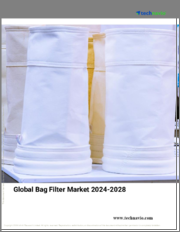
|
시장보고서
상품코드
1754054
백 필터 시장 보고서 : 재료, 유형, 미디어, 최종사용자, 지역별(2025-2033년)Bag Filter Market Report by Material, Type, Media, End User, and Region 2025-2033 |
||||||

세계 백 필터 시장 규모는 2024년 37억 달러에 달했습니다. 향후 IMARC Group은 2033년까지 시장 규모가 54억 달러에 달할 것으로 예상하며, 2025-2033년 연평균 성장률(CAGR)은 4.06%에 달할 것으로 전망하고 있습니다. 효율적인 집진이 필요한 건설 및 산업 활동의 증가, 대기 오염 방지에 대한 정부의 엄격한 규제, 집중 집진 장치 및 펄스 제트 백 필터와 같은 여과 시스템의 기술 발전은 시장 성장을 촉진하는 주요 요인 중 일부입니다.
백 필터는 백하우스라고도 불리며, 고점도 유체 및 가스의 여과에 사용되는 대기오염 방지 장치입니다. 먼지 호퍼, 공기 덕트, 필터실, 세척실, 공압 버터플라이 밸브, 먼지 제거 장치, 필터 백 및 프레임, 수동 흡기 밸브로 구성됩니다. 여과 원리로 작동하며, 유기 또는 무기 섬유 필터 천을 사용하여 가스에서 먼지와 불순물을 걸러냅니다. 이산화황(SO2) 및 기타 가스 수준을 제어하기 위해 증기 보일러 어셈블리에 채택되었습니다. 현재 기계식 셰이커, 리버스 에어, 펄스 제트 백 필터는 대 유량 여과 및 배치 여과를 위한 경제적인 산업 솔루션으로 널리 사용되고 있습니다.
백 필터 시장 동향:
건설 및 산업 응용 분야 증가
주택 및 상업용 건물의 건설 및 리노베이션이 증가함에 따라 백 필터 시장 규모가 크게 확대되고 있습니다. 이러한 시스템은 건설 공정에서 발생하는 먼지와 미립자 물질을 포집하여 깨끗한 공기를 유지하는 데 필수적입니다. 시멘트 산업 역시 유해한 배출을 최소화하고 환경 규제를 준수하기 위해 백 필터에 크게 의존하고 있습니다. 건설 부문이 성장함에 따라, 특히 도시화된 지역에서는 공기질 보호를 위한 집진 솔루션에 대한 수요가 증가하고 있습니다. 또한, 특히 신흥국 시장의 급속한 산업화로 인해 안전 및 환경 기준을 충족하기 위해 효율적인 먼지 제어가 중요한 석탄 및 광업과 같은 산업에서 백 필터의 사용이 증가하고 있으며, 이는 시장의 성장 궤도를 더욱 강화시키고 있습니다.
정부 규제와 전략적 파트너십
백 필터 시장 보고서에 따르면, 대기 오염을 줄이고 공중 보건을 보호하는 데 중점을 둔 정부 규제가 산업 성장에 큰 영향을 미치고 있습니다. 일부 국가에서는 미립자 물질 및 유해 오염 물질의 배출을 제한하기 위해 산업계가 첨단 여과 기술을 채택하도록 요구하는 엄격한 환경 기준을 도입했습니다. 이에 따라 산업계는 이러한 규제를 충족하기 위해 고성능 백 필터를 채택하고 있습니다. 그 결과, 주요 기업들은 전략적 파트너십, 합병, 인수, 합작 투자 및 합작 투자를 하고 있습니다. 이러한 제휴는 생산능력을 확장하고 여과 기술 혁신을 촉진하는 데 도움이 되고 있습니다. 제품 라인업을 강화하고 시장 범위를 확대함으로써, 이들 기업은 진화하는 규제 요구와 산업계의 요구에 대응할 수 있는 체제를 갖추고 시장 확장을 더욱 촉진하고 있습니다.
기술 발전과 혁신
기술의 발전은 백 필터 시장 점유율에 긍정적인 영향을 미치고 있으며, 보다 기능적이고 사용하기 쉽게 만들어주고 있습니다. 중앙집진기는 설치 공정을 간소화하고, 다운타임을 줄이며, 다양한 산업에서 효율성을 향상시키고 있습니다. 이러한 기술 혁신으로 백 필터 시스템은 사용자 친화적이고 비용 효율적이며 응용 분야에 새로운 가능성을 가져다주었습니다. 또한, 특히 석탄, 광업, 시멘트와 같은 중공업 분야에서 펄스 제트 백 필터에 대한 수요가 증가하고 있으며, 보다 진보된 여과 솔루션에 대한 요구가 증가하고 있습니다. 이러한 필터는 더 높은 집진 효율과 최소한의 유지보수를 제공합니다. 따라서 분진 부하가 높은 산업에 이상적입니다. 기술이 발전함에 따라 생산성을 유지하면서 엄격한 환경 및 안전 기준을 충족할 수 있는 혁신이 이루어지고 있습니다.
본 보고서에서 다루는 주요 질문
- 백 필터 세계 시장 규모는?
- 백 필터 세계 시장 성장률 전망(2025-2033년)?
- 백 필터 세계 시장을 주도하는 주요 요인은 무엇인가?
- COVID-19가 백 필터 세계 시장에 미치는 영향은?
- 세계 백 필터 시장의 유형별 분류는?
- 백 필터 세계 시장에서의 매체별 분류는 어떻게 되는가?
- 백 필터 세계 시장에서 주요 지역은?
- 세계 백 필터 시장의 주요 업체는?
목차
제1장 서문
제2장 조사 범위와 조사 방법
- 조사 목적
- 이해관계자
- 데이터 소스
- 1차 정보
- 2차 정보
- 시장 추정
- 상향식 접근
- 하향식 접근
- 조사 방법
제3장 주요 요약
제4장 소개
- 개요
- 주요 업계 동향
제5장 세계의 백 필터 시장
- 시장 개요
- 시장 실적
- COVID-19의 영향
- 시장 예측
제6장 시장 내역 : 재료별
- 나일론
- 폴리프로필렌
- 폴리에스테르
- 다공질 PTFE 필름
제7장 시장 내역 : 유형별
- 펄스 제트
- 리버스 에어
- 셰이커
제8장 시장 내역 : 미디어별
- 직조
- 주름형
- 부직포
제9장 시장 내역 : 최종사용자별
- 화학 및 석유화학
- 식품 가공
- 미네랄
- 시멘트
- 자동차
- 기타
제10장 시장 내역 : 지역별
- 북미
- 미국
- 캐나다
- 아시아태평양
- 중국
- 일본
- 인도
- 한국
- 호주
- 인도네시아
- 기타
- 유럽
- 독일
- 프랑스
- 영국
- 이탈리아
- 스페인
- 러시아
- 기타
- 라틴아메리카
- 브라질
- 멕시코
- 기타
- 중동 및 아프리카
- 시장 내역 : 국가별
제11장 SWOT 분석
- 개요
- 강점
- 약점
- 기회
- 위협
제12장 밸류체인 분석
제13장 Porter's Five Forces 분석
- 개요
- 구매자의 교섭력
- 공급 기업의 교섭력
- 경쟁 정도
- 신규 참여업체의 위협
- 대체품의 위협
제14장 가격 분석
제15장 경쟁 구도
- 시장 구조
- 주요 기업
- 주요 기업 개요
- Babcock & Wilcox Enterprises Inc.
- BWF Offermann Waldenfels & Co. KG
- Camfil Group
- Donaldson Company Inc.
- Eaton Corporation plc
- Lenntech B.V.
- Parker Hannifin Corporation
- Rosedale Products Inc.
- Shanghai Sffiltech Co. Ltd.
- Thermax Limited
- W.L. Gore & Associates Inc.
The global bag filter market size reached USD 3.7 Billion in 2024. Looking forward, IMARC Group expects the market to reach USD 5.4 Billion by 2033, exhibiting a growth rate (CAGR) of 4.06% during 2025-2033. The increasing construction and industrial activities requiring efficient dust collection, stringent government regulations on air pollution control, and technological advancements in filtration systems, such as centralized dust collectors and pulse jet bag filters, represent some of the key factors driving the market growth.
A bag filter, also known as a baghouse, is an air pollution-controlling equipment used in the filtration of highly viscous fluids and gases. It comprises a dust hopper, air duct, filter chamber, cleaning room, pneumatic butterfly valve, dust removal unit, filter bag and frame, and manual air intake valve. It works on the filtration principle and uses organic or inorganic fiber filter cloth that filters out dust and impurities from the gas. It is employed in a steam boiler assembly to control the levels of sulfur dioxide (SO2) and other gases. At present, mechanical shakers, reverse air, and pulse jet bag filters are widely used as economical industrial solutions for high-flow filtration and batch filtration.
Bag Filter Market Trends:
Increasing Construction and Industrial Applications
The rising construction and remodeling activities in residential and commercial buildings are significantly increasing the bag filter market size. These systems are essential for maintaining clean air by capturing dust and particulate matter generated during construction processes. The expanding cement industry also relies heavily on bag filters to minimize harmful emissions and comply with environmental regulations. As the construction sector grows, particularly in urbanized areas, the demand for dust collection solutions is becoming more important to protect air quality. Furthermore, rapid industrialization, particularly in developing nations, is boosting the use of bag filters in industries such as coal and mining, where efficient dust control is crucial for meeting safety and environmental standards, further strengthening the growth trajectory of the market.
Government Regulations and Strategic Partnerships
According to the bag filter market report, government regulations focused on reducing air pollution and safeguarding public health are significantly influencing industry growth. Several nations are implementing strict environmental standards that require industries to adopt advanced filtration technologies to limit emissions of particulate matter and harmful pollutants. As a result, industries are increasingly turning to high-performance bag filters to meet these regulations. Consequently, leading companies are forming strategic partnerships, mergers, acquisitions, and joint ventures. These collaborations help in expanding production capacity and foster innovation in filtration technologies. By enhancing their product offerings and extending market reach, these companies are positioning themselves to capitalize on evolving regulatory demands and industrial needs, further facilitating market expansion.
Technological Advancements and Innovation
Technological advancements are providing a favorable impact on the bag filter market share by making them more functional and accessible. Central dust collectors have streamlined the installation processes, reducing downtime and improving efficiency across various industries. These innovations make the bag filter systems user-friendly and cost-effective, which opens up new possibilities in the areas of application. Additionally, the rising demand for pulse jet bag filters, particularly in heavy industries such as coal, mining, and cement, is raising the need for more advanced filtration solutions. These filters offer higher dust collection efficiency and minimal maintenance. This makes them ideal for industries with high dust loads. As technology evolves, it continues to drive innovation, helping industries meet stringent environmental and safety standards while maintaining productivity.
Key Market Segmentation:
Breakup by Material:
- Nylon
- Polypropylene
- Polyester
- Porous PTFE Film
Breakup by Type:
- Pulse Jet
- Reverse Air
- Shaker
Breakup by Media:
- Woven
- Pleated
- Non woven
Breakup by End User:
- Chemical and Petrochemical
- Food Processing
- Mineral
- Cement
- Automotive
- Others
Breakup by Region:
- North America
- United States
- Canada
- Asia-Pacific
- China
- Japan
- India
- South Korea
- Australia
- Indonesia
- Others
- Europe
- Germany
- France
- United Kingdom
- Italy
- Spain
- Russia
- Others
- Latin America
- Brazil
- Mexico
- Others
- Middle East and Africa
Competitive Landscape:
The report has also provided a comprehensive analysis of the competitive landscape in the global bag filter market. Detailed profiles of all major companies have also been provided. Some of the companies covered include:
- Babcock & Wilcox Enterprises Inc.
- BWF Offermann Waldenfels & Co. KG
- Camfil Group
- Donaldson Company Inc.
- Eaton Corporation plc
- Lenntech B.V.
- Parker Hannifin Corporation
- Rosedale Products Inc.
- Shanghai Sffiltech Co. Ltd.
- Thermax Limited
- W.L. Gore & Associates Inc.
Key Questions Answered in This Report
- 1.How big is the global bag filter market?
- 2.What is the expected growth rate of the global bag filter market during 2025-2033?
- 3.What are the key factors driving the global bag filter market?
- 4.What has been the impact of COVID-19 on the global bag filter market?
- 5.What is the breakup of the global bag filter market based on the type?
- 6.What is the breakup of the global bag filter market based on the media?
- 7.What are the key regions in the global bag filter market?
- 8.Who are the key players/companies in the global bag filter market?
Table of Contents
1 Preface
2 Scope and Methodology
- 2.1 Objectives of the Study
- 2.2 Stakeholders
- 2.3 Data Sources
- 2.3.1 Primary Sources
- 2.3.2 Secondary Sources
- 2.4 Market Estimation
- 2.4.1 Bottom-Up Approach
- 2.4.2 Top-Down Approach
- 2.5 Forecasting Methodology
3 Executive Summary
4 Introduction
- 4.1 Overview
- 4.2 Key Industry Trends
5 Global Bag Filter Market
- 5.1 Market Overview
- 5.2 Market Performance
- 5.3 Impact of COVID-19
- 5.4 Market Forecast
6 Market Breakup by Material
- 6.1 Nylon
- 6.1.1 Market Trends
- 6.1.2 Market Forecast
- 6.2 Polypropylene
- 6.2.1 Market Trends
- 6.2.2 Market Forecast
- 6.3 Polyester
- 6.3.1 Market Trends
- 6.3.2 Market Forecast
- 6.4 Porous PTFE Film
- 6.4.1 Market Trends
- 6.4.2 Market Forecast
7 Market Breakup by Type
- 7.1 Pulse Jet
- 7.1.1 Market Trends
- 7.1.2 Market Forecast
- 7.2 Reverse Air
- 7.2.1 Market Trends
- 7.2.2 Market Forecast
- 7.3 Shaker
- 7.3.1 Market Trends
- 7.3.2 Market Forecast
8 Market Breakup by Media
- 8.1 Woven
- 8.1.1 Market Trends
- 8.1.2 Market Forecast
- 8.2 Pleated
- 8.2.1 Market Trends
- 8.2.2 Market Forecast
- 8.3 Non woven
- 8.3.1 Market Trends
- 8.3.2 Market Forecast
9 Market Breakup by End User
- 9.1 Chemical and Petrochemical
- 9.1.1 Market Trends
- 9.1.2 Market Forecast
- 9.2 Food Processing
- 9.2.1 Market Trends
- 9.2.2 Market Forecast
- 9.3 Mineral
- 9.3.1 Market Trends
- 9.3.2 Market Forecast
- 9.4 Cement
- 9.4.1 Market Trends
- 9.4.2 Market Forecast
- 9.5 Automotive
- 9.5.1 Market Trends
- 9.5.2 Market Forecast
- 9.6 Others
- 9.6.1 Market Trends
- 9.6.2 Market Forecast
10 Market Breakup by Region
- 10.1 North America
- 10.1.1 United States
- 10.1.1.1 Market Trends
- 10.1.1.2 Market Forecast
- 10.1.2 Canada
- 10.1.2.1 Market Trends
- 10.1.2.2 Market Forecast
- 10.1.1 United States
- 10.2 Asia-Pacific
- 10.2.1 China
- 10.2.1.1 Market Trends
- 10.2.1.2 Market Forecast
- 10.2.2 Japan
- 10.2.2.1 Market Trends
- 10.2.2.2 Market Forecast
- 10.2.3 India
- 10.2.3.1 Market Trends
- 10.2.3.2 Market Forecast
- 10.2.4 South Korea
- 10.2.4.1 Market Trends
- 10.2.4.2 Market Forecast
- 10.2.5 Australia
- 10.2.5.1 Market Trends
- 10.2.5.2 Market Forecast
- 10.2.6 Indonesia
- 10.2.6.1 Market Trends
- 10.2.6.2 Market Forecast
- 10.2.7 Others
- 10.2.7.1 Market Trends
- 10.2.7.2 Market Forecast
- 10.2.1 China
- 10.3 Europe
- 10.3.1 Germany
- 10.3.1.1 Market Trends
- 10.3.1.2 Market Forecast
- 10.3.2 France
- 10.3.2.1 Market Trends
- 10.3.2.2 Market Forecast
- 10.3.3 United Kingdom
- 10.3.3.1 Market Trends
- 10.3.3.2 Market Forecast
- 10.3.4 Italy
- 10.3.4.1 Market Trends
- 10.3.4.2 Market Forecast
- 10.3.5 Spain
- 10.3.5.1 Market Trends
- 10.3.5.2 Market Forecast
- 10.3.6 Russia
- 10.3.6.1 Market Trends
- 10.3.6.2 Market Forecast
- 10.3.7 Others
- 10.3.7.1 Market Trends
- 10.3.7.2 Market Forecast
- 10.3.1 Germany
- 10.4 Latin America
- 10.4.1 Brazil
- 10.4.1.1 Market Trends
- 10.4.1.2 Market Forecast
- 10.4.2 Mexico
- 10.4.2.1 Market Trends
- 10.4.2.2 Market Forecast
- 10.4.3 Others
- 10.4.3.1 Market Trends
- 10.4.3.2 Market Forecast
- 10.4.1 Brazil
- 10.5 Middle East and Africa
- 10.5.1 Market Trends
- 10.5.2 Market Breakup by Country
- 10.5.3 Market Forecast
11 SWOT Analysis
- 11.1 Overview
- 11.2 Strengths
- 11.3 Weaknesses
- 11.4 Opportunities
- 11.5 Threats
12 Value Chain Analysis
13 Porters Five Forces Analysis
- 13.1 Overview
- 13.2 Bargaining Power of Buyers
- 13.3 Bargaining Power of Suppliers
- 13.4 Degree of Competition
- 13.5 Threat of New Entrants
- 13.6 Threat of Substitutes
14 Price Analysis
15 Competitive Landscape
- 15.1 Market Structure
- 15.2 Key Players
- 15.3 Profiles of Key Players
- 15.3.1 Babcock & Wilcox Enterprises Inc.
- 15.3.1.1 Company Overview
- 15.3.1.2 Product Portfolio
- 15.3.1.3 Financials
- 15.3.2 BWF Offermann Waldenfels & Co. KG
- 15.3.2.1 Company Overview
- 15.3.2.2 Product Portfolio
- 15.3.3 Camfil Group
- 15.3.3.1 Company Overview
- 15.3.3.2 Product Portfolio
- 15.3.3.3 SWOT Analysis
- 15.3.4 Donaldson Company Inc.
- 15.3.4.1 Company Overview
- 15.3.4.2 Product Portfolio
- 15.3.4.3 Financials
- 15.3.4.4 SWOT Analysis
- 15.3.5 Eaton Corporation plc
- 15.3.5.1 Company Overview
- 15.3.5.2 Product Portfolio
- 15.3.5.3 Financials
- 15.3.5.4 SWOT Analysis
- 15.3.6 Lenntech B.V.
- 15.3.6.1 Company Overview
- 15.3.6.2 Product Portfolio
- 15.3.7 Parker Hannifin Corporation
- 15.3.7.1 Company Overview
- 15.3.7.2 Product Portfolio
- 15.3.7.3 Financials
- 15.3.7.4 SWOT Analysis
- 15.3.8 Rosedale Products Inc.
- 15.3.8.1 Company Overview
- 15.3.8.2 Product Portfolio
- 15.3.9 Shanghai Sffiltech Co. Ltd.
- 15.3.9.1 Company Overview
- 15.3.9.2 Product Portfolio
- 15.3.10 Thermax Limited
- 15.3.10.1 Company Overview
- 15.3.10.2 Product Portfolio
- 15.3.10.3 Financials
- 15.3.11 W.L. Gore & Associates Inc.
- 15.3.11.1 Company Overview
- 15.3.11.2 Product Portfolio
- 15.3.11.3 SWOT Analysis
- 15.3.1 Babcock & Wilcox Enterprises Inc.