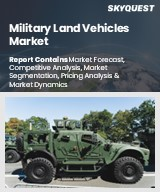
|
시장보고서
상품코드
2008950
군용 육상 차량 시장 : 제공 형태, 제품 유형, 용도, 지역별(2026-2034년)Military Land Vehicles Market by Offering, Product Type, Application, and Region 2026-2034 |
||||||

세계의 군용 육상 차량 시장 규모는 2025년에 245억 달러에 달했습니다. 향후 IMARC Group은 2034년까지 시장 규모가 322억 달러에 달하며, 2026-2034년에 CAGR 2.98%로 성장할 것으로 예측하고 있습니다. 이 시장은 고도로 기술적으로 정교한 차량 조달을 필요로 하는 지정학적 긴장과 안보 위협의 증가, 세계 국방 예산의 증가, 군사 작전에 인공지능(AI)의 통합을 배경으로 꾸준한 성장세를 보이고 있습니다.
군용 육상 차량 시장 동향:
기술 발전과 현대화 노력
세계 군용 육상 차량 시장을 촉진하는 주요 요인 중 하나는 기술 혁신과 현대화에 대한 지속적인 투자입니다. 세계 각국은 자율주행 기술, 장갑 보호 강화, 신무기 개발 등 신기술을 이용해 자국 장갑차 부대를 개선하기 위해 자금을 투자하고 있습니다. 이러한 능력은 군대의 작전 능력, 생존성 및 전투 능력을 향상시키는 것을 목표로 합니다. 예를 들어 차량 시스템에 인공지능(AI)과 머신러닝을 적용함으로써 전장 상황 파악이 향상되고 의사결정의 자동화가 진행되고 있습니다. 한 시장 조사 보고서에 따르면 군용 로봇 및 자율 시스템 시장 규모는 2023년 112억 달러에 달할 것으로 예상됩니다. IMARC Group은 2024-2032년 CAGR 11.9%로 2032년까지 시장 규모가 318억 달러에 달할 것으로 예측하고 있습니다. 또한 하이브리드 또는 전기 추진 시스템이 개발되고 있으며, 연비 효율 향상과 후방 지원 발자국 감소에 대한 관심을 보이고 있습니다. 이러한 발전으로 군용 육상 차량은 국방 전략에서 중요한 역할을 계속 수행하며 현대 전쟁의 요구에 부응할 준비가 되어 있습니다.
지정학적 긴장과 국방비 지출
격화되는 지정학적 갈등과 이에 따른 국방비 증가는 군용 육상 수송차량 시장을 촉진하는 주요 요인입니다. 영토 문제, 정치적 긴장, 국경 분쟁에 직면한 지역에서 군사력 확대와 현대화를 우선시하는 국가들은 군대 강화에 많은 예산을 투자하고 있으며, 그 중 대부분은 육상 차량 획득과 개선에 중점을 두고 있습니다. 이와 함께 중동, 동유럽, 남중국해에서의 분쟁은 견고하고 기술적으로 진보된 군용 차량에 대한 긴급한 필요성을 강조하고 있습니다. 이러한 추세는 작전 및 안보 협정을 준수하는 협정에 의해 더욱 강화되고 있으며, 각국은 잠재적 위협에 대한 대비와 억지력을 확보하기 위해 최첨단 지상 차량에 투자할 수 있게 되었습니다. 따라서 이로 인해 군용 육상 차량 시장 규모가 크게 확대되고 있습니다.
비대칭 전쟁 및 대반란 작전 증가
시장 성장을 촉진하는 또 다른 중요한 요인은 비정규전, 비대칭 전쟁 및 대반란 작전의 관행이 증가하고 있다는 점입니다. 현대 분쟁에서 비국가 주체와 기타 무장단체는 비정규 전술을 사용하는 경우가 많습니다. 또한 특수 육상 차량을 통해 군대는 기동성, 방어력, 범용성을 향상시킬 수 있으며, 이는 앞서 언급한 위협 유형에 대응하는 데 필수적인 능력입니다. 여기에는 지뢰 및 매복 공격 대응 차량(MRAP), 경전술 차량, 다양한 환경과 다양한 임무 프로파일에 맞게 개발된 무인 지상 차량(UGV) 등이 포함됩니다. 비대칭 전쟁 환경에서 정찰, 병력 수송 및 직접 사격용 차량이 이에 해당합니다. 또한 비대칭 전술에서는 신속한 전개, 쉬운 적응, 생존성을 갖춘 차량이 특히 요구되고 있으며, 아프가니스탄과 이라크에서의 수요 증가는 서방 국가의 군대에 차량과 항공기를 포함한 육상전력의 능력을 향상시켜야 한다는 압력을 가하고 있습니다.
목차
제1장 서문
제2장 조사 범위와 조사 방법
제3장 개요
제4장 서론
제5장 세계의 군용 육상 차량 시장
제6장 시장 내역 : 제공별
제7장 시장 내역 : 제품 유형별
제8장 시장 내역 : 용도별
제9장 시장 내역 : 지역별
제10장 촉진·억제·기회
제11장 밸류체인 분석
제12장 Porter's Five Forces 분석
제13장 가격 분석
제14장 경쟁 구도
KSA 26.04.30The global military land vehicles market size reached USD 24.5 Billion in 2025. Looking forward, IMARC Group expects the market to reach USD 32.2 Billion by 2034, exhibiting a growth rate (CAGR) of 2.98 % during 2026-2034. The market is experiencing steady growth driven by the rising geopolitical tensions and security threats necessitating the procurement of advanced, technologically sophisticated vehicles, the increasing global defense budgets, and the integration of artificial intelligence in military operations.
MILITARY LAND VEHICLES MARKET ANALYSIS:
- Major Market Drivers: Increasing defense budgets across the globe drive the demand for military land vehicles. Additionally, the growing demand for advanced and technologically up-to-date vehicles is propelling the market growth.
- Key Market Trends: The deployment of unmanned ground into an automation era to mitigate the risk of human interference and facilitate robotic movements is one of the major trends. Land army forces continue to channel funds to promote ground automatic operations, prompting an escalation and market growth.
- Geographical Trends: With large reserves in the defense budget and advancement in technology, North America holds the major military land vehicles market share. Geographically, the Asia-Pacific region is experiencing significant growth in the military due to mounting geopolitical tensions and the large military modernization programs that have been initiated.
- Competitive Landscape: The market is dominated by companies such as General Dynamics, BAE Systems, and Rheinmetall, among others. The key market players are adopting the strategy of strategic collaboration, mergers, and acquisitions to enhance their market presence and to enhance their technological capabilities.
- Challenges and Opportunities: High costs for development and maintenance are major challenges in scaling of market. Nevertheless, the rising demand for autonomous and electric military vehicles is providing substantial opportunities to the market players.
MILITARY LAND VEHICLES MARKET TRENDS:
Technological advancements and modernization initiatives
One of the major factors driving the global military land vehicles market is continued investment in technological advancements and modernization. Countries around the globe are spending on improving their armor fleets with new technologies of autonomous driving, armor protection improvement, and the development of new weaponry. These capabilities are designed to enhance the operational capabilities, survival, and combat capacity of the armed forces. For instance, the applications of artificial intelligence (AI) and machine learning within vehicle systems are improving battlefield awareness and automating decision-making. According to a market research report, the military robotics and autonomous systems market size reached US$ 11.2 Billion in 2023. IMARC Group expects the market to reach US$ 31.8 Billion by 2032, exhibiting a growth rate (CAGR) of 11.9% during 2024-2032. In addition, hybrid or electric propulsion systems are under development, demonstrating an interest in increasing fuel efficiency and decreasing logistic footprint. These advancements keep military land vehicles relevant to defense strategies and prepared for the demands of contemporary warfare.
Geopolitical tensions and defense spending
The accelerating geopolitical conflict and consequent increase in defense expenditure are the major factors driving the military land transport vehicle market. Countries that prioritize expanding and modernizing their military capabilities in areas facing territorial disputes, political tensions, and border disputes devote substantial budgets to strengthening their armed forces and, for the most part, focus on acquiring and improving ground vehicles. In confluence with this, conflicts in the Middle East, Eastern Europe, and the South China Sea highlight the urgent need for robust and technologically advanced military vehicles This trend is further strengthened by route agreements comply with operational and security agreements, allowing nations to invest in state-of-the-art ground vehicles to ensure preparedness and deterrence against potential threats. Therefore, this is significantly expanding the military land vehicles market size.
Rising asymmetric warfare and counterinsurgency operations
Another important factor propelling the growth of the market is the rising practice of irregular warfare, asymmetric warfare, and counterinsurgency operations. In modern conflicts, non-state actors and other militant groups often use irregular tactics. In addition, specialized land vehicles allow militaries to increase their mobility, protection, and versatility, capabilities that are critical in responding to the threat types outlined above. Some of these include mine-resistant ambush-protected (MRAP) vehicles, light tactical vehicles, and unmanned ground vehicles (UGVs) built for a broad spectrum of environments and different mission profiles. This includes vehicles for reconnaissance, troop transport, and direct fire in an irregular warfare environment. Moreover, asymmetric tactics particularly require vehicles that deploy quickly, adapt readily, and survive, and the escalating demand in Afghanistan and Iraq has put pressure on Western militaries to improve the capabilities of their land including their vehicles and aircraft.
MILITARY LAND VEHICLES MARKET SEGMENTATION:
Breakup by Offering:
- Platforms
- Services
Services accounts for the majority of the market share
In the military land vehicles market, the services are the largest offering segment, as they are required for the ongoing maintenance, training, and support of military land vehicles. These services ensure that military vehicles are always operationally ready and have a long service life, from regular maintenance and spare parts deliveries to full-service training programs for military personnel. Moreover, with current military land vehicles becoming ever more complex and technologically advanced, they require ongoing support and technical backup, providing an even greater incentive to sell a full-service package. In addition, defense agencies increasingly outsourcing maintenance and support activities to third-party contractors is creating a positive market outlook.
Breakup by Product Type:
- Infantry Fighting Vehicles
- Armoured Personnel Carriers
- Main Battle Tank
- Light Multi-Role Vehicles
- Tactical Trucks
- Others
Infantry fighting vehicles holds the largest share of the industry
Infantry fighting vehicles dominate the military ground vehicle market as the largest product category, primarily due to their vital role in modern combat operations. IFVs are designed to carry infantry on the battlefield, provide direct fire support, and enhance cavalry mobility, protection, and firepower. Their ability to be used in a variety of combat situations makes them an independent asset. Additionally, continued improvements in defense, weaponry, and transport IFVs further contribute to their widespread acceptance. Furthermore, ongoing geopolitical conflicts and modernization policies in various countries are driving significant investments in IFVs, reinforcing their position as the most sought-after military ground vehicles.
Breakup by Application:
- Defense
- Transportation
Breakup by Region:
- North America
- United States
- Canada
- Europe
- Germany
- France
- United Kingdom
- Italy
- Spain
- Russia
- Others
- Asia Pacific
- China
- Japan
- India
- South Korea
- Australia
- Indonesia
- Others
- Latin America
- Brazil
- Mexico
- Others
- Middle East and Africa
North America leads the market, accounting for the largest military land vehicles market share
The report has also provided a comprehensive analysis of all the major regional markets, which include North America (the United States and Canada); Europe (Germany, France, the United Kingdom, Italy, Spain, Russia, and others); Asia Pacific (China, Japan, India, South Korea, Australia, Indonesia, and others); Latin America (Brazil, Mexico, and others); and the Middle East and Africa. According to the report, North America represents the largest regional market for military land vehicles.
North America is the largest region segment of the military land vehicles market, supported by well-defined defense budgets maintaining a focus on innovation in technologies. Being the biggest and most essential contributor to this category, the US is responsible for vast resources dedicated to synchronizing the advantages of both strategic and tactical capability in its advanced military vehicles. Along with this, continual new-land-vehicle introduction is made possible by the region's strong defense industrial base and substantial research and development projects. According to the military land vehicles market report, the advent of autonomous and hybrid vehicles is also spiraling modernization initiatives in North America, thus benefiting the region to hold a dominant position. The region is home to leading defense contractors and manufacturers as well, which fastens the market, which in turn, results in continuous development of high-technology military land vehicles.
COMPETITIVE LANDSCAPE:
The market research report has also provided a comprehensive analysis of the competitive landscape in the market. Detailed profiles of all major companies have also been provided. Some of the major market players in the military land vehicles industry include:
- Ashok Leyland Ltd. (Hinduja Group Ltd.)
- BAE Systems Plc
- General Dynamics Corporation
- Hyundai Rotem Company (Hyundai Motor Group)
- IVECO S.p.A. (Iveco Group)
- Krauss-Mafeeo Wegman GmbH & Co. KG (KMW+ Nexter Defense Systems N.V.)
- Oshkosh Defense LLC (Oshkosh Corporation)
- Rheinmetall AG
- ST Engineering Ltd.
()
Leading players in the military ground vehicles market are actively engaging in strategic initiatives to retain and enhance their market positions. These companies are focused on innovation and technological development, investing heavily in research and development to develop sophisticated, autonomous vehicles and integrated AI. Along with this, ongoing collaboration, mergers, and acquisitions are expanding the technological capabilities and global reach of these companies. Through this, they are entering into long-term agreements with defense agencies, ensuring steady revenue and strengthening their market presence. By constantly upgrading their product offerings and expanding their services, these key players are well-positioned to meet the changing demands of modern armed forces.
KEY QUESTIONS ANSWERED IN THIS REPORT
1. How big is the military land vehicles market?
2. What is the future outlook of military land vehicles market?
3. What are the key factors driving the military land vehicles market?
4. Which region accounts for the largest military land vehicles market share?
5. Which are the leading companies in the global military land vehicles market?
Table of Contents
1 Preface
2 Scope and Methodology
- 2.1 Objectives of the Study
- 2.2 Stakeholders
- 2.3 Data Sources
- 2.3.1 Primary Sources
- 2.3.2 Secondary Sources
- 2.4 Market Estimation
- 2.4.1 Bottom-Up Approach
- 2.4.2 Top-Down Approach
- 2.5 Forecasting Methodology
3 Executive Summary
4 Introduction
- 4.1 Overview
- 4.2 Key Industry Trends
5 Global Military Land Vehicles Market
- 5.1 Market Overview
- 5.2 Market Performance
- 5.3 Impact of COVID-19
- 5.4 Market Forecast
6 Market Breakup by Offering
- 6.1 Platforms
- 6.1.1 Market Trends
- 6.1.2 Market Forecast
- 6.2 Services
- 6.2.1 Market Trends
- 6.2.2 Market Forecast
7 Market Breakup by Product Type
- 7.1 Infantry Fighting Vehicles
- 7.1.1 Market Trends
- 7.1.2 Market Forecast
- 7.2 Armoured Personnel Carriers
- 7.2.1 Market Trends
- 7.2.2 Market Forecast
- 7.3 Main Battle Tank
- 7.3.1 Market Trends
- 7.3.2 Market Forecast
- 7.4 Light Multi-Role Vehicles
- 7.4.1 Market Trends
- 7.4.2 Market Forecast
- 7.5 Tactical Trucks
- 7.5.1 Market Trends
- 7.5.2 Market Forecast
- 7.6 Others
- 7.6.1 Market Trends
- 7.6.2 Market Forecast
8 Market Breakup by Application
- 8.1 Defence
- 8.1.1 Market Trends
- 8.1.2 Market Forecast
- 8.2 Transportation
- 8.2.1 Market Trends
- 8.2.2 Market Forecast
9 Market Breakup by Region
- 9.1 North America
- 9.1.1 United States
- 9.1.1.1 Market Trends
- 9.1.1.2 Market Forecast
- 9.1.2 Canada
- 9.1.2.1 Market Trends
- 9.1.2.2 Market Forecast
- 9.1.1 United States
- 9.2 Asia-Pacific
- 9.2.1 China
- 9.2.1.1 Market Trends
- 9.2.1.2 Market Forecast
- 9.2.2 Japan
- 9.2.2.1 Market Trends
- 9.2.2.2 Market Forecast
- 9.2.3 India
- 9.2.3.1 Market Trends
- 9.2.3.2 Market Forecast
- 9.2.4 South Korea
- 9.2.4.1 Market Trends
- 9.2.4.2 Market Forecast
- 9.2.5 Australia
- 9.2.5.1 Market Trends
- 9.2.5.2 Market Forecast
- 9.2.6 Indonesia
- 9.2.6.1 Market Trends
- 9.2.6.2 Market Forecast
- 9.2.7 Others
- 9.2.7.1 Market Trends
- 9.2.7.2 Market Forecast
- 9.2.1 China
- 9.3 Europe
- 9.3.1 Germany
- 9.3.1.1 Market Trends
- 9.3.1.2 Market Forecast
- 9.3.2 France
- 9.3.2.1 Market Trends
- 9.3.2.2 Market Forecast
- 9.3.3 United Kingdom
- 9.3.3.1 Market Trends
- 9.3.3.2 Market Forecast
- 9.3.4 Italy
- 9.3.4.1 Market Trends
- 9.3.4.2 Market Forecast
- 9.3.5 Spain
- 9.3.5.1 Market Trends
- 9.3.5.2 Market Forecast
- 9.3.6 Russia
- 9.3.6.1 Market Trends
- 9.3.6.2 Market Forecast
- 9.3.7 Others
- 9.3.7.1 Market Trends
- 9.3.7.2 Market Forecast
- 9.3.1 Germany
- 9.4 Latin America
- 9.4.1 Brazil
- 9.4.1.1 Market Trends
- 9.4.1.2 Market Forecast
- 9.4.2 Mexico
- 9.4.2.1 Market Trends
- 9.4.2.2 Market Forecast
- 9.4.3 Others
- 9.4.3.1 Market Trends
- 9.4.3.2 Market Forecast
- 9.4.1 Brazil
- 9.5 Middle East and Africa
- 9.5.1 Market Trends
- 9.5.2 Market Breakup by Country
- 9.5.3 Market Forecast
10 Drivers, Restraints, and Opportunities
- 10.1 Overview
- 10.2 Drivers
- 10.3 Restraints
- 10.4 Opportunities
11 Value Chain Analysis
12 Porters Five Forces Analysis
- 12.1 Overview
- 12.2 Bargaining Power of Buyers
- 12.3 Bargaining Power of Suppliers
- 12.4 Degree of Competition
- 12.5 Threat of New Entrants
- 12.6 Threat of Substitutes
13 Price Analysis
14 Competitive Landscape
- 14.1 Market Structure
- 14.2 Key Players
- 14.3 Profiles of Key Players
- 14.3.1 Ashok Leyland Ltd. (Hinduja Group Ltd.)
- 14.3.1.1 Company Overview
- 14.3.1.2 Product Portfolio
- 14.3.1.3 Financials
- 14.3.1.4 SWOT Analysis
- 14.3.2 BAE Systems plc
- 14.3.2.1 Company Overview
- 14.3.2.2 Product Portfolio
- 14.3.2.3 Financials
- 14.3.2.4 SWOT Analysis
- 14.3.3 General Dynamics Corporation
- 14.3.3.1 Company Overview
- 14.3.3.2 Product Portfolio
- 14.3.3.3 Financials
- 14.3.3.4 SWOT Analysis
- 14.3.4 Hyundai Rotem Company (Hyundai Motor Group)
- 14.3.4.1 Company Overview
- 14.3.4.2 Product Portfolio
- 14.3.4.3 Financials
- 14.3.5 IVECO S.p.A. (Iveco Group)
- 14.3.5.1 Company Overview
- 14.3.5.2 Product Portfolio
- 14.3.5.3 Financials
- 14.3.6 Krauss-Maffei Wegmann GmbH & Co. KG (KMW+Nexter Defense Systems N.V.)
- 14.3.6.1 Company Overview
- 14.3.6.2 Product Portfolio
- 14.3.7 Oshkosh Defense LLC (Oshkosh Corporation)
- 14.3.7.1 Company Overview
- 14.3.7.2 Product Portfolio
- 14.3.8 Rheinmetall AG
- 14.3.8.1 Company Overview
- 14.3.8.2 Product Portfolio
- 14.3.8.3 Financials
- 14.3.9 ST Engineering Ltd.
- 14.3.9.1 Company Overview
- 14.3.9.2 Product Portfolio
- 14.3.9.3 Financials
- 14.3.9.4 SWOT Analysis
- 14.3.1 Ashok Leyland Ltd. (Hinduja Group Ltd.)