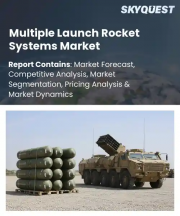
|
시장보고서
상품코드
2049485
다연장 로켓 시스템(MLRS) 시장 보고서 : 발사기, 구경 유형, 사정 범위, 포드 용량 및 지역별(2026-2034년)Multiple Launch Rocket Systems (MLRS) Market Report by Launch Vehicle (Tracked, Wheeled), Caliber Type (70-180 mm, 180-300 mm), Range (10-100 km, 100-300 km), Pod Capacity (Upto 16, More Than 16), and Region 2026-2034 |
||||||

세계의 다연장 로켓 시스템(MLRS) 시장 규모는 2025년에 8억 1,800만 달러에 달했습니다. 향후 IMARC Group은 2034년까지 시장 규모가 13억 100만 달러에 달하며, 2026-2034년에 CAGR 5.13%로 성장할 것으로 예측하고 있습니다. 지정학적 긴장의 증가, 군대의 현대화, 국방 예산의 증가, 지속적인 기술 발전이 시장 성장을 주도하고 있습니다.
다연장 로켓 시스템(MLRS) 시장 동향:
군사비 증가
군사비 증가가 다연장 로켓 시스템(MLRS) 시장을 주도하고 있습니다. 예를 들어 스톡홀름 국제평화연구소(SIPRI)가 발표한 기사에 따르면 2023년 세계 군사비 총액은 2조 4,400억 달러로 2022년 대비 실질 6.8% 증가했다고 합니다. 각국 정부는 정밀유도탄, 사거리 연장 로켓, 네트워크화된 전장 시스템 등 신기술을 도입한 차세대 MLRS 플랫폼 개발에 자금을 지원하고 있습니다. 이러한 요인들로 인해 향후 수년간 다연장 로켓 시스템 시장의 점유율이 확대될 것으로 예상됩니다.
군 현대화
많은 국가들이 군대 현대화를 추진하고 있으며, 노후화된 장비를 보다 첨단이고 효과적인 시스템으로 대체하고 있습니다. 여기에는 구식 MLRS 플랫폼을 최신 기술로 업그레이드하고, 정밀유도탄과 사거리 연장 등 향상된 능력을 갖춘 완전히 새로운 시스템을 도입하는 것이 포함됩니다. 예를 들어 2024년 5월 미 육군은 록히드마틴에 4억 5,100만 달러 규모의 M270 다연장 로켓 시스템(MLRS)을 추가로 갱신하는 계약을 체결했습니다. 이를 통해 국내 발사체군이 확대되고, 전 세계 파트너 국가에 대한 지원 체계도 강화됩니다. 이러한 요인들은 다연장 로켓 시스템 시장 예측에 더욱 긍정적인 영향을 미칠 것으로 예상됩니다.
기술혁신
MLRS 기술 혁신이 시장 성장을 주도하고 있습니다. 이러한 발전에는 표적 포착 정확도 향상, 사거리 연장, 기동성 강화, 최신 디지털 전투 시스템과의 통합 등이 포함됩니다. 정밀유도탄(PGM)과 스마트 로켓의 개발은 MLRS 시스템의 효과를 높이고, 군 구매자에게 더욱 매력적으로 만들고 있습니다. 예를 들어 2024년 9월 호주는 미국산 유도 다연장 로켓 시스템(GMLRS) 미사일에 국내 생산 로켓 모터와 탄두를 탑재하여 정밀유도탄(PGM)의 국내 생산 능력을 확대할 계획을 세웠습니다. 이를 통해 다연장 로켓 시스템 시장의 매출을 끌어올릴 수 있을 것으로 예상됩니다.
목차
제1장 서문
제2장 조사 범위와 조사 방법
제3장 개요
제4장 서론
제5장 세계의 다연장 로켓 시스템(MLRS) 시장
제6장 시장 내역 : 발사기별
제7장 시장 내역 : 구경 유형
제8장 시장 내역 : 사정 범위별
제9장 시장 내역 : 포드 용량별
제10장 시장 내역 : 지역별
제11장 SWOT 분석
제12장 밸류체인 분석
제13장 Porter's Five Forces 분석
제14장 가격 분석
제15장 경쟁 구도
KSA 26.06.11The global multiple launch rocket systems (MLRS) market size reached USD 818.0 Million in 2025. Looking forward, IMARC Group expects the market to reach USD 1,301.0 Million by 2034, exhibiting a growth rate (CAGR) of 5.13% during 2026-2034.The rising geopolitical tensions, modernization of armed forces, increased defense budgets, and ongoing technological advancements are primarily driving the market's growth.
Multiple Launch Rocket Systems (MLRS) Market Trends:
Rising Military Expenditure
The increasing military expenditure is driving the multiple launch rocket systems (MLRS) Market. For instance, according to an article published by the Stockholm International Peace Research Institute, total global military expenditure reached US$ 2.44 trillion in 2023, up 6.8% in real terms from 2022. Governments are funding the development of next-generation MLRS platforms that incorporate new technologies such as precision-guided munitions, extended-range rockets, and networked battlefield systems. These factors are expected to propel the multiple launch rocket systems market share in the coming years.
Modernization of Military Forces
Many countries are pursuing the modernization of their armed forces, replacing aging equipment with more sophisticated and effective systems. This includes upgrading older MLRS platforms with newer technology, as well as acquiring entirely new systems with enhanced capabilities, such as precision-guided munitions and extended range. For instance, in May 2024, the United States Army granted Lockheed Martin a US$ 451 million contract to recapitalize additional M270 Multiple Launch Rocket Systems (MLRS), expanding its domestic fleet of launchers and providing improvements for global partners. These factors further positively influence the multiple launch rocket systems market forecast.
Technological Innovations
Innovations in MLRS technology are driving the market growth. These advancements include improved targeting accuracy, longer ranges, enhanced mobility, and integration with modern digital warfare systems. The development of precision-guided munitions (PGMs) and smart rockets enhances the effectiveness of MLRS systems, making them more attractive to military buyers. For instance, in September 2024, Australia planned to increase its domestic production capability of precision guided munitions (PGM) by inserting locally produced rocket motors and warheads into US guided multiple launch rocket system (GMLRS) missiles, thereby boosting the multiple launch rocket systems market revenue.
Global Multiple Launch Rocket Systems (MLRS) Industry Segmentation:
The publisher provides an analysis of the key trends in each segment of the global multiple launch rocket systems (MLRS) market report, along with forecasts at the global, regional, and country levels from 2026-2034. Our report has categorized the market based on launch vehicle, caliber type, range and pod capacity.
Breakup by Launch Vehicle:
- Tracked
- Wheeled
Wheeled exhibits a clear dominance in the market
According to the multiple launch rocket systems market outlook, wheeled MLRS platforms offer greater mobility compared to their tracked counterparts, allowing for faster deployment and repositioning. This makes them ideal for rapid-response operations and for covering large areas of terrain in dynamic combat environments. Moreover, wheeled systems generally have lower maintenance costs than tracked systems. They experience less wear and tear on components and tend to be easier and cheaper to maintain and repair. This is attractive for militaries looking to reduce the overall lifecycle costs of their artillery systems.
Breakup by Caliber Type:
- 70-180 mm
- 180-300 mm
Currently, 70-180 mm accounts for the majority of the total market share
According to the multiple launch rocket systems market overview, the caliber range of 70-180 mm is versatile, offering a balance between range, payload capacity, and mobility. These systems are suitable for a variety of missions, from close support operations to longer-range bombardment, making them attractive to many military forces. Moreover, the growing emphasis on asymmetric and irregular warfare, including counter-insurgency operations, is driving the demand for MLRS in this caliber range.
Breakup by Range:
- 10-100 km
- 100-300 km
100-300 km holds the largest market share
These systems provide the ability to strike deeper into enemy territory, targeting critical infrastructure, command centers, and supply lines. This range capability is essential for modern military strategies focused on precision strikes and disrupting enemy operations from a safe distance. Moreover, countries seek to enhance their strategic deterrence by acquiring MLRS systems with a 100-300 km range. These systems act as a deterrent against adversaries, giving militaries the ability to respond quickly and effectively to threats without needing to move forces into vulnerable positions.
Breakup by Pod Capacity:
- Upto 16
- More Than 16
Upto 16 exhibits a clear dominance in the market
Systems with up to 16 pod capacity provide a balance between firepower and mobility. These systems can be deployed in a wide variety of combat scenarios, from smaller-scale engagements to medium-intensity conflicts, offering versatility to military forces that need flexibility. Moreover, this capacity enables effective fire support in tactical operations, allowing for substantial barrages without overwhelming logistical requirements. It's particularly useful for supporting infantry and armored units in mid-scale battlefield environments.
Breakup by Region:
- North America
- United States
- Canada
- Asia Pacific
- China
- Japan
- India
- South Korea
- Australia
- Indonesia
- Others
- Europe
- Germany
- France
- United Kingdom
- Italy
- Spain
- Russia
- Others
- Latin America
- Brazil
- Mexico
- Others
- Middle East and Africa
North America currently dominates the global market
The report has also provided a comprehensive analysis of all the major regional markets, which include North America (the United States and Canada); Europe (Germany, France, the United Kingdom, Italy, Spain, Russia, and others); Asia Pacific (China, Japan, India, South Korea, Australia, Indonesia, and others); Latin America (Brazil, Mexico, and others); and the Middle East and Africa. According to the report, North America currently dominates the global market.
According to the multiple launch rocket systems market statistics, the U.S. and Canada continue to allocate substantial resources to defense, with a focus on modernizing their military capabilities. The U.S. has one of the largest defense budgets globally, and a significant portion is directed towards artillery systems like MLRS as part of long-term modernization strategies, which is further driving the market's growth. For instance, in May 2024, Lockheed Martin received a contract to supply additional High Mobility Artillery Rocket Systems (HIMARS) to the US Army. The HIMARS can fire the full MLRS family of weapons, including the extended-range variant.
Competitive Landscape:
The multiple launch rocket systems market research report has provided a comprehensive analysis of the competitive landscape. Detailed profiles of all major market companies have also been provided. Some of the key players in the market include:
- Avibras Industria Aeroespacial
- BAE Systems Plc
- Denel Land Systems (Denel SOC Ltd.)
- Diehl Defence GmbH & Co. KG (Diehl Stiftung & Co. KG)
- Hanwha Corporation
- IMI Systems Ltd. (Elbit Systems Ltd.)
- Larsen & Toubro Limited
- Lockheed Martin Corporation
- Roketsan Roket Sanayii ve Ticaret A.S.
- Tata Advanced Systems Limited (Tata Sons Private Limited)
Key Questions Answered in This Report
1. What was the size of the global multiple launch rocket systems (MLRS) market in 2025?
2. What is the expected growth rate of the global multiple launch rocket systems (MLRS) market during 2026-2034?
3. What has been the impact of COVID-19 on the global multiple launch rocket systems (MLRS) market?
4. What are the key factors driving the global multiple launch rocket systems (MLRS) market?
5. What is the breakup of the global multiple launch rocket systems (MLRS) market based on the launch vehicle?
6. What is the breakup of the global multiple launch rocket systems (MLRS) market based on the caliber type?
7. What is the breakup of the global multiple launch rocket systems (MLRS) market based on the range?
8. What is the breakup of the global multiple launch rocket systems (MLRS) market based on the pod capacity?
9. What are the key regions in the global multiple launch rocket systems (MLRS) market?
10. Who are the key players/companies in the global multiple launch rocket systems (MLRS) market?
Table of Contents
1 Preface
2 Scope and Methodology
- 2.1 Objectives of the Study
- 2.2 Stakeholders
- 2.3 Data Sources
- 2.3.1 Primary Sources
- 2.3.2 Secondary Sources
- 2.4 Market Estimation
- 2.4.1 Bottom-Up Approach
- 2.4.2 Top-Down Approach
- 2.5 Forecasting Methodology
3 Executive Summary
4 Introduction
- 4.1 Overview
- 4.2 Key Industry Trends
5 Global Multiple Launch Rocket Systems (MLRS) Market
- 5.1 Market Overview
- 5.2 Market Performance
- 5.3 Impact of COVID-19
- 5.4 Market Forecast
6 Market Breakup by Launch Vehicle
- 6.1 Tracked
- 6.1.1 Market Trends
- 6.1.2 Market Forecast
- 6.2 Wheeled
- 6.2.1 Market Trends
- 6.2.2 Market Forecast
7 Market Breakup by Caliber Type
- 7.1 70-180 mm
- 7.1.1 Market Trends
- 7.1.2 Market Forecast
- 7.2 180-300 mm
- 7.2.1 Market Trends
- 7.2.2 Market Forecast
8 Market Breakup by Range
- 8.1 10-100 km
- 8.1.1 Market Trends
- 8.1.2 Market Forecast
- 8.2 100-300 km
- 8.2.1 Market Trends
- 8.2.2 Market Forecast
9 Market Breakup by Pod Capacity
- 9.1 Upto 16
- 9.1.1 Market Trends
- 9.1.2 Market Forecast
- 9.2 More Than 16
- 9.2.1 Market Trends
- 9.2.2 Market Forecast
10 Market Breakup by Region
- 10.1 North America
- 10.1.1 United States
- 10.1.1.1 Market Trends
- 10.1.1.2 Market Forecast
- 10.1.2 Canada
- 10.1.2.1 Market Trends
- 10.1.2.2 Market Forecast
- 10.1.1 United States
- 10.2 Asia Pacific
- 10.2.1 China
- 10.2.1.1 Market Trends
- 10.2.1.2 Market Forecast
- 10.2.2 Japan
- 10.2.2.1 Market Trends
- 10.2.2.2 Market Forecast
- 10.2.3 India
- 10.2.3.1 Market Trends
- 10.2.3.2 Market Forecast
- 10.2.4 South Korea
- 10.2.4.1 Market Trends
- 10.2.4.2 Market Forecast
- 10.2.5 Australia
- 10.2.5.1 Market Trends
- 10.2.5.2 Market Forecast
- 10.2.6 Indonesia
- 10.2.6.1 Market Trends
- 10.2.6.2 Market Forecast
- 10.2.7 Others
- 10.2.7.1 Market Trends
- 10.2.7.2 Market Forecast
- 10.2.1 China
- 10.3 Europe
- 10.3.1 Germany
- 10.3.1.1 Market Trends
- 10.3.1.2 Market Forecast
- 10.3.2 France
- 10.3.2.1 Market Trends
- 10.3.2.2 Market Forecast
- 10.3.3 United Kingdom
- 10.3.3.1 Market Trends
- 10.3.3.2 Market Forecast
- 10.3.4 Italy
- 10.3.4.1 Market Trends
- 10.3.4.2 Market Forecast
- 10.3.5 Spain
- 10.3.5.1 Market Trends
- 10.3.5.2 Market Forecast
- 10.3.6 Russia
- 10.3.6.1 Market Trends
- 10.3.6.2 Market Forecast
- 10.3.7 Others
- 10.3.7.1 Market Trends
- 10.3.7.2 Market Forecast
- 10.3.1 Germany
- 10.4 Latin America
- 10.4.1 Brazil
- 10.4.1.1 Market Trends
- 10.4.1.2 Market Forecast
- 10.4.2 Mexico
- 10.4.2.1 Market Trends
- 10.4.2.2 Market Forecast
- 10.4.3 Others
- 10.4.3.1 Market Trends
- 10.4.3.2 Market Forecast
- 10.4.1 Brazil
- 10.5 Middle East and Africa
- 10.5.1 Market Trends
- 10.5.2 Market Breakup by Country
- 10.5.3 Market Forecast
11 SWOT Analysis
- 11.1 Overview
- 11.2 Strengths
- 11.3 Weaknesses
- 11.4 Opportunities
- 11.5 Threats
12 Value Chain Analysis
13 Porters Five Forces Analysis
- 13.1 Overview
- 13.2 Bargaining Power of Buyers
- 13.3 Bargaining Power of Suppliers
- 13.4 Degree of Competition
- 13.5 Threat of New Entrants
- 13.6 Threat of Substitutes
14 Price Analysis
15 Competitive Landscape
- 15.1 Market Structure
- 15.2 Key Players
- 15.3 Profiles of Key Players
- 15.3.1 Avibras Industria Aeroespacial
- 15.3.1.1 Company Overview
- 15.3.1.2 Product Portfolio
- 15.3.1.3 Financials
- 15.3.2 BAE Systems Plc
- 15.3.2.1 Company Overview
- 15.3.2.2 Product Portfolio
- 15.3.2.3 Financials
- 15.3.2.4 SWOT Analysis
- 15.3.3 Denel Land Systems (Denel SOC Ltd.)
- 15.3.3.1 Company Overview
- 15.3.3.2 Product Portfolio
- 15.3.4 Diehl Defence GmbH & Co. KG (Diehl Stiftung & Co. KG)
- 15.3.4.1 Company Overview
- 15.3.4.2 Product Portfolio
- 15.3.5 Hanwha Corporation
- 15.3.5.1 Company Overview
- 15.3.5.2 Product Portfolio
- 15.3.5.3 Financials
- 15.3.6 IMI Systems Ltd. (Elbit Systems Ltd.)
- 15.3.6.1 Company Overview
- 15.3.6.2 Product Portfolio
- 15.3.7 Larsen & Toubro Limited
- 15.3.7.1 Company Overview
- 15.3.7.2 Product Portfolio
- 15.3.7.3 Financials
- 15.3.7.4 SWOT Analysis
- 15.3.8 Lockheed Martin Corporation
- 15.3.8.1 Company Overview
- 15.3.8.2 Product Portfolio
- 15.3.8.3 Financials
- 15.3.8.4 SWOT Analysis
- 15.3.9 Roketsan Roket Sanayii ve Ticaret A.S.
- 15.3.9.1 Company Overview
- 15.3.9.2 Product Portfolio
- 15.3.10 Tata Advanced Systems Limited (Tata Sons Private Limited)
- 15.3.10.1 Company Overview
- 15.3.10.2 Product Portfolio
- 15.3.1 Avibras Industria Aeroespacial