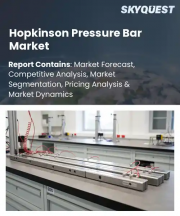
|
시장보고서
상품코드
1955193
스플릿 홉킨슨 바 시장 : 시험 모드, 장비 유형, 재료, 최종 용도별 - 세계 예측(2026-2032년)Split Hopkinson Bar Market by Test Mode, Equipment Type, Material, End Use - Global Forecast 2026-2032 |
||||||
 360iResearch
스플릿 홉킨슨 바 시장은 2025년에 1억 2,943만 달러로 평가되었으며, 2026년에는 1억 3,986만 달러로 성장하여 CAGR은 6.22%로 성장하여 2032년에는 1억 9,754만 달러에 달할 것으로 예측됩니다.
| 주요 시장 통계 | |
|---|---|
| 기준 연도 2025년 | 1억 2,943만 달러 |
| 추정 연도 2026년 | 1억 3,986만 달러 |
| 예측 연도 2032년 | 1억 9,754만 달러 |
| CAGR(%) | 6.22 |
스플릿 홉킨슨 바의 기본 원리, 현대적 응용 및 산업 전반의 고변형 속도 테스트에서 전략적 중요성에 대해 간결하고 포괄적으로 소개합니다.
스플릿 홉킨슨 바는 높은 변형률에서 재료의 거동을 특성화하는 결정적인 실험실 기술로, 다양한 과학적 및 산업적 요구를 충족시킵니다. 동적 재료 시험의 기초 연구에서 시작된 이 방법은 계측 기술, 신호 처리, 재료 과학의 발전과 함께 발전해 왔습니다. 오늘날, 구성 모델 검증, 충돌 안전성 계산 및 급격한 하중 조건에서 고성능 합금 및 복합재료의 개발을 지원하기 위한 경험적 기초를 제공하고 있습니다.
계측기 자동화, 재료 혁신, 다학제적 통합 등 스플릿 홉킨스 바 시험 분야를 재구성하는 혁신적인 변화가 성과를 가속화하는 데 기여하고 있습니다.
스플릿 홉킨스 바 시험의 상황은 기술의 발전, 재료 수요의 변화, 그리고 분야 간 협력으로 인해 몇 가지 혁신적인 변화를 겪고 있습니다. 새로운 계측기 아키텍처는 디지털 제어, 자동 펄스 성형, 실시간 데이터 분석을 점점 더 통합하고 있으며, 이를 결합하여 실험 처리 시간을 단축하고 재현성을 향상시킵니다. 계측장비의 혁신과 더불어 고강도 알루미늄 합금, 섬유강화 복합재료, 새로운 티타늄 배합 등 첨단 재료의 보급으로 설계 및 인증에 정보를 제공하기 위한 정확한 고변형률 특성 확보가 다시금 중요시되고 있습니다.
2025년 미국에서 시행된 최근 관세 조치가 조달 전략, 공급망 연속성 및 테스트 인프라에 대한 기술적 의사결정에 미치는 영향
2025년 미국에서 시행된 최근 관세 조치로 인해 스플릿 홉킨슨 바 시스템 및 관련 부품을 조달하는 조직은 구체적인 운영상의 고려사항이 생겼습니다. 조달팀은 수입되는 계측기 서브 어셈블리, 정밀 센서 및 펄스 성형 부품에 사용되는 특수 재료에 대한 관세의 영향을 고려하여 공급업체 선정 기준을 재평가하고 있습니다. 그 결과, 바이어들은 비용 변동을 완화하고 프로그램 리스크를 최소화하기 위해 공급업체의 투명성, 리드타임의 확실성, 현지 재고 전략을 더욱 중요하게 여기고 있습니다.
중요한 세분화 결과는 동적 테스트의 실제 사용 패턴을 결정하고, 최종 용도, 테스트 모드, 장비 유형 및 재료별 거동을 결정합니다.
부문 분석을 통해 최종 용도, 테스트 모드, 장비 유형, 재료 종류에 따른 미묘한 수요 요인이 밝혀졌으며, 이러한 요인들이 종합적으로 스플릿 홉킨스 바의 기능을 전개하는 방식을 형성합니다. 최종 사용 범주에서 학술 연구는 종종 기초 변형 메커니즘과 방법론 개발에 초점을 맞추는 반면, 항공우주 및 방위 분야의 활동은 민간 인증 요구 사항과 특수 군사 검증 프로그램 모두에 초점을 맞추고 있습니다. 자동차 업계 이해관계자들은 OEM 제품 개발 및 애프터마켓 부품 인증에 시험을 활용하고 있으며, 산업 사용자들은 제조 품질 보증 및 석유 및 가스 부품의 복원력 평가에 고변형 속도 특성평가를 적용하고 있습니다.
아메리카, 유럽, 중동 및 아프리카, 아시아태평양의 지역적 동향과 전략적 고려사항이 도입 개발 및 공동 테스트 프로그램에 영향을 미치고 있습니다.
지역적 역학은 스플릿 홉킨스 바의 인프라와 전문 지식의 발전에 큰 영향을 미치고 있으며, 지리적 시장에 따라 연구 중점, 조달 관행 및 협력 네트워크에 차이가 있습니다. 아메리카에는 첨단 국방 프로그램, 자동차 연구 센터 및 대학 연구소가 집중되어 있어 계측 장비의 정확성, 추적 가능한 조사 방법 및 신속한 대응 능력에 대한 수요를 주도하고 있습니다. 이러한 환경은 인증 지원 및 조사 방법의 표준화를 위해 벤더와 고객과의 긴밀한 파트너십과 서비스를 촉진하고 있습니다.
스플릿 홉킨스 바의 기능을 촉진하는 계측기 제조업체, 전문 통합업체, 공인 서비스 제공업체 간의 주요 경쟁 행동 및 전략적 포지셔닝
스플릿 홉킨스 바 분야의 경쟁 역학은 플레이어의 수보다는 기술 전문성의 깊이, 애프터 서비스, 그리고 현대 진단 생태계와 통합하는 능력에 의해 정의됩니다. 기존 장비 공급업체들은 정밀 엔지니어링, 검증된 제어 알고리즘, 광범위한 교정 지원으로 차별화를 꾀하고 있습니다. 한편, 전문 통합업체와 기계 공장은 자체 실험 요구에 맞는 맞춤형 가스총 시스템 및 맞춤형 펄스 성형 부품을 공급하고 있습니다. 서비스 연구소 및 제3자 테스트 제공업체는 인증된 테스트 경로, 신속한 대응, 고객이 공급업체의 주장을 검증하고 프로그램 제약 조건 하에서 재료를 인증하는 데 도움이 되는 비교 데이터를 제공함으로써 부가가치를 창출하고 있습니다.
업계 리더들이 스플릿 홉킨슨 바에 대한 투자 수익을 극대화하기 위한 조달, 교정 및 협업 전략을 최적화하기 위한 실용적인 권장 사항
업계 리더들은 스플릿 홉킨슨 바 테스트 자산의 가치를 극대화하기 위해 조달, 연구소 운영, R&D 전략을 통합하는 협력적 접근 방식을 채택해야 합니다. 첫째, 자본 투자를 보호하고 단계적 용량 확장을 촉진하기 위해 모듈식 장비 아키텍처와 업그레이드 가능한 제어 시스템을 우선시하십시오. 이러한 접근 방식을 통해 조직은 전체 플랫폼을 교체하지 않고도 고급 진단 및 펄스 성형 기능을 도입할 수 있으며, 장기적인 테스트 프로그램의 연속성을 유지할 수 있습니다.
신뢰할 수 있고 재현성 있는 스플릿 홉킨슨 바의 연구 결과를 확보하기 위해 주요 이해관계자 인터뷰, 기술 통합, 표적화된 장비 검증을 결합한 강력한 조사 방법을 사용합니다.
이 분석은 1차 인터뷰, 기술 문헌의 통합, 장비 수준의 검증 연습을 결합한 혼합 연구 접근 방식을 채택하여 견고하고 실용적인 인사이트를 확보했습니다. 주요 활동으로는 연구소장, 시험 엔지니어, 조달 전문가와의 토론을 통해 업무 우선순위, 과제, 새로운 요구사항에 대해 직접적으로 파악할 수 있었습니다. 이러한 정성적 정보를 기술 논문, 표준 문서, 장비 사양과 비교하여 방법의 차이, 신호 처리의 실제, 교정 체계에 대한 종합적인 이해를 구축했습니다.
결론적으로, 스플릿 홉킨슨 바 시험 기능을 활용하는 조직을 위한 기술적 요점, 전략적 시사점 및 실무적 다음 단계를 통합합니다.
결론적으로, 스플릿 홉킨슨 바는 높은 변형률 재료 특성 평가의 기본 기술로 남아 있으며, 지속적인 진화는 계측 장비, 재료 공학 및 데이터 기반 분석의 광범위한 추세를 반영하고 있습니다. 디지털 제어, 진단, 모듈식 장비 설계의 발전으로 재현성이 향상되어 항공우주, 국방, 자동차, 산업 사용 사례 등 이 기술의 적용 범위가 확대되고 있습니다. 동시에, 조달 역학의 발전과 지역적 우선순위에 따라 조직은 위험을 줄이고 역량 개발을 가속화하기 위해 전략적 조달, 공급업체 투명성 및 협업을 채택해야 합니다.
자주 묻는 질문
목차
제1장 서문
제2장 조사 방법
제3장 주요 요약
제4장 시장 개요
제5장 시장 인사이트
제6장 미국 관세의 누적 영향, 2025
제7장 AI의 누적 영향, 2025
제8장 스플릿 홉킨슨 바 시장 : 시험 모드별
제9장 스플릿 홉킨슨 바 시장 : 장비별
제10장 스플릿 홉킨슨 바 시장 : 소재별
제11장 스플릿 홉킨슨 바 시장 : 최종 용도별
제12장 스플릿 홉킨슨 바 시장 : 지역별
제13장 스플릿 홉킨슨 바 시장 : 그룹별
제14장 스플릿 홉킨슨 바 시장 : 국가별
제15장 미국 스플릿 홉킨슨 바 시장
제16장 중국 스플릿 홉킨슨 바 시장
제17장 경쟁 구도
KSM 26.03.25The Split Hopkinson Bar Market was valued at USD 129.43 million in 2025 and is projected to grow to USD 139.86 million in 2026, with a CAGR of 6.22%, reaching USD 197.54 million by 2032.
| KEY MARKET STATISTICS | |
|---|---|
| Base Year [2025] | USD 129.43 million |
| Estimated Year [2026] | USD 139.86 million |
| Forecast Year [2032] | USD 197.54 million |
| CAGR (%) | 6.22% |
A concise yet comprehensive introduction to Split Hopkinson Bar fundamentals contemporary applications and strategic relevance for high strain-rate testing across industries
The Split Hopkinson Bar remains the definitive laboratory technique for characterizing material behavior at high strain rates, serving a diverse set of scientific and industrial needs. Originating from foundational work in dynamic materials testing, the method has evolved in parallel with advances in instrumentation, signal processing, and material science. Today it provides the empirical basis for validating constitutive models, informing crashworthiness calculations, and supporting the development of high-performance alloys and composites under rapid loading conditions.
Practitioners rely on the apparatus to resolve time-resolved stress-strain relationships at strain rates that elude quasi-static testing methods. As testing paradigms mature, investigators combine advanced diagnostics such as high-speed imaging, digital image correlation, and embedded sensors to obtain richer datasets and to reduce uncertainty in derived parameters. Consequently, laboratories and testing providers that emphasize calibration rigor, instrument traceability, and data reproducibility command greater trust among stakeholders. Ultimately, the introduction frames the remainder of the executive summary by clarifying the technique's technical scope, operational prerequisites, and the practical problems it solves across research, defense, and industrial applications
Transformative shifts reshaping the Split Hopkinson Bar landscape including instrumentation automation materials innovation and cross-disciplinary integration to accelerate outcomes
The landscape for Split Hopkinson Bar testing is undergoing several transformative shifts driven by technological advances, changing material demands, and cross-sector collaboration. New instrumentation architectures increasingly integrate digital control, automated pulse-shaping, and real-time data analytics, which together compress experimental turnaround and enhance repeatability. Parallel to instrumentation innovation, the proliferation of advanced materials-such as high-strength aluminum alloys, fiber-reinforced composites, and novel titanium formulations-has placed renewed emphasis on obtaining accurate high strain-rate properties to inform design and certification.
Moreover, multidisciplinary teams now combine numerical simulation, machine learning, and uncertainty quantification with experimental campaigns to accelerate model development and reduce the number of physical iterations required. Defense and aerospace programs have pushed for standardized protocols and traceable test procedures, prompting laboratories to invest in accreditation and inter-laboratory correlation studies. At the same time, supply chain pressures and onshoring initiatives have increased demand for local testing capacity and vendor diversification. In sum, these shifts are converging to create a testing ecosystem that is more automated, data-centric, and tightly coupled to downstream engineering workflows
How recent tariff actions in the United States during 2025 are influencing procurement strategies supply chain continuity and technical decision-making for testing infrastructure
Recent tariff actions in the United States during 2025 have introduced tangible operational considerations for organizations procuring Split Hopkinson Bar systems and related components. Procurement teams are reassessing vendor selection criteria to account for tariff exposure on imported instrumentation subassemblies, precision sensors, and specialized materials used in pulse-forming components. Consequently, buyers are placing greater emphasis on supplier transparency, lead-time certainty, and local inventory strategies to mitigate cost volatility and minimize program risk.
In response, some suppliers have adjusted sourcing strategies and expanded regional manufacturing footprints to preserve price stability and service levels. Research laboratories and OEMs have explored modular upgrade paths that allow incremental capitalization on new capabilities without replacing entire systems, thereby reducing sensitivity to import duties. At the same time, academic and defense laboratories are strengthening documentation and justification practices for capital acquisitions to ensure compliance with procurement policies and to demonstrate lifecycle value. Taken together, these developments underscore the importance of a strategic procurement posture that integrates tariff risk assessment, supplier continuity planning, and technical fit-for-purpose evaluations
Critical segmentation insights illuminating end-use applications test modes equipment types and material-specific behaviors that determine practical utilization patterns for dynamic testing
Segmentation analysis reveals nuanced demand drivers across end uses, test modes, equipment types, and material classes that collectively shape how Split Hopkinson Bar capabilities are deployed. Within end-use categories, academic research frequently focuses on fundamental deformation mechanisms and method development, while Aerospace & Defense activities concentrate on both civilian certification requirements and specialized military validation programs. Automotive stakeholders leverage testing for both OEM product development and aftermarket component qualification, and industrial users apply high strain-rate characterization to manufacturing quality assurance and oil & gas component resilience assessments.
When viewed by test mode, compressive testing remains central to impact and crash-relevant evaluations, tensile modes support dynamic failure and fracture studies, and torsional configurations address shear-dominated deformation scenarios. Equipment type distinctions are equally consequential: double-stage systems enable very high strain rates and are often selected for extreme-event simulations, gas gun arrangements emphasize controlled projectile-driven loading for impact replication, and single-stage apparatus retain strong value for routine lab-based dynamic material screening. Material-specific segmentation further refines test design; aluminum alloys exhibit distinct strain-rate sensitivity compared with composites, steels present complex strain-hardening and rate-dependent thermomechanical responses, and titanium requires tailored pulse shaping to avoid measurement artifacts. By integrating these segmentation layers, stakeholders can better align experimental protocols, equipment selection, and data-analysis pathways with their technical objectives
Regional dynamics and strategic considerations across the Americas Europe Middle East & Africa and Asia-Pacific shaping deployment development and collaborative testing programs
Regional dynamics exert a pronounced influence on how Split Hopkinson Bar infrastructure and expertise develop, with variation in research emphases, procurement practices, and collaboration networks across geographic markets. In the Americas, a concentration of advanced defense programs, automotive research centers, and university laboratories drives demand for instrument precision, traceable methodologies, and rapid turnaround capabilities. This environment favors close vendor-customer partnerships and services oriented toward certification support and method standardization.
Europe, Middle East & Africa present a heterogeneous picture where aerospace certification frameworks, robust industrial manufacturing bases, and regional research consortia collectively emphasize interoperability, harmonized protocols, and sustainability considerations in test campaigns. Laboratories across this region often participate in collaborative inter-laboratory studies and prioritize equipment that conforms to regional calibration and accreditation practices. Meanwhile, Asia-Pacific shows accelerating investment in domestic testing capability as supply chains mature, advanced materials research expands, and local OEMs scale product development. Here, stakeholders increasingly seek cost-effective modular systems, local service networks, and training programs to build in-country expertise. Across all regions, the interplay between regulatory requirements, industrial priorities, and academic collaboration shapes demand patterns and preferred partner profiles
Key competitive behaviors and strategic positioning among instrument manufacturers specialized integrators and accredited service providers that advance Split Hopkinson Bar capabilities
Competitive dynamics in the Split Hopkinson Bar space are defined less by the number of players and more by the depth of technical specialization, after-sales support, and the ability to integrate with contemporary diagnostic ecosystems. Established instrument vendors differentiate through precision engineering, validated control algorithms, and extensive calibration support, while specialized integrators and machine shops supply bespoke gas gun systems and custom pulse-shaping components tailored to unique experimental needs. Service laboratories and third-party testing providers add value by offering accredited testing pathways, rapid turnaround, and comparative data that help clients validate vendor claims and certify materials under program constraints.
Collaboration between equipment providers and academic or defense laboratories frequently accelerates capability development, enabling early access to novel diagnostics and joint method standardization. Providers that invest in modularity, documentation, and operator training secure stronger client retention because they reduce the technical barrier to adopting advanced test modes. Meanwhile, emerging entrants concentrate on software-enabled analytics, cloud-based data management, and retrofit options that extend the life of existing assets. Overall, company strategies that combine rigorous technical validation, responsive service offerings, and clear integration roadmaps generate the most traction among end users seeking reliable high strain-rate characterization
Actionable recommendations for industry leaders to optimize procurement calibration and collaboration strategies that maximize the return on Split Hopkinson Bar investments
Industry leaders should adopt a coordinated approach that aligns procurement, laboratory operations, and R&D strategies to extract maximal value from Split Hopkinson Bar testing assets. First, prioritize modular equipment architectures and upgradeable control systems to protect capital investments and facilitate staged capability expansion. This approach allows organizations to introduce advanced diagnostics and pulse-shaping features without replacing entire platforms, thereby preserving continuity in long-term test programs.
Second, invest in operator training programs and rigorous calibration protocols to minimize variability and to increase confidence in inter-laboratory data comparisons. Third, cultivate supplier relationships that emphasize transparency in component sourcing, lead-time guarantees, and service-level agreements to reduce operational risk in environments subject to regulatory shifts or supply-chain disruption. Fourth, integrate experimental campaigns with simulation and uncertainty-quantification workflows to accelerate model validation while reducing the number of costly physical iterations. Finally, pursue strategic collaborations with academic centers and certified third-party laboratories to access specialized test modes and to participate in inter-laboratory correlation studies that enhance credibility. By implementing these recommendations, organizations can improve data quality, reduce lifecycle cost, and accelerate the translation of high strain-rate insights into engineering decisions
Robust research methodology combining primary stakeholder interviews technical synthesis and targeted equipment validation to ensure credible and reproducible Split Hopkinson Bar insights
This analysis employs a mixed-methods research approach combining primary interviews, technical literature synthesis, and equipment-level validation exercises to ensure robust and actionable findings. Primary engagements included discussions with laboratory directors, test engineers, and procurement specialists, providing direct insight into operational priorities, pain points, and emerging requirements. These qualitative inputs were triangulated with technical papers, standards documents, and instrument specifications to build a comprehensive understanding of method variation, signal-processing practices, and calibration regimes.
Where feasible, equipment-level validation was undertaken through controlled comparative exercises that examined data fidelity across representative single-stage, double-stage, and gas-driven systems, and across compressive, tensile, and torsional test modes. Data integrity controls focused on sensor calibration, pulse-shaping fidelity, and the traceability of time-resolved measurements. Analytical safeguards included cross-referencing experimental outcomes with numerical model expectations and applying sensitivity analyses to identify critical sources of uncertainty. Finally, the research process emphasized transparency in assumptions and the documentation of methodological limitations to support reproducibility and to guide future research efforts
Conclusion synthesizing technical takeaways strategic implications and practical next steps for organizations leveraging Split Hopkinson Bar testing capabilities
In conclusion, the Split Hopkinson Bar remains a cornerstone technique for high strain-rate materials characterization, and its continued evolution reflects broader trends in instrumentation, materials engineering, and data-driven analysis. Advances in digital controls, diagnostics, and modular equipment design have improved repeatability and expanded the technique's applicability across aerospace, defense, automotive, and industrial use cases. At the same time, evolving procurement dynamics and regional priorities require organizations to adopt strategic sourcing, supplier transparency, and collaborations that mitigate risk and accelerate capability development.
Looking ahead, the most successful organizations will be those that couple rigorous experimental protocols with integrated simulation and analytics workflows, that invest in operator training and accreditation, and that pursue flexible procurement models that retain optionality in the face of regulatory and supply-chain change. By synthesizing technical, operational, and strategic considerations, stakeholders can better align testing programs to their engineering imperatives and ensure that high strain-rate data reliably informs design, certification, and materials innovation
Table of Contents
1. Preface
- 1.1. Objectives of the Study
- 1.2. Market Definition
- 1.3. Market Segmentation & Coverage
- 1.4. Years Considered for the Study
- 1.5. Currency Considered for the Study
- 1.6. Language Considered for the Study
- 1.7. Key Stakeholders
2. Research Methodology
- 2.1. Introduction
- 2.2. Research Design
- 2.2.1. Primary Research
- 2.2.2. Secondary Research
- 2.3. Research Framework
- 2.3.1. Qualitative Analysis
- 2.3.2. Quantitative Analysis
- 2.4. Market Size Estimation
- 2.4.1. Top-Down Approach
- 2.4.2. Bottom-Up Approach
- 2.5. Data Triangulation
- 2.6. Research Outcomes
- 2.7. Research Assumptions
- 2.8. Research Limitations
3. Executive Summary
- 3.1. Introduction
- 3.2. CXO Perspective
- 3.3. Market Size & Growth Trends
- 3.4. Market Share Analysis, 2025
- 3.5. FPNV Positioning Matrix, 2025
- 3.6. New Revenue Opportunities
- 3.7. Next-Generation Business Models
- 3.8. Industry Roadmap
4. Market Overview
- 4.1. Introduction
- 4.2. Industry Ecosystem & Value Chain Analysis
- 4.2.1. Supply-Side Analysis
- 4.2.2. Demand-Side Analysis
- 4.2.3. Stakeholder Analysis
- 4.3. Porter's Five Forces Analysis
- 4.4. PESTLE Analysis
- 4.5. Market Outlook
- 4.5.1. Near-Term Market Outlook (0-2 Years)
- 4.5.2. Medium-Term Market Outlook (3-5 Years)
- 4.5.3. Long-Term Market Outlook (5-10 Years)
- 4.6. Go-to-Market Strategy
5. Market Insights
- 5.1. Consumer Insights & End-User Perspective
- 5.2. Consumer Experience Benchmarking
- 5.3. Opportunity Mapping
- 5.4. Distribution Channel Analysis
- 5.5. Pricing Trend Analysis
- 5.6. Regulatory Compliance & Standards Framework
- 5.7. ESG & Sustainability Analysis
- 5.8. Disruption & Risk Scenarios
- 5.9. Return on Investment & Cost-Benefit Analysis
6. Cumulative Impact of United States Tariffs 2025
7. Cumulative Impact of Artificial Intelligence 2025
8. Split Hopkinson Bar Market, by Test Mode
- 8.1. Compressive
- 8.2. Tensile
- 8.3. Torsional
9. Split Hopkinson Bar Market, by Equipment Type
- 9.1. Double Stage
- 9.2. Gas Gun
- 9.3. Single Stage
10. Split Hopkinson Bar Market, by Material
- 10.1. Aluminum
- 10.2. Composite
- 10.3. Steel
- 10.4. Titanium
11. Split Hopkinson Bar Market, by End Use
- 11.1. Academic Research
- 11.2. Aerospace & Defense
- 11.2.1. Civilian
- 11.2.2. Military
- 11.3. Automotive
- 11.3.1. Aftermarket
- 11.3.2. Oem
- 11.4. Industrial
- 11.4.1. Manufacturing
- 11.4.2. Oil & Gas
12. Split Hopkinson Bar Market, by Region
- 12.1. Americas
- 12.1.1. North America
- 12.1.2. Latin America
- 12.2. Europe, Middle East & Africa
- 12.2.1. Europe
- 12.2.2. Middle East
- 12.2.3. Africa
- 12.3. Asia-Pacific
13. Split Hopkinson Bar Market, by Group
- 13.1. ASEAN
- 13.2. GCC
- 13.3. European Union
- 13.4. BRICS
- 13.5. G7
- 13.6. NATO
14. Split Hopkinson Bar Market, by Country
- 14.1. United States
- 14.2. Canada
- 14.3. Mexico
- 14.4. Brazil
- 14.5. United Kingdom
- 14.6. Germany
- 14.7. France
- 14.8. Russia
- 14.9. Italy
- 14.10. Spain
- 14.11. China
- 14.12. India
- 14.13. Japan
- 14.14. Australia
- 14.15. South Korea
15. United States Split Hopkinson Bar Market
16. China Split Hopkinson Bar Market
17. Competitive Landscape
- 17.1. Market Concentration Analysis, 2025
- 17.1.1. Concentration Ratio (CR)
- 17.1.2. Herfindahl Hirschman Index (HHI)
- 17.2. Recent Developments & Impact Analysis, 2025
- 17.3. Product Portfolio Analysis, 2025
- 17.4. Benchmarking Analysis, 2025
- 17.5. Advance Instrument Inc.
- 17.6. DK Hottinger Bruel & Kjaer A/S
- 17.7. DYNA-MESS Prufsysteme GmbH
- 17.8. Instron
- 17.9. MTS Systems Corporation
- 17.10. Oriental Option Sdn. Bhd.
- 17.11. REL Inc.
- 17.12. Shimadzu Corporation
- 17.13. Team Corporation
- 17.14. THIOT INGENIERIE by EURENCO Group
- 17.15. Tinius Olsen, Inc.
- 17.16. ZwickRoell GmbH & Co. KG