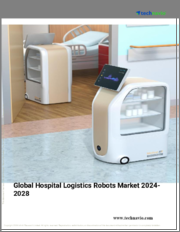
|
시장보고서
상품코드
2003935
병원 물류 로봇 시장 : 로봇 유형별, 적재량별, 내비게이션 기술별, 용도별, 최종 사용자별 - 시장 예측(2026-2032년)Hospital Logistics Robots Market by Robot Type, Payload Capacity, Navigation Technology, Application, End User - Global Forecast 2026-2032 |
||||||
 360iResearch
병원 물류 로봇 시장은 2025년에 12억 3,000만 달러로 평가되었고, 2026년에는 13억 6,000만 달러로 성장할 전망이며, CAGR 10.40%로 성장을 지속하여, 2032년까지 24억 6,000만 달러에 이를 것으로 예측됩니다.
| 주요 시장 통계 | |
|---|---|
| 기준 연도 : 2025년 | 12억 3,000만 달러 |
| 추정 연도 : 2026년 | 13억 6,000만 달러 |
| 예측 연도 : 2032년 | 24억 6,000만 달러 |
| CAGR(%) | 10.40% |
의료 시스템이 임상 업무에서 효율성, 안전성, 강력한 공급망을 추구함에 따라 병원 물류 로봇의 전략적 필요성이 대두되고 있습니다.
병원과 의료 시스템은 업무 효율성을 높이고, 임상적 위험을 줄이며, 인적 자원을 보다 가치 있는 환자 치료에 투입해야 한다는 지속적인 압박을 받고 있습니다. 병원 물류 로봇은 반복적인 이송 작업의 자동화, 자재 흐름의 표준화, 예측 가능한 공급의 연속성을 실현함으로써 이러한 과제를 해결하기 위한 실용적인 수단으로 부상하고 있습니다. 초기 도입은 식사 배식이나 린넨 운반과 같은 제한된 이용 사례에 초점을 맞추었지만, 센서 융합, 내비게이션, 임상 워크플로우와의 통합이 성숙해짐에 따라 현재 약품 분배, 검체 취급, 폐기물 관리로 점점 더 확대되고 있습니다.
임상 현장 전반의 자율 운영, AI를 활용한 워크플로우, 인간과 협동로봇의 협업을 통해 병원 물류 로봇을 재구성하는 혁신적 변화의 식별
자율성, 센싱, 소프트웨어 오케스트레이션의 발전이 새로운 운영상의 기대와 결합하면서 병원 물류 로봇의 상황은 빠르게 변화하고 있습니다. 자율 내비게이션 기능은 제한된 채널 유도에서 동적 장애물 회피 및 다중 에이전트 협동으로 진화하여 로봇이 복잡한 임상 환경 내에서 안전하게 이동할 수 있도록 하고 있습니다. 동시에 AI와 엣지 컴퓨팅의 발전으로 디바이스 상에서 의사결정을 내릴 수 있게 되어 트래픽이 많은 환경에서 지연을 줄이고 신뢰성을 높일 수 있게 되었습니다.
2025년 미국의 관세 정책이 병원용 로봇 공급망, 조달 전략, 조달 동향에 미치는 누적 영향 평가
2025년에 도입된 새로운 관세 조치는 병원용 로봇 프로그램을 지원하는 공급망 전체에 분명한 파급 효과를 가져왔습니다. 특수 센서, 구동 시스템, 반도체 모듈 등의 부품은 대부분 해외에서 조달하는 경우가 많은데, 관세 구조의 변화로 인해 수입 하드웨어의 총 착륙 비용이 증가하고 있습니다. 따라서 조달팀은 공급업체 선정 기준을 재검토하고, 단기적인 비용 압박과 장기적인 신뢰성 및 지원 체계와의 균형을 고려해야 합니다.
로봇 유형, 용도, 최종 사용자, 적재 능력, 네비게이션 기술별 수요 요인 파악, 실용적인 세분화에 대한 인사이트
관점은 전체 병원 물류 로봇 수요 패턴과 운영상의 적합성을 명확히 합니다. 로봇 유형별로 살펴보면, 무인운반차(AGV)와 자율이동로봇(AMR)은 각각 다른 도입 패턴을 보입니다. 무인 운반 차량은 높은 처리 능력이 요구되는 구조화된 통로에서 운영되는 경우가 많은 반면, 자율 이동 로봇은 변화무쌍한 임상 환경에서 유연한 채널 설정과 주문형 작업을 가능하게 합니다. 용도에 따른 세분화에서는 자재관리이나 약품 배송은 약국 시스템이나 재고 관리 시스템과의 고도의 통합 정밀도가 요구되는 반면, 식사 배식이나 폐기물 관리는 운영 노하우를 구축하기 위한 리스크가 적은 파일럿 프로젝트로 도입할 수 있는 경우가 많다는 것을 알 수 있습니다. 최종 사용자별 세분화에서는 도입 촉진요인과 제약 조건이 각각 다릅니다. 외래진료센터는 처리 능력과 환자 경험을 우선시하고, 진단검사실은 관리의 사슬(Chain of Custody)과 오염 관리를 중시하며, 병원은 확장성과 야간 운영을 요구하고, 연구소는 재현성과 프로토콜 준수에 중점을 둡니다. 적재 용량을 고려하면 기술 선택의 폭이 더욱 좁혀집니다. 200kg 이하의 플랫폼은 각 부서 내 빈번하고 고빈도 업무에 대응하고, 200-500kg의 솔루션은 시설 간 대규모 대량 운송에 대응하며, 500kg 이상의 시스템은 중량물 물류 및 집중 공급의 이동을 가능하게 합니다. 항법 기술(관성 항법 시스템, 레이저 비전, LiDAR, 자기 테이프 등)의 선택은 환경의 복잡성, 규제 당국의 승인 절차, 시설 내 유지보수 능력과 일치해야 합니다.
로봇 도입에 영향을 미치는 북미, 남미, 유럽, 중동 및 아프리카, 아시아태평양 의료시스템의 지역별 전략적 차별화 요소와 도입 패턴
지역별 동향은 병원용 물류용 로봇의 도입 방식과 의료 시스템과의 통합에 큰 영향을 미칩니다. 북미와 남미에서는 의료 제공업체들이 상호운용성과 확장성 있는 도입에 큰 관심을 보이고 있으며, 그 배경에는 공급망 중앙집중화 및 업무 절차의 표준화를 지향하는 통합 의료 네트워크의 존재가 종종 있습니다. 이러한 시스템에서는 총소유비용(TCO)과 임상 업무에 지장을 최소화하는 확립된 서비스 모델이 우선시되고 있으며, 이에 따라 차량 관리 플랫폼과 엔터프라이즈 통합 기능에 대한 관심이 높아지고 있습니다. 유럽, 중동 및 아프리카에서는 규제 조화, 데이터 프라이버시 고려, 다양한 시설 인프라가 도입의 길을 형성하고 있습니다. 각 조직은 인증된 안전 사례, 제약이 많은 건물 구조에 대응하는 멀티모달 내비게이션, 기술 및 문화적 격차를 해소하기 위한 지역 통합업체와의 제휴를 중요시하고 있습니다. 아시아태평양에서는 새로운 의료 인프라에 대한 급속한 투자와 밀집된 도시 병원 캠퍼스가 결합되어 가동률이 높은 로봇 차량과 이동형 로봇 용도의 혁신에 유리한 환경이 조성되고 있습니다. 따라서 공급업체의 전략은 지역마다 다르며, 각 공급업체는 다양한 요구사항을 충족시키기 위해 현지 지원 모델, 지역 규제에 부합하는 소프트웨어, 구성 가능한 하드웨어 옵션에 중점을 두고 있습니다.
병원 물류 로봇 생태계를 구성하는 주요 기업 정의, 경쟁 행태, 파트너십 모델, 기술 로드맵 검증
병원 물류 로봇 부문에서 사업을 전개하는 기업들은 견고한 입지를 구축하고 도입을 가속화하기 위해 다양한 전략을 조합하고 있습니다. 일반적인 패턴은 하드웨어 개발자와 소프트웨어 플랫폼 제공업체 간의 수직적 통합을 통해 의료 시스템에서 통합의 부담을 줄이는 엔드 투 엔드 서비스 제안을 실현하는 것입니다. IT 벤더 및 자재 관리 솔루션 제공업체와의 전략적 파트너십을 통해 벤더가 자사의 플랫폼을 기존 운영 생태계에 통합하고, 매니지드 서비스 및 소프트웨어 구독을 통해 지속적인 수익을 창출할 수 있도록 돕습니다. 경쟁 우위를 확보하기 위해서는 검증된 플릿 오케스트레이션, 안전한 상호운용성, 미션 크리티컬한 임상 환경에서 가동 시간을 보장하는 강력한 애프터서비스에 대한 의존도가 점점 더 높아지고 있습니다.
병원 내 로봇 이니셔티브 전반에 걸쳐 도입 가속화, 운영 리스크 감소, 가치 창출을 위해 업계 리더에게 우선순위를 정하고 실행 가능한 권고사항을 제시합니다.
잠재력을 측정 가능한 성과로 전환하기 위해 업계 리더는 기술, 인력, 프로세스를 연계하고, 우선순위를 정하고 실행 가능한 일련의 전략을 채택해야 합니다. 먼저, 리더는 로봇 도입 이니셔티브에 대한 명확한 운영 목표를 정의해야 하며, 이는 작업 주기 시간, 직원 재배치 또는 오염 위험 감소와 같은 측정 가능한 성과와 직접적으로 연관되어 있습니다. 명확한 목표, 파일럿 사업의 범위, 성공 기준, 확장 트리거에 대한 의사결정 기준을 수립합니다. 그런 다음, 안전성과 상호운용성을 검증할 수 있는 통제된 환경에서 시작하여 성능 데이터와 직원 수용도가 축적됨에 따라 단계적으로 범위를 확대하는 단계적 도입 접근 방식을 채택합니다. 이를 통해 업무에 대한 혼란을 줄이고 조직 내 신뢰를 구축할 수 있습니다.
분석의 일관성을 보장하기 위해 1차 인터뷰, 기술적 실사, 다각적 검증을 결합한 투명하고 엄격한 조사 방법을 채택했습니다.
본 분석의 기반이 되는 조사에서는 견고성과 실용적 연관성을 확보하기 위해 다각적인 방법을 채택했습니다. 1차 데이터 수집에는 병원 운영 책임자, 임상 엔지니어, 조달 전문가, 로봇 솔루션 설계자를 대상으로 한 구조화된 인터뷰를 통해 일선 도입 경험, 의사결정 기준, 통합의 문제점 등을 파악했습니다. 이러한 인터뷰와 더불어 플랫폼의 기능, 내비게이션 기술, 유지보수 체계에 대한 기술적 실사 평가를 통해 운영 준비 상태와 지원 모델을 평가했습니다.
전략적 우선순위, 운영상 필수 요건, 의료 부문 전반에 걸쳐 병원 물류 로봇 도입 및 확장에 사용된 다음 단계를 강조한 요약
결론적으로, 병원 물류 로봇은 틈새 시장인 파일럿 사업에서 처리 능력 향상, 임상 부담 감소, 공급 탄력성 강화로 이어지는 운영상 의미 있는 개입으로 전환되고 있습니다. 이러한 성과를 달성하기 위해서는 단순히 기술을 도입하는 것만으로는 충분하지 않으며, 치밀한 통합 계획, 직원 참여, 공급망에 대한 선견지명이 필요합니다. 임상, 시설, 조달 팀의 목표가 일치하고, 상호운용성을 우선시하며, 강력한 서비스 모델을 가진 파트너를 선정하는 병원이 가장 확실한 결과를 얻을 수 있을 것입니다.
자주 묻는 질문
목차
제1장 서문
제2장 조사 방법
제3장 주요 요약
제4장 시장 개요
제5장 시장 인사이트
제6장 미국 관세의 누적 영향(2025년)
제7장 AI의 누적 영향(2025년)
제8장 병원 물류 로봇 시장 : 로봇 유형별
제9장 병원 물류 로봇 시장 : 적재량별
제10장 병원 물류 로봇 시장 : 내비게이션 기술별
제11장 병원 물류 로봇 시장 : 용도별
제12장 병원 물류 로봇 시장 : 최종 사용자별
제13장 병원 물류 로봇 시장 : 지역별
제14장 병원 물류 로봇 시장 : 그룹별
제15장 병원 물류 로봇 시장 : 국가별
제16장 미국의 병원 물류 로봇 시장
제17장 중국의 병원 물류 로봇 시장
제18장 경쟁 구도
AJY 26.04.24The Hospital Logistics Robots Market was valued at USD 1.23 billion in 2025 and is projected to grow to USD 1.36 billion in 2026, with a CAGR of 10.40%, reaching USD 2.46 billion by 2032.
| KEY MARKET STATISTICS | |
|---|---|
| Base Year [2025] | USD 1.23 billion |
| Estimated Year [2026] | USD 1.36 billion |
| Forecast Year [2032] | USD 2.46 billion |
| CAGR (%) | 10.40% |
Framing the strategic imperative for hospital logistics robotics as healthcare systems pursue efficiency, safety, and resilient supply chains in clinical operations
Hospitals and health systems are under sustained pressure to improve operational efficiency, reduce clinical risk, and allocate human capital to higher-value patient care. Robotics for hospital logistics have emerged as a practical lever to address these pressures by automating repetitive transport tasks, standardizing material flow, and enabling predictable supply continuity. Early deployments focused on narrow use cases such as meal delivery and linen transport; however, contemporary initiatives increasingly span medication distribution, specimen handling, and waste management, reflecting maturation in sensor fusion, navigation, and integration with clinical workflows.
Transitioning from pilot programs to scaled operations requires organizations to reconcile clinical priorities with facilities constraints, IT interoperability, and workforce considerations. Decision-makers must balance the promise of operational resilience and infection control with the realities of retrofit costs, staff training, and change management. As a result, hospital leadership is adopting phased deployment strategies that start with lower-risk operational corridors and expand into clinical adjacencies only after validated performance and stakeholder buy-in.
Looking ahead, hospitals that adopt a systems perspective-aligning policy, procurement, clinical workflows, and vendor ecosystems-will capture the greatest operational and safety benefits. To achieve that, leaders should emphasize rigorous deployment metrics, real-time monitoring, and continuous improvement loops that translate early wins into sustainable practice. This report provides the context, practical insights, and strategic framing necessary for executives and operational leaders to make informed decisions about integrating logistics robots into their care delivery model.
Identifying transformative shifts reshaping hospital logistics robotics with operational autonomy, AI-enabled workflows, and human-robot collaboration across clinical settings
The landscape for hospital logistics robotics is changing rapidly as advances in autonomy, sensing, and software orchestration converge with new operational expectations. Autonomous navigation capabilities have evolved from constrained path guidance to dynamic obstacle avoidance and multi-agent coordination, enabling robots to move safely through complex clinical environments. Simultaneously, developments in AI and edge computing are allowing on-device decision making that reduces latency and increases reliability in high-traffic settings.
These technological shifts are complemented by changes in procurement behavior and ecosystem structure. Health systems are moving from one-off pilots to platform-oriented investments that emphasize open APIs, standards-based integration with electronic health records and materials management systems, and vendor ecosystems that support modular upgrades. As a result, the adoption curve is accelerating for organizations that prioritize interoperability and can integrate robot fleets into broader automation strategies.
Human factors have also become central to design and deployment. Designers and clinicians are co-creating operational protocols that embed robots into clinical teams, clarifying shared responsibilities and handover procedures. This human-robot collaboration reduces friction during adoption and improves acceptance among frontline staff. Collectively, these transformative shifts establish a new baseline for what hospital logistics robotics must deliver: reliable autonomy, seamless integration, and measurable contributions to operational resilience.
Assessing the cumulative impact of evolving United States tariff policies in 2025 on hospital robotics supply chains, sourcing strategies, and procurement dynamics
The introduction of new tariff measures in 2025 has created a distinct ripple effect across supply chains that support hospital robotics programs. Components such as specialized sensors, drive systems, and semiconductor modules are often sourced globally, and changes in duty structures increase the total landed cost of imported hardware. Procurement teams must therefore reassess supplier selection criteria and consider the trade-offs between short-term cost pressures and long-term reliability and support commitments.
In response, health systems and robotics suppliers are evolving sourcing strategies. Some suppliers are accelerating local assembly and qualification of critical subassemblies to reduce exposure to cross-border duties, while others are reconfiguring product roadmaps to substitute tariff-sensitive components with alternate vendors or functionally equivalent parts. These adjustments can preserve uptime and supportability, but they also require rigorous validation to maintain safety, performance, and regulatory compliance.
Moreover, tariffs influence contractual terms and service models. Organizations increasingly negotiate clauses that account for input cost volatility, incorporate longer-term spare parts agreements, and emphasize remote diagnostics to minimize cross-border logistics. From a strategic perspective, the tariff environment is shifting emphasis toward supply chain resilience and vendor transparency rather than purely transactional price competition. Consequently, procurement leaders must incorporate scenario planning for procurement cycles, total lifecycle costs, and partner ecosystems when evaluating robotics investments.
Uncovering actionable segmentation insights that reveal demand drivers across robot types, applications, end users, payload capacities, and navigation technologies
A segmentation-informed view clarifies demand patterns and operational fit across hospital logistics robotics. When examined by robot type, automated guided vehicles and autonomous mobile robots show distinct deployment profiles: automated guided vehicles often serve structured corridors with high throughput requirements, while autonomous mobile robots enable flexible routing and on-demand tasks in dynamic clinical environments. Application-based segmentation highlights that material handling and medication delivery require higher integration fidelity with pharmacy and inventory systems, whereas meal delivery and waste management can often be implemented as lower-risk pilots to build operational expertise. End user segmentation points to different adoption drivers and constraints: ambulatory care centers prioritize throughput and patient experience, diagnostic laboratories emphasize chain-of-custody and contamination controls, hospitals demand scalability and overnight operations, and research institutes focus on reproducibility and protocol adherence. Consideration of payload capacity further refines technology choices; under 200 kilograms platforms support frequent, high-frequency tasks within departments, 200 to 500 kilograms solutions address larger consolidated transports between facilities, and over 500 kilograms systems enable heavy logistics and centralized supply movement. Navigation technology selection-whether inertial navigation system, laser vision, LiDAR, or magnetic tape-must align with environmental complexity, regulatory clearance processes, and maintenance competencies within the facility.
Taken together, these segmentation lenses enable leaders to match operational requirements to technology characteristics, thereby reducing deployment risk and accelerating time to dependable service. By mapping use cases to robot type, application, end user profile, payload capacity, and navigation technology, organizations can prioritize pilots that deliver measurable operational uplift and build a foundation for broader automation strategies.
Regional strategic differentiators and adoption patterns across the Americas, Europe, Middle East & Africa, and Asia-Pacific health systems influencing robotics deployment
Regional dynamics materially influence how hospital logistics robotics are adopted and integrated into health systems. In the Americas, healthcare providers exhibit a strong appetite for interoperability and scalable deployments, often driven by integrated delivery networks that seek to centralize supply chains and standardize operating procedures. These systems prioritize total cost of ownership and established service models that minimize disruption to clinical operations, which accelerates interest in fleet management platforms and enterprise integration capabilities. In Europe, Middle East & Africa, regulatory harmonization, data privacy considerations, and diverse facility infrastructures shape adoption pathways; organizations emphasize certified safety cases, multi-modal navigation that accommodates constrained building stock, and partnerships with regional integrators to bridge technical and cultural gaps. In Asia-Pacific, rapid investment in new care infrastructure, coupled with dense urban hospital campuses, creates favorable conditions for high-utilization robot fleets and innovation in mobile robotics applications. Supplier strategies therefore vary by region, with providers emphasizing local support models, regionally compliant software, and configurable hardware options to meet heterogeneous requirements.
Understanding these regional differentiators enables vendors and providers to tailor commercialization strategies, prioritize deployment pilots, and design training programs that reflect local workforce dynamics. Transitional approaches that begin with regionally consistent product baselines and then layer localized service and compliance measures tend to achieve faster adoption while controlling implementation risk.
Examining competitive behaviors, partnership models, and technology roadmaps that define the leading companies shaping hospital logistics robotics ecosystems
Companies operating in the hospital logistics robotics space are pursuing a mix of strategies to build defensible positions and accelerate adoption. A common pattern is vertical integration between hardware developers and software platform providers to deliver end-to-end service propositions that reduce integration burden for health systems. Strategic partnerships with IT vendors and materials management solution providers help vendors embed their platforms into existing operational ecosystems and create recurring revenue through managed services and software subscriptions. Competitive differentiation increasingly rests on proven fleet orchestration, secure interoperability, and robust after-sales support that assures uptime in mission-critical clinical contexts.
Innovation roadmaps emphasize modularity and upgradeability, enabling fleets to evolve as navigation sensors, safety software, and battery technologies advance. At the same time, some companies are specializing in narrow clinical applications where regulatory clarity and high repeatability create defensible niches, while others pursue broader platform plays that target multi-application value across a hospital campus. Funding and partnership strategies reflect these choices: firms focusing on integration and services prioritize clinical validation and partnerships with health systems, whereas product-centric players invest heavily in component-level improvements and manufacturing scale.
For health system executives, vendor selection should therefore weigh not only immediate functional fit, but also the provider's roadmap for interoperability, service delivery, and resilience against supply chain disruptions. Choosing partners with demonstrated clinical deployments, transparent support models, and the ability to co-develop operational protocols will materially de-risk implementation.
Prioritized, actionable recommendations for industry leaders to accelerate adoption, mitigate operational risk, and capture value across hospital robotics initiatives
To translate potential into measurable outcomes, industry leaders should adopt a set of prioritized, actionable strategies that align technology, people, and processes. First, leaders should define clear operational objectives for robotics initiatives that are directly tied to measurable outcomes such as task cycle time, staff redeployment, or contamination risk reduction. Clear objectives establish decision criteria for pilot scope, success thresholds, and scale triggers. Next, adopt a phased implementation approach that begins in controlled environments where safety and interoperability can be validated, then iteratively expand scope as performance data and staff acceptance accumulate. This reduces disruption and builds organizational confidence.
Complement these steps with rigorous vendor governance: require integration demonstrations, verify remote diagnostics and software update pathways, and negotiate service level agreements that align incentives on uptime and continuous improvement. Invest in workforce transition plans that combine role redefinition, hands-on training, and ongoing engagement to ensure frontline staff understand the technology's limits and strengths. Additionally, develop a procurement framework that evaluates total lifecycle factors, including spare parts logistics, software licensing models, and strategies for component obsolescence. Finally, foster cross-functional governance that brings together clinical leadership, facilities, IT, procurement, and operations to maintain alignment across objectives, timelines, and risk tolerances. When implemented in concert, these actions materially increase the likelihood that robotics programs will deliver durable operational and clinical benefits.
Transparent and rigorous research methodology combining primary interviews, technical due diligence, and multi-source validation to ensure analytical integrity
The research that underpins this analysis used a multi-method approach to ensure robustness and practical relevance. Primary data collection included structured interviews with hospital operations leaders, clinical engineers, procurement specialists, and robotics solution architects to capture first-hand deployment experiences, decision criteria, and integration challenges. These interviews were complemented by technical due diligence assessments of platform capabilities, navigation technologies, and maintenance regimes to evaluate operational readiness and support models.
Secondary research incorporated peer-reviewed literature, standards documentation, and regulatory guidance to contextualize safety and compliance considerations. Comparative case studies of deployment trajectories provided insight into effective governance structures and change management practices. Throughout the process, findings were validated through cross-stakeholder workshops that reconciled technical performance data with clinical workflow constraints and user acceptance dynamics. Analytical rigor was maintained by triangulating evidence across qualitative insights, technical assessments, and operational performance indicators, ensuring that recommendations reflect both technological capability and real-world feasibility.
This methodological framework supports actionable conclusions that are grounded in practical experience and technical validation, enabling decision-makers to assess implementation choices with clarity and confidence.
Concluding synthesis highlighting strategic priorities, operational imperatives, and the next stages for hospital logistics robotics adoption and scale-up across healthcare
In conclusion, hospital logistics robotics are transitioning from niche pilots to operationally meaningful interventions that can improve throughput, reduce clinical burden, and strengthen supply resilience. Achieving these outcomes requires more than technology acquisition; it demands rigorous integration planning, workforce engagement, and supply chain foresight. Hospitals that align objectives across clinical, facilities, and procurement teams, prioritize interoperability, and select partners with strong service models will realize the most reliable outcomes.
External forces such as changes in trade policy and regional infrastructure variation further underscore the need for strategic sourcing and local support arrangements. By applying segmentation lenses to match use cases with robot capabilities and by adopting phased deployment models with clear success metrics, organizations can manage risk while building scalable automation programs. Ultimately, hospitals that combine operational discipline with strategic partnerships will be best positioned to turn logistics automation into a durable competitive and clinical advantage.
This synthesis provides the operational framing, methodological transparency, and tactical recommendations necessary for leaders to move from exploratory pilots to enterprise-grade deployments that deliver measurable, sustainable improvements in clinical logistics.
Table of Contents
1. Preface
- 1.1. Objectives of the Study
- 1.2. Market Definition
- 1.3. Market Segmentation & Coverage
- 1.4. Years Considered for the Study
- 1.5. Currency Considered for the Study
- 1.6. Language Considered for the Study
- 1.7. Key Stakeholders
2. Research Methodology
- 2.1. Introduction
- 2.2. Research Design
- 2.2.1. Primary Research
- 2.2.2. Secondary Research
- 2.3. Research Framework
- 2.3.1. Qualitative Analysis
- 2.3.2. Quantitative Analysis
- 2.4. Market Size Estimation
- 2.4.1. Top-Down Approach
- 2.4.2. Bottom-Up Approach
- 2.5. Data Triangulation
- 2.6. Research Outcomes
- 2.7. Research Assumptions
- 2.8. Research Limitations
3. Executive Summary
- 3.1. Introduction
- 3.2. CXO Perspective
- 3.3. Market Size & Growth Trends
- 3.4. Market Share Analysis, 2025
- 3.5. FPNV Positioning Matrix, 2025
- 3.6. New Revenue Opportunities
- 3.7. Next-Generation Business Models
- 3.8. Industry Roadmap
4. Market Overview
- 4.1. Introduction
- 4.2. Industry Ecosystem & Value Chain Analysis
- 4.2.1. Supply-Side Analysis
- 4.2.2. Demand-Side Analysis
- 4.2.3. Stakeholder Analysis
- 4.3. Porter's Five Forces Analysis
- 4.4. PESTLE Analysis
- 4.5. Market Outlook
- 4.5.1. Near-Term Market Outlook (0-2 Years)
- 4.5.2. Medium-Term Market Outlook (3-5 Years)
- 4.5.3. Long-Term Market Outlook (5-10 Years)
- 4.6. Go-to-Market Strategy
5. Market Insights
- 5.1. Consumer Insights & End-User Perspective
- 5.2. Consumer Experience Benchmarking
- 5.3. Opportunity Mapping
- 5.4. Distribution Channel Analysis
- 5.5. Pricing Trend Analysis
- 5.6. Regulatory Compliance & Standards Framework
- 5.7. ESG & Sustainability Analysis
- 5.8. Disruption & Risk Scenarios
- 5.9. Return on Investment & Cost-Benefit Analysis
6. Cumulative Impact of United States Tariffs 2025
7. Cumulative Impact of Artificial Intelligence 2025
8. Hospital Logistics Robots Market, by Robot Type
- 8.1. Automated Guided Vehicle
- 8.2. Autonomous Mobile Robot
9. Hospital Logistics Robots Market, by Payload Capacity
- 9.1. 200 To 500 Kilograms
- 9.2. Over 500 Kilograms
- 9.3. Under 200 Kilograms
10. Hospital Logistics Robots Market, by Navigation Technology
- 10.1. Inertial Navigation System
- 10.2. Laser Vision
- 10.3. LiDAR
- 10.4. Magnetic Tape
11. Hospital Logistics Robots Market, by Application
- 11.1. Material Handling
- 11.2. Meal Delivery
- 11.3. Medication Delivery
- 11.4. Specimen Transport
- 11.5. Waste Management
12. Hospital Logistics Robots Market, by End User
- 12.1. Ambulatory Care Center
- 12.2. Diagnostic Laboratory
- 12.3. Hospital
- 12.4. Research Institute
13. Hospital Logistics Robots Market, by Region
- 13.1. Americas
- 13.1.1. North America
- 13.1.2. Latin America
- 13.2. Europe, Middle East & Africa
- 13.2.1. Europe
- 13.2.2. Middle East
- 13.2.3. Africa
- 13.3. Asia-Pacific
14. Hospital Logistics Robots Market, by Group
- 14.1. ASEAN
- 14.2. GCC
- 14.3. European Union
- 14.4. BRICS
- 14.5. G7
- 14.6. NATO
15. Hospital Logistics Robots Market, by Country
- 15.1. United States
- 15.2. Canada
- 15.3. Mexico
- 15.4. Brazil
- 15.5. United Kingdom
- 15.6. Germany
- 15.7. France
- 15.8. Russia
- 15.9. Italy
- 15.10. Spain
- 15.11. China
- 15.12. India
- 15.13. Japan
- 15.14. Australia
- 15.15. South Korea
16. United States Hospital Logistics Robots Market
17. China Hospital Logistics Robots Market
18. Competitive Landscape
- 18.1. Market Concentration Analysis, 2025
- 18.1.1. Concentration Ratio (CR)
- 18.1.2. Herfindahl Hirschman Index (HHI)
- 18.2. Recent Developments & Impact Analysis, 2025
- 18.3. Product Portfolio Analysis, 2025
- 18.4. Benchmarking Analysis, 2025
- 18.5. Aethon Inc.
- 18.6. Aethon Inc.
- 18.7. Diligent Robotics, Inc.
- 18.8. General Electric Company
- 18.9. Hitachi, Ltd.
- 18.10. KUKA AG
- 18.11. Mobile Industrial Robots A/S
- 18.12. Omron Corporation
- 18.13. Panasonic Corporation
- 18.14. Savioke, Inc.
- 18.15. Siemens Healthineers AG
- 18.16. Swisslog Holding AG
- 18.17. UBTech Robotics Corp.