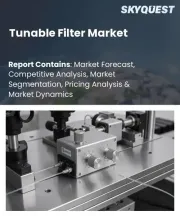
|
시장보고서
상품코드
2012364
액정 가변 필터 시장 : 제품 유형, 파장 범위, 용도, 최종 사용자별 예측(2026-2032년)Liquid Crystal Tunable Filter Market by Product Type, Wavelength Range, Application, End User - Global Forecast 2026-2032 |
||||||
 360iResearch
액정 가변 필터 시장은 2025년에 1억 7,433만 달러로 평가되었고 2026년에는 1억 9,342만 달러로 성장하여 CAGR 11.72%로 성장을 지속하여, 2032년까지 3억 7,884만 달러에 이를 것으로 예측됩니다.
| 주요 시장 통계 | |
|---|---|
| 기준 연도 : 2025년 | 1억 7,433만 달러 |
| 추정 연도 : 2026년 | 1억 9,342만 달러 |
| 예측 연도 : 2032년 | 3억 7,884만 달러 |
| CAGR(%) | 11.72% |
액정 가변 필터의 구조, 최근 재료 기술의 발전, 그리고 이미징 및 분석 시스템에서 왜 중요한지 간략한 기술 개요를 설명합니다.
액정 가변 필터(LCTF)는 전기적으로 제어되는 복굴절과 컴팩트한 고체 구조를 결합한 파장 선택형 광학 부품의 범주로, 과학, 산업 및 방위 분야의 광범위한 응용 분야에서 동적 스펙트럼 선택을 가능하게 합니다. 이 장치는 움직이는 부품 없이 투과 파장대를 신속하게 조정할 수 있어 이미징 시스템, 분석 기기, 레이저 플랫폼에 통합을 단순화하고 기계적 복잡성 및 유지보수 부담을 줄여줍니다.
재료 기술의 비약적인 발전, 응용 분야 확대 및 시스템 통합에 대한 수요가 각 분야에서 가변파장 광학 필터의 도입에 어떤 전략적 전환을 가져왔는가?
조정 가능한 광학 필터 시장 환경은 재료 과학의 발전, 응용 범위의 확장 및 진화하는 시스템 통합의 우선 순위에 따라 일련의 혁신적인 변화를 겪고 있습니다. 고성능 액정 배합과 정교한 제조 기술을 통해 투과 효율이 향상되고, 작동 파장 범위가 근적외선 및 단파 적외선 대역으로 확장되었습니다. 한편, 장치의 균일성 향상으로 정량적 이미징 워크플로우를 제한하던 아티팩트를 줄일 수 있게 되었습니다.
2025년 미국의 관세 상황이 광학 부품 제조업체의 조달 전략, 공급업체 선정 및 공급망 리스크 관리에 미치는 영향에 대한 분석
2025년 미국이 최근 도입한 관세 조치는 세계 광학 부품 공급망에 구체적인 마찰을 일으켜 필터 제조업체와 계측기 통합 업체의 조달 결정과 조달 일정에 변화를 가져왔습니다. 그 누적된 영향은 여러 측면에서 나타나고 있습니다. 수입 관세가 해외에 집중된 제조 거점에서 일반적으로 생산되는 개별 광학 기판, 특수 코팅 및 특정 전자 제어 모듈에 영향을 미치기 때문에 비용 구조를 예측하기 어려워졌습니다. 이러한 추가 선적 비용으로 인해 바이어들은 공급업체와의 계약을 재검토하고, 현지 생산을 통해 관세를 흡수할 수 있거나 특혜 무역 협정을 통해 위험을 줄일 수 있는 대체 공급업체를 찾게 됩니다.
제품 형태, 스펙트럼 커버리지, 채널 전략, 용도 수요, 최종 사용자 요구사항이 공급자의 우선순위와 구매자의 사양을 어떻게 형성하고 있는지에 대한 상세한 분석, 종합적인 세분화에 기반한 인사이트
세분화를 통한 인사이트는 제품군, 스펙트럼 영역, 판매 경로, 응용 분야, 최종 사용자 범주에 걸친 미묘한 요구 사항을 파악할 수 있습니다. 각 축은 각기 다른 성능 및 상품화 우선순위를 부여하고 있습니다. 제품 유형에 따라 고정 스캐닝에 최적화된 설계는 재현성 있는 측정을 위해 스펙트럼 순도와 처리량을 우선시하는 반면, 가변 스캐닝 변형은 다중 스펙트럼 획득을 위한 빠른 튜닝과 유연성을 중요시합니다. 따라서 시스템 설계자는 필터를 지정할 때 재현성과 시간적 응답성을 균형 있게 고려해야 합니다. 파장 범위에 따라, 장치 설계는 근적외선 및 단파 적외선에서 허용 가능한 성능을 달성하기 위해 재료의 분산 및 정렬 공차에 대응해야 합니다. 한편, 자외선 및 가시광선 영역에서의 구현은 고감도 이미징 실험에서 신호 대 잡음비를 유지하기 위해 코팅 및 편광판과의 상호 작용을 엄격하게 제어해야 합니다.
미주, 유럽, 중동 및 아프리카, 아시아태평양의 지리적 수요 패턴, 규제 기대치, 제조 생태계가 파장 가변 필터의 도입 전략을 재구성하는 방법
지역별로 제조 거점, 규제 환경, 용도 수요 곡선을 다르게 형성하고 있으며, 이는 공급업체와 통합업체의 전략적 결정에 영향을 미치고 있습니다. 북미와 남미에서는 강력한 학술 연구 클러스터와 대규모 국방 조달의 시너지 효과로 인해 엄격한 인증 요건을 충족하는 고성능 가변 필터에 대한 수요가 발생하고 있습니다. 동시에 물류의 복잡성을 줄이기 위해 현지 제조 및 애프터마켓 지원도 촉진되고 있습니다. 이 지역에서는 공급업체의 대응력, 인증 프로세스, 연방정부가 요구하는 조달 표준에 대한 적합성이 중요시되고 있으며, 이는 리드타임과 인증 획득에 대한 투자에도 영향을 미치고 있습니다.
필터 개발자, 통합업체, 용도 전문가 간의 경쟁과 협업의 역학은 지적 재산권, 제조 유연성, 애프터 서비스를 통해 차별화를 결정합니다.
액정 가변 필터 생태계의 경쟁 역학은 제품의 반복적 개선, 전략적 파트너십, 선택적 수직 통합으로 특징지어집니다. 주요 기술 개발 기업들은 처리량, 스위칭 속도, 스펙트럼 순도를 차별화하기 위해 독자적인 액정 화학, 전극 형상 및 반사 방지 스택 설계에 투자하고 있습니다. 동시에 필터 모듈을 카메라 시스템, 라이트 엔진, 분석 플랫폼과 결합하는 통합 파트너는 개별 구성요소가 아닌 엔드투엔드 솔루션을 제공함으로써 더 깊은 고객 가치를 창출하고 있습니다.
지속적인 경쟁력을 유지하기 위해 공급망 탄력성, 모듈화된 제품 설계, 용도 파트너십, 채널 민첩성의 균형을 맞추기 위한 제조업체 및 통합업체를 위한 구체적인 전략적 우선순위
업계 리더는 단기적 회복탄력성과 중기적 기술 차별화의 균형을 맞추는 다각적인 전략을 우선시해야 합니다. 첫째, 중요한 기판, 컨트롤러 전자기기, 코팅제공급업체 기반을 다양화하여 관세 리스크를 줄이고 인증 기간을 단축합니다. 지리적으로 멀리 떨어진 제조 거점에 중복 공급원을 구축하여 공급 중단의 위험을 줄일 수 있습니다. 둘째, 고정 스캔과 가변 스캔을 모두 도입할 수 있는 모듈식 제품 아키텍처에 선택적으로 투자하여 다양한 고객 이용 사례에 빠르게 대응할 수 있도록 하는 동시에 SKU 증가를 최소화해야 합니다.
대상별 1차 인터뷰, 동료 검토를 거친 기술 검증, 특허 및 규제 분석, 데이터 삼각측량(트라이앵글레이션)을 결합한 투명한 조사 접근법을 통해 실용적인 결론을 도출합니다.
이러한 인사이트를 뒷받침하는 연구는 1차 정성적 연구와 타겟팅된 2차 조사 및 기술적 검증을 결합하여 견고하고 실용적인 결과를 보장합니다. 1차 조사에서는 조달 관리자, R&D 책임자, 시스템 통합사업자를 대상으로 구조화된 인터뷰를 실시하여 인증 주기, 환경적 요구사항, 통합의 트레이드오프와 관련된 실제 제약 조건을 파악했습니다. 이러한 인터뷰는 광학 기판, 액정 셀 조립 및 컨트롤러 전자 장치와 관련된 제조 능력, 품질 관리 관행 및 생산 능력 제약을 명확히 하는 공급업체 브리핑으로 보완되었습니다.
기술 성숙도, 시스템 통합 및 공급망 탄력성이 결합하여 가변 필터 도입의 미래 궤도를 결정하는 이유를 강조하는 간결한 요약
요약하면, 액정 가변 필터는 첨단 광학 기술, 시스템 통합 및 용도 중심 분석이 교차하는 지점에서 매우 중요한 역할을 합니다. 재료 및 제조 기술의 발전으로 적용 가능한 파장 범위가 확대되고 장치의 신뢰성이 향상되었습니다. 한편, 생명과학, 환경 모니터링, 국방 분야 등 다양한 분야 수요로 인해 통합에 대한 기대와 공급업체의 책임이 커지고 있습니다. 동시에 무역 정책의 변화와 관세 조치로 인해 조직은 비즈니스 연속성을 유지하기 위해 조달 전략, 재고 정책 및 인증 일정을 재검토해야 합니다.
자주 묻는 질문
목차
제1장 서문
제2장 조사 방법
제3장 주요 요약
제4장 시장 개요
제5장 시장 인사이트
제6장 미국 관세의 누적 영향, 2025년
제7장 AI의 누적 영향, 2025년
제8장 액정 가변 필터 시장 : 제품 유형별
제9장 액정 가변 필터 시장 : 파장대별
제10장 액정 가변 필터 시장 : 용도별
제11장 액정 가변 필터 시장 : 최종 사용자별
제12장 액정 가변 필터 시장 : 지역별
제13장 액정 가변 필터 시장 : 그룹별
제14장 액정 가변 필터 시장 : 국가별
제15장 미국의 액정 가변 필터 시장
제16장 중국의 액정 가변 필터 시장
제17장 경쟁 구도
JHSThe Liquid Crystal Tunable Filter Market was valued at USD 174.33 million in 2025 and is projected to grow to USD 193.42 million in 2026, with a CAGR of 11.72%, reaching USD 378.84 million by 2032.
| KEY MARKET STATISTICS | |
|---|---|
| Base Year [2025] | USD 174.33 million |
| Estimated Year [2026] | USD 193.42 million |
| Forecast Year [2032] | USD 378.84 million |
| CAGR (%) | 11.72% |
A concise technological overview explaining how liquid crystal tunable filters function, recent material advances, and why they matter across imaging and analytical systems
Liquid crystal tunable filters (LCTFs) represent a class of wavelength-selective optical components that combine electrically controlled birefringence with compact, solid-state form factors to enable dynamic spectral selection across a broad range of scientific, industrial, and defense applications. These devices permit rapid tuning of transmitted wavelength bands without moving parts, which simplifies integration into imaging systems, analytical instruments, and laser platforms while reducing mechanical complexity and maintenance demands.
In recent years, improvements in liquid crystal materials, electrode patterning, and anti-reflective coating technologies have expanded the usable wavelength windows and enhanced throughput, contrast, and switching speeds. As a result, LCTFs have migrated from niche demonstration systems to validated subsystems within fluorescence imaging suites, hyperspectral imagers, and laser tuning assemblies. The technology's inherent flexibility supports both fixed scanning and variable scanning modalities, enabling system architects to trade off spectral sampling density against temporal resolution depending on application needs. This introduction sets the stage for a focused executive analysis of technological inflection points, supply chain considerations, regulatory impacts, and market segmentation that influence procurement and R&D strategies.
How material breakthroughs, broadened applications, and system integration demands are driving a strategic shift in tunable optical filter deployment across sectors
The landscape for tunable optical filters is undergoing a series of transformative shifts driven by material science advances, expanding application breadth, and evolving system-integration priorities. Higher-performance liquid crystal formulations and refined fabrication techniques have increased transmission efficiency and extended operational wavelength ranges into both near-infrared and shortwave infrared bands, while improvements in device uniformity have reduced artefacts that once limited quantitative imaging workflows.
Simultaneously, cross-domain convergence is reshaping product requirements: life sciences researchers demand spectral fidelity and repeatability for fluorescence imaging assays, industrial process monitoring teams prioritize robustness and uptime for inline sensing, and defense integrators emphasize environmental ruggedization and low SWaP (size, weight, and power). This convergence pressures suppliers to offer configurable solutions supporting fixed scanning and variable scanning modes, while also addressing diverse wavelength ranges spanning ultraviolet through visible to infrared. As image processing and AI-enabled analytics mature, systems increasingly rely on tunable filters to deliver spectrally rich data streams, making LCTFs a key enabler of multi-modal sensing architectures rather than a stand-alone optical component.
Analysis of how the 2025 United States tariff landscape has reshaped sourcing strategies, supplier qualification, and supply chain risk management for optical component manufacturers
Recent tariff measures introduced by the United States in 2025 have introduced tangible friction into the global optical components supply chain, altering sourcing calculus and procurement timelines for filter manufacturers and instrument integrators. The cumulative impact manifests across several dimensions: cost structures have become less predictable as import duties affect discrete optical substrates, specialized coatings, and certain electronic control modules that are commonly produced in concentrated manufacturing hubs overseas. These additional landed costs prompt buyers to re-evaluate supplier contracts and to explore alternative vendors that can either absorb duties through local production or mitigate exposure via preferential trade arrangements.
Beyond direct cost implications, tariffs influence strategic decisions about vertical integration, inventory policy, and qualification timelines. System developers facing longer lead times and higher input costs are more likely to accelerate qualification of domestically sourced subcomponents, to increase safety-stock levels to buffer against shipment variability, and to pursue design adaptations that reduce reliance on tariff-exposed parts. Regulatory uncertainty also elevates the premium on supplier diversification and contract flexibility: manufacturers with multi-region supply bases or those capable of relocating critical manufacturing steps can offer stability to end users. Importantly, research collaborations and co-development agreements have become a practical tool for sharing compliance burdens and for aligning product roadmaps with shifting trade policies, thereby enabling continuity of innovation amid a more complex cross-border trade environment.
Comprehensive segmentation-driven insights detailing how product form, spectral coverage, channel strategy, application demands, and end-user requirements shape supplier priorities and buyer specifications
Segmentation insights reveal the nuanced requirements across product families, spectral domains, sales pathways, application verticals, and end-user categories-each axis imposes distinct performance and commercialization priorities. Based on product type, designs optimized for fixed scanning prioritize spectral purity and throughput for repeatable measurements, while variable scanning variants emphasize rapid tuning and flexibility for multi-spectral acquisition; system architects must therefore weigh repeatability against temporal responsiveness when specifying filters. Based on wavelength range, device engineering must accommodate material dispersion and alignment tolerances to deliver acceptable performance in the near infrared range and shortwave infrared range, while ultraviolet range and visible range implementations demand stringent control of coatings and polarizer interactions to preserve signal-to-noise ratios in sensitive imaging experiments.
Based on sales channel, commercial strategies diverge: direct sales foster close engineering collaboration and customization for large OEMs, distributor sales enable broader geographic reach and inventory support for mid-size customers, and online sales streamline access for smaller laboratories and niche integrators seeking off-the-shelf modules. Based on application, performance metrics and integration challenges vary significantly; colorimetric analysis emphasizes wavelength stability and calibration traceability, fluorescence imaging requires filter sets compatible with confocal microscopy and in vivo imaging modalities to minimize photobleaching and maximize contrast, hyperspectral imaging drives high spectral sampling for agriculture analysis, environmental monitoring, and remote sensing workflows, laser tuning demands low insertion loss and rapid settling, and Raman spectroscopy requires narrowband selection tuned to chemical analysis and material identification tasks. Based on end user, procurement criteria shift from ruggedized and field-deployable systems for defense and security applications such as night vision and surveillance systems, to precision-controlled platforms for life sciences research disciplines including genomics and proteomics, to compliance-focused instrumentation for medical diagnostics and environmental monitoring; each end-user class imposes certification, lifecycle, and support expectations that suppliers must explicitly address.
How geographic demand patterns, regulatory expectations, and manufacturing ecosystems across the Americas, Europe Middle East & Africa, and Asia-Pacific are reshaping deployment strategies for tunable filters
Regional dynamics shape manufacturing footprints, regulatory environments, and application demand curves in distinctive ways that influence strategic decisions for suppliers and integrators. In the Americas, a combination of strong academic research clusters and substantial defense procurement creates demand for high-performance tunable filters that meet rigorous qualification regimes, while also encouraging localized manufacturing and aftermarket support to reduce logistical complexity. This region places a premium on supplier responsiveness, certification pathways, and alignment with federally mandated procurement standards, which in turn affects lead times and qualification investments.
Across Europe, Middle East & Africa, regulatory harmonization and an emphasis on environmental monitoring foster adoption of hyperspectral-enabled sensing for industrial emissions control and agricultural optimization, with customers seeking interoperable solutions and adherence to regional compliance frameworks. The Asia-Pacific region drives volume demand through a diverse mix of industrial automation, medical diagnostic manufacturing, and imaging OEMs; rapid innovation cycles and cost-sensitive procurement in this region incentivize suppliers to optimize manufacturing yields and to develop scalable designs suitable for both high-volume production and integration into compact consumer or industrial devices. These regional differences create opportunities for geographically tailored go-to-market approaches and for co-located support models that reduce total cost of ownership for end users.
Competitive and collaborative dynamics among filter developers, integrators, and application specialists that determine differentiation through IP, manufacturing flexibility, and aftersales service
Competitive dynamics in the liquid crystal tunable filter ecosystem are characterized by iterative product refinement, strategic partnerships, and selective vertical integration. Leading technology developers invest in proprietary liquid crystal chemistries, electrode geometries, and anti-reflective stack designs to differentiate on throughput, switching speed, and spectral purity. At the same time, integration partners that combine filter modules with camera systems, light engines, and analytics platforms create deeper customer value by delivering end-to-end solutions rather than discrete components.
Collaboration between optical component suppliers and application specialists accelerates time-to-market for domain-specific products, such as filters tuned for fluorescence microscopy or for ruggedized imagers used in surveillance. Suppliers that offer flexible manufacturing scales and robust quality management systems attract OEM partnerships, while those with strong post-sales service networks secure recurring revenue from calibration, refurbishment, and field support. Intellectual property portfolios and participation in standards forums further influence competitive positioning by signaling long-term technology roadmaps and interoperability commitments that matter to enterprise buyers.
Actionable strategic priorities for manufacturers and integrators to balance supply chain resilience, modular product design, application partnerships, and channel agility for sustained competitiveness
Industry leaders should prioritize a multi-dimensional strategy that balances near-term resilience with medium-term technology differentiation. First, diversify the supplier base for critical substrates, controller electronics, and coatings to reduce tariff exposure and to shorten qualification horizons; establishing redundant sources across geographically distinct manufacturing hubs will reduce disruption risk. Second, invest selectively in modular product architectures that support both fixed scanning and variable scanning deployments, enabling rapid configuration for diverse customer use cases while minimizing SKU proliferation.
Third, strengthen partnerships with system integrators and analytics vendors to co-develop bundled offerings for high-value applications such as confocal microscopy, remote sensing, and Raman spectroscopy; these collaborations increase system-level value and create higher switching costs for customers. Fourth, align product development roadmaps with application-specific certification and environmental standards anticipated by end users in defense, medical diagnostics, and environmental monitoring, ensuring that new releases simplify procurement and reduce validation timelines. Finally, enhance commercial agility by offering flexible sales channels-direct engagement for large OEMs, distributor relationships for regional coverage, and streamlined online options for small lab buyers-so that procurement friction is minimized across the customer spectrum.
Transparent research approach combining targeted primary interviews, peer-reviewed technical validation, patent and regulatory analysis, and data triangulation to ensure actionable conclusions
The research underpinning these insights blends primary qualitative inquiry with targeted secondary analysis and technical validation to ensure robust, actionable outputs. Primary research involved structured interviews with procurement managers, R&D leads, and system integrators to capture real-world constraints related to qualification cycles, environmental requirements, and integration trade-offs. These interviews were complemented by supplier briefings that clarified manufacturing capabilities, quality control practices, and capacity constraints relevant to optical substrates, liquid crystal cell assembly, and controller electronics.
Secondary analysis drew on peer-reviewed materials science literature, patent filings, and regulatory documentation to validate material performance claims, ascertain coating and polarizer innovations, and map certification pathways for medical and defense applications. Technical validation included cross-referencing laboratory performance reports and publicly disclosed product datasheets to confirm stated device characteristics such as tuning range, insertion loss trends, and switching behavior. All data streams were triangulated and documented to provide reproducible methodological steps and to enable confidence in the thematic conclusions presented in this executive synthesis.
A concise closing synthesis highlighting why technological maturation, systems integration, and supply chain resilience together determine the future trajectory of tunable filter deployment
In summary, liquid crystal tunable filters occupy a pivotal role at the intersection of advanced optics, system integration, and application-driven analytics. Technological improvements in materials and manufacturing have broadened applicable wavelength ranges and enhanced device reliability, while cross-domain demand from life sciences, environmental monitoring, and defense has elevated integration expectations and supplier responsibilities. At the same time, trade policy shifts and tariff measures have compelled organizations to rethink sourcing strategies, inventory policies, and qualification timelines to preserve operational continuity.
Moving forward, success will hinge on the ability to translate component-level advances into system-level performance gains by partnering closely with integrators, optimizing product modularity for diverse scanning modalities, and implementing geographically resilient supply chains. Organizations that address certification requirements proactively and that offer comprehensive post-sales support will be best positioned to gain extended engagement with enterprise customers and to capture growth opportunities as multispectral and hyperspectral sensing proliferate across applications.
Table of Contents
1. Preface
- 1.1. Objectives of the Study
- 1.2. Market Definition
- 1.3. Market Segmentation & Coverage
- 1.4. Years Considered for the Study
- 1.5. Currency Considered for the Study
- 1.6. Language Considered for the Study
- 1.7. Key Stakeholders
2. Research Methodology
- 2.1. Introduction
- 2.2. Research Design
- 2.2.1. Primary Research
- 2.2.2. Secondary Research
- 2.3. Research Framework
- 2.3.1. Qualitative Analysis
- 2.3.2. Quantitative Analysis
- 2.4. Market Size Estimation
- 2.4.1. Top-Down Approach
- 2.4.2. Bottom-Up Approach
- 2.5. Data Triangulation
- 2.6. Research Outcomes
- 2.7. Research Assumptions
- 2.8. Research Limitations
3. Executive Summary
- 3.1. Introduction
- 3.2. CXO Perspective
- 3.3. Market Size & Growth Trends
- 3.4. Market Share Analysis, 2025
- 3.5. FPNV Positioning Matrix, 2025
- 3.6. New Revenue Opportunities
- 3.7. Next-Generation Business Models
- 3.8. Industry Roadmap
4. Market Overview
- 4.1. Introduction
- 4.2. Industry Ecosystem & Value Chain Analysis
- 4.2.1. Supply-Side Analysis
- 4.2.2. Demand-Side Analysis
- 4.2.3. Stakeholder Analysis
- 4.3. Porter's Five Forces Analysis
- 4.4. PESTLE Analysis
- 4.5. Market Outlook
- 4.5.1. Near-Term Market Outlook (0-2 Years)
- 4.5.2. Medium-Term Market Outlook (3-5 Years)
- 4.5.3. Long-Term Market Outlook (5-10 Years)
- 4.6. Go-to-Market Strategy
5. Market Insights
- 5.1. Consumer Insights & End-User Perspective
- 5.2. Consumer Experience Benchmarking
- 5.3. Opportunity Mapping
- 5.4. Distribution Channel Analysis
- 5.5. Pricing Trend Analysis
- 5.6. Regulatory Compliance & Standards Framework
- 5.7. ESG & Sustainability Analysis
- 5.8. Disruption & Risk Scenarios
- 5.9. Return on Investment & Cost-Benefit Analysis
6. Cumulative Impact of United States Tariffs 2025
7. Cumulative Impact of Artificial Intelligence 2025
8. Liquid Crystal Tunable Filter Market, by Product Type
- 8.1. Fixed Scanning
- 8.2. Variable Scanning
9. Liquid Crystal Tunable Filter Market, by Wavelength Range
- 9.1. Near Infrared Range
- 9.2. Shortwave Infrared Range
- 9.3. Ultraviolet Range
- 9.4. Visible Range
10. Liquid Crystal Tunable Filter Market, by Application
- 10.1. Colorimetric Analysis
- 10.2. Fluorescence Imaging
- 10.2.1. Confocal Microscopy
- 10.2.2. In Vivo Imaging
- 10.3. Hyperspectral Imaging
- 10.3.1. Agriculture Analysis
- 10.3.2. Environmental Monitoring
- 10.3.3. Remote Sensing
- 10.4. Laser Tuning
- 10.5. Raman Spectroscopy
- 10.5.1. Chemical Analysis
- 10.5.2. Material Identification
11. Liquid Crystal Tunable Filter Market, by End User
- 11.1. Defense & Security
- 11.1.1. Night Vision
- 11.1.2. Surveillance Systems
- 11.2. Environmental Monitoring
- 11.3. Industrial Process Monitoring
- 11.4. Life Sciences Research
- 11.4.1. Genomics
- 11.4.2. Proteomics
- 11.5. Medical Diagnostics
12. Liquid Crystal Tunable Filter Market, by Region
- 12.1. Americas
- 12.1.1. North America
- 12.1.2. Latin America
- 12.2. Europe, Middle East & Africa
- 12.2.1. Europe
- 12.2.2. Middle East
- 12.2.3. Africa
- 12.3. Asia-Pacific
13. Liquid Crystal Tunable Filter Market, by Group
- 13.1. ASEAN
- 13.2. GCC
- 13.3. European Union
- 13.4. BRICS
- 13.5. G7
- 13.6. NATO
14. Liquid Crystal Tunable Filter Market, by Country
- 14.1. United States
- 14.2. Canada
- 14.3. Mexico
- 14.4. Brazil
- 14.5. United Kingdom
- 14.6. Germany
- 14.7. France
- 14.8. Russia
- 14.9. Italy
- 14.10. Spain
- 14.11. China
- 14.12. India
- 14.13. Japan
- 14.14. Australia
- 14.15. South Korea
15. United States Liquid Crystal Tunable Filter Market
16. China Liquid Crystal Tunable Filter Market
17. Competitive Landscape
- 17.1. Market Concentration Analysis, 2025
- 17.1.1. Concentration Ratio (CR)
- 17.1.2. Herfindahl Hirschman Index (HHI)
- 17.2. Recent Developments & Impact Analysis, 2025
- 17.3. Product Portfolio Analysis, 2025
- 17.4. Benchmarking Analysis, 2025
- 17.5. AA Opto Electronic
- 17.6. Alluxa LLC
- 17.7. Channel Systems Inc
- 17.8. Evident Corporation
- 17.9. EXFO Corporation
- 17.10. Kent Optronics Inc
- 17.11. Meadowlark Optics Inc
- 17.12. MKS Instruments Inc
- 17.13. Optotune
- 17.14. PerkinElmer Inc
- 17.15. Santec Corporation
- 17.16. Semrock Inc
- 17.17. Spectral Imaging Ltd
- 17.18. Thorlabs Inc