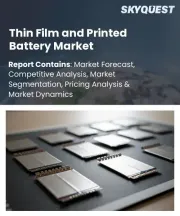
|
시장보고서
상품코드
2017011
박막 및 프린티드 배터리 시장 : 배터리 유형, 재료, 출력, 셀 타입, 용도별 예측(2026-2032년)Thin Film & Printed Battery Market by Battery Type, Material, Power Output, Cell Type, Application - Global Forecast 2026-2032 |
||||||
 360iResearch
박막 및 프린티드 배터리 시장은 2025년에 28억 달러로 평가되었고 2026년에는 33억 1,000만 달러로 성장하여 CAGR 18.37%로 성장을 지속하여, 2032년까지 91억 1,000만 달러에 이를 것으로 예측됩니다.
| 주요 시장 통계 | |
|---|---|
| 기준 연도 : 2025년 | 28억 달러 |
| 추정 연도 : 2026년 | 33억 1,000만 달러 |
| 예측 연도 : 2032년 | 91억 1,000만 달러 |
| CAGR(%) | 18.37% |
박막 및 프린티드 배터리를 소형 전자기기의 기술적 진보와 제품 설계상의 요구 속에 위치시키는 간결하고 전략적인 도입부
박막 배터리 및 프린티드 배터리 기술이 실험실 단계에서 제품 개발 및 초기 상용화로 전환됨에 따라 소형 전자기기용 에너지 저장의 전망은 빠르게 발전하고 있습니다. 이 보고서는 이러한 배터리 형태를 소형화, 유연한 폼팩터, 시스템 레벨 통합이라는 광범위한 흐름 속에 위치시키는 집중적인 소개로 시작합니다. 또한, 제조 기술의 혁신과 재료의 다양화가 제한된 폼팩터를 가진 장치와 시스템에서 전력 공급의 방식을 재검토할 수 있도록 설계자들이 어떻게 변화하고 있는지를 설명합니다.
재료, 적층 가공, 공급망 혁신이 소형 통합 에너지 솔루션의 제품 아키텍처와 상용화 경로를 재구성하는 방법
배터리 기술 분야는 재료 과학, 적층 가공, 시스템 통합의 발전과 함께 혁신적인 변화를 겪고 있습니다. 고분자 및 고체 전해질과 같은 새로운 재료는 더 안전하고, 더 얇고, 더 유연한 구성을 가능하게 하고 있습니다. 한편, 인쇄 성형 기술은 특정 형상의 비용 구조를 낮추고, 장치 내 새로운 배치 옵션을 가능하게 합니다. 이러한 기술적 변화로 인해 제품 개발팀은 기존 배터리 아키텍처를 재검토하고 장치 표면 전체에 분산된 에너지 저장의 가능성을 모색하고 있습니다.
최근 미국의 관세 조치와 향후 전망에 따라 박막 및 프린티드 배터리의 이해관계자들에게 전략적 공급망 재편과 공급업체 다변화가 어떻게 요구되는지 평가합니다.
미국의 관세 및 무역 조치의 도입은 박막 및 프린티드 배터리 부품을 취급하는 공급업체, OEM 및 설계자에게 새로운 일련의 전략적 고려 사항을 가져왔습니다. 관세 조치는 조달 결정, 부품 비용 구조 및 현지화 전략에 영향을 미치며, 기업들은 관세 위험과 물류 혼란을 줄이기 위해 공급업체 배치를 재검토하고, 니어쇼어링 및 이중 소싱을 고려해야 합니다. 그 직접적인 결과로, 전통적인 비용 및 품질 지표와 더불어 공급망 복원력(resilience)이 우선순위를 정하는 데 중요한 요소로 부상하고 있습니다.
박막 및 프린티드 배터리 기술 전반에 걸쳐 용도별 우선순위, 화학적 트레이드오프, 폼팩터에 미치는 영향에 대한 상세한 세분화 기반 인사이트를 제공합니다.
부문 수준의 이해는 제품 전략을 용도별 요구사항 및 재료의 트레이드오프와 일치시키는 데 필요한 세부적인 관점을 제공합니다. 전체 용도 부문을 살펴보면, 항공우주 및 방위, 자동차용 일렉트로닉스, 가전제품, IoT 기기, 의료기기, 스마트 카드, 웨어러블 기기 등 다양한 분야에 적용되고 있습니다. 또한, 가정용 전자기기는 카메라, 노트북, 스마트폰, 태블릿으로, 의료기기는 바이오센서, 내장형 센서, 심박조율기로, 웨어러블 기기는 피트니스 밴드, 스마트웨어, 스마트 워치로 세분화되어 있습니다. 이러한 각 최종 용도는 각각 다른 성능 우선순위를 가지고 있습니다. 항공우주 및 국방 분야에서는 신뢰성과 환경 저항성, 자동차 전장에서는 내열성과 내진동성, 가전제품에서는 에너지 밀도와 충전성, IoT 기기에서는 초저전력 소비와 장기보관성, 의료기기에서는 엄격한 생체 적합성과 내구성이 요구되며, 스마트카드에서는 얇고 안전한 폼팩터, 웨어러블 기기에서는 유연성과 신체적합성, 사용자 편의성이 요구됩니다. 스마트카드에는 얇은 두께와 안전한 폼팩터가 필요하고, 웨어러블 기기에는 유연성, 신체적합성, 사용자 편의성이 요구됩니다.
미주, EMEA, 아시아태평양의 지역별 공급망, 규제 우선순위, 제조 역량, 차별화된 도입 경로 및 파트너십 전략이 어떻게 차별화되는지 살펴봅니다.
지역별 동향은 박막 및 프린티드 배터리 기술 도입 경로, 공급업체 생태계, 규제 환경에 큰 영향을 미치고 있습니다. 북미와 남미에서는 혁신 클러스터와 강력한 전자제품 OEM 기반이 고도의 통합 능력과 국내 인증 공급처에 대한 수요를 주도하고 있습니다. 이 지역에서는 규제 준수, 안전 인증, 지적재산권 보호가 매우 중요하게 여겨지며, 이는 조달 결정을 형성하고 현지 파트너십을 촉진하는 데 영향을 미치고 있습니다.
지적재산권, 프로세스 스케일업, 배터리 기술 혁신의 확실한 상용화를 위한 파트너십 모델을 통한 차별화를 강조하고, 경쟁 환경 및 공급업체 환경 분석
기존 재료 제조업체, 특수 배합 제조업체, 장비 공급업체 및 신규 배터리 제조업체가 가치사슬의 인접 부문에서 경쟁하면서 공급업체와 공급업체들의 동향이 변화하고 있습니다. 주요 기업들은 재료 전문성과 확장 가능한 증착 및 조립 능력을 결합한 통합 솔루션에 중점을 두는 반면, 다른 기업들은 저온 공정, 초박형 패키징 또는 높은 유연성 신뢰성과 같은 틈새 차별화에 초점을 맞추었습니다. 조직이 스케일업 리스크를 줄이고 OEM 고객과의 통합 시간을 단축하기 위해 노력하면서 전략적 제휴, 공동 개발 계약, 생산 능력에 대한 파트너십이 일반화되고 있습니다.
상용화를 가속화하고 통합 리스크를 줄이기 위해 경영진이 R&D, 조달, 규제 대응 계획을 연계할 수 있는 실용적인 전략 제안
박막 및 프린티드 배터리 기술에서 가치를 창출하고자 하는 리더는 R&D, 공급망 및 상업화 활동을 통합하는 협력적 전략을 추구해야 합니다. 먼저, 디바이스 설계 제약 조건을 배터리 화학적 구성 및 제조 옵션과 연계하는 부서 간 로드맵 수립에 투자하여, 후기 단계의 재설계를 피하고 공급업체가 인증 프로세스에 조기에 참여할 수 있도록 합니다. 이러한 정합성을 통해 반복 주기를 단축하고, 시장 출시 기간을 예측 가능하게 합니다.
전문가 1차 인터뷰, 기술 문헌 검토, 시나리오 기반 기술 성숙도 평가를 결합한 엄격하고 증거에 기반한 조사 방법을 통해 전략적 의사결정을 뒷받침합니다.
본 조사에서는 1차 조사와 2차 조사 정보를 통합하여 박막 및 프린티드 배터리 현황에 대한 종합적인 견해를 제시합니다. 1차 조사에는 재료 과학자, 디바이스 OEM의 엔지니어링 책임자, 제조 및 공정 엔지니어, 그리고 대상 최종 사용 산업 분야의 조달 담당 임원을 대상으로 한 구조화된 인터뷰가 포함됩니다. 이러한 대화를 통해 공급자와 최종 사용자의 관점에서 제조 가능성, 인증 프로세스 및 상용화 준비 상태에 대한 평가가 이루어졌습니다.
박막 및 프린티드 배터리의 혁신을 신뢰할 수 있는 상용 제품으로 전환하기 위한 실용적인 경로와 전략적 요구 사항을 강조하는 개요
요약하면, 박막 및 프린티드 배터리 기술은 실험실의 신기한 기술에서 다양한 소형 전자기기 및 웨어러블 기기를 위한 실용적인 구성 요소로 전환되고 있습니다. 재료 및 제조 기술의 발전으로 새로운 폼팩터와 통합의 길이 열리고 있지만, 성공적인 상용화를 위해서는 내구성, 안전성 및 확장 가능한 생산을 동시에 해결하는 것이 필수적입니다. 이해관계자들이 설계 선택을 공급업체의 역량 및 규제 요건과 적극적으로 일치시킬 때, 기술적 잠재력을 차별화된 제품으로 전환하는 데 가장 유리한 위치에 서게 될 것입니다.
자주 묻는 질문
목차
제1장 서문
제2장 조사 방법
제3장 주요 요약
제4장 시장 개요
제5장 시장 인사이트
제6장 미국 관세의 누적 영향, 2025년
제7장 AI의 누적 영향, 2025년
제8장 박막 및 프린티드 배터리 시장 : 배터리 유형별
제9장 박막 및 프린티드 배터리 시장 : 재료별
제10장 박막 및 프린티드 배터리 시장 : 출력별
제11장 박막 및 프린티드 배터리 시장 : 셀 타입별
제12장 박막 및 프린티드 배터리 시장 : 용도별
제13장 박막 및 프린티드 배터리 시장 : 지역별
제14장 박막 및 프린티드 배터리 시장 : 그룹별
제15장 박막 및 프린티드 배터리 시장 : 국가별
제16장 미국의 박막 및 프린티드 배터리 시장
제17장 중국의 박막 및 프린티드 배터리 시장
제18장 경쟁 구도
JHS 26.05.12The Thin Film & Printed Battery Market was valued at USD 2.80 billion in 2025 and is projected to grow to USD 3.31 billion in 2026, with a CAGR of 18.37%, reaching USD 9.11 billion by 2032.
| KEY MARKET STATISTICS | |
|---|---|
| Base Year [2025] | USD 2.80 billion |
| Estimated Year [2026] | USD 3.31 billion |
| Forecast Year [2032] | USD 9.11 billion |
| CAGR (%) | 18.37% |
A concise, strategic introduction that situates thin film and printed batteries within technological advances and product design imperatives for compact electronics
The landscape of energy storage for compact electronic devices is evolving at pace as thin film and printed battery technologies move from component laboratories into product development and early commercial applications. This report opens with a focused introduction that situates these battery formats within the broader trajectory of miniaturization, flexible form factors, and systems-level integration. It explains how manufacturing innovations and materials diversification are enabling designers to reimagine power delivery for constrained form factor devices and systems.
The introduction outlines key technical differentiators between printed and thin film approaches, emphasizing deposition techniques, substrate compatibility, and integration pathways with flexible electronics and rigid substrates. It evaluates how incremental advances in electrolyte chemistry, electrode architecture, and encapsulation are reducing barriers to adoption while also reshaping design parameters for original equipment manufacturers. In addition, the introduction identifies the primary end-user segments driving demand and summarizes regulatory, reliability, and lifecycle considerations that engineers and procurement leaders must balance.
Finally, the introduction frames the ensuing analysis by highlighting strategic inflection points for stakeholders. It underscores the importance of aligning product roadmaps with evolving standards, prioritizing manufacturability and supply chain resilience, and coordinating cross-functional efforts to translate component-level advances into differentiated product performance and improved user experience
How advances in materials, additive manufacturing, and supply chain innovation are reshaping product architectures and commercial pathways for tiny, integrated energy solutions
The battery technology landscape is undergoing transformative shifts driven by converging advances in materials science, additive manufacturing, and system integration. Emerging materials such as polymer and solid-state electrolytes are enabling safer, thinner, and more flexible configurations, while printed deposition techniques are lowering cost structures for certain form factors and enabling new placement options within devices. These technical shifts are prompting product teams to rethink traditional battery architectures and to explore distributed energy storage across device surfaces.
At the same time, manufacturing innovation is altering supply chain relationships. Scale-up of roll-to-roll printing, improvements in vacuum deposition for thin films, and increased automation in assembly lines are changing unit economics and the locus of value capture. As a result, business models are adapting: component suppliers are moving upstream into system design collaborations, and OEMs are engaging earlier with materials partners to secure capacity and co-develop application-specific solutions. Regulatory and safety frameworks are also evolving in response to the introduction of new chemistries and integrated form factors, affecting qualification cycles and compliance roadmaps.
Transitioning from laboratory demonstrations to reliable fielded products requires addressing longevity, thermal performance, and recyclability. As these issues are resolved, adoption will broaden across consumer electronics, wearable devices, medical implants, and select aerospace applications, creating a differentiated competitive landscape where design agility and manufacturing partnerships will determine who captures the first-wave commercial opportunities
Assessing how recent and prospective U.S. tariff measures compel strategic supply chain realignment and supplier diversification for thin film and printed battery stakeholders
The imposition of tariffs and trade measures in the United States has introduced a new set of strategic considerations for suppliers, OEMs, and designers working with thin film and printed battery components. Tariff actions influence sourcing decisions, component cost stacks, and localization strategies, prompting firms to reassess supplier footprints and to consider nearshoring or dual-sourcing to mitigate tariff exposure and logistical disruption. The immediate consequence is a reprioritization of supply chain resilience alongside traditional cost and quality metrics.
In response, many organizations are accelerating qualification of alternative suppliers and exploring partnerships with domestic fabrication facilities or with partners in tariff-advantaged jurisdictions. This reorientation affects procurement timelines and necessitates more robust supplier risk assessment processes, including evaluation of intellectual property protections, capacity ramp capabilities, and compliance readiness. Engineering teams are also adapting by designing with greater modularity to accommodate multiple battery form factors and by specifying components that can be sourced from a broader supplier base without materially affecting performance.
Longer term, tariff-driven dynamics are encouraging investments in regional manufacturing capabilities and in research collaborations that reduce dependence on constrained international supply chains. Policy uncertainty is therefore a driver of strategic diversification: firms that proactively rework sourcing architectures, establish redundant supply lanes, and integrate tariff scenario planning into procurement and product development cycles will be better positioned to preserve cost competitiveness and product continuity under varying trade policy regimes
Detailed segmentation-driven insights that illuminate application-specific priorities, chemistry trade-offs, and form factor implications across thin film and printed battery technologies
Segment-level understanding provides the granular lens needed to align product strategy with application-specific requirements and material trade-offs. Looking across application segments, the landscape includes Aerospace & Defense, Automotive Electronics, Consumer Electronics, IoT Devices, Medical Devices, Smart Cards, and Wearable Devices, with Consumer Electronics further differentiated into Cameras, Laptops, Smartphones, and Tablets, Medical Devices further parsed into Biosensors, Implantable Sensors, and Pacemakers, and Wearable Devices further categorized into Fitness Bands, Smart Clothing, and Smart Watches. Each of these end uses imposes distinct performance priorities: aerospace and defense emphasize reliability and environmental tolerance; automotive electronics demand thermal robustness and vibration resistance; consumer electronics prioritize energy density and rechargeability; IoT devices focus on ultra-low power and long shelf life; medical devices require stringent biocompatibility and longevity; smart cards need thinness and secure form factors; and wearable devices rely on flexibility, conformability, and user comfort.
From the perspective of battery type, the market bifurcates into Printed and Thin Film formats, which differ in manufacturability, integration pathways, and mechanical properties. Material segmentation spans Lithium Ion Polymer, Nickel Metal Hydride, Solid State, and Zinc Air, with Lithium Ion Polymer broken down into Lithium Cobalt Oxide, Lithium Iron Phosphate, and Lithium Manganese Oxide chemistries, and Solid State further split into Oxide Electrolytes, Polymer Electrolytes, and Sulfide Electrolytes. These material distinctions determine safety profiles, cycle life behavior, energy density, and processing constraints applicable to different applications. Power output categories include 10-100 Mw, <10 Mw, and >100 Mw, and must be matched to use-case power budgets, peak load requirements, and thermal management strategies. Finally, cell type divides into Primary and Secondary, with Secondary further studied across Rechargeable Printed and Rechargeable Thin Film configurations, influencing product service models and end-of-life handling.
Taken together, segmentation reveals that no single technology addresses all requirements simultaneously; instead, design teams must navigate trade-offs among energy density, flexibility, rechargeability, manufacturing scalability, and safety. In practice, choice of chemistry and format is guided by the dominant application constraints and by the ecosystem of suppliers and manufacturing partners available to support integration and qualification
How regional supply chains, regulatory priorities, and manufacturing capabilities in the Americas, EMEA, and Asia-Pacific drive differentiated adoption pathways and partnership strategies
Regional dynamics have a profound influence on technology adoption pathways, supplier ecosystems, and regulatory environments for thin film and printed batteries. In the Americas, innovation clusters and a strong base of electronics OEMs drive demand for advanced integration capabilities and domestically qualified supply. This region places premium emphasis on regulatory compliance, safety certification, and intellectual property protection, which shapes procurement decisions and encourages localized partnerships.
Europe, Middle East & Africa collectively exhibit a mix of stringent regulatory regimes, growing industrial electrification initiatives, and an increasing focus on sustainability and circularity. These factors incentivize investments in safer chemistries and recyclable form factors, as well as collaborations between materials suppliers and manufacturers to meet environmental and safety mandates. Standards harmonization and cross-border supply agreements in this region are influential in determining how suppliers prioritize product certifications and lifecycle management practices.
Asia-Pacific remains a central hub for manufacturing scale, materials supply, and process innovation, with established capabilities in advanced deposition and high-volume assembly. The dense concentration of component suppliers and contract manufacturers in this region accelerates iterative development cycles and supports competitive cost structures, while also creating a rich environment for co-development relationships. Taken together, regional differences shape where new production capacity is deployed, how qualification timelines are managed, and which partnership models are most effective for commercializing thin film and printed battery solutions
Competitive and supplier landscape analysis highlighting differentiation through IP, process scale-up, and partnership models that enable reliable commercialization of battery innovations
Provider and supplier dynamics are evolving as established material houses, specialty formulators, equipment suppliers, and new entrant battery fabricators contest adjacent segments of the value chain. Leading firms are emphasizing integrated offerings that combine materials expertise with scalable deposition and assembly capabilities, while others focus on niche differentiation such as low-temperature processing, ultra-thin packaging, or high-flex reliability. Strategic alliances, joint development agreements, and capacity partnerships are common as organizations seek to de-risk scale-up and accelerate time-to-integration with OEM customers.
Competitive positioning is increasingly influenced by IP portfolios around electrolyte chemistries, printing techniques, and encapsulation methods, as well as by the ability to support qualification and regulatory pathways for targeted applications like medical implants and aerospace components. In addition, service differentiation through testing, certification support, and tailored supply agreements is becoming a meaningful source of value for customers that require predictable long-term supply and performance warranties. Investors and corporate development teams are watching consolidation and vertical integration closely, particularly where materials suppliers move downstream into cell assembly or where contract manufacturers invest in proprietary processes that raise switching costs for OEMs.
For procurement and business development leaders, the critical inference is to map supplier capabilities against product roadmaps and to prioritize partners that demonstrate both technical alignment and capacity to scale under commercial conditions. This approach reduces integration risk and enables faster transitions from prototype to production
Actionable strategic recommendations for executives to synchronize R&D, procurement, and regulatory planning to accelerate commercialization and mitigate integration risk
Leaders seeking to capture value in thin film and printed battery technologies should pursue a coordinated strategy that aligns R&D, supply chain, and commercialization activities. First, invest in cross-functional roadmapping that links device design constraints to battery chemistry and manufacturing options, thereby avoiding late-stage redesigns and ensuring that suppliers are engaged early in qualification. Such alignment reduces cycles of iteration and enables predictable time-to-market.
Second, diversify supplier relationships and qualify secondary sources that provide complementary process capabilities or geographic redundancy. This reduces exposure to trade measures and single-source interruptions, and it creates optionality when scaling capacity. Third, prioritize partnerships with materials and equipment providers that offer co-development agreements and shared risk models, as these arrangements accelerate learning curves and distribute capital intensity across collaborators. Fourth, embed regulatory and lifecycle considerations into technology selection by emphasizing recyclable materials, safe chemistry profiles, and designs that simplify end-of-life recovery. Finally, adopt modular design practices that make it feasible to substitute cell formats or chemistries without extensive system redesign, which preserves flexibility as new materials and processes mature.
By implementing these actions in concert-integrating technical planning with procurement and regulatory strategy-industry leaders can reduce commercialization risk, shorten development cycles, and position their organizations to seize early adopter opportunities in high-value applications
A rigorous, evidence-based methodology combining primary expert interviews, technical literature review, and scenario-driven technology readiness assessments to inform strategic decisions
This research synthesizes primary and secondary inputs to present a comprehensive view of the thin film and printed battery landscape. Primary research included structured interviews with materials scientists, engineering leads at device OEMs, manufacturing and process engineers, and procurement executives across target end-use industries. These conversations informed assessments of manufacturability, qualification pathways, and commercial readiness from the perspectives of both suppliers and end users.
Secondary research reviewed peer-reviewed journals, industry technical papers, conference proceedings, standards documents, and public disclosures from firms active in materials, deposition equipment, and battery fabrication. Data triangulation was applied to reconcile differing viewpoints and to ensure that technical claims were evaluated against reproducible evidence and engineering constraints. Where appropriate, case studies were constructed to illustrate typical qualification timelines, design trade-offs, and supplier engagement models.
Analytical methods combined qualitative scenario planning with technology readiness assessments and value-chain mapping. Special attention was given to supply chain resilience, regulatory trajectories, and manufacturing scalability. Throughout, the analysis prioritized verifiable technical attributes and stakeholder testimony over speculative forecasts, with conclusions drawn from documented developments and consensus expert insights
Concluding synthesis that highlights the practical pathways and strategic prerequisites for translating thin film and printed battery innovations into reliable commercial products
In summary, thin film and printed battery technologies are shifting from laboratory novelty toward practical components for a diverse set of compact electronic and wearable applications. Advances in materials and manufacturing are unlocking new form factors and integration pathways, but successful commercialization depends on addressing longevity, safety, and scalable production concurrently. Stakeholders who proactively align design choices with supplier capabilities and regulatory requirements will be best positioned to translate technical potential into differentiated products.
The strategic considerations outlined throughout this analysis underscore the importance of cross-functional collaboration, supplier diversification, and early-stage qualification planning. Trade policy dynamics and regional manufacturing strengths further influence where capacity and partnerships should be prioritized. Ultimately, the transition from prototype to production will be governed by the ability to balance performance trade-offs with manufacturability and lifecycle management, creating opportunities for actors that can navigate this complexity while delivering reliable, certifiable solutions
Table of Contents
1. Preface
- 1.1. Objectives of the Study
- 1.2. Market Definition
- 1.3. Market Segmentation & Coverage
- 1.4. Years Considered for the Study
- 1.5. Currency Considered for the Study
- 1.6. Language Considered for the Study
- 1.7. Key Stakeholders
2. Research Methodology
- 2.1. Introduction
- 2.2. Research Design
- 2.2.1. Primary Research
- 2.2.2. Secondary Research
- 2.3. Research Framework
- 2.3.1. Qualitative Analysis
- 2.3.2. Quantitative Analysis
- 2.4. Market Size Estimation
- 2.4.1. Top-Down Approach
- 2.4.2. Bottom-Up Approach
- 2.5. Data Triangulation
- 2.6. Research Outcomes
- 2.7. Research Assumptions
- 2.8. Research Limitations
3. Executive Summary
- 3.1. Introduction
- 3.2. CXO Perspective
- 3.3. Market Size & Growth Trends
- 3.4. Market Share Analysis, 2025
- 3.5. FPNV Positioning Matrix, 2025
- 3.6. New Revenue Opportunities
- 3.7. Next-Generation Business Models
- 3.8. Industry Roadmap
4. Market Overview
- 4.1. Introduction
- 4.2. Industry Ecosystem & Value Chain Analysis
- 4.2.1. Supply-Side Analysis
- 4.2.2. Demand-Side Analysis
- 4.2.3. Stakeholder Analysis
- 4.3. Porter's Five Forces Analysis
- 4.4. PESTLE Analysis
- 4.5. Market Outlook
- 4.5.1. Near-Term Market Outlook (0-2 Years)
- 4.5.2. Medium-Term Market Outlook (3-5 Years)
- 4.5.3. Long-Term Market Outlook (5-10 Years)
- 4.6. Go-to-Market Strategy
5. Market Insights
- 5.1. Consumer Insights & End-User Perspective
- 5.2. Consumer Experience Benchmarking
- 5.3. Opportunity Mapping
- 5.4. Distribution Channel Analysis
- 5.5. Pricing Trend Analysis
- 5.6. Regulatory Compliance & Standards Framework
- 5.7. ESG & Sustainability Analysis
- 5.8. Disruption & Risk Scenarios
- 5.9. Return on Investment & Cost-Benefit Analysis
6. Cumulative Impact of United States Tariffs 2025
7. Cumulative Impact of Artificial Intelligence 2025
8. Thin Film & Printed Battery Market, by Battery Type
- 8.1. Printed
- 8.2. Thin Film
9. Thin Film & Printed Battery Market, by Material
- 9.1. Lithium Ion Polymer
- 9.1.1. Lithium Cobalt Oxide
- 9.1.2. Lithium Iron Phosphate
- 9.1.3. Lithium Manganese Oxide
- 9.2. Nickel Metal Hydride
- 9.3. Solid State
- 9.3.1. Oxide Electrolytes
- 9.3.2. Polymer Electrolytes
- 9.3.3. Sulfide Electrolytes
- 9.4. Zinc Air
10. Thin Film & Printed Battery Market, by Power Output
- 10.1. 10-100 Mw
- 10.2. <10 Mw
- 10.3. >100 Mw
11. Thin Film & Printed Battery Market, by Cell Type
- 11.1. Primary
- 11.2. Secondary
- 11.2.1. Rechargeable Printed
- 11.2.2. Rechargeable Thin Film
12. Thin Film & Printed Battery Market, by Application
- 12.1. Aerospace & Defense
- 12.2. Automotive Electronics
- 12.3. Consumer Electronics
- 12.3.1. Cameras
- 12.3.2. Laptops
- 12.3.3. Smartphones
- 12.3.4. Tablets
- 12.4. Iot Devices
- 12.5. Medical Devices
- 12.5.1. Biosensors
- 12.5.2. Implantable Sensors
- 12.5.3. Pacemakers
- 12.6. Smart Cards
- 12.7. Wearable Devices
- 12.7.1. Fitness Bands
- 12.7.2. Smart Clothing
- 12.7.3. Smart Watches
13. Thin Film & Printed Battery Market, by Region
- 13.1. Americas
- 13.1.1. North America
- 13.1.2. Latin America
- 13.2. Europe, Middle East & Africa
- 13.2.1. Europe
- 13.2.2. Middle East
- 13.2.3. Africa
- 13.3. Asia-Pacific
14. Thin Film & Printed Battery Market, by Group
- 14.1. ASEAN
- 14.2. GCC
- 14.3. European Union
- 14.4. BRICS
- 14.5. G7
- 14.6. NATO
15. Thin Film & Printed Battery Market, by Country
- 15.1. United States
- 15.2. Canada
- 15.3. Mexico
- 15.4. Brazil
- 15.5. United Kingdom
- 15.6. Germany
- 15.7. France
- 15.8. Russia
- 15.9. Italy
- 15.10. Spain
- 15.11. China
- 15.12. India
- 15.13. Japan
- 15.14. Australia
- 15.15. South Korea
16. United States Thin Film & Printed Battery Market
17. China Thin Film & Printed Battery Market
18. Competitive Landscape
- 18.1. Market Concentration Analysis, 2025
- 18.1.1. Concentration Ratio (CR)
- 18.1.2. Herfindahl Hirschman Index (HHI)
- 18.2. Recent Developments & Impact Analysis, 2025
- 18.3. Product Portfolio Analysis, 2025
- 18.4. Benchmarking Analysis, 2025
- 18.5. Blue Spark Technologies, Inc.
- 18.6. Cymbet Corporation
- 18.7. Enfucell AB
- 18.8. Imprint Energy, Inc.
- 18.9. Johnson Matthey PLC
- 18.10. Molex, LLC
- 18.11. Murata Manufacturing Co., Ltd.
- 18.12. NEC Corporation
- 18.13. Nippon Kayaku Co., Ltd.
- 18.14. Panasonic Corporation
- 18.15. PolyPlus Battery Company
- 18.16. ProLogium Technology Co., Ltd.
- 18.17. Samsung SDI Co., Ltd.
- 18.18. ZPower, Inc.