|
시장보고서
상품코드
2085496
약물 방출 풍선 시장 : 약제 유형, 제품 유형, 용도, 최종 사용자, 유통 채널별 예측(2026-2032년)Drug Eluting Balloon Market by Drug Type, Product Type, Application, End User, Distribution Channel - Global Forecast 2026-2032 |
||||||
 360iResearch
약물 방출 풍선 시장은 2032년까지 연평균 복합 성장률(CAGR) 16.26%로 36억 6,000만 달러 규모로 확대될 것으로 예측됩니다.
| 주요 시장 통계 | |
|---|---|
| 기준 연도 : 2025년 | 12억 7,000만 달러 |
| 추정 연도 : 2026년 | 14억 8,000만 달러 |
| 예측 연도 : 2032년 | 36억 6,000만 달러 |
| CAGR(%) | 16.26% |
약물 방출 풍선 시장 개요
약물 방출 풍선(약물 코팅 풍선이라고도 함)은 카테터를 이용한 혈관 성형술용 기기로, 영구적인 이식물을 남기지 않고 혈관벽에 항증식제를 전달하는 장치입니다. 이 기술은 말초동맥질환, 특히 대퇴슬와동맥 병변에서 가장 확립되어 있으며, 또한 스텐트 내 재협착이나 소혈관 질환 등 추가적인 금속층을 피하는 것이 임상적으로 유익한 특정 관상동맥 치료에도 활용되고 있습니다.
약물 방출 풍선 시장의 획기적인 변화
약물 방출 풍선 분야는 단일 제품의 혁신에서 더 광범위한 혈관 치료 플랫폼으로 전환되고 있습니다. 파클리탁셀 코팅 풍선은 파클리탁셀이 친유성 물질이며, 풍선이 단시간에 팽창하는 동안 신속하게 방출된다는 특성 덕분에 상업적 기반을 다졌습니다. 그러나 현재 각 제조업체들은 안전성에 대한 인식 제고, 약물 방출 제어, 그리고 더욱 복잡한 혈관 환경에서의 사용에 대응하기 위해 시롤리무스 코팅 풍선 기술에 대한 투자를 확대되고 있습니다.
인공지능(AI)의 누적 영향
인공지능(AI)은 단순한 기기 기능이라는 틀을 넘어, 약물 방출 풍선의 전체 밸류체인에 걸쳐 누적적인 추진력으로 자리 잡고 있습니다. 임상 현장에서는 AI를 활용한 혈관조영술 및 혈관 내 영상 분석을 통해 병변 측정, 석회화 평가, 혈관 직경 측정, 박리, 리코일, 그리고 혈관성형술 후 결과 평가를 지원할 수 있습니다. 이 모든 요인들은 약제의 이동 및 장기적인 안정성에 영향을 미칩니다.
주요 지역별 분석 : 아시아태평양, 북미, 유럽, 라틴아메리카, 중동 및 아프리카
아시아태평양은 중국, 인도, 일본, 한국, 호주에서 당뇨병 및 노화에 따른 혈관 질환의 부담이 커지고, 혈관 내 치료 수요가 증가함에 따라 최우선 성장 지역으로 부상하고 있습니다. 일본과 호주는 성숙한 보험 환급 제도, 경험이 풍부한 중재 시술 전문의, 그리고 수준 높은 임상 거버넌스를 갖추고 있는 반면, 중국과 인도에서는 주요 대도시권에서 국내 생산, 병원 접근성, 혈관 내 치료 연수 및 임상 도입이 확대되고 있습니다.
주요 지역별 인사이트: 아세안(ASEAN), GCC, EU, 브릭스(BRICS), G7, 나토(NATO)
태국, 말레이시아, 싱가포르, 인도네시아, 베트남, 필리핀에서 심혈관 및 말초혈관 중재 시술 서비스가 확대됨에 따라 아세안 시장의 중요성이 커지고 있습니다. 3차 의료기관, 민간 보험, 전문의 연수가 복잡한 혈관 내 치료를 뒷받침하고 있는 지역에서 도입이 가장 활발히 이루어지고 있지만, 가격에 대한 민감성과 공공 조달의 제약이 여전히 치료 접근성에 영향을 미치고 있습니다.
주요 약물 방출 풍선 시장의 주요 국가에 대한 인사이트
미국은 FDA의 허가 및 승인을 받은 의료기기의 도입 경로, 전문의들의 적극적인 도입, 광범위한 임상시험 활동, 그리고 활발한 외래 혈관 중재 시술 활동을 통해 가장 큰 전략적 시장으로 자리매김하고 있습니다. 캐나다에서는 임상적 근거와 주 예산에 미치는 영향이 중시되는 반면, 멕시코에서는 사립 병원과 주요 공립 의뢰 의료기관에 도입이 집중되어 있습니다. 브라질은 인구 규모, 확립된 중재적 심장학 기반, 확대되는 혈관 내 치료 역량, 그리고 주요 대도시권에 집중된 첨단 의료 서비스 덕분에 라틴아메리카에서 가장 중요한 시장으로 자리매김하고 있습니다.
약물 방출 풍선 업계의 선두주자를 위한 실천적 제안
업계의 선도 기업은 제품의 가용성뿐만 아니라 차별화된 임상적 근거를 우선시해야 합니다. 임상시험 및 등록연구에서는 병변 특이적 예후, 내구성, 표적 병변 재혈관재건 회피율, 사지 예후, 상처 치유, 환자 보고 결과, 그리고 당뇨병, 만성 신장 질환, 장부위 병변, 석회화 병변, 무릎 아래 병변, 스텐트 내 재협착에 대한 실제 임상에서의 성능에 초점을 맞추어야 합니다.
조사 방법
본 요약본은 체계적인 2차 조사, 규제 당국의 발표, 임상시험 논문, 동료 심사를 거친 혈관 및 중재 심장학 문헌, 의학 학회의 지침, 보험 급여 동향, 공개된 규제 당국 제출 서류, 그리고 말초동맥질환, 관상동맥 재협착, 당뇨병, 만성 신장질환 및 혈관내 치료와 관련된 공중보건 데이터에 걸친 증거의 삼각 검증을 바탕으로 작성되었습니다.
결론
약물 방출 풍선은 저침습 혈관 치료, 기기를 통한 약물 전달, 그리고 근거 기반 의료 구매의 교차점에 위치합니다. 그 핵심적인 가치 제안은 재협착을 억제하면서도 영구적인 임플란트 시술을 피할 수 있다는 점에 있으며, 이는 말초 혈관 및 특정 관상동맥 중재술에서 여전히 중요한 의미를 지닙니다.
자주 묻는 질문
목차
제1장 서문
제2장 조사 방법
제3장 주요 요약
제4장 시장 개요
제5장 시장 인사이트
제6장 AI의 누적 영향, 2026년
제7장 약물 방출 풍선 시장 : 약제 유형별
제8장 약물 방출 풍선 시장 : 제품 유형별
제9장 약물 방출 풍선 시장 : 용도별
제10장 약물 방출 풍선 시장 : 최종 사용자별
제11장 약물 방출 풍선 시장 : 유통 채널별
제12장 약물 방출 풍선 시장 : 지역별
제13장 약물 방출 풍선 시장 : 그룹별
제14장 약물 방출 풍선 시장 : 국가별
제15장 경쟁 구도
제16장 기업 개요
JHS 26.07.20The Drug Eluting Balloon Market is projected to grow by USD 3.66 billion at a CAGR of 16.26% by 2032.
| KEY MARKET STATISTICS | |
|---|---|
| Base Year [2025] | USD 1.27 billion |
| Estimated Year [2026] | USD 1.48 billion |
| Forecast Year [2032] | USD 3.66 billion |
| CAGR (%) | 16.26% |
Drug Eluting Balloon Market Introduction
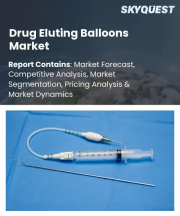
Drug eluting balloons, also known as drug-coated balloons, are catheter-based angioplasty devices that deliver an antiproliferative drug to the vessel wall without leaving a permanent implant. The technology is most established in peripheral artery disease, especially femoropopliteal lesions, and in selected coronary applications such as in-stent restenosis and small-vessel disease where avoiding additional metal layers can be clinically valuable.
The market is shaped by a strong evidence requirement because drug eluting balloon performance depends on drug choice, dose density, excipient chemistry, balloon transfer efficiency, lesion preparation, and operator technique. Randomized clinical studies, meta-analyses, and real-world registries have shown that effective drug-coated balloon platforms can reduce restenosis-related repeat procedures compared with plain balloon angioplasty in appropriate lesions, making the category strategically important for hospitals, ambulatory vascular centers, payers, and medical device manufacturers.
Transformative Shifts in the Drug Eluting Balloon Landscape
The drug eluting balloon landscape is moving from a single-product innovation story toward a broader vascular therapy platform. Paclitaxel-coated balloons built the commercial foundation because paclitaxel is lipophilic and transfers rapidly during short balloon inflation; however, manufacturers are now investing in sirolimus-coated balloon technologies to address safety perception, drug-release control, and use in more complex vascular beds.
Regulatory expectations have also transformed. The U.S. FDA updated its position in 2023, stating that available data did not support an excess late mortality risk for paclitaxel-coated devices, following years of additional follow-up and patient-level analyses. At the same time, Europe's Medical Device Regulation has increased clinical evidence, technical documentation, and post-market surveillance obligations, pushing companies to build stronger trial, registry, and pharmacovigilance systems.
Cumulative Impact of Artificial Intelligence
Artificial intelligence is becoming a cumulative enabler across the drug eluting balloon value chain rather than a standalone device feature. In clinical practice, AI-assisted angiographic and intravascular imaging analytics can support lesion measurement, calcification assessment, vessel sizing, dissections, recoil, and post-angioplasty result evaluation, all of which influence drug transfer and long-term patency.
For manufacturers, AI can improve coating process control, defect detection, batch consistency, sterilization validation review, and signal detection in post-market data. For health systems and payers, machine learning models can combine claims, imaging, comorbidity, and procedural data to identify patients at higher risk of restenosis or reintervention, supporting evidence-based device selection while preserving clinician oversight and regulatory compliance.
Key Regional Insights: Asia-Pacific, North America, Europe, Latin America, Middle East, and Africa
Asia-Pacific is a high-priority growth region because China, India, Japan, South Korea, and Australia face rising burdens of diabetes, aging-related vascular disease, and endovascular procedure demand. Japan and Australia have mature reimbursement pathways, experienced interventional specialists, and high-quality clinical governance, while China and India are expanding domestic manufacturing, hospital access, vascular training, and clinical adoption across large urban centers.
North America remains an evidence-driven market led by the United States, where FDA-approved drug-coated balloon indications, outpatient endovascular programs, and value-based care scrutiny shape purchasing decisions. Canada follows a more centralized health technology assessment and provincial reimbursement pathway, favoring devices with strong clinical, safety, and economic evidence.
Europe continues to be a major innovation and clinical evidence hub, but the EU Medical Device Regulation has increased documentation, clinical evaluation, notified body review, and post-market performance requirements. Latin America is led by Brazil and Mexico, where private hospitals adopt advanced endovascular devices faster than public systems, while reimbursement variability affects broader access. The Middle East, especially GCC healthcare systems, is investing in cardiovascular infrastructure and diabetes-related vascular care, while Africa remains constrained by uneven catheterization laboratory capacity, specialist availability, reimbursement gaps, and affordability.
Key Group Insights: ASEAN, GCC, EU, BRICS, G7, and NATO
ASEAN markets are becoming more relevant as Thailand, Malaysia, Singapore, Indonesia, Vietnam, and the Philippines expand cardiovascular and peripheral vascular intervention services. Adoption is strongest where tertiary hospitals, private insurance, and specialist training support complex endovascular care, while price sensitivity and public procurement constraints continue to influence access.
The GCC benefits from national healthcare investment, high diabetes prevalence, and expansion of vascular centers, making evidence-based premium devices attractive when supported by procurement value analysis and clinician training. The European Union remains highly regulated under MDR, favoring suppliers with rigorous clinical evidence, UDI readiness, quality management discipline, and post-market surveillance systems.
BRICS countries represent large-volume opportunity but require localized pricing, registration expertise, domestic partnership strategies, and physician education. The G7 markets are characterized by advanced intervention capacity, mature payer systems, strong clinical trial ecosystems, and stricter evidence standards. NATO-aligned markets overlap significantly with North America and Europe, where supply chain resilience, regulatory compliance, cybersecurity, traceability, and trusted manufacturing networks are increasingly important for medical device procurement.
Key Country Insights Across Major Drug Eluting Balloon Markets
The United States is the largest strategic market due to FDA-cleared and FDA-approved device pathways, robust specialist adoption, extensive clinical trial activity, and strong outpatient vascular intervention activity. Canada emphasizes clinical evidence and provincial budget impact, while Mexico's adoption is concentrated in private hospitals and major public referral centers. Brazil is Latin America's most important country market because of its population scale, established interventional cardiology base, growing endovascular capability, and concentration of advanced care in major metropolitan regions.
In Europe, the United Kingdom prioritizes National Health Service value, clinical guidance, and procurement efficiency. Germany benefits from a large hospital base and advanced cardiovascular intervention capacity, while France, Italy, and Spain combine specialist expertise with reimbursement pressure and stronger demand for real-world evidence. Russia remains a complex market shaped by localization, procurement policy, registration requirements, and geopolitical constraints.
China is scaling domestic innovation, hospital adoption, and regulatory modernization, India is driven by vascular disease burden, diabetes prevalence, affordability needs, and expanding private healthcare capacity, and Japan is characterized by high-quality evidence expectations, advanced physician training, and disciplined reimbursement review. Australia has a mature specialist environment and structured reimbursement evaluation, while South Korea combines strong hospital technology adoption, physician expertise, and an export-oriented medical device ecosystem.
Actionable Recommendations for Drug Eluting Balloon Industry Leaders
Industry leaders should prioritize differentiated clinical evidence, not only product availability. Trials and registries should focus on lesion-specific outcomes, durability, freedom from target lesion revascularization, limb outcomes, wound healing, patient-reported measures, and real-world performance in diabetes, chronic kidney disease, long lesions, calcified disease, below-the-knee disease, and in-stent restenosis.
Manufacturers should invest in AI-enabled quality systems, coating consistency analytics, digital physician training, and post-market surveillance. Commercial teams should align claims with approved indications, build health economic dossiers for payers, strengthen adverse-event reporting, and localize strategies for MDR-regulated Europe, FDA-driven North America, fast-growing Asia-Pacific, and price-sensitive emerging markets.
Research Methodology
This executive summary is based on structured secondary research and evidence triangulation across regulatory communications, clinical trial publications, peer-reviewed vascular and interventional cardiology literature, medical society guidance, reimbursement context, public regulatory filings, and public health data related to peripheral artery disease, coronary restenosis, diabetes, chronic kidney disease, and endovascular procedures.
The methodology emphasizes verified and reproducible sources, including FDA safety communications, European regulatory requirements, published randomized studies, meta-analyses, post-market registries, and country-level healthcare infrastructure indicators. Insights are synthesized to identify market direction, clinical relevance, regional adoption patterns, technology shifts, and strategic implications for drug eluting balloon stakeholders while avoiding unsupported sizing, share, or forecasting assumptions.
Conclusion
Drug eluting balloons are positioned at the intersection of minimally invasive vascular therapy, device-based drug delivery, and evidence-driven healthcare purchasing. Their central value proposition is the ability to inhibit restenosis while avoiding permanent implants, which remains relevant in peripheral and selected coronary interventions.
Future market leadership will depend on proven outcomes, disciplined regulatory execution, coating and drug-delivery innovation, physician education, and real-world evidence generation. Companies that combine clinical credibility with scalable manufacturing, digital surveillance, compliant market access, and localized adoption strategies are best positioned to compete as the drug eluting balloon market evolves.
Table of Contents
1. Preface
- 1.1. Objectives of the Study
- 1.2. Market Definition
- 1.3. Market Segmentation & Coverage
- 1.4. Years Considered for the Study
- 1.5. Currency Considered for the Study
- 1.6. Language Considered for the Study
- 1.7. Key Stakeholders
2. Research Methodology
- 2.1. Introduction
- 2.2. Research Design
- 2.2.1. Primary Research
- 2.2.2. Secondary Research
- 2.3. Research Framework
- 2.3.1. Qualitative Analysis
- 2.3.2. Quantitative Analysis
- 2.4. Market Size Estimation
- 2.4.1. Top-Down Approach
- 2.4.2. Bottom-Up Approach
- 2.5. Data Triangulation
- 2.6. Research Outcomes
- 2.7. Research Assumptions
- 2.8. Research Limitations
3. Executive Summary
- 3.1. Introduction
- 3.2. CXO Perspective
- 3.3. Market Size & Growth Trends
- 3.4. Market Share Analysis, 2025
- 3.5. FPNV Positioning Matrix, 2025
- 3.6. New Revenue Opportunities
- 3.7. Next-Generation Business Models
- 3.8. Industry Roadmap
4. Market Overview
- 4.1. Introduction
- 4.2. Industry Ecosystem & Value Chain Analysis
- 4.2.1. Supply-Side Analysis
- 4.2.2. Demand-Side Analysis
- 4.2.3. Stakeholder Analysis
- 4.3. Market Dynamics
- 4.3.1. Key Drivers
- 4.3.2. Key Restraints
- 4.3.3. Key Opportunities
- 4.3.4. Key Challenges
- 4.4. Porter's Five Forces Analysis
- 4.5. PESTLE Analysis
- 4.6. Market Outlook
- 4.6.1. Near-Term Market Outlook (0-2 Years)
- 4.6.2. Medium-Term Market Outlook (3-5 Years)
- 4.6.3. Long-Term Market Outlook (5-10 Years)
- 4.7. Go-to-Market Strategy
5. Market Insights
- 5.1. Consumer Insights & End-User Perspective
- 5.2. Consumer Experience Benchmarking
- 5.3. Opportunity Mapping
- 5.4. Distribution Channel Analysis
- 5.5. Pricing Trend Analysis
- 5.6. Regulatory Compliance & Standards Framework
- 5.7. ESG & Sustainability Analysis
- 5.8. Disruption & Risk Scenarios
- 5.9. Return on Investment & Cost-Benefit Analysis
6. Cumulative Impact of Artificial Intelligence 2026
7. Drug Eluting Balloon Market, by Drug Type
- 7.1. Paclitaxel-Coated
- 7.2. Sirolimus-Coated
8. Drug Eluting Balloon Market, by Product Type
- 8.1. Conventional Balloon
- 8.2. Specialty Balloon
9. Drug Eluting Balloon Market, by Application
- 9.1. Coronary Artery Disease
- 9.1.1. De Novo Lesion
- 9.1.2. In-Stent Restenosis
- 9.2. Peripheral Artery Disease
- 9.2.1. Below Knee
- 9.2.2. Femoropopliteal
10. Drug Eluting Balloon Market, by End User
- 10.1. Ambulatory Surgical Center
- 10.2. Clinic
- 10.3. Hospital
11. Drug Eluting Balloon Market, by Distribution Channel
- 11.1. Direct
- 11.2. Distributor
12. Drug Eluting Balloon Market, by Region
- 12.1. Asia-Pacific
- 12.2. North America
- 12.3. Latin America
- 12.4. Europe
- 12.5. Middle East
- 12.6. Africa
13. Drug Eluting Balloon Market, by Group
- 13.1. ASEAN
- 13.2. GCC
- 13.3. European Union
- 13.4. BRICS
- 13.5. G7
- 13.6. NATO
14. Drug Eluting Balloon Market, by Country
- 14.1. United States
- 14.2. Canada
- 14.3. Mexico
- 14.4. Brazil
- 14.5. United Kingdom
- 14.6. Germany
- 14.7. France
- 14.8. Russia
- 14.9. Italy
- 14.10. Spain
- 14.11. China
- 14.12. India
- 14.13. Japan
- 14.14. Australia
- 14.15. South Korea
15. Competitive Landscape
- 15.1. Market Concentration Analysis, 2025
- 15.1.1. Concentration Ratio (CR)
- 15.1.2. Herfindahl Hirschman Index (HHI)
- 15.2. Recent Developments & Impact Analysis, 2025
- 15.3. Product Portfolio Analysis, 2025
- 15.4. Benchmarking Analysis, 2025
16. Company Profiles
- 16.1. Abbott Laboratories
- 16.2. B. Braun Melsungen AG
- 16.3. Balton Sp. z o. o.
- 16.4. Bayer AG
- 16.5. Becton, Dickinson and Company
- 16.6. Biosensors International Group, Ltd.
- 16.7. Biotronik SE & Co. KG
- 16.8. Boston Scientific Corporation
- 16.9. Cardionovum GmbH
- 16.10. Concept Medical
- 16.11. Cook Medical, Inc.
- 16.12. Eurocor Tech GmbH
- 16.13. Invamed
- 16.14. iVascular S.L.U.
- 16.15. Johnson & Johnson Services, Inc.
- 16.16. Koninklijke Philips N.V.
- 16.17. Laborie Medical Technologies, Inc.
- 16.18. Lepu Medical Technology
- 16.19. M.A. Med Alliance SA by Cordis Corporation
- 16.20. Medtronic PLC
- 16.21. SurModics, Inc.
- 16.22. Terumo Corporation
- 16.23. Wellinq
- 16.24. Zylox-Tonbridge Medical Technology Co., Ltd.