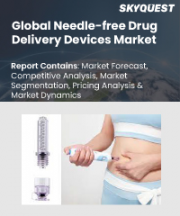
|
시장보고서
상품코드
2086140
무침 약물전달 디바이스 시장 : 제품 유형, 약제 유형, 투여 경로, 용도, 최종사용자, 유통 채널별 - 세계 예측(2026-2032년)Needle Free Drug Delivery Device Market by Product Type, Drug Type, Administration Route, Application, End User, Distribution Channel - Global Forecast 2026-2032 |
||||||
 360iResearch
무침 약물전달 디바이스 시장은 2032년까지 CAGR 13.31%로 314억 1,000만 달러 규모로 확대할 것으로 예측됩니다.
| 주요 시장 통계 | |
|---|---|
| 기준연도 2025 | 130억 9,000만 달러 |
| 추정연도 2026 | 147억 6,000만 달러 |
| 예측연도 2032 | 314억 1,000만 달러 |
| CAGR(%) | 13.31% |
무침약물전달 장치 시장 개요
의료 현장에서 기존의 주사를 대체할 수 있는 보다 안전하고 환자 중심의 대안이 요구됨에 따라 무바늘 약물전달 기기 시장이 확대되고 있습니다. 무바늘 주사기, 마이크로니들 플랫폼, 경피 흡수 시스템 및 커넥티드 웨어러블 투여 장치는 기존의 피하 주사 바늘을 사용하지 않고 생물제제, 백신, 인슐린, 호르몬 및 진통 요법을 투여하도록 설계되었습니다.
무침 투여 분야의 획기적인 변화
의료의 형태는 병원에서 주사를 맞는 방식에서 분산형 치료로 점차 전환되고 있으며, 환자들은 집에서 편리하고 신뢰할 수 있으며 통증이 적은 약물 투여를 기대하고 있습니다. 당뇨병, 자가면역질환, 편두통, 불임 치료, 호르몬 요법 및 장기간에 걸친 생물제제 치료로 인해 사용 편의성과 투여량의 정확성을 모두 갖춘 반복 투여 시스템에 대한 수요가 증가하고 있습니다.
AI가 바늘을 사용하지 않는 기기에 미치는 누적 영향
인공지능(AI)은 설계 최적화, 제조 품질, 연결형 복약 준수 지원, 시판 후 조사를 통해 무침 약물전달 기기의 밸류체인에 영향을 미치기 시작하고 있습니다. AI를 활용한 시뮬레이션을 통해 엔지니어는 실제 프로토타입을 제작하기 전에 노즐의 형상, 주입 압력, 마이크로니들 어레이의 성능, 웨어러블 기기의 구조 및 피부와의 상호작용과 관련된 변수들을 평가할 수 있습니다.
무침약물 투여에 관한 주요 지역별 인사이트
아시아태평양은 중국, 인도, 일본, 한국, 호주에서 만성질환 환자 수가 많은 데다, 백신 인프라, 생산 능력, 디지털 헬스케어의 보급이 확대되고 있으며, 시장이 성장하고 있습니다. 중국과 인도는 당뇨병 관리, 예방접종 프로그램, 비용 효율성을 중시하는 의료기기 도입 분야에서 대규모 시장을 강점으로 삼고 있는 반면, 일본, 한국, 호주는 고품질 의료기기, 고령화 사회에 대한 대응, 재택 치료, 그리고 규제를 준수하는 혁신의 방향을 중시하고 있습니다.
아세안(ASEAN), GCC, EU, 브릭스(BRICS), G7, 나토(NATO)의 주요 그룹별 인사이트
아세안 시장에서는 공중보건 프로그램, 중산층의 의료 접근성 확대, 그리고 지역 차원의 제조 구상이 사용자 친화적인 약물 투여 기술의 보급을 지원하고 있으며, 그 중요성이 점점 더 커지고 있습니다. 수요는 백신 접종, 당뇨병 관리 및 1차 진료 접근성과 관련이 있지만, 시장 진출을 위해서는 체계적인 가격 책정, 판매 대리점의 품질, 다국어 환자 교육 및 임상의 교육이 필요합니다.
무침약물전달에 관한 주요 국가의 인사이트
미국은 혁신, 임상 연구 활동, 규제 대상 의료기기의 승인 절차, 그리고 만성질환 및 전문 질환에 대한 생물제제의 사용 분야에서 선도적인 위치를 차지하고 있습니다. 캐나다는 주(州) 의료제도를 통한 안전성, 품질, 접근성 확보를 중시하는 반면, 멕시코는 제조 거점으로서의 지역적 근접성, 의료기기 생산 능력, 그리고 증가하는 만성질환 치료 수요를 강점으로 삼고 있습니다. 브라질은 방대한 인구, 공공 예방접종 실시 실적, 그리고 민간 의료 서비스 이용 확대에 힘입어 라틴아메리카에서 가장 영향력 있는 시장으로 자리매김하고 있습니다.
업계 리더를 위한 실천적인 제안
업계 리더들은 특히 생물제제, 펩티드, 백신, 인슐린, 호르몬 및 고점도 제제의 경우, 초기 단계부터 의약품과 의료기기의 적합성을 우선시해야 합니다. 그 근거로는 투여량의 정확성, 생체이용률, 사용자의 선호도, 주사 부위의 내약성, 누출 방지 성능, 그리고 피부 유형, 연령대, 관리 환경을 아우르는 성능 등이 있습니다.
조사 방법
본 요약본은 전 세계 보건 기관, 규제 지침, 임상 문헌, 표준화 기관, 의료 안전 관련 참고 자료, 공중보건 데이터 등 공개되어 있고 검증 가능한 정보원을 활용한 체계적인 2차 조사 접근법을 바탕으로 작성되었습니다. 본 분석에서는 만성질환 관리, 백신 접종, 날카로운 의료 기구에 의한 부상 예방, 재택 의료, 생물제제 투여, 의료기기와 의약품의 병용에 관한 요건 등, 실증된 업계의 촉진요인에 중점을 두고 있습니다.
결론
무침약물전달 장치는 틈새 대체 수단에서 더 안전하고, 더 편리하며, 확장성이 뛰어난 치료 투여를 위한 전략적 플랫폼으로 전환되고 있습니다. 만성질환의 유병률, 생물제제 치료의 확대, 백신 접종 체계, 의료 종사자의 안전, 재택 간호가 교차하는 분야에서 가장 큰 비즈니스 기회가 창출되고 있습니다.
자주 묻는 질문
목차
제1장 서문
제2장 조사 방법
제3장 개요
제4장 시장 개요
제5장 시장 인사이트
제6장 AI의 누적 영향, 2026년
제7장 무침 약물전달 디바이스 시장 : 제품 유형별
제8장 무침 약물전달 디바이스 시장 : 약제 유형별
제9장 무침 약물전달 디바이스 시장 : 투여 경로별
제10장 무침 약물전달 디바이스 시장 : 용도별
제11장 무침 약물전달 디바이스 시장 : 최종사용자별
제12장 무침 약물전달 디바이스 시장 : 유통 채널별
제13장 무침 약물전달 디바이스 시장 : 지역별
제14장 무침 약물전달 디바이스 시장 : 그룹별
제15장 무침 약물전달 디바이스 시장 : 국가별
제16장 경쟁 구도
제17장 기업 개요
KSA 26.07.21The Needle Free Drug Delivery Device Market is projected to grow by USD 31.41 billion at a CAGR of 13.31% by 2032.
| KEY MARKET STATISTICS | |
|---|---|
| Base Year [2025] | USD 13.09 billion |
| Estimated Year [2026] | USD 14.76 billion |
| Forecast Year [2032] | USD 31.41 billion |
| CAGR (%) | 13.31% |
Needle-Free Drug Delivery Device Market Introduction
The needle-free drug delivery device market is advancing as healthcare systems pursue safer, more patient-centered alternatives to conventional injections. Needle-free injectors, microneedle platforms, transdermal systems, and connected wearable delivery devices are designed to administer biologics, vaccines, insulin, hormones, and pain therapies without a traditional hypodermic needle.
Demand is supported by measurable clinical and operational needs. The World Health Organization has reported that billions of injections are administered globally each year, while the U.S. CDC has estimated hundreds of thousands of sharps injuries annually among hospital-based healthcare personnel. These facts keep needlestick prevention, infection-control efficiency, healthcare worker safety, and medication adherence at the center of procurement decisions.
For manufacturers, providers, and investors, the opportunity is no longer limited to needle aversion. It now includes chronic disease self-management, mass immunization readiness, biologic drug lifecycle management, reduced sharps waste, dose accuracy, and digitally enabled dose tracking across home care and clinical settings.
Transformative Shifts in Needle-Free Delivery
The landscape is shifting from hospital-administered injections toward decentralized care, where patients expect convenient, reliable, and less painful drug delivery at home. Diabetes, autoimmune disorders, migraine, fertility care, hormone therapy, and long-term biologic treatment are increasing the need for repeat-administration systems that combine usability with dose accuracy.
Regulatory expectations are also reshaping product design. Needle-free drug delivery devices must demonstrate biocompatibility, mechanical reliability, human-factors validation, sterility assurance, and, for combination products, performance with the drug formulation itself. This is especially important for biologics and high-viscosity formulations, where delivery force, fill volume, and tissue penetration depth affect clinical performance.
Sustainability and health-worker safety are becoming differentiators. Needle-free systems can reduce reliance on exposed sharps and may lower injury-related workflow burden when properly implemented. Competitive advantage is increasingly tied to evidence generation, device-drug compatibility, connected monitoring, patient training, and scalable manufacturing quality.
Cumulative Impact of AI on Needle-Free Devices
Artificial intelligence is beginning to influence the needle-free drug delivery device value chain through design optimization, manufacturing quality, connected adherence support, and post-market surveillance. AI-enabled simulation can help engineers evaluate nozzle geometry, injection pressure, microneedle array performance, wearable device mechanics, and skin-interaction variables before physical prototyping.
In production, machine vision and predictive analytics can strengthen defect detection for micro-scale components, springs, cartridges, seals, reservoirs, and wearable device assemblies. These applications are particularly relevant where small dimensional variations can affect dose delivery, leakage risk, or patient comfort.
In patient use, AI can support dose reminders, adherence risk scoring, injection-site rotation guidance, and anomaly detection from connected devices. However, AI adoption must be governed by cybersecurity, explainability, data privacy, clinical validation, and regulatory controls, particularly when software influences clinical decision-making or dosing behavior.
Key Regional Insights for Needle-Free Drug Delivery
Asia-Pacific is expanding as China, India, Japan, South Korea, and Australia combine large chronic disease populations with growing vaccine infrastructure, manufacturing capability, and digital health adoption. China and India offer scale for diabetes care, immunization programs, and cost-sensitive device deployment, while Japan, South Korea, and Australia emphasize high-quality devices, aging-population care, home-based treatment, and regulated innovation pathways.
North America remains a leading commercialization region due to advanced reimbursement systems, high biologics use, diabetes prevalence, strong regulated pathways for device-drug combination products, and established home healthcare adoption. The United States is especially important for connected needle-free injectors, wearable injectors, autoinjector alternatives, and pediatric or needle-phobia applications, while Canada supports adoption through quality-focused public healthcare systems and patient safety priorities.
Europe benefits from mature medical device oversight, strong pharmacovigilance systems, and demand for safer occupational healthcare practices, with the EU MDR reinforcing clinical evidence, post-market surveillance, and risk management requirements. Latin America shows opportunity in Brazil and Mexico as access to chronic disease treatment and private healthcare expands. The Middle East is supported by high diabetes burden, health modernization, and premium hospital infrastructure, while Africa presents targeted opportunities in vaccination initiatives, infectious disease programs, and diabetes care, with adoption influenced by affordability, training, procurement models, and supply-chain resilience.
Key Group Insights Across ASEAN, GCC, EU, BRICS, G7, and NATO
ASEAN markets are gaining relevance as public health programs, expanding middle-class healthcare access, and regional manufacturing initiatives support adoption of user-friendly drug delivery technologies. Demand is linked to vaccination delivery, diabetes management, and primary care access, while market entry requires pricing discipline, distributor quality, multilingual patient education, and clinician training.
The GCC is positioned for premium adoption through advanced hospital systems, high diabetes burden, and government investment in health modernization. The European Union offers a structured but demanding environment where MDR compliance, clinical evidence, post-market surveillance, usability engineering, and sustainability considerations are central to product acceptance.
BRICS countries represent major volume potential, led by China, India, and Brazil, but success depends on localization, affordability, domestic regulatory navigation, and partnerships that support training and service availability. G7 markets remain the benchmark for evidence-based commercialization, connected device integration, cybersecurity expectations, and combination product approvals. NATO countries, while not a healthcare trade bloc, include many high-income systems focused on medical preparedness, resilient supply chains, occupational safety, and sharps-safety standards.
Key Country Insights for Needle-Free Drug Delivery
The United States leads in innovation, clinical research activity, regulated device pathways, and use of biologics for chronic and specialty diseases. Canada emphasizes safety, quality, and access through provincial healthcare systems, while Mexico offers manufacturing proximity, medical device production capability, and growing chronic care demand. Brazil is the most influential Latin American market, supported by a large population, public immunization experience, and expanding private healthcare use.
In Europe, the United Kingdom, Germany, France, Italy, and Spain present strong demand for evidence-backed needle-free systems in home care, vaccination, and specialty drug delivery. Germany and France are particularly important for reimbursement scrutiny, clinical validation, and quality requirements, while the United Kingdom supports digital health integration and real-world evidence. Italy and Spain offer adoption potential through aging populations and chronic disease management needs. Russia remains relevant through domestic healthcare demand, although sanctions, procurement constraints, and regulatory complexity can affect market access.
China and India are central to long-term scale because of population size, diabetes prevalence, vaccine capacity, and manufacturing ecosystems. Japan prioritizes quality, aging-population care, and patient-friendly delivery systems suited to home treatment. South Korea combines digital health capability with advanced device manufacturing, while Australia offers a transparent regulatory environment, strong safety standards, and adoption potential for reliable home-based therapies.
Actionable Recommendations for Industry Leaders
Industry leaders should prioritize drug-device compatibility early, especially for biologics, peptides, vaccines, insulin, hormones, and high-viscosity formulations. Evidence should include dose accuracy, bioavailability, user preference, injection-site tolerability, leakage performance, and performance across skin types, age groups, and care settings.
Companies should invest in human-factors engineering, connected adherence features, cybersecurity, and manufacturability from the start. Partnerships with pharmaceutical firms, contract manufacturers, diabetes care providers, vaccination programs, payers, and digital health platforms can accelerate commercialization and strengthen real-world evidence generation.
Market access strategies should be region-specific. Premium markets require strong clinical, usability, safety, and health-economic evidence, while emerging markets need cost-effective designs, training materials, local service models, and durable supply chains. Privacy, software validation, and post-market surveillance must be built into connected needle-free delivery platforms.
Research Methodology
This executive summary is based on a structured secondary-research approach using publicly available, verifiable sources, including global health agencies, regulatory guidance, clinical literature, standards bodies, healthcare safety references, and public health data. The analysis emphasizes validated industry drivers such as chronic disease management, vaccination delivery, sharps injury prevention, home healthcare, biologic therapy administration, and device-drug combination requirements.
The methodology triangulates qualitative and quantitative indicators across regions, country healthcare infrastructure, regulatory maturity, disease burden, technology readiness, manufacturing capability, and commercialization feasibility. No unsupported proprietary market-size, market-share, or forecasting claims are used; insights are framed around documented healthcare needs, regulatory realities, and observable technology trends.
Findings are reviewed for consistency with medical device dynamics, including human-factors validation, manufacturing quality, sterility assurance, risk management, cybersecurity, post-market surveillance, and evidence requirements for clinical adoption.
Conclusion
Needle-free drug delivery devices are moving from niche alternatives to strategic platforms for safer, more convenient, and more scalable therapy administration. The strongest opportunities are emerging where chronic disease prevalence, biologic therapy growth, vaccine readiness, healthcare worker safety, and home-based care converge.
AI, connected health, and advanced materials will improve device design, quality control, adherence support, and real-world monitoring, but regulatory rigor and clinical evidence will determine adoption. Organizations that combine patient-centered engineering with robust drug-device validation and region-specific market access strategies will be best positioned to lead.
The market outlook is defined by practical healthcare value: reducing needle-related barriers, supporting safer care delivery, improving treatment adherence, and enabling reliable drug administration outside traditional clinical settings.
Table of Contents
1. Preface
- 1.1. Objectives of the Study
- 1.2. Market Definition
- 1.3. Market Segmentation & Coverage
- 1.4. Years Considered for the Study
- 1.5. Currency Considered for the Study
- 1.6. Language Considered for the Study
- 1.7. Key Stakeholders
2. Research Methodology
- 2.1. Introduction
- 2.2. Research Design
- 2.2.1. Primary Research
- 2.2.2. Secondary Research
- 2.3. Research Framework
- 2.3.1. Qualitative Analysis
- 2.3.2. Quantitative Analysis
- 2.4. Market Size Estimation
- 2.4.1. Top-Down Approach
- 2.4.2. Bottom-Up Approach
- 2.5. Data Triangulation
- 2.6. Research Outcomes
- 2.7. Research Assumptions
- 2.8. Research Limitations
3. Executive Summary
- 3.1. Introduction
- 3.2. CXO Perspective
- 3.3. Market Size & Growth Trends
- 3.4. Market Share Analysis, 2025
- 3.5. FPNV Positioning Matrix, 2025
- 3.6. New Revenue Opportunities
- 3.7. Next-Generation Business Models
- 3.8. Industry Roadmap
4. Market Overview
- 4.1. Introduction
- 4.2. Industry Ecosystem & Value Chain Analysis
- 4.2.1. Supply-Side Analysis
- 4.2.2. Demand-Side Analysis
- 4.2.3. Stakeholder Analysis
- 4.3. Market Dynamics
- 4.3.1. Key Drivers
- 4.3.2. Key Restraints
- 4.3.3. Key Opportunities
- 4.3.4. Key Challenges
- 4.4. Porter's Five Forces Analysis
- 4.5. PESTLE Analysis
- 4.6. Market Outlook
- 4.6.1. Near-Term Market Outlook (0-2 Years)
- 4.6.2. Medium-Term Market Outlook (3-5 Years)
- 4.6.3. Long-Term Market Outlook (5-10 Years)
- 4.7. Go-to-Market Strategy
5. Market Insights
- 5.1. Consumer Insights & End-User Perspective
- 5.2. Consumer Experience Benchmarking
- 5.3. Opportunity Mapping
- 5.4. Distribution Channel Analysis
- 5.5. Pricing Trend Analysis
- 5.6. Regulatory Compliance & Standards Framework
- 5.7. ESG & Sustainability Analysis
- 5.8. Disruption & Risk Scenarios
- 5.9. Return on Investment & Cost-Benefit Analysis
6. Cumulative Impact of Artificial Intelligence 2026
7. Needle Free Drug Delivery Device Market, by Product Type
- 7.1. Jet Injector
- 7.1.1. Gas Powered
- 7.1.2. Spring Based
- 7.2. Microarray Patch
- 7.2.1. Dissolvable Microarray
- 7.2.2. Hollow Microarray
- 7.2.3. Solid Microarray
8. Needle Free Drug Delivery Device Market, by Drug Type
- 8.1. Insulin
- 8.1.1. Basal Insulin
- 8.1.1.1. Intermediate Acting Insulin
- 8.1.1.2. Long Acting Insulin
- 8.1.2. Bolus Insulin
- 8.1.2.1. Rapid Acting Insulin
- 8.1.2.2. Short Acting Insulin
- 8.1.1. Basal Insulin
- 8.2. Vaccines
- 8.2.1. Covid-19 Vaccine
- 8.2.1.1. Mrna Vaccine
- 8.2.1.2. Viral Vector Vaccine
- 8.2.2. Influenza Vaccine
- 8.2.2.1. H5N1 Influenza
- 8.2.2.2. Seasonal Influenza
- 8.2.1. Covid-19 Vaccine
9. Needle Free Drug Delivery Device Market, by Administration Route
- 9.1. Intradermal
- 9.2. Intramuscular
- 9.3. Subcutaneous
10. Needle Free Drug Delivery Device Market, by Application
- 10.1. Dermatology
- 10.2. Diabetes Management
- 10.3. Immunization
- 10.4. Pain Management
11. Needle Free Drug Delivery Device Market, by End User
- 11.1. Ambulatory Surgical Centers
- 11.2. Clinics
- 11.3. Home Care Settings
- 11.4. Hospitals
12. Needle Free Drug Delivery Device Market, by Distribution Channel
- 12.1. Offline
- 12.2. Online
13. Needle Free Drug Delivery Device Market, by Region
- 13.1. Asia-Pacific
- 13.2. North America
- 13.3. Latin America
- 13.4. Europe
- 13.5. Middle East
- 13.6. Africa
14. Needle Free Drug Delivery Device Market, by Group
- 14.1. ASEAN
- 14.2. GCC
- 14.3. European Union
- 14.4. BRICS
- 14.5. G7
- 14.6. NATO
15. Needle Free Drug Delivery Device Market, by Country
- 15.1. United States
- 15.2. Canada
- 15.3. Mexico
- 15.4. Brazil
- 15.5. United Kingdom
- 15.6. Germany
- 15.7. France
- 15.8. Russia
- 15.9. Italy
- 15.10. Spain
- 15.11. China
- 15.12. India
- 15.13. Japan
- 15.14. Australia
- 15.15. South Korea
16. Competitive Landscape
- 16.1. Market Concentration Analysis, 2025
- 16.1.1. Concentration Ratio (CR)
- 16.1.2. Herfindahl Hirschman Index (HHI)
- 16.2. Recent Developments & Impact Analysis, 2025
- 16.3. Product Portfolio Analysis, 2025
- 16.4. Benchmarking Analysis, 2025
17. Company Profiles
- 17.1. 3M Company
- 17.2. Antares Pharma, Inc.
- 17.3. Becton, Dickinson and Company (BD)
- 17.4. Bioject Medical Technologies Inc.
- 17.5. Crossject SA
- 17.6. Endo International plc
- 17.7. Gerresheimer AG
- 17.8. Haselmeier GmbH
- 17.9. Injex Pharma AG
- 17.10. Inovio Pharmaceuticals, Inc.
- 17.11. Medical International Technology, Inc.
- 17.12. National Medical Products Inc.
- 17.13. Nemera Development S.A.
- 17.14. NuGen Medical Devices Inc.
- 17.15. PenJet Corporation
- 17.16. PharmaJet, Inc.
- 17.17. Portal Instruments, Inc.
- 17.18. Schott AG
- 17.19. SHL Medical AG
- 17.20. Stevanato Group S.p.A.
- 17.21. Valeritas Holdings, Inc.
- 17.22. West Pharmaceutical Services, Inc.
- 17.23. Ypsomed Holding AG
- 17.24. Zogenix, Inc.