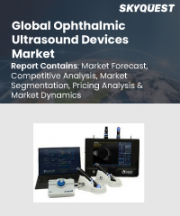
|
시장보고서
상품코드
2086141
안과용 초음파 영상 진단 시스템 시장 : 제품 유형별, 휴대성별, 용도별, 최종 사용자별 시장 예측(2026-2032년)Ophthalmic Ultrasound Imaging System Market by Product Type, Portability, Application, End User - Global Forecast 2026-2032 |
||||||
 360iResearch
안과용 초음파 영상 진단 시스템 시장은 2032년까지 연평균 복합 성장률(CAGR) 6.42%로 성장이 전망되며, 10억 6,085만 달러 규모로 성장할 것으로 예측됩니다.
| 주요 시장 통계 | |
|---|---|
| 기준 연도 : 2025년 | 6억 8,620만 달러 |
| 추정 연도 : 2026년 | 7억 2,916만 달러 |
| 예측 연도 : 2032년 | 10억 6,085만 달러 |
| CAGR(%) | 6.42% |
안과용 초음파 영상 진단 시스템 시장의 도입
안과용 초음파 영상 진단 시스템 시장은 백내장, 각막 혼탁, 유리체 출혈, 외상, 종양 또는 고밀도 매체 혼탁으로 인해 광학 경로가 제한되는 상황에서 눈의 해부학적 구조를 시각화해야 한다는 뿌리 깊은 임상적 요구에 힘입어 성장하고 있습니다. A-스캔을 이용한 생체 측정, B-스캔 안구 초음파 검사, 초음파 생체 현미경 검사 및 각막 두께 측정은 백내장 수술 계획, 유리체 및 망막 평가, 녹내장 평가, 안구 종양의 경과 관찰, 그리고 응급 안과 진료에서 여전히 필수적인 역할을 수행하고 있습니다.
안과용 초음파 분야의 획기적인 변화
고령화, 백내장 수술 건수 증가, 당뇨병성 안과 질환에 대한 감시 체계 강화, 그리고 응급실 및 외래 진료 현장에서 신속한 안과적 평가의 필요성으로 인해, 안과 초음파 분야는 재편되고 있습니다. 휴대용 B-스캔 시스템과 소형 초음파 생체 현미경 플랫폼 덕분에, 3차 안과 병원은 물론 전문 클리닉, 외래수술센터(ASC), 진단센터 등으로의 접근성이 확대되고 있습니다.
인공지능(AI)의 누적 영향
인공지능(AI)은 영상 획득 지원, 영상 보정, 분할, 측정 재현성 및 임상 의사결정 지원을 개선함으로써 안과용 초음파 영상 진단 전반에 걸쳐 누적 영향을 미치고 있습니다. 실제 진료 현장에서는 AI가 프로브 위치 결정 지침의 표준화, 시술자 간 편차 감소, 그리고 망막 박리, 유리체 출혈, 안구 내 종양, 전안부 구조 이상 등의 일반적인 소견에 대한 진단 속도 향상에 기여하고 있습니다.
주요 지역별 분석 : 아시아태평양, 북미, 유럽, 라틴아메리카, 중동 및 아프리카
아시아태평양은 환자 수가 많고, 백내장 수술 역량이 확대되며, 안과 의료 인프라에 대한 투자가 증가함에 따라 안과용 초음파 영상 진단 시스템에 있어 우선순위가 높은 지역으로 부상하고 있습니다. 중국, 인도, 일본, 한국, 호주에서는 대규모 공중보건 수요부터 선진 안과 센터의 최첨단 기술에 대한 수요에 이르기까지, 도입 양상이 각기 다릅니다. 또한, 해당 지역에서 당뇨병 및 노화성 안과 질환의 부담이 증가함에 따라, 병원과 전문 클리닉 모두에서 B-스캔 안구 초음파, A-스캔 생체 측정 및 초음파 생체 현미경 검사에 대한 수요가 증가하고 있습니다.
주요 지역별 인사이트 : 아세안(ASEAN), GCC, EU, 브릭스(BRICS), G7, 나토(NATO)
인도네시아, 베트남, 태국, 말레이시아, 필리핀, 싱가포르가 안과 서비스와 수술 체계를 확충함에 따라 아세안 시장의 중요성이 커지고 있습니다. 특히, 주요 3차 의료 센터 이외의 지역에서 접근성을 개선할 수 있는 휴대용 안과용 초음파 장비가 활용되는 지역에서는 공공 및 민간 혼합형 의료 모델 전반에 걸쳐 백내장 생체 측정, 후안부 평가 및 진료소 내 진단을 지원하는 신뢰성이 높고 연수에 적합한 시스템에 대한 수요가 가장 높게 나타나고 있습니다.
주요 안과용 초음파 시장의 주요 국가에 대한 인사이트
미국은 안과 수술 건수가 많고, 외래수술센터(ASC), 망막 전문 진료소, 그리고 혁신에 주력하는 학술 기관들의 지원을 바탕으로, 첨단 안과용 초음파 시스템의 주요 시장으로 자리매김하고 있습니다. 캐나다에서는 표준화된 의료 서비스와 주별 조달 모델에 부합하는 신뢰성 높은 시스템에 대한 수요가 꾸준히 증가하고 있는 반면, 멕시코에서는 도시 전역에 걸쳐 전문적인 안과 의료 체계가 강화되면서 백내장, 녹내장, 당뇨병성 안질환의 진단용 영상 검사에 대한 접근성이 확대되고 있습니다.
업계 리더를 위한 실천적인 제안
업계 리더는 고해상도 이미지, 자동 측정, 체계적인 보고서 작성, 그리고 안과 정보 시스템과의 상호 운용성을 결합하여 워크플로우 중심의 혁신을 우선시해야 합니다. 스캔 시간을 단축하고, 재현성을 높이며, 훈련 과정을 간소화하는 시스템은 인력 부족과 환자 수 증가에 직면한 진료소에 측정 가능한 가치를 창출할 수 있습니다.
조사 방법
본 요약본은 세계보건기구(WHO)의 전 세계 안과 의료 데이터, 미국 식품의약국(FDA) 및 유럽집행위원회 등 규제 당국의 정보, 안과 학회의 임상 실무 배경, 그리고 안과용 초음파 응용에 관한 검증된 업계 지식 등, 공개된 신뢰할 수 있는 정보원을 활용한 체계적인 2차 조사 프레임워크에 기반을 두고 있습니다.
결론
안과용 초음파 영상 진단 시스템은 광학 영상 진단이 제한되거나 불완전한 경우 실용적인 영상 정보를 제공하기 때문에 현대 안과 의료에서 여전히 없어서는 안 될 존재입니다. 그 가치는 백내장 치료 계획, 후안부 평가, 전안부 영상 진단, 외상 평가, 안과 종양학, 그리고 복잡한 안과 질환의 경과 관찰에서 가장 두드러집니다.
자주 묻는 질문
목차
제1장 서문
제2장 조사 방법
제3장 주요 요약
제4장 시장 개요
제5장 시장 인사이트
제6장 AI의 누적 영향(2026년)
제7장 안과용 초음파 영상 진단 시스템 시장 : 제품 유형별
제8장 안과용 초음파 영상 진단 시스템 시장 : 휴대성별
제9장 안과용 초음파 영상 진단 시스템 시장 : 용도별
제10장 안과용 초음파 영상 진단 시스템 시장 : 최종 사용자별
제11장 안과용 초음파 영상 진단 시스템 시장 : 지역별
제12장 안과용 초음파 영상 진단 시스템 시장 : 그룹별
제13장 안과용 초음파 영상 진단 시스템 시장 : 국가별
제14장 경쟁 구도
제15장 기업 개요
AJY 26.07.20The Ophthalmic Ultrasound Imaging System Market is projected to grow by USD 1,060.85 million at a CAGR of 6.42% by 2032.
| KEY MARKET STATISTICS | |
|---|---|
| Base Year [2025] | USD 686.20 million |
| Estimated Year [2026] | USD 729.16 million |
| Forecast Year [2032] | USD 1,060.85 million |
| CAGR (%) | 6.42% |
Ophthalmic Ultrasound Imaging System Market Introduction
The ophthalmic ultrasound imaging system market is anchored by a durable clinical need: visualizing ocular anatomy when optical pathways are limited by cataract, corneal opacity, vitreous hemorrhage, trauma, tumors, or dense media opacity. A-scan biometry, B-scan ocular ultrasound, ultrasound biomicroscopy, and pachymetry remain essential across cataract surgery planning, vitreoretinal assessment, glaucoma evaluation, ocular oncology follow-up, and emergency ophthalmology.
Demand is supported by the global burden of eye disease. The World Health Organization reports that at least 2.2 billion people have near or distance vision impairment, with cataract and uncorrected refractive error remaining leading causes. As populations age and diabetes prevalence increases, ophthalmology providers require reliable, noninvasive, point-of-care imaging tools that complement optical coherence tomography, fundus imaging, and slit-lamp examination.
For manufacturers and healthcare leaders, the opportunity is shifting from standalone ocular ultrasound devices toward connected, workflow-integrated platforms that improve measurement consistency, documentation, interoperability, and clinical confidence.
Transformative Shifts in the Ophthalmic Ultrasound Landscape
The landscape is being reshaped by aging demographics, rising cataract procedure volumes, growing diabetic eye disease surveillance, and the need for rapid ocular assessment in emergency and ambulatory settings. Portable B-scan systems and compact ultrasound biomicroscopy platforms are expanding access beyond tertiary eye hospitals into specialty clinics, ambulatory surgical centers, and diagnostic centers.
Technology expectations are also changing. Clinicians increasingly seek higher-resolution probes, intuitive user interfaces, electronic medical record connectivity, automated measurement tools, and multimodal integration with OCT, fundus photography, and surgical planning software. Procurement decisions now evaluate total workflow value, not only image quality.
Regulatory and reimbursement dynamics further influence adoption. Compliance with U.S. FDA quality system expectations, EU Medical Device Regulation requirements, cybersecurity controls, and data privacy standards has become central to product development. Vendors that demonstrate clinical utility, service reliability, and measurable operational efficiency are better positioned in competitive tenders.
Cumulative Impact of Artificial Intelligence
Artificial intelligence is creating a cumulative impact across ophthalmic ultrasound imaging by improving acquisition support, image enhancement, segmentation, measurement repeatability, and clinical decision support. In practice, AI can help standardize probe positioning guidance, reduce operator variability, and accelerate interpretation for common findings such as retinal detachment, vitreous hemorrhage, ocular masses, and anterior segment structural abnormalities.
The strongest near-term value is expected in workflow augmentation rather than autonomous diagnosis. AI-enabled ophthalmic ultrasound systems can prioritize suspicious scans, flag poor image quality, populate structured reports, and support longitudinal comparison. This is particularly relevant for high-volume cataract biometry, glaucoma-related anterior segment assessment, and remote screening models where trained ophthalmic imagers are limited.
Adoption will depend on validated datasets, transparent performance reporting, post-market monitoring, and regulatory clearance for intended use. Healthcare providers are likely to favor AI tools that integrate seamlessly into ophthalmology workflows, maintain clinician oversight, and provide explainable outputs suitable for documentation and audit.
Key Regional Insights: Asia-Pacific, North America, Europe, Latin America, Middle East, and Africa
Asia-Pacific is emerging as a high-priority region for ophthalmic ultrasound imaging systems due to large patient populations, expanding cataract surgery capacity, and rising investment in eye care infrastructure. China, India, Japan, South Korea, and Australia represent different adoption patterns, from high-volume public health needs to premium technology demand in advanced ophthalmology centers. The region's growing burden of diabetes and age-related eye disease also supports demand for B-scan ocular ultrasound, A-scan biometry, and ultrasound biomicroscopy in both hospital and specialty clinic settings.
North America remains a mature and innovation-led landscape, supported by strong ophthalmology networks, ambulatory surgery centers, academic medical centers, and established regulatory pathways. The United States drives adoption of advanced B-scan, A-scan, and UBM systems across cataract, retina, glaucoma, and ocular oncology care, while Canada emphasizes quality, access, standardized clinical practice, and procurement aligned with public healthcare priorities.
Europe shows steady demand shaped by public healthcare procurement, EU MDR compliance, and strong ophthalmic research ecosystems in Germany, France, Italy, Spain, and the United Kingdom. Latin America, led by Brazil and Mexico, is expanding diagnostic capacity as private specialty care and public eye health programs address cataract, glaucoma, diabetes-related eye disease, and ocular trauma.
The Middle East is investing in specialist hospitals and premium diagnostic platforms, particularly in GCC healthcare hubs where advanced ophthalmology services are central to medical infrastructure development. Africa presents a longer-term access opportunity, where portable, durable, and cost-effective ocular ultrasound systems can support cataract outreach, trauma evaluation, and referral decisions in settings with limited access to advanced optical imaging infrastructure.
Key Group Insights: ASEAN, GCC, EU, BRICS, G7, and NATO
ASEAN markets are gaining relevance as Indonesia, Vietnam, Thailand, Malaysia, the Philippines, and Singapore expand ophthalmology services and surgical capacity. Demand is strongest for reliable, training-friendly systems that support cataract biometry, posterior segment evaluation, and clinic-based diagnostics across mixed public-private healthcare models, especially where portable ophthalmic ultrasound can improve access outside major tertiary centers.
The GCC is characterized by high healthcare spending, specialist hospital development, and preference for advanced diagnostic technology. Ophthalmic ultrasound vendors can benefit from partnerships with tertiary hospitals, medical cities, and private ophthalmology groups that prioritize premium imaging, service quality, digital integration, and compliance with evolving health data governance requirements.
The European Union remains a regulated, evidence-driven market where MDR readiness, clinical documentation, post-market surveillance, and interoperability influence vendor selection. BRICS economies collectively represent large patient pools, expanding hospital networks, and increasing local manufacturing priorities, with China and India particularly important for volume-driven adoption, affordability, and cost-sensitive innovation in ophthalmic diagnostic imaging.
G7 countries drive premium demand, research adoption, and regulatory benchmarks for advanced ophthalmic ultrasound imaging systems, including AI-assisted workflow and integrated ophthalmology platforms. NATO countries overlap significantly with high-income markets that prioritize healthcare resilience, cybersecurity, supply continuity, and standardized procurement for medical technologies used in hospital, ambulatory, and emergency care environments.
Key Country Insights Across Major Ophthalmic Ultrasound Markets
The United States is the leading country market for advanced ophthalmic ultrasound systems, supported by high ophthalmology procedure volumes, ambulatory surgery centers, retina practices, and innovation-focused academic institutions. Canada shows consistent demand for dependable systems aligned with standardized care and provincial procurement models, while Mexico is strengthening specialty eye care capacity across urban centers and expanding access to diagnostic imaging for cataract, glaucoma, and diabetic eye disease.
Brazil is the largest Latin American opportunity, driven by cataract needs, diabetic eye disease burden, and a broad private healthcare base. In Europe, the United Kingdom emphasizes clinical governance and efficient diagnostics; Germany prioritizes engineering quality and hospital-based innovation; France supports structured public and private ophthalmology care; Italy and Spain maintain demand linked to aging populations and cataract care; and Russia retains a sizable ophthalmology infrastructure shaped by import, localization, and access considerations.
China is a major growth engine due to population scale, hospital expansion, local medical device capabilities, and rising cataract and retinal care demand. India offers substantial long-term potential as high-volume cataract programs and private eye hospital networks expand diagnostic access. Japan and South Korea are technology-forward markets with strong expectations for precision, reliability, compact design, and workflow efficiency, while Australia favors quality-assured platforms for specialist clinics, hospitals, and geographically distributed care.
Actionable Recommendations for Industry Leaders
Industry leaders should prioritize workflow-centered innovation by combining high-resolution imaging, automated measurements, structured reporting, and interoperability with ophthalmology information systems. Systems that reduce scan time, improve repeatability, and simplify training can create measurable value for clinics facing staffing pressure and rising patient volumes.
Manufacturers should build evidence portfolios that demonstrate clinical performance across cataract biometry, posterior segment assessment, ultrasound biomicroscopy, trauma, and ocular oncology use cases. Regulatory strategy must be integrated early, especially for AI-enabled functions, cybersecurity, software lifecycle management, clinical evaluation, and post-market surveillance.
Commercial teams should tailor market access by region: premium integrated platforms for North America, Europe, Japan, South Korea, and GCC markets; scalable and serviceable systems for Asia-Pacific, Latin America, and Africa; and partnerships with eye hospitals, distributors, training institutes, and teleophthalmology programs to accelerate adoption.
Research Methodology
This executive summary is based on a structured secondary research framework using publicly available and authoritative sources, including global eye health data from the World Health Organization, regulatory information from agencies such as the U.S. FDA and European Commission, clinical practice context from ophthalmology associations, and verified industry knowledge on ocular ultrasound applications.
The analysis evaluates market drivers, clinical use cases, technology shifts, regulatory considerations, regional adoption patterns, and competitive positioning factors. Insights are synthesized to support strategic planning for manufacturers, investors, distributors, healthcare providers, and policymakers involved in ophthalmic ultrasound imaging systems.
No unverified sizing, share, or forecast claims are used. The emphasis is on evidence-backed demand signals, validated clinical utility, and observable healthcare infrastructure trends that influence adoption.
Conclusion
Ophthalmic ultrasound imaging systems remain indispensable in modern eye care because they provide actionable visualization when optical imaging is limited or incomplete. Their value is strongest in cataract planning, posterior segment evaluation, anterior segment imaging, trauma assessment, ocular oncology, and longitudinal monitoring of complex ocular conditions.
The next phase of market development will be shaped by portability, AI-assisted workflow, multimodal integration, regulatory readiness, and access-oriented product design. Organizations that combine clinical credibility with digital usability, strong service networks, and region-specific commercialization strategies will be best positioned for sustainable growth.
As eye disease burden rises globally, ophthalmic ultrasound will continue to serve as a core diagnostic modality across advanced ophthalmology centers and resource-constrained care settings alike.
Table of Contents
1. Preface
- 1.1. Objectives of the Study
- 1.2. Market Definition
- 1.3. Market Segmentation & Coverage
- 1.4. Years Considered for the Study
- 1.5. Currency Considered for the Study
- 1.6. Language Considered for the Study
- 1.7. Key Stakeholders
2. Research Methodology
- 2.1. Introduction
- 2.2. Research Design
- 2.2.1. Primary Research
- 2.2.2. Secondary Research
- 2.3. Research Framework
- 2.3.1. Qualitative Analysis
- 2.3.2. Quantitative Analysis
- 2.4. Market Size Estimation
- 2.4.1. Top-Down Approach
- 2.4.2. Bottom-Up Approach
- 2.5. Data Triangulation
- 2.6. Research Outcomes
- 2.7. Research Assumptions
- 2.8. Research Limitations
3. Executive Summary
- 3.1. Introduction
- 3.2. CXO Perspective
- 3.3. Market Size & Growth Trends
- 3.4. Market Share Analysis, 2025
- 3.5. FPNV Positioning Matrix, 2025
- 3.6. New Revenue Opportunities
- 3.7. Next-Generation Business Models
- 3.8. Industry Roadmap
4. Market Overview
- 4.1. Introduction
- 4.2. Industry Ecosystem & Value Chain Analysis
- 4.2.1. Supply-Side Analysis
- 4.2.2. Demand-Side Analysis
- 4.2.3. Stakeholder Analysis
- 4.3. Market Dynamics
- 4.3.1. Key Drivers
- 4.3.2. Key Restraints
- 4.3.3. Key Opportunities
- 4.3.4. Key Challenges
- 4.4. Porter's Five Forces Analysis
- 4.5. PESTLE Analysis
- 4.6. Market Outlook
- 4.6.1. Near-Term Market Outlook (0-2 Years)
- 4.6.2. Medium-Term Market Outlook (3-5 Years)
- 4.6.3. Long-Term Market Outlook (5-10 Years)
- 4.7. Go-to-Market Strategy
5. Market Insights
- 5.1. Consumer Insights & End-User Perspective
- 5.2. Consumer Experience Benchmarking
- 5.3. Opportunity Mapping
- 5.4. Distribution Channel Analysis
- 5.5. Pricing Trend Analysis
- 5.6. Regulatory Compliance & Standards Framework
- 5.7. ESG & Sustainability Analysis
- 5.8. Disruption & Risk Scenarios
- 5.9. Return on Investment & Cost-Benefit Analysis
6. Cumulative Impact of Artificial Intelligence 2026
7. Ophthalmic Ultrasound Imaging System Market, by Product Type
- 7.1. A Mode
- 7.1.1. Biometric
- 7.1.2. Standard
- 7.2. B Mode
- 7.2.1. Three Dimensional
- 7.2.2. Two Dimensional
- 7.3. Ultrasound Biomicroscopy
- 7.3.1. Anterior Segment
- 7.3.2. Posterior Segment
8. Ophthalmic Ultrasound Imaging System Market, by Portability
- 8.1. Console Based
- 8.1.1. Floor Standing
- 8.1.2. Wall Mounted
- 8.2. Portable
- 8.2.1. Handheld
- 8.2.2. Mobile Cart
9. Ophthalmic Ultrasound Imaging System Market, by Application
- 9.1. Diagnostic
- 9.1.1. Glaucoma Assessment
- 9.1.2. Retinal Assessment
- 9.2. Research
- 9.2.1. Academic Research
- 9.2.2. Pharmaceutical Studies
- 9.3. Surgical
- 9.3.1. Phacoemulsification Guidance
- 9.3.2. Vitrectomy Guidance
10. Ophthalmic Ultrasound Imaging System Market, by End User
- 10.1. Ambulatory Surgical Center
- 10.1.1. Multispecialty
- 10.1.2. Ophthalmic
- 10.2. Clinic
- 10.2.1. Multispecialty
- 10.2.2. Ophthalmic
- 10.3. Hospital
- 10.3.1. Private
- 10.3.2. Public
11. Ophthalmic Ultrasound Imaging System Market, by Region
- 11.1. Asia-Pacific
- 11.2. North America
- 11.3. Latin America
- 11.4. Europe
- 11.5. Middle East
- 11.6. Africa
12. Ophthalmic Ultrasound Imaging System Market, by Group
- 12.1. ASEAN
- 12.2. GCC
- 12.3. European Union
- 12.4. BRICS
- 12.5. G7
- 12.6. NATO
13. Ophthalmic Ultrasound Imaging System Market, by Country
- 13.1. United States
- 13.2. Canada
- 13.3. Mexico
- 13.4. Brazil
- 13.5. United Kingdom
- 13.6. Germany
- 13.7. France
- 13.8. Russia
- 13.9. Italy
- 13.10. Spain
- 13.11. China
- 13.12. India
- 13.13. Japan
- 13.14. Australia
- 13.15. South Korea
14. Competitive Landscape
- 14.1. Market Concentration Analysis, 2025
- 14.1.1. Concentration Ratio (CR)
- 14.1.2. Herfindahl Hirschman Index (HHI)
- 14.2. Recent Developments & Impact Analysis, 2025
- 14.3. Product Portfolio Analysis, 2025
- 14.4. Benchmarking Analysis, 2025
15. Company Profiles
- 15.1. Accutome, Inc.
- 15.2. Appasamy Associates Private Limited
- 15.3. Carl Zeiss Meditec AG
- 15.4. Chongqing Sun Medical Instrument Co., Ltd.
- 15.5. DGH Technology, Inc.
- 15.6. Ellex Medical Lasers Limited
- 15.7. Escalon Medical Corp.
- 15.8. Halma plc
- 15.9. Keeler Ltd.
- 15.10. MEDA Co., Ltd.
- 15.11. Metrovision SAS
- 15.12. Micro Medical Devices, Inc.
- 15.13. NIDEK Co., Ltd.
- 15.14. Optos plc
- 15.15. Quantel Medical SAS
- 15.16. Rimed Ltd.
- 15.17. Shenzhen Bestman Instrument Co., Ltd.
- 15.18. Sonomedical GmbH
- 15.19. Suzhou Kangjie Medical Inc.
- 15.20. Suzhou Maxter Meditech Co., Ltd.
- 15.21. Tianjin Suowei Electronic Technology Co., Ltd.
- 15.22. Tomey Corporation
- 15.23. Topcon Corporation